[an error occurred while processing this directive]

Journal of Chinese Integrative Medicine ›› 2011, Vol. 9 ›› Issue (10): 1094-1100.doi: 10.3736/jcim20111010

Special Issue: Acupuncture & Moxibustion

• Original Clinical Research • Previous Articles     Next Articles

To accomplish preliminary Qigong simulation state by acupuncture

Feng-Ming Ho1, Hsiou-Yu Ding2, Charng-Cherng Chyau3, Hui-Yen Kuo2, Ming-Tsung Yen4, Tsun-Cheng Kuo2()   

  1. 1. Department of Internal Medicine, Tao-Yuan General Hospital, Taoyuan, Taiwan, China
    2. Department of Cosmetic Science, Chia Nan University of Pharmacy and Science, Tainan, Taiwan, China
    3. Department of Biotechnology, Hungkuang University, Taichung, Taiwan, China
    4. Department of Applied Life Science and Health, Chia Nan University of Pharmacy and Science, Tainan, Taiwan, China
  • Received:2011-06-23 Accepted:2011-08-22 Online:2011-10-20 Published:2011-10-15
  • Contact: Kuo Tsun-Cheng E-mail:kuotsung@mail.chna.edu.tw

Objective: The purpose of the study was to find out how to enter the preliminary Qigong simulation state in a short period of time.

Methods: This is a non-randomized, human experiment with healthy participants. A multi-channel digital physiological data recorder was used to detect whether the participants had entered the Qigong state. Participants were assisted to enter the Qigong state (relaxation, tranquility and naturalness) by being given the sore (sour) feeling produced by acupuncturing Hegu (LI4), and suggestions (repeating words “relax” and “heat” from the hypogastrium).

Results: About 72.2% of the participants who had no Qigong experience were found entering the preliminary Qigong simulation state. Most of the physiological parameters measured after the participants entering the Qigong state showed significant changes compared with the baseline data.

Conclusion: This study revealed that acupuncture-made sore feeling is able to induce the participants to quickly enter the preliminary Qigong simulation state; hence this can be seen as no longer a limited phenomenon, but can be commonly applied to everybody.

Key words: Qigong, point LI4 (Hegu), acupuncture

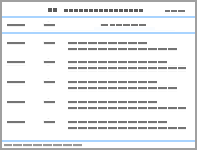
"

Group n With acupuncture Without acupuncture
Qigong experience
(Neiyang Gong)
28 8.2±6.4 25.4±10.7
No Qigong experience 36 15.6±10.8 29.5±12.6

"

Physiological parameter Baseline Qigong state
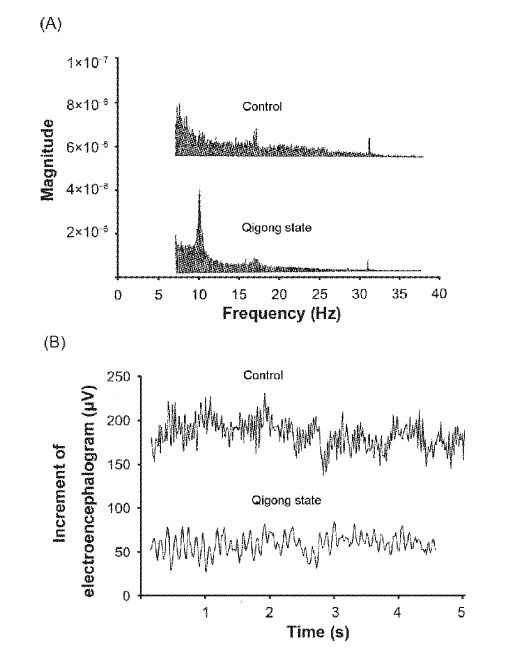
Electroencephalogram (16.8±5.9)% (38.5±13.5)%*
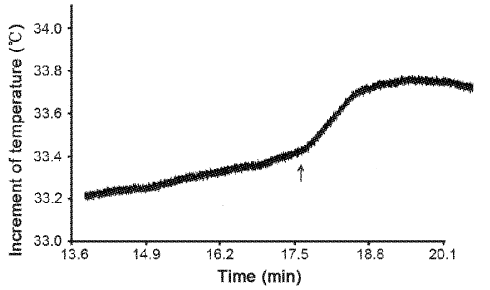
Skin temperature (33.31±0.13) ℃ (33.79±0.24) ℃*
Electromyogram 9.4±4.3 116.5±35.6*
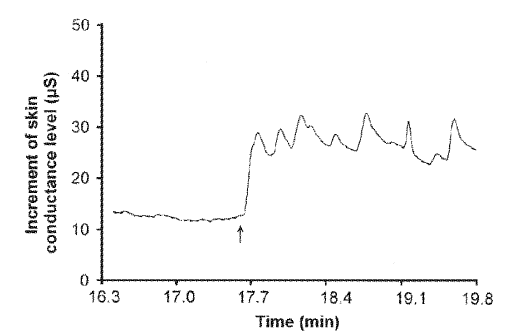
Skin conductance level (13.2±4.9) μs (30.2±11.7) μs*
Finger pulse amplitude (32.5±7.8) pulses/min (65.5±14.3) pulses/min*
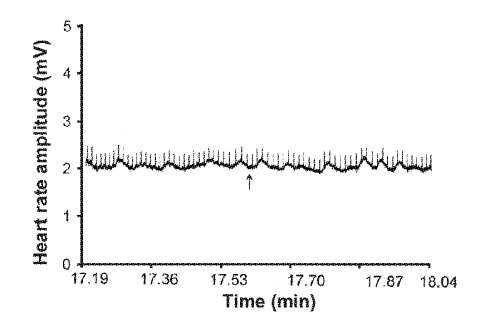
Heart rate (72.9±8.6) beats/min (70.8±11.9) beats/min

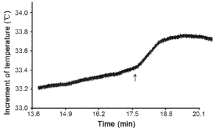
Figure 1

Effects of Qigong state on the change of dorsum of skin temperature at the right palmAfter the participants entered the Qigong state (indicated by arrow), the skin temperature of their palms increased. A representative curve of 36 experiments is shown. "

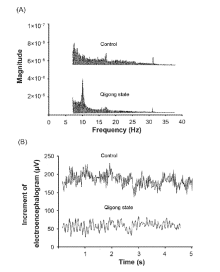
Figure 2

Changes of mean relative power of α wave during Qigong state at the right frontal lobe of cerebrum site(A) Typical spectra of control (baseline) stage and Qigong state. (B) The raw electroencephalogram signals were displayed (the Qigong state being achieved). A representative curve of 42 experiments is shown."

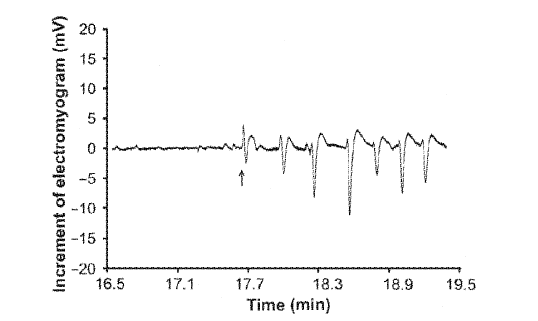
Figure 3

The pattern of the electromyogram at the dorsum of the right hand for each stage during control (before Qigong state) and the Qigong state (indicated by arrow)A representative curve of 30 separate experiments is shown."

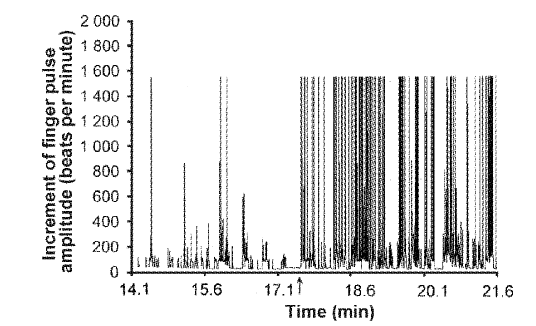
Figure 4

Effects of the Qigong state on the change of finger pulse amplitude When the participants entered the Qigong state (indicated by arrow), the finger pulse amplitude and frequency were increased. A representative curve of 49 experiments is shown."

Figure 5

The change of the skin conductance level pattern for each stage during control (before Qigong state) and Qigong state (indicated by arrow) A representative curve of 52 experiments is shown."

Figure 6

Effects of the Qigong state on the heart rateArrow indicated the participants entered the Qigong state. A representative curve of 56 experiments is shown."

[1] Ng BH, Tsang HW . Psychophysiological outcomes of health Qigong for chronic conditions: a systematic review[J]. Psychophysiology, 2009,46(2):257-269
doi: 10.1111/j.1469-8986.2008.00763.x pmid: 19170945
[2] Oh B, Butow P, Mullan B, Clarke S . Medical Qigong for cancer patients: pilot study of impact on quality of life, side effects of treatment and inflammation[J]. Am J Chin Med, 2008,36(3):459-472
doi: 10.1142/S0192415X08005904
[3] Jin P . Efficacy of Tai Chi, brisk walking, meditation, and reading in reducing mental and emotional stress[J]. J Psychosom Res, 1992,36(4):361-370
doi: 10.1016/0022-3999(92)90072-A
[4] Lim YA, Boone T, Flarity JR, Thompson WR . Effects of Qigong on cardiorespiratory changes: a preliminary study[J]. Am J Chin Med, 1993,21(1):1-6
doi: 10.1142/S0192415X93000029 pmid: 8328418
[5] Kimura M, Tohya K, Kuroiwa K, Oda H, Gorawski EC, Hua ZX, Toda S, Ohnishi M, Noguchi E . Electron microscopical and immunohistochemical studies on the induction of “Qi” employing needling manipulation[J]. Am J Chin Med, 1992,20(1):25-35
doi: 10.1142/S0192415X92000047
[6] Kim Y, Park J, Lee H, Bang H, Park HJ . Content validity of an acupuncture sensation questionnaire[J]. J Altern Complement Med, 2008,14(8):957-963
doi: 10.1089/acm.2007.0565 pmid: 18925869
[7] Xing W, Li Q . Effects of different manipulations of acupuncture on electrical activity of stomach in humans[J]. J Tradit Chin Med, 1998,18(1):39-42
pmid: 10437261
[8] Dringenberg HC, Diavolitsis P, Noseworthy PA . Effect of tacrine on EEG slowing in the rat: enhancement by concurrent monoamine therapy[J]. Neurobiol Aging, 2000,21(1):135-143
doi: 10.1016/S0197-4580(00)00108-1 pmid: 10794858
[9] Zhang JZ, Li JZ, He QN . Statistical brain topographic mapping analysis for EEGs recorded during Qi Gong state[J]. Int J Neurosci, 1988,38(3-4):415-425
doi: 10.3109/00207458808990702 pmid: 3286559
[10] Tang KC . Qigong therapy — its effectiveness and regulation[J]. Am J Chin Med, 1994,22(3-4):235-242
doi: 10.1142/S0192415X94000292 pmid: 7872235
[11] Gehricke JG, Shapiro D . Facial and autonomic activity in depression: social context differences during imagery[J]. Int J Psychophysiol, 2001,41(1):53-64
doi: 10.1016/S0167-8760(00)00181-1 pmid: 11239697
[12] Chen KW . An analytic review of studies on measuring effects of external Qi in China[J]. Altern Ther Health Med, 2004,10(4):38-50
doi: 10.1016/j.jep.2004.05.001 pmid: 15285273
[13] Sancier KM, Holman D . Commentary: multifaceted health benefits of medical qigong[J]. J Altern Complement Med, 2004,10(1):163-165
doi: 10.1089/107555304322849084 pmid: 15025890
[14] Morone NE, Greco CM . Mind-body interventions for chronic pain in older adults: a structured review[J]. Pain Med, 2007,8(4):359-375
doi: 10.1111/j.1526-4637.2007.00312.x pmid: 17610459124
[15] Pierce B . The use of biofield therapies in cancer care[J]. Clin J Oncol Nurs, 2007,11(2):253-258
doi: 10.1188/07.CJON.253-258 pmid: 17573275
[16] Kemp CA . Qigong as a therapeutic intervention with older adults[J]. J Holist Nurs, 2004,22(4):351-373
doi: 10.1177/0898010104269313 pmid: 15486154
[17] Dorcas A, Yung P . Qigong: harmonising the breath, the body and the mind[J]. Complement Ther Nurs Midwifery, 2003,9(4):198-202
doi: 10.1016/S1353-6117(03)00053-2 pmid: 14556769
[18] Shang C . Emerging paradigms in mind-body medicine[J]. J Altern Complement Med, 2001,7(1):83-91
doi: 10.1089/107555301300004565 pmid: 11246939
[19] Streitberger K, Eichenberger U, Schneider A, Witte S, Greher M . Ultrasound measurements of the distance between acupuncture needle tip at P6 and the median nerve[J]. J Altern Complement Med, 2007,13(5):585-591
doi: 10.1089/acm.2007.6247
[20] Kao MJ, Hsieh YL, Kuo FJ, Hong CZ . Electrophysiological assessment of acupuncture points[J]. Am J Phys Med Rehabil, 2006,85(5):443-448
doi: 10.1097/01.phm.0000214308.02631.9f pmid: 16628152
[21] Zhang YP, Zhang ZJ, Liang XC, Guan XM, Ai MK . The effect of extradural injection of capsaicin on pain threshold and electroacupuncture analgesia of rat[J]. Zhen Ci Yan Jiu, 1990,15(2):130-135
张晏平, 张志坚, 梁勋厂, 关新民, 艾民康 . 硬脊膜外注射辣椒素对大鼠痛阈及电针镇痛效应的影响[J]. 针刺研究, 1990,15(2):130-135
[22] 杨杰, 唐敬师, 袁斌, 贾虹 . 大鼠丘脑中央下核神经元对电刺激腓神经和“足三里”穴的反应[J]. 针刺研究, 1996,21(4):28-33
Yang J, Tang JS, Yuan B, Jia H . Responses of neurons in thalamic nucleus submedius to electrical stimulation of peroneal nerve and “zusanli” point in rats[J]. Zhen Ci Yan Jiu, 1996,21(4):28-33
[23] Hsieh JC, Tu CH, Chen FP, Chen MC, Yeh TC, Cheng HC, Wu YT, Liu RS, Ho LT . Activation of the hypothalamus characterizes the acupuncture stimulation at the analgesic point in human: a positron emission tomography study[J]. Neurosci Lett, 2001,307(2):105-108
doi: 10.1016/S0304-3940(01)01952-8
[24] Litscher G, Wenzel G, Niederwieser G, Schwarz G . Effects of QiGong on brain function[J]. Neurol Res, 2001,23(5):501-505
doi: 10.1179/016164101101198749 pmid: 11474806
[25] Skoglund L, Jansson E . Qigong reduces stress in computer operators[J]. Complement Ther Clin Pract, 2007,13(2):78-84
doi: 10.1016/j.ctcp.2006.09.003 pmid: 17400142
[26] Stefano GB, Esch T . Integrative medical therapy: examination of meditation’s therapeutic and global medicinal outcomes via nitric oxide(review)[J]. Int J Mol Med, 2005,16(4):621-630
[27] Hankey A , McCrum S.Qigong: life energy and a new science of life[J]. J Altern Complement Med, 2006,12(9):841-842
doi: 10.1089/acm.2006.12.841 pmid: 17109573
[28] Kaushik RM, Kaushik R, Mahajan SK, Rajesh V . Effects of mental relaxation and slow breathing in essential hypertension[J]. Complement Ther Med, 2006,14(2):120-126
doi: 10.1016/j.ctim.2005.11.007 pmid: 16765850312
[29] Boyer BA, Poppen R . Effects of abdominal and thoracic breathing upon multiple-site electromyography and peripheral skin temperature[J]. Percept Mot Skills, 1995,81(1):3-14
doi: 10.2466/pms.1995.81.1.3
[30] Vinik AI, Ullal J, Parson HK, Barlow PM, Casellini CM . Pioglitazone treatment improves nitrosative stress in type 2 diabetes[J]. Diabetes Care, 2006,29(4):869-876
doi: 10.1103/PhysRevC.91.044301 pmid: 16567830
[31] Lee MS, Pittler MH, Guo R, Ernst E . Qigong for hypertension: a systematic review of randomized clinical trials[J]. J Hypertens, 2007,25(8):1525-1532
doi: 10.1097/HJH.0b013e328092ee18 pmid: 17620944
[32] Xin L, Miller YD, Brown WJ . A qualitative review of the role of qigong in the management of diabetes[J]. J Altern Complement Med, 2007,13(4):427-433
doi: 10.1089/acm.2006.6052 pmid: 17532735
[1] Lan He , Dong Li , Ying-sheng Xu. Target points: A discussion on acupuncture treatment of primary trigeminal neuralgia. Journal of Chinese Integrative Medicine, 2012, 10(9): 961-965.
[2] Jing-lin Shi, Wan-hong Miao. Effects of acupuncture on lactoferrin content in tears and tear secretion in patients suffering from dry eyes: A randomized controlled trial. Journal of Chinese Integrative Medicine, 2012, 10(9): 1003-1008.
[3] Zhang-ling Zhou, Cheng-xin Li, Yue-bo Jiang, Cong Zuo, Yun Cai, Rui Wang. Correlation between facial nerve functional evaluation and efficacy evaluation of acupuncture treatment for Bell’s palsy. Journal of Chinese Integrative Medicine, 2012, 10(9): 997-1002.
[4] Ming T. Tan , Jian-ping Liu , Lixing Lao. Adequate application of quantitative and qualitative statistic analytic methods in acupuncture clinical trials. Journal of Chinese Integrative Medicine, 2012, 10(8): 847-852.
[5] Claudia Maria Sous, Mario Goncalves, Jorge Machado, Thomas Efferth, Tobias Greten , Petra Froeschen , Henry J. Greten. Effects of qigong on performance-related anxiety and physiological stress functions in transverse flute music schoolchildren: A feasibility study. Journal of Chinese Integrative Medicine, 2012, 10(8): 858-865.
[6] Fan Yin, Ziyi Fan. Dr. Wu: A beautiful, moving and meditative song — In memory of Dr. Jing Nuan Wu, a pioneer of acupuncture and a Chinese medicine doctor in the United States. Journal of Chinese Integrative Medicine, 2012, 10(8): 837-840.
[7] Meng Li, Ling Hu, Rong-lin Cai, Zi-jian Wu, Ke-ming Wang. Effects of electro-acupuncture at PC6 and BL15 on nerve electrical activity in spinal dorsal root and norepinephrine and dopamine contents in paraventricular nucleus of hypothalamus in rats with acute myocardial ischemia. Journal of Chinese Integrative Medicine, 2012, 10(8): 874-879.
[8] C. Matos Luís, J. Goncalves Mário, R. Silva António, G. Mendes Joaquim, P. Machado Jorge, J. Greten Henry. Assessment of Qigong-related effects by infrared thermography: A case study. Journal of Chinese Integrative Medicine, 2012, 10(6): 663-666.
[9] Christoph A. Doenitz, Ana Anjos, Thomas Efferth , Tobias Greten, Henry J. Greten. Can heat and cold be parameterized? Clinical data of a preliminary study. Journal of Chinese Integrative Medicine, 2012, 10(5): 532-537.
[10] Fan Yin . The first acupuncture center in the United States: An interview with Dr. Yao Wu Lee, Washington Acupuncture Center. Journal of Chinese Integrative Medicine, 2012, 10(5): 481-492.
[11] De-bo Qi, Wei-min Li. Effects of electroacupuncture on expression of c-fos protein and N-methyl-D-aspartate receptor 1 in the rostral ventromedia medulla of rats with chronic visceral hyperalgesia. Journal of Chinese Integrative Medicine, 2012, 10(4): 416-423.
[12] Gerhard Litscher. High-tech acupuncture made in Austria — cerebral circulation. Journal of Chinese Integrative Medicine, 2012, 10(4): 362-368.
[13] Paula de Sousa Fragoso Ana, de Sá Ferreira Arthur. Evaluation of the immediate effects of manual acupuncture on brachial bicep muscle function in healthy individuals and poststroke patients: a study protocol of a parallel-group randomized clinical trial. Journal of Chinese Integrative Medicine, 2012, 10(3): 303-309.
[14] Zhuo-xin Yang, Peng-dian Chen, Hai-bo Yu, Min Pi, Wen-shu Luo, Yuan-yuan Zhuo . Study strategies for acupuncture treatment of chronic nonbacterial prostatitis. Journal of Chinese Integrative Medicine, 2012, 10(3): 293-297.
[15] Zheng Ying. Research and application progress of the infrared effects of moxibustion. Journal of Chinese Integrative Medicine, 2012, 10(2): 135-140.
Viewed
Full text


Abstract

Cited

  Shared   
  Discussed   
[1] Dong Yang, Yong-ping Du, Qing Shen, Wei Chen, Yan Yu, Guang-lei Chen. Expression of alpha-smooth muscle actin in renal tubulointerstitium in patients with kidney collateral stasis. Journal of Chinese Integrative Medicine, 2008, 6(1): 41-44
[2] Hai-feng Wei, Bai-liu Ya, Ling Zhao, Cui-fei Ye, Li Zhang, Lin Li. Evaluation of tongue manifestation of blood stasis syndrome and its relationship with blood rheological disorder in a rat model of transient brain ischemia. Journal of Chinese Integrative Medicine, 2008, 6(1): 73-76
[3] Xi Lin, Jian-ping Liu. Herbal medicines for viral myocarditis. Journal of Chinese Integrative Medicine, 2008, 6(1): 76
[4] Xi Lin, Jian-ping Liu. Tai chi for treating rheumatoid arthritis. Journal of Chinese Integrative Medicine, 2008, 6(1): 82
[5] Liang-ping Hu, Hui Gao. Discrimination of errors in statistical analysis of medical papers published in the first issue of 2006 in Journal of Chinese Integrative Medicine. Journal of Chinese Integrative Medicine, 2008, 6(1): 98-106
[6] Yan-bo Zhu , Qi Wang, Cheng-yu Wu, Guo-ming Pang, Jian-xiong Zhao, Shi-lin Shen, Zhong-yuan Xia , Xue Yan . Logistic regression analysis on relationships between traditional Chinese medicine constitutional types and overweight or obesity. Journal of Chinese Integrative Medicine, 2010, 8(11): 1023-1035
[7] Wei Xu, Meng Shi, Jian-gang Liu, Cheng-long Wang . Collagen protein expressions in ischemic myocardium of rats with acute myocardial infarction and effects of qi-tonifying, yin-tonifying and blood-activating herbs and detoxifying and blood-activating herbs. Journal of Chinese Integrative Medicine, 2010, 8(11): 1041-1047
[8] Tao Wang , Feng Qin. Effects of Chinese herbal medicine Xiaoyao Powder on monoamine neurotransmitters in hippocampus of rats with postpartum depression. Journal of Chinese Integrative Medicine, 2010, 8(11): 1075-1079
[9] Ying Xu , Chang-chun Zeng , Xiu-yu Cai , Rong-ping Guo , Guang Nie , Ying Jin. Chromaticity and optical spectrum colorimetry of the tongue color in different syndromes of primary hepatic carcinoma. Journal of Chinese Integrative Medicine, 2012, 10(11): 1263-1271
[10] Xiang-ying Mao , Qin Bian , Zi-yin Shen. Analysis of the osteogenetic effects exerted on mesenchymal stem cell strain C3H10T1/2 by icariin via MAPK signaling pathway in vitro. Journal of Chinese Integrative Medicine, 2012, 10(11): 1272-1278
[an error occurred while processing this directive]