[an error occurred while processing this directive]

Journal of Chinese Integrative Medicine ›› 2012, Vol. 10 ›› Issue (9): 1003-1008.doi: 10.3736/jcim20120909

Special Issue: Acupuncture & Moxibustion

Previous Articles     Next Articles

Effects of acupuncture on lactoferrin content in tears and tear secretion in patients suffering from dry eyes: A randomized controlled trial

Jing-lin Shi,  Wan-hong Miao()   

  1. Department of Ophthalmology, Shuguang Hospital, Shanghai University of Traditional Chinese Medicine, Shanghai 201203, China
  • Received:2012-03-12 Accepted:2012-03-23 Online:2012-09-20 Published:2018-09-15
  • Contact: Wan-hong Miao E-mail:miaowh@126.com

Background: With the understanding of the immune inflammatory response in the pathogenesis of dry eyes, and the limitations of widely used artificial tears and numerous pharmaceuticals and methods to promote tear secretion, clinicians pay more attention to the therapies that can promote tear secretion actively. Acupuncture treatment for dry eye may meet this requirement.

Objective: To observe the clinical efficacy of acupuncture treatment on dry eye and the effects on duration, and to examine the mechanisms of acupuncture in treating patients with dye eyes. DESIGN, SETTING, PARTICIPANTS AND INTERVENTIONS: The study was performed at Department of Ophthalmology, Shuguang Hospital, Shanghai University of Traditional Chinese Medicine from August 2010 to May 2011. Patients with the primary diagnosis of dry eye were enrolled. Sixty-five patients were randomly divided into treatment group and control group, and were given 3 weeks of acupuncture treatment or artificial tear therapy respectively. MAIN OUTCOME MEASURES: The enzyme-linked immunosorbent assay was used to detect the lactoferrin content of the tears before and after treatment. In order to evaluate the efficacy of the treatment methods, the Schirmer Ⅰ test and break-up time were also measured.

Results: Compared with before treatment, the lactoferrin content in the tears of patients in the treatment group increased, break-up time was prolonged and the result of the Schirmer Ⅰ test showed improvement after 3 weeks of treatment. The indexes mentioned above did not change in the control group after treatment. There were no significant differences in tear lactoferrin and Schirmer Ⅰ test between one week after treatment and after 3-week treatment in the treatment group, but break-up time was significantly shortened. The result of Schirmer I test in the treatment group was significantly higher than that in the control group one week after treatment.

Conclusion: Acupuncture can increase tear lactoferrin level, extend tear film break-up time and promote tear secretion in patients with dry eye in a time-limited trial. With the end of treatment, the effect decreased.

Key words: dry eye, lactoferrin, acupuncture, randomized controlled trial

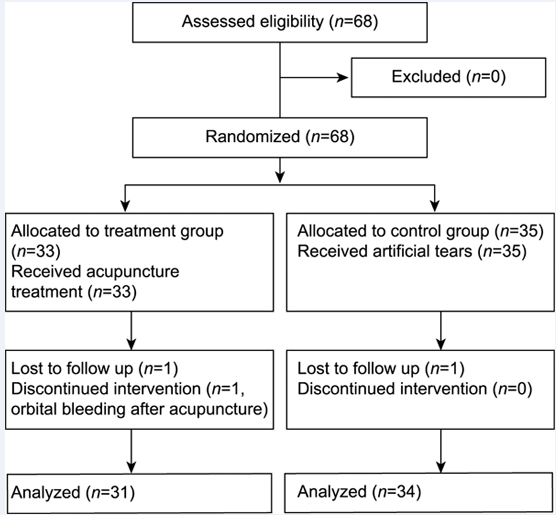
Figure 1

Flow diagram of this trial"

Table 1

Tear lactoferrin concentration in treatment group and control group before and after treatment ($\overline{x}$±s, g/L)"

Group n Tear lactoferrin
Before treatment After 1 course of treatment One week after treatment
Control 34 1.44±0.27 1.49±0.30 1.52±0.32
Treatment 31 1.55±0.34 1.72±0.32*▲▲ 1.62±0.32

Table 2

Tear break-up time in treatment group and control group before and after treatment ($\overline{x}$±s, s)"

Group n Break-up time
Before treatment After 1 course of treatment One week after treatment
Control 34 3.91±1.38 3.68±1.41 3.29±1.51
Treatment 31 3.55±1.46 4.45±1.46*▲ 3.62±0.21

Table 3

Schirmer Ⅰ test in treatment group and control group before and after treatment ($\overline{x}$±s, mm in 5 min)"

Group n Schirmer Ⅰ test
Before treatment After 1 course of treatment One week after treatment
Control 34 4.47±1.93 4.76±2.05 4.24±1.82
Treatment 31 4.94±1.53 6.00±2.02*▲ 5.41±2.09△▲
[1] Liu ZG, Peng J . Diagnosis and treatment guidelines for dry eye[J]. Yan Ke Yan Jiu, 2008,26(3):161-164
刘祖国, 彭娟 , 干眼的诊断与治疗规范. 眼科研究. 2008; 26(3):161-164.
[2] Gao CL, Lu FQ . Epidmiological characteristics of dry eye in ophthalmic clinic[J]. Shanxi Yi Ke Da Xue Xue Bao, 2011,42(8):667-669
高春玲, 路风青 . 眼科门诊干眼症的流行病学特征分析[J]. 山西医科大学学报, 2011,42(8):667-669
[3] Li FM. Chinese ophthalmology.2nd ed[M]. Beijing: People’s Medical Publishing House, 2005, 1158-1160
李凤鸣 . 中华眼科学.第2版[M]. 北京: 人民卫生出版社, 2005, 1158-1160
[4] Chen J, Liu XY, Chen M . Progress of drug therapy in dry eye[J]. Zhongguo Shi Yong Yan Ke Za Zhi, 2006,24(10):1014-1017
陈剑, 刘小勇, 陈敏 . 干眼的药物治疗进展[J]. 中国实用眼科杂志, 2006,24(10):1014-1017
[5] Gong L, Sun XH, Ma XP, Zhao NQ . Preliminary study of clinical efficacy and safety on acupuncture treatment for dry eye[J]. Zhonghua Yan Ke Za Zhi, 2006,42(11):1026-1028
龚岚, 孙兴怀, 马晓芃, 赵耐青 . 针刺治疗干眼症临床疗效和安全性观察的初步研究[J]. 中华眼科杂志, 2006,42(11):1026-1028
[6] Liu GF, Liu YX, Qiu LX. Medical statistics.2nd ed[M]. Beijing: Peking Union Medical College Press, 2007, 176-177
刘桂芬, 刘玉秀, 仇丽霞 . 医学统计学.第2版[M]. 北京: 中国协和医科大学出版社, 2007, 176-177
[7] Liu ZG . Diagnosis of dry eye[J]. Zhonghua Yan Ke Za Zhi, 2002,38(5):318-320
刘祖国 . 干眼的诊断[J]. 中华眼科杂志, 2002,38(5):318-320
[8] Shi XM. Acupuncture and moxibustion.2nd ed[M]. Beijing: China Press of Traditional Chinese Medicine, 2004, 30-130
石学敏. 针灸学. 第2版[M]. 北京: 中国中医药出版社, 2004, 30-130
[9] Yan JX . Research progress of Western medinine and traditional Chinese medicine in dry eye[J]. Hunan Zhong Yi Za Zhi, 2007,23(1):88-89
杨健修 . 中西医对干眼病的研究进展[J]. 湖南中医杂志, 2007,23(1):88-89
[10] Liu ZG, Yang WZ . Dry eye and its pathogenesis[J]. Yan Ke, 2005,14(5):342-345
刘祖国, 杨文照 . 干眼症的发病机制[J]. 眼科, 2005,14(5):342-345
[11] Mishima S, Gasset A, Klyce SD Jr, Baum JL . Determination of tear volume and tear flow[J]. Invest Ophthalmol, 1966,5(3):264-276
[12] Kijlstra A, Jeurissen SH, Koning KM . Lactoferrin levels in normal human tears[J]. Br J Ophthalmol, 1983,67(3):199-202
doi: 10.1136/bjo.67.3.199
[13] Arnold RR, Cole MF , McGhee JR.A bactericidal effect for human lactoferrin[J]. Science, 1977,197(4300):263-265
doi: 10.1126/science.327545
[14] Arnold RR, Russell JE, Champion WJ, Brewer M, Gauthier JJ . Bactericidal activity of human lactoferrin: differentiation from the stasis of iron deprivation[J]. Infect Immun, 1982,35(3):792-799
[15] An N, Zhu XP . Research advances of lactoferrin in tear[J]. Guo Ji Yan Ke Za Zhi, 2008,8(5):1012-1014
安娜, 朱秀萍 . 泪液乳铁蛋白的研究进展[J]. 国际眼科杂志, 2008,8(5):1012-1014
[16] Yu DF, Liu ZG, Hu JY, Jiang AH, Hao SC, Xu CC, Zou WJ, Li MY . Establishment and preliminary clinical application of enzyme-linked immunosorbent assay in detecting lactoferrin[J]. Zhonghua Yan Ke Za Zhi, 2007,43(5):451-453
虞东芳, 刘祖国, 胡皎月, 蒋爱华, 郝尚臣, 许传超, 邹文进, 李民友 . 泪液乳铁蛋白夹心法酶联免疫吸附试验的建立及初步临床应用[J]. 中华眼科杂志, 2007,43(5):451-453
[17] Flanagan JL, Willcox MD . Role of lactoferrin in the tear film[J]. Biochimie, 2009,91(1):35-43
doi: 10.1016/j.biochi.2008.07.007
[18] Zhu CL . Effect of acupuncture on visual system and its mechanism[J]. Heilongjiang Yi Xue, 2005,29(10):744-745
朱春霖 . 针灸对视觉系统的影响及其作用机制的研究进展[J]. 黑龙江医学, 2005,29(10):744-745
[19] Chen X, Chen J, Liu B, Li NN, Liu X, Long Y, Shang XJ . Central modulating mechanism of ST36(Zusanlii) acupuncturing on amplitude of low-frequency fluctuation in resting-state[J]. Zhongguo Zhong Xi Yi Jie He Za Zhi, 2010,30(10):1030-1035
陈鑫, 陈俊, 刘波, 李宁娜, 刘岘, 龙玉, 尚晓静 . 静息态低频振幅对针刺足三里穴中枢作用机制初探[J]. 中国中西医结合杂志, 2010,30(10):1030-1035
[20] Fullard RJ, Snyder C . Protein levels in nonstimulated and stimulated tears of normal human subjects[J]. Invest Ophthalmol Vis Sci, 1990,31(6):1119-1126
[1] Lan He , Dong Li , Ying-sheng Xu. Target points: A discussion on acupuncture treatment of primary trigeminal neuralgia. Journal of Chinese Integrative Medicine, 2012, 10(9): 961-965.
[2] Zhang-ling Zhou, Cheng-xin Li, Yue-bo Jiang, Cong Zuo, Yun Cai, Rui Wang. Correlation between facial nerve functional evaluation and efficacy evaluation of acupuncture treatment for Bell’s palsy. Journal of Chinese Integrative Medicine, 2012, 10(9): 997-1002.
[3] Ming T. Tan , Jian-ping Liu , Lixing Lao. Adequate application of quantitative and qualitative statistic analytic methods in acupuncture clinical trials. Journal of Chinese Integrative Medicine, 2012, 10(8): 847-852.
[4] Fan Yin, Ziyi Fan. Dr. Wu: A beautiful, moving and meditative song — In memory of Dr. Jing Nuan Wu, a pioneer of acupuncture and a Chinese medicine doctor in the United States. Journal of Chinese Integrative Medicine, 2012, 10(8): 837-840.
[5] Lu Yu, Shui-miao Lin, Ru-qian Zhou, Wei-jun Tang, Pin-xian Huang, Ying Dong, Jian Wang, Zhi-hua Yu, Jiu-lin Chen, Li Wei, San-li Xing, Hui-juan Cao, Hong-bin Zhao. Chinese herbal medicine for patients with mild to moderate Alzheimer disease based on syndrome differentiation: A randomized controlled trial. Journal of Chinese Integrative Medicine, 2012, 10(7): 766-776.
[6] Hui Luo, Jian-ping Liu, Qing Li. Methodological issues and suggestions for improvement in randomized controlled trials of Chinese herbal medicine for recurrent miscarriage. Journal of Chinese Integrative Medicine, 2012, 10(6): 604-614.
[7] Peng Fu , Xue-qiang Huang, Ai-hong Yuan, Guang Yu, Xiao-bin Mei, Ruo-lan Cu. Effects of salvianolate combined with alprostadil and reduced glutathione on progression of chronic renal failure in patients with chronic kidney diseases: a long-term randomized controlled trial. Journal of Chinese Integrative Medicine, 2012, 10(6): 641-646.
[8] Shui-qiu Deng, Xue-nong Ouyang, Zong-yang Yu, Xi-hu Dai, Xi Chen, Fang-zheng Fang, Wen-wu Wang, Zhi-zhen Liu. Influence of Chinese herbal medicine Feitai Capsule on completion or delay of chemotherapy in patients with stage ⅢB/Ⅳ non-small-cell lung cancer: a Randomized controlled trial. Journal of Chinese Integrative Medicine, 2012, 10(6): 635-640.
[9] Ming-xing Zhao, Zhen-hua Dong, Zhong-hai Yu, Shi-yuan Xiao, Ya-ming Li . Effects of Ginkgo biloba extract in improving episodic memory of patients with mild cognitive impairment: A randomized controlled trial. Journal of Chinese Integrative Medicine, 2012, 10(6): 628-634.
[10] Fan Yin . The first acupuncture center in the United States: An interview with Dr. Yao Wu Lee, Washington Acupuncture Center. Journal of Chinese Integrative Medicine, 2012, 10(5): 481-492.
[11] Christoph A. Doenitz, Ana Anjos, Thomas Efferth , Tobias Greten, Henry J. Greten. Can heat and cold be parameterized? Clinical data of a preliminary study. Journal of Chinese Integrative Medicine, 2012, 10(5): 532-537.
[12] Ying-chun Miao , Jin-zhou Tian , Jing Shi , Min Mao. Effects of Chinese medicine for tonifying the kidney and resolving phlegm and blood stasis in treating patients with amnestic mild cognitive impairment: A randomized, double-blind and parallel-controlled trial. Journal of Chinese Integrative Medicine, 2012, 10(4): 390-397.
[13] Xiao-hui Sun, Sheng Liu . External Chinese medical therapy for pain associated with hyperplastic disease of the breast: Study protocol of a randomized, double-blind, multicenter, controlled trial. Journal of Chinese Integrative Medicine, 2012, 10(4): 384-389.
[14] De-bo Qi, Wei-min Li. Effects of electroacupuncture on expression of c-fos protein and N-methyl-D-aspartate receptor 1 in the rostral ventromedia medulla of rats with chronic visceral hyperalgesia. Journal of Chinese Integrative Medicine, 2012, 10(4): 416-423.
[15] Gerhard Litscher. High-tech acupuncture made in Austria — cerebral circulation. Journal of Chinese Integrative Medicine, 2012, 10(4): 362-368.
Viewed
Full text


Abstract

Cited

  Shared   
  Discussed   
[1] Dong Yang, Yong-ping Du, Qing Shen, Wei Chen, Yan Yu, Guang-lei Chen. Expression of alpha-smooth muscle actin in renal tubulointerstitium in patients with kidney collateral stasis. Journal of Chinese Integrative Medicine, 2008, 6(1): 41-44
[2] Hai-feng Wei, Bai-liu Ya, Ling Zhao, Cui-fei Ye, Li Zhang, Lin Li. Evaluation of tongue manifestation of blood stasis syndrome and its relationship with blood rheological disorder in a rat model of transient brain ischemia. Journal of Chinese Integrative Medicine, 2008, 6(1): 73-76
[3] Xi Lin, Jian-ping Liu. Herbal medicines for viral myocarditis. Journal of Chinese Integrative Medicine, 2008, 6(1): 76
[4] Xi Lin, Jian-ping Liu. Tai chi for treating rheumatoid arthritis. Journal of Chinese Integrative Medicine, 2008, 6(1): 82
[5] Liang-ping Hu, Hui Gao. Discrimination of errors in statistical analysis of medical papers published in the first issue of 2006 in Journal of Chinese Integrative Medicine. Journal of Chinese Integrative Medicine, 2008, 6(1): 98-106
[6] Yan-bo Zhu , Qi Wang, Cheng-yu Wu, Guo-ming Pang, Jian-xiong Zhao, Shi-lin Shen, Zhong-yuan Xia , Xue Yan . Logistic regression analysis on relationships between traditional Chinese medicine constitutional types and overweight or obesity. Journal of Chinese Integrative Medicine, 2010, 8(11): 1023-1035
[7] Wei Xu, Meng Shi, Jian-gang Liu, Cheng-long Wang . Collagen protein expressions in ischemic myocardium of rats with acute myocardial infarction and effects of qi-tonifying, yin-tonifying and blood-activating herbs and detoxifying and blood-activating herbs. Journal of Chinese Integrative Medicine, 2010, 8(11): 1041-1047
[8] Tao Wang , Feng Qin. Effects of Chinese herbal medicine Xiaoyao Powder on monoamine neurotransmitters in hippocampus of rats with postpartum depression. Journal of Chinese Integrative Medicine, 2010, 8(11): 1075-1079
[9] Ying Xu , Chang-chun Zeng , Xiu-yu Cai , Rong-ping Guo , Guang Nie , Ying Jin. Chromaticity and optical spectrum colorimetry of the tongue color in different syndromes of primary hepatic carcinoma. Journal of Chinese Integrative Medicine, 2012, 10(11): 1263-1271
[10] Xiang-ying Mao , Qin Bian , Zi-yin Shen. Analysis of the osteogenetic effects exerted on mesenchymal stem cell strain C3H10T1/2 by icariin via MAPK signaling pathway in vitro. Journal of Chinese Integrative Medicine, 2012, 10(11): 1272-1278
[an error occurred while processing this directive]