[an error occurred while processing this directive]

Journal of Chinese Integrative Medicine ›› 2008, Vol. 6 ›› Issue (5): 463-467.doi: 10.3736/jcim20080506

• Original Clinical Research • Previous Articles     Next Articles

Correlation between traditional Chinese medicine syndromes in primary immunoglobulin A nephropathy and A267G in 5'-untranslated region within exonal of megsin gene

Yi-fei Zhong1(), Yi-ping Chen1, Yue-yi Deng1, Nan Chen2, Zhao-hui Wang2   

  1. 1. Department of Nephrology, Longhua Hospital, Shanghai University of Tradtional Chinese Medicine, Shanghai 200032, China
    2. Department of Nephrology, Ruijin Hospital, Shanghai Jiao Tong University School of Medicine, Shanghai 200025, China
  • Received:2008-01-17 Online:2008-05-20 Published:2008-05-15
  • Contact: ZHONG Yi-fei E-mail:yifeilili@126.com

Objective: To observe the correlation between traditional Chinese medicine (TCM) syndromes ("deficiency of qi and yin" and "deficiency of liver yin and kidney yin") and A267G in 5'-untranslated region within exonal of megsin gene, and to search the substantial genetic basis for micro-differentiation of TCM syndromes in primary immunoglobulin A nephropathy (IgAN).
Methods: A total of 120 IgAN cases meeting the diagnostic criteria were enrolled. The sequence of single nucleotide polymorphism (SNP) of A267G in 5'-untranslated region within exonal of megsin gene was tested. The correlation between SNP and TCM syndromes was observed.
Results: There were 83 cases carrying GG genotype, 34 cases carrying GA genotype and 3 cases carrying AA genotype in 120 cases of primary IgAN. There was a high proportion of "deficiency of liver yin and kidney yin" in IgAN cases with AA and GA genotypes, and a high proportion of "deficiency of qi and yin" in IgAN cases with GG genotype (P<0.01). Odds ratio in TCM syndrome distribution between GG genotype and GA plus AA genotype was 9.800, and 95% confidence interval was 3.969-24.199. The discrepancy also resided in IgAN patients with different genders and ages.
Conclusion: A267G in 5'-untranslated region within exonal of the megsin gene may be one of the substantial genetic basis for differentiating "deficiency of liver yin and kidney yin" syndrome and "deficiency of qi and yin" syndrome in primary IgAN.

Key words: immunoglobulin A nephropathy, polymorphism, single nucleotide, gene, megsin

CLC Number: 

  • R692.9

Figure 1

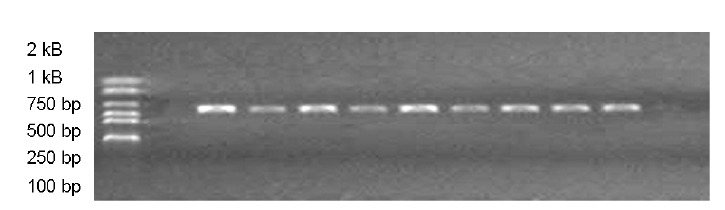
650 bp PCR production in different patients A 650 bp fragment was detected in nine IgAN patients' DNA. The DNA ladder sizes were shown on the left."

Figure 2

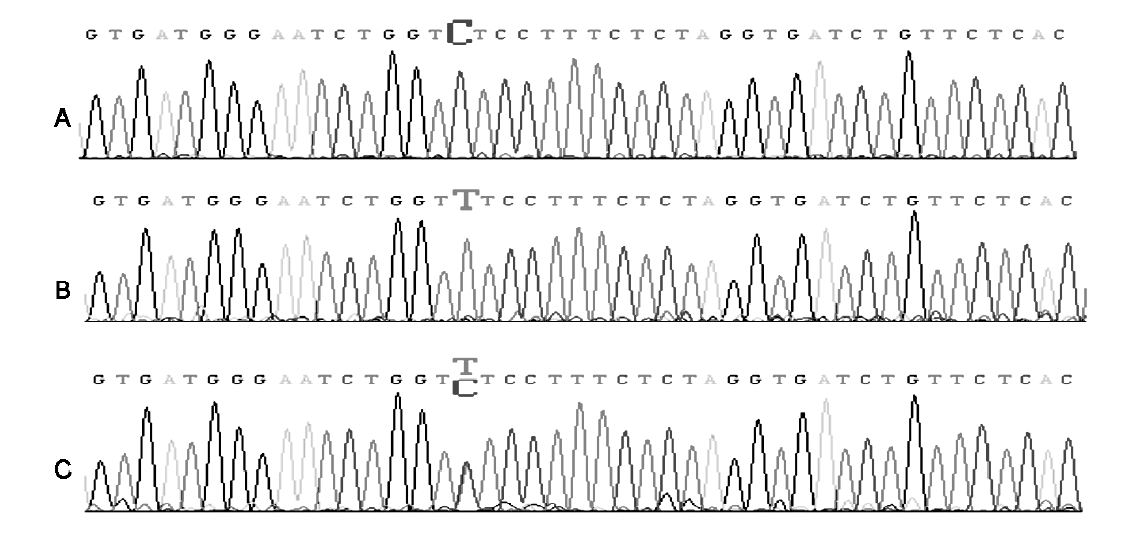
The sequence wave of megsin gene (Reverse) A: GG genotype; B: AA genotype; C: GA genotype."

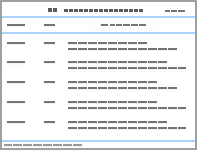
Table 1

Distribution differences of polymorphism of A267G in 5'-untranslated region within exonal of megsin gene in different traditional Chinese medicine syndromes"

Syndrome type n Polymorphism of A267G in 5'-untranslated region within exonal of the megsin gene Total
GA AA GG
Deficiency of qi and yin 72 9 (12.50%) 0 (0.00%) 63 (87.50%) 72 (100%)
Deficiency of liver yin and kidney yin 48 25 (52.08%) 3 (6.25%) 20 (41.67%) 48 (100%)
Total 120 34 (28.33%) 3 (2.50%) 83 (69.17%) 120 (100%)

Table 2

Distribution differences of polymorphism of A267G in 5’-untranslated region within exonal of megsin gene in traditional Chinese medicine syndromes of different sexes"

Sex Syndrome type Polymorphism of A267G in 5'-untranslatedregion within exonal of the megsin gene Total
GG GA AA
Male
Deficiency of qi and yin 28 (87.50%) 4 (12.50%) 0 (0.00%) 32 (100%)
Deficiency of liver yin and kidney yin 10 (45.45%) 11 (50.00%) 1 (4.55%) 22 (100%)
Total 38 (70.37%) 15 (27.78%) 1 (1.85%) 54 (100%)
Female
Deficiency of qi and yin 35 (87.50%) 5 (12.50%) 0 (0.00%) 40 (100%)
Deficiency of liver yin and kidney yin 10 (38.46%) 14 (53.85%) 2 (7.69%) 26 (100%)
Total 45 (68.18%) 19 (28.79%) 2 (3.03%) 66 (100%)

Table 3

Distribution differences of polymorphism of A267G in 5'-untranslated region within exonal of megsin gene in traditional Chinese medicine syndromes of different ages"

Age Syndrome type Polymorphism of A267G in 5'-untranslated region within exonal of the megsin gene Total
GG GA AA
<35 years
Deficiency of qi and yin 31 (86.11%) 5 (13.89%) 0 (0.00%) 36 (100%)
Deficiency of liver yin and kidney yin 9 (42.86%) 10 (47.62%) 2 (9.52%) 21 (100%)
Total 40 (70.18%) 15 (26.32%) 2 (3.50%) 57 (100%)
≥35 years
Deficiency of qi and yin 32 (88.89%) 4 (11.11%) 0 (0.00%) 36 (100%)
Deficiency of liver yin and kidney yin 11 (40.74%) 15 (55.56%) 1 (3.70%) 27 (100%)
Total 43 (68.25%) 19 (30.16%) 1 (1.59%) 63 (100%)
[1] Barratt J, Feehally J . IgA Nephropathy[J]. J Am Soc Nephrol, 2005,16(7):2088-2097
doi: 10.1681/ASN.2005020134
[2] Li LS, Liu ZH . Epidemiologic data of renal diseases from a single unit in China: analysis based on 13,519 renal biopsies[J]. Kidney Int, 2004,66(3):920-923
doi: 10.1111/j.1523-1755.2004.00837.x
[3] Chen XM, Chen YP, Chen YP , et al. Multicenter prospective study on relationship of TCM syndrome type and renal pathology in 286 patients with IgA nephropathy[J]. Zhongguo Zhong Xi Yi Jie He Za Zhi, 2004,24(2):101-105
doi: 10.7661/CJIM.2004.2.101
陈香美, 陈以平, 谌贻璞 , 等. 286例IgA肾病中医辨证与肾脏病理关系的多中心前瞻性研究[J]. 中国中西医结合杂志, 2004,24(2):101-105
doi: 10.7661/CJIM.2004.2.101
[4] Wang ZH, Chen N, Pan XX , et al. Association of single nucleotide polymorphism of megsin gene with IgA nephropathy[J]. Zhonghua Yi Xue Za Zhi, 2006,86(19):1337-1341
doi: 10.3760/j:issn:0376-2491.2006.19.010
王朝晖, 陈楠, 潘晓霞 , 等. Megsin基因单核苷酸多态性与IgA肾病相关性研究[J]. 中华医学杂志, 2006,86(19):1337-1341
doi: 10.3760/j:issn:0376-2491.2006.19.010
[5] Wang ZH, Chen N, Wang WM , et al. Search and confirmation of single nucleotide polymorphism in susceptibility genes for IgA nephropathy[J]. Zhonghua Shen Zang Bing Za Zhi, 2006,22(5):282-285
doi: 10.3760/j.issn:1001-7097.2006.05.007
王朝晖, 陈楠, 王伟铭 , 等. IgA肾病候选基因单核苷酸多态性的搜寻和确定[J]. 中华肾脏病杂志, 2006,22(5):282-285
doi: 10.3760/j.issn:1001-7097.2006.05.007
[6] Miyata T, Nangaku M, Suzuki D , et al. A mesangium-predominant gene, megsin, is a new serpin upregulated in IgA nephropathy[J]. J Clin Invest, 1998,102(4):828-836
doi: 10.1172/JCI2450 pmid: 9710452
[7] Wang HY. Nephrology(2nd ed)[M]. Beijing: People's Medical Publishing House, 2001,( 2nd ed):367
王海燕.肾脏病学( 第2版)[M]. 北京: 人民卫生出版社, 2001,( 第2版):367
[8] Li CD . Review and prospect for correlative study on differentiation of symptoms and signs on TCM and gene as well as its products[J]. Hunan Zhong Yi Yao Dao Bao, 2000,6(6):6-8
李灿东 . 中医辨证与基因及其产物相关性研究的回顾与展望[J]. 湖南中医药导报, 2000,6(6):6-8
No related articles found!
Viewed
Full text


Abstract

Cited

  Shared   
  Discussed   
[1] Wei-xiong Liang. Problems-solving strategies in clinical treatment guideline for traditional Chinese medicine and integrative medicine. Journal of Chinese Integrative Medicine, 2008, 6(1): 1-4
[2] Zhao-guo Li. Discussion on English translation of commonly used sentences in traditional Chinese medicine: part one. Journal of Chinese Integrative Medicine, 2008, 6(1): 107-110
[3] Jun Hu, Jian-ping Liu. Non-invasive physical treatments for chronic/recurrent headache. Journal of Chinese Integrative Medicine, 2008, 6(1): 31
[4] Xue-mei Liu, Qi-fu Huang, Yun-ling Zhang, Jin-li Lou, Hong-sheng Liu, Hong Zheng. Effects of Tribulus terrestris L. saponion on apoptosis of cortical neurons induced by hypoxia-reoxygenation in rats. Journal of Chinese Integrative Medicine, 2008, 6(1): 45-50
[5] . Uniform requirements for manuscripts submitted to biomedical journals: Writing and editing for biomedical publication (Chinese version, part two). Journal of Chinese Integrative Medicine, 2010, 8(11): 1001-1005
[6] Daniel Weber, Janelle M Wheat, Geoffrey M Currie. Inflammation and cancer: Tumor initiation, progression and metastasis,and Chinese botanical medicines. Journal of Chinese Integrative Medicine, 2010, 8(11): 1006-1013
[7] Hong Liu , Guo-liang Zhang, Li Shen , Zhen Zeng, Bao-luo Zhou, Cheng-hai Liu, Guang Nie . Application and evaluation of a pseudotyped virus assay for screening herbs for anti-H5Nl avian influenza virus. Journal of Chinese Integrative Medicine, 2010, 8(11): 1036-1040
[8] Zhao-guo Li . A discussion of English translation of 1995 and 1997 Chinese National Standards of Traditional Chinese Medical Terminologies for Clinical Diagnosis and Treatment. Journal of Chinese Integrative Medicine, 2010, 8(11): 1090-1096
[9] Rui Jin, Bing Zhang. A complexity analysis of Chinese herbal property theory: the multiple formations of herbal property (Part 1). Journal of Chinese Integrative Medicine, 2012, 10(11): 1198-1205
[10] Hui-min Liu, Xian-bo Wang, Yu-juan Chang, Li-li Gu. Systematic review and meta-analysis of randomized controlled trials of integrative medicine therapy for treatment of chronic severe hepatitis. Journal of Chinese Integrative Medicine, 2012, 10(11): 1211-1228
[an error occurred while processing this directive]