[an error occurred while processing this directive]

Journal of Chinese Integrative Medicine ›› 2010, Vol. 8 ›› Issue (2): 126-130.doi: 10.3736/jcim20100206

• Original Clinical Research • Previous Articles     Next Articles

Scalp penetration acupuncture for insomnia: A randomized controlled trial

Zhang-ling Zhoua, Xian Shia, Shao-dan Lib, Ling Guana   

  1. a Department of Acupuncture and Moxibustion, General Hospital of Peopled Liberation Army, Beijing 100853, China
    b Department of Traditional Chinese Medicine, General Hospital of Peopled Liberation Army, Beijing 100853, China
  • Received:2009-09-22 Accepted:2010-01-20 Online:2010-02-20 Published:2010-02-15
  • Contact: Zhang-ling Zhou E-mail:zhouzhangling@sina.com

Background

Insomnia has become a threat to public health, and acupuncture has shown an advantage in treatment of insomnia with good efficacy and few side effects.
Objective

To observe the therapeutic effects of scalp penetration acupuncture for insomnia.
Design, setting, participants and interventions

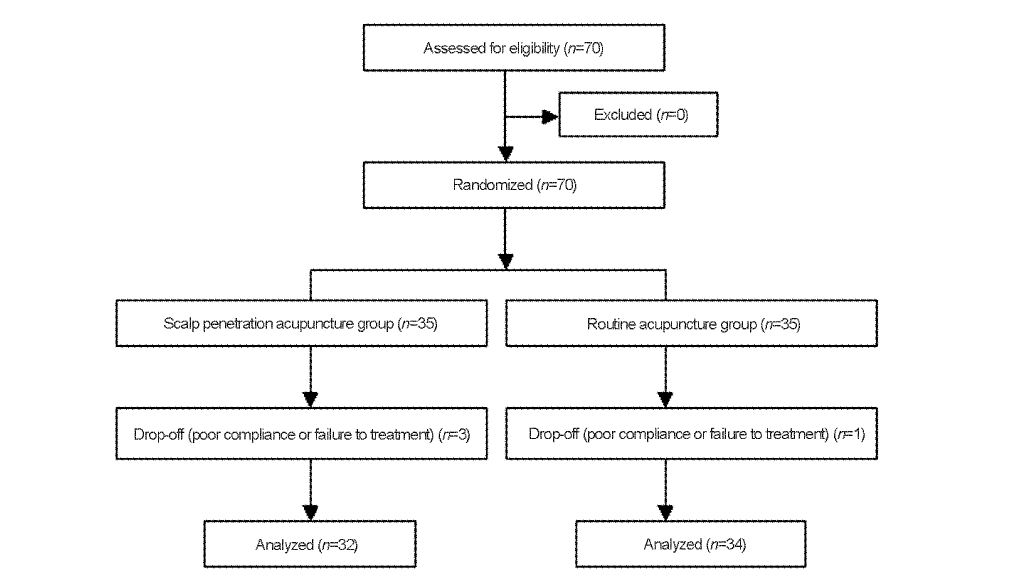
A total of 70 insomnia cases meeting inclusion criteria from Department of Acupuncture and Moxibustion, General Hospital of People's Liberation Army were randomly divided into routine acupuncture group and scalp penetration acupuncture group. There were 32 cases in the scalp penetration acupuncture group, and 34 cases in the routine acupuncture group, for four cases lost to follow-up. The insomnia patients were all treated for four weeks.
Main outcome measures

The therapeutic effects, cumulative scores of Pittsburgh Sleep Quality Index (PSQI) and contents of sleep architecture were compared before and after treatment in the two groups.
Results

The total response rate of 90.6% in the scalp penetration acupuncture group was higher than 73.5% in the routine acupuncture group (P<0.05), and the improvements of PSQI cumulative scores in sleep quality, sleep time and sleep efficiency in the scalp penetration acupuncture group were superior to those in the routine acupuncture group (P<0.05, P<0.01). The total sleep time and deep sleep time of sleep architecture in the scalp penetration acupuncture group significantly increased as compared with those in the routine acupuncture group (P<0.01).
Conclusion

The therapeutic effects of scalp penetration acupuncture are better than those of routine acupuncture, especially for improving sleep quality, sleep time and sleep efficiency.

Key words: Insomnia, Acupuncture and moxibustion, Scalp acupuncture, Randomized controlled trial

Figure 1

Flow diagram of this randomized trial"

Table 1

PSQI component scores before and after treatment in two groups ($\bar{x}±s$)"

Routine acupuncture group (n=34) Scalp penetration acupuncture group (n=32)
PSQI component Before treatment After treatment Difference Before treatment After treatment Difference
Sleep quality 2.69±0.48 1.23±0.55** 1.45±0.72 2.84±0.37 0.90±0.60** 1.94±0.91
Time of getting to sleep 2.09±0.78 1.08±0.75** 1.01±0.57 2.39±0.56 1.16±0.45** 1.23±0.76
Sleep time 2.94±0.48 1.68±1.18** 1.26±0.81 2.94±0.25 1.19±0.60** 1.75±0.88
Sleep efficiency 2.81±0.41 1.65±0.85** 1.16±0.55 2.90±0.40 0.81±0.65** 2.09±0.32△△
Sleep disorders 1.58±0.48 1.04±0.48** 0.54±0.30 1.52±0.63 1.10±0.47** 0.42±0.22
Hypnotic drug 1.62±0.51 0.88±0.57** 0.75±0.61 2.03±1.17 0.65±0.55** 1.38±0.94
Daytime function 2.64±0.82 1.42±1.21** 1.22±0.73 2.33±1.15 1.26±0.96** 1.18±0.78
PSQI cumulative score 16.37±3.11 8.78±3.92** 7.59±3.01 16.97±2.33 7.16±2.22** 9.81±4.03△**

Table 2

Various components of sleep architecture before and after treatment in two groups ($\bar{x}±s$, min)"

Component of
sleep architecture
Routine acupuncture group (n=34) Scalp penetration acupuncture group (n=32)
Before treatment After treatment Difference Before treatment After treatment Difference
Total sleep time 393.40±26.78 409.07±33.17* 15.66±5.31 411.22±68.02 442.78±40.50* 31.49±11.09△△
Deep sleep time 17.36±10.08 22.18±10.84 4.86±2.24 21.09±16.28 38.09±14.60** 17.05±9.37△△
Total time of awakening 36.72±20.15 23.50±11.07** 13.27±8.65 33.04±27.47 18.39±16.15* 14.71±7.34
[1] Fan LF, Wang PR, Lan PM . The study on the sleeping mechanisms[J]. Lin Chuang Nei Ke Za Zhi, 2005,22(10):662-664
范利锋, 王平仁, 兰培敏 . 睡眠机制的研究概况[J]. 临床内科杂志, 2005,22(10):662-664
[2] Li SD, Yang MH . Relationship between brain and insomnia in TCM theory[J]. Tianjin Zhong Yi Yao, 2008,25(1):34-36
李绍旦, 杨明会 . 试论中医“脑”与失眠[J]. 天津中医药, 2008,25(1):34-36
[3] Society of Psychiatric Diseases, Chinese Medical Association . Classification and diagnostic criteria of psychiatric diseases in China[J].3rd ed. Jinan: Shandong Science and Technology Press, 2001: 87-89
中华医学会精神科分会. 中国精神疾病分类与诊断标准(CCMD-Ⅲ)[J].第3版. 济南: 山东科学技术出版社, 2001: 87-89
[4] Ministry of Health of the People's Republic of China. Guidelines for clinical research on Chinese new herbal medicines[J].Beijing: Medical Science and Technology Publishing House of China, 1993
中华人民共和国卫生部. 中药新药临床研究指导原则[J].北京: 中国医药科技出版社, 1993
[5] Wang XD, Wang XL, Ma H. Rating scales for mental health[J]. Beijing: Chinese Mental Health Journal Press, 1999: 375-378
汪向东, 王希林, 马弘 . 心理卫生评定量表手册(增订版)[J].北京: 中国心理卫生杂志社, 1999: 375-378
[6] Li SD, Yang MH, Liu Y, Zhou DF . Analysis of sleep architecture in sub-healthy people with insomnia[J]. hongguo Zong He Lin Chuang, 2008,24(7):631-633
李绍旦, 杨明会, 刘毅, 周登峰 . 亚健康失眠人群睡眠结构分析[J]. 中国综合临床, 2008,24(7):631-633
[7] Expert Consensus Group . A draft for expert consensus in definition, diagnosis and medication treatment of insomnia[J]. Zhonghua Shen Jing Ke Za Zhi, 2006,39(2):141-143
共识专家组. 失眠定义、诊断及药物治疗专家共识(草案)[J]. 中华神经科杂志, 2006,39(2):141-143
[8] Zhang Y, Wu XD . Factor analysis and countermeasures of insomnia[J]. Shaanxi Zhong Yi Xue Yuan Xue Bao, 2002,25(5):12-14
张颖, 吴旭东 . 失眠症因素分析与对策[J]. 陕西中医学院学报, 2002,25(5):12-14
[9] Ni JX, Zhu WZ . Clinical comparative study of scalp penetration acupuncture in treatment of 76 cases of insomnia[J]. Zhen Jiu Lin Chuang Za Zhi, 2006,22(12):35-36
倪金霞, 朱文增 . 头穴透刺为主治疗失眠76例患者临床对比研究[J]. 针灸临床杂志, 2006,22(12):35-36
[10] Tian J . Efficacy observation of scalp penetration acupuncture in treatment of 30 cases of migraine headache[J]. Shi Yong Zhong Yi Nei Ke Za Zhi, 2006,20(6):675-676
田菁 . 头部透穴疗法治疗偏头痛30例疗效观察[J]. 实用中医内科杂志, 2006,20(6):675-676
[1] Jing-lin Shi, Wan-hong Miao. Effects of acupuncture on lactoferrin content in tears and tear secretion in patients suffering from dry eyes: A randomized controlled trial. Journal of Chinese Integrative Medicine, 2012, 10(9): 1003-1008.
[2] Ming T. Tan , Jian-ping Liu , Lixing Lao. Adequate application of quantitative and qualitative statistic analytic methods in acupuncture clinical trials. Journal of Chinese Integrative Medicine, 2012, 10(8): 847-852.
[3] Lu Yu, Shui-miao Lin, Ru-qian Zhou, Wei-jun Tang, Pin-xian Huang, Ying Dong, Jian Wang, Zhi-hua Yu, Jiu-lin Chen, Li Wei, San-li Xing, Hui-juan Cao, Hong-bin Zhao. Chinese herbal medicine for patients with mild to moderate Alzheimer disease based on syndrome differentiation: A randomized controlled trial. Journal of Chinese Integrative Medicine, 2012, 10(7): 766-776.
[4] Peng Fu , Xue-qiang Huang, Ai-hong Yuan, Guang Yu, Xiao-bin Mei, Ruo-lan Cu. Effects of salvianolate combined with alprostadil and reduced glutathione on progression of chronic renal failure in patients with chronic kidney diseases: a long-term randomized controlled trial. Journal of Chinese Integrative Medicine, 2012, 10(6): 641-646.
[5] Hui Luo, Jian-ping Liu, Qing Li. Methodological issues and suggestions for improvement in randomized controlled trials of Chinese herbal medicine for recurrent miscarriage. Journal of Chinese Integrative Medicine, 2012, 10(6): 604-614.
[6] Shui-qiu Deng, Xue-nong Ouyang, Zong-yang Yu, Xi-hu Dai, Xi Chen, Fang-zheng Fang, Wen-wu Wang, Zhi-zhen Liu. Influence of Chinese herbal medicine Feitai Capsule on completion or delay of chemotherapy in patients with stage ⅢB/Ⅳ non-small-cell lung cancer: a Randomized controlled trial. Journal of Chinese Integrative Medicine, 2012, 10(6): 635-640.
[7] Ming-xing Zhao, Zhen-hua Dong, Zhong-hai Yu, Shi-yuan Xiao, Ya-ming Li . Effects of Ginkgo biloba extract in improving episodic memory of patients with mild cognitive impairment: A randomized controlled trial. Journal of Chinese Integrative Medicine, 2012, 10(6): 628-634.
[8] Qin-hui Fu, Jian Pei, Qi Jia, Yi Song, Yue-hua Gu, Xiao-xin You . Acupuncture treatment programs for post-stroke motor rehabilitation in community hospitals: Study protocol of a multicenter, randomized, controlled trial. Journal of Chinese Integrative Medicine, 2012, 10(5): 516-524.
[9] Ying-chun Miao , Jin-zhou Tian , Jing Shi , Min Mao. Effects of Chinese medicine for tonifying the kidney and resolving phlegm and blood stasis in treating patients with amnestic mild cognitive impairment: A randomized, double-blind and parallel-controlled trial. Journal of Chinese Integrative Medicine, 2012, 10(4): 390-397.
[10] Xiao-hui Sun, Sheng Liu . External Chinese medical therapy for pain associated with hyperplastic disease of the breast: Study protocol of a randomized, double-blind, multicenter, controlled trial. Journal of Chinese Integrative Medicine, 2012, 10(4): 384-389.
[11] Zhu Yan-feng, Luo Hai-ming, Deng Zhong-long, Fu De-yu, Yao Wang, Dai Jian. Effects of the Chinese patent medicine, Honghua Injection, on platelet glycoprotein Ⅱb/Ⅲa receptors in patients with acute coronary syndrome: a randomized controlled trial. Journal of Chinese Integrative Medicine, 2012, 10(3): 318-323.
[12] Li Min, Yang Ming-hui, Liu Yi. Effects of Chinese herbal medicine Bushen Huoxue Granule on quality of life of patients with Parkinson disease: a randomized, double-blinded and placebo-controlled trial. Journal of Chinese Integrative Medicine, 2012, 10(3): 310-317.
[13] Paula de Sousa Fragoso Ana, de Sá Ferreira Arthur. Evaluation of the immediate effects of manual acupuncture on brachial bicep muscle function in healthy individuals and poststroke patients: a study protocol of a parallel-group randomized clinical trial. Journal of Chinese Integrative Medicine, 2012, 10(3): 303-309.
[14] Li-xin Ma, Yu-yi Wang, Xin-xue Li, Jian-ping Liu . Systematic review on methodology of randomized controlled trials of post-marketing Chinese patent drugs for treatment of type 2 diabetes. Journal of Chinese Integrative Medicine, 2012, 10(3): 279-292.
[15] Wang Yun-fei, Que Hua-fa, Xu Jie-nan, Tang Han-jun, Xiang Huan-yu, Liu Xiao-dong, Zhang Zhen, Xing Jie, Shen Liang, Shan Wei, Liu An-min, Qiu Lian-yin, Deng Da-yi, Gao Dan. Assessment of external methods of traditional Chinese medicine in patients with chronic ulcer of the lower extremities: study protocol of a multicenter, randomized, parallel-group, prospective trial. Journal of Chinese Integrative Medicine, 2012, 10(2): 166-175.
Viewed
Full text


Abstract

Cited

  Shared   
  Discussed   
[1] Wei-xiong Liang. Problems-solving strategies in clinical treatment guideline for traditional Chinese medicine and integrative medicine. Journal of Chinese Integrative Medicine, 2008, 6(1): 1-4
[2] Zhao-guo Li. Discussion on English translation of commonly used sentences in traditional Chinese medicine: part one. Journal of Chinese Integrative Medicine, 2008, 6(1): 107-110
[3] Jun Hu, Jian-ping Liu. Non-invasive physical treatments for chronic/recurrent headache. Journal of Chinese Integrative Medicine, 2008, 6(1): 31
[4] Xue-mei Liu, Qi-fu Huang, Yun-ling Zhang, Jin-li Lou, Hong-sheng Liu, Hong Zheng. Effects of Tribulus terrestris L. saponion on apoptosis of cortical neurons induced by hypoxia-reoxygenation in rats. Journal of Chinese Integrative Medicine, 2008, 6(1): 45-50
[5] . Uniform requirements for manuscripts submitted to biomedical journals: Writing and editing for biomedical publication (Chinese version, part two). Journal of Chinese Integrative Medicine, 2010, 8(11): 1001-1005
[6] Daniel Weber, Janelle M Wheat, Geoffrey M Currie. Inflammation and cancer: Tumor initiation, progression and metastasis,and Chinese botanical medicines. Journal of Chinese Integrative Medicine, 2010, 8(11): 1006-1013
[7] Hong Liu , Guo-liang Zhang, Li Shen , Zhen Zeng, Bao-luo Zhou, Cheng-hai Liu, Guang Nie . Application and evaluation of a pseudotyped virus assay for screening herbs for anti-H5Nl avian influenza virus. Journal of Chinese Integrative Medicine, 2010, 8(11): 1036-1040
[8] Zhao-guo Li . A discussion of English translation of 1995 and 1997 Chinese National Standards of Traditional Chinese Medical Terminologies for Clinical Diagnosis and Treatment. Journal of Chinese Integrative Medicine, 2010, 8(11): 1090-1096
[9] Rui Jin, Bing Zhang. A complexity analysis of Chinese herbal property theory: the multiple formations of herbal property (Part 1). Journal of Chinese Integrative Medicine, 2012, 10(11): 1198-1205
[10] Hui-min Liu, Xian-bo Wang, Yu-juan Chang, Li-li Gu. Systematic review and meta-analysis of randomized controlled trials of integrative medicine therapy for treatment of chronic severe hepatitis. Journal of Chinese Integrative Medicine, 2012, 10(11): 1211-1228
[an error occurred while processing this directive]