[an error occurred while processing this directive]

Journal of Chinese Integrative Medicine ›› 2007, Vol. 5 ›› Issue (2): 141-146.doi: 10.3736/jcim20070208

• Original Clinical Research • Previous Articles     Next Articles

A double-blind, randomized controlled trial of Chaige Qingre Granule in treating acute upper respiratory tract infection of wind heat syndrome

Jing Chang, Ying Zhang, Bing Mao, Lei Wang, Ting-qian Li, Rui-ming Zhang   

  1. Department of Integrated Chinese and Western Medicine, West China Hospital, Sichuan University, Chengdu, Sichuan Province 610041, China
  • Online:2007-03-31 Published:2007-03-15

Objective: To evaluate the safety and efficacy of Chaige Qingre Granule, a traditional Chinese compound herbal medicine, in treating acute upper respiratory tract infection of wind heat syndrome. 

Methods: A multi-center, double-blinded, randomized controlled trial was conducted. In the phase Ⅱ, 60 patients with acute upper respiratory tract infection were randomly divided into the trial group (n=30) and the control group (n=30). In the phase Ⅲ, 112 patients were randomly divided into the trial group (n=84) and the control group (n=28). The trial group received 6 g Chaige Qingre Granule, and the control group received 6 g Fufang Shuanghua Granule (another traditional Chinese compound herbal medicine). The two groups were all treated for 3 days and four times daily. Clinical symptoms, syndromes, adverse effect, blood, urine and stool test, hepatorenal function and electrocardiogram were examined before and after the treatment. 

Results: After treatment, the overall obvious response rates of the trial group and the control group were 78.57%, 82.14% (by per-protocol analysis) and 75.86%, 79.31% (by intention-to-treat analysis) respectively, and the overall response rates of the two groups were 96.43%, 100% (by per-protocol analysis) and 93.10%, 96.55% (by intention-to-treat analysis) respectively in phaseⅡ. There were no significant differences between the two groups (P>0.05). In the phase Ⅲ, the overall obvious response rates of the trial group and the control group were 90.54%, 73.08% (by per-protocol analysis) and 88.16%, 70.37% (by intention-to-treat analysis) respectively, and the overall response rates of the two groups were 94.59%, 96.15% (by per-protocol analysis) and 92.11%, 92.59% (by intention-to-treat analysis) respectively. There were no statistical differences between the two groups (P>0.05) too. No adverse effects were found in the trial. 

Conclusion: Chaige Qingre Granule is effective and safe in treating acute upper respiratory tract infection of wind heat syndrome.

Key words: herbal preparations, randomized controlled trials, doubleblinded method, respiratory tract infections, wind heat, traditional Chinese medicine

CLC Number: 

  • R562.2+1

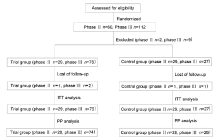
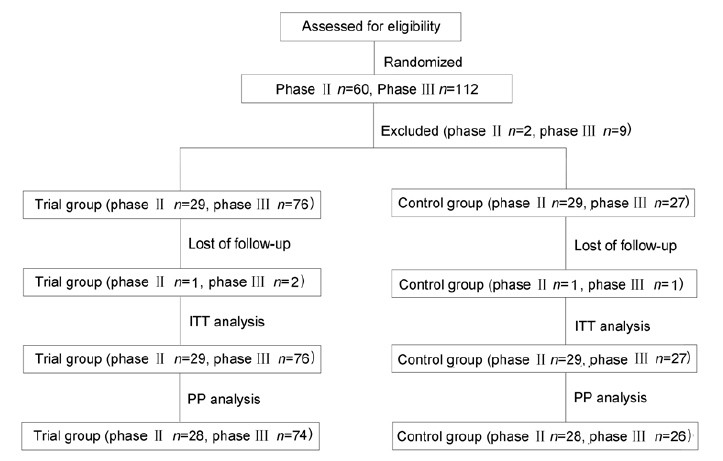
Figure 1

Diagram of the randomized trial"

Table 1

Comparison of the baseline between two groups in phase Ⅱ (ITT)"

Items Trial Control t /χ2 P
Cases 29 229 21 21
Sex(M/F) ####### 5月24日 3.107 0.141
Mean age (x±s, year) 30.42±8.67 32.67±11.00 -0.863 0.392
Course (x±s, year) 1.28±0.45 1.43±0.50 -1.243 0.219
Severity (mild/moderate/severe) 10/19/0 13/16/0 0.649 0.592
Fever (none/mild/moderate/severe) 26/14/9/0 6/15/8/0 0.093 0.954
Tongue (normal/abnormal) 2月27日 5月24日 1.462 0.423
Pulse condition (normal/abnormal) 5月24日 9月20日 1.506 0.358

Table 2

Comparison of effect between two groups in phase Ⅱ [Cases (%)]"

Group n Cure Obvious effect Improvment Failur Z P
ITT 2 2 2 2 2 1 1
Trial 29 14 (48.28) 8 (27.59) 5 (17.24) 2 (6.70)
-0.54 -0.59
Control 29 16 (55.17) 7 (24.14) 5 (17.24) 1 (3.45) 1 1
PP 2 2 2 2 2 11 11
Trial 28 14 (50.00) 8 (28.57) 5 (17.86) 1 (3.57)
-0.57 0.569
Control 28 16 (57.14) 7 (25.00) 5 (17.86) 0 (0.00) 1 1

Table 3

Comparison of the baseline between two groups in phase Ⅲ (ITT)"

Items Trial Control t /χ2 P
Cases 76 227 21 21
Sex(M/F) 36/40 11月16日 3.107 0.141
Mean age (x±s, year) 35.24±15.15 39.22±17.35 1.128 0.262
Course (x±s, year) 1.22±0.45 1.07±0.27 1.628 0.107
Severity (mild/moderate/severe) 26/49/1 10/17/0 0 0.996
Body temperature (x±s, ℃) 37.81±0.88 37.86±0.42 -0.321 0.749
Tongue (normal/abnormal) 6/70 4月23日 1.088 0.297
Pulse condition (normal/abnormal) 31/45 11月16日 0 0.996

Table 4

Comparison of effect between two groups in [Cases (%)]"

Group n Cure Obvious effect Improvment Failur Z P
ITT 2 2 2 2 2 1 1
Trial 76 41 (53.95) 26 (34.21) 3 (3.95) 6 (7.89)
-1.276 0.202
Control 27 12 (44.44) 7 (25.93) 6 (22.22) 2 (7.41) 1 1
PP 2 2 2 2 2 11 11
Trial 74 41 (55.41) 26 (35.14) 3 (4.05) 4 (5.41)
-1.263 0.207
Control 26 12 (46.15) 7 (26.92) 6 (23.08) 1 (3.85) 1 1
[1] Del Mar C, Glasziou P. 上呼吸道感染的治疗[J]. 中国循证医学杂志, 2004,4(4):274-277, 284
Del Mar C, Glasziou P . Treatment of upper respiratory tract infection[J]. Zhongguo Xun Zheng Yi Xue Za Zhi, 2004,4(4):274-277, 284
[2] 钱桂生 . 急性上呼吸道感染[J]. 高校保健医学研究与实践, 2005,2(1):4-5
Qian GS . Acute upper respiratory tract infection[J]. Gao Xiao Bao Jian Yi Xue Yan Jiu Yu Shi Jian, 2005,2(1):4-5
[3] 常静, 李廷谦, 万美华 , 等. 中国4种中医药大学学报随机对照临床试验文献的质量评价[J]. 中国循证医学杂志, 2006,6(3):171-178
doi: 10.3969/j.issn.1672-2531.2006.03.004
[1] Zhao-guo Li , Rui-qiang Liu. Comparative study on WHO Western Pacific Region and World Federation of Chinese Medicine Societies international standard terminologies on traditional medicine: Diseases in Internal Medicine (Part 5). Journal of Chinese Integrative Medicine, 2012, 10(9): 1061-1065.
[2] Zhao-lan Liu, Qing Li , Yu-jie Mu , Ying Gao, Jian-ping Liu. Using nested case-control study to appraise the effectiveness of Chinese medicines in the treatment of diabetic nephropathy. Journal of Chinese Integrative Medicine, 2012, 10(9): 991-996.
[3] Jing-lin Shi, Wan-hong Miao. Effects of acupuncture on lactoferrin content in tears and tear secretion in patients suffering from dry eyes: A randomized controlled trial. Journal of Chinese Integrative Medicine, 2012, 10(9): 1003-1008.
[4] Claudia Maria Sous, Mario Goncalves, Jorge Machado, Thomas Efferth, Tobias Greten , Petra Froeschen , Henry J. Greten. Effects of qigong on performance-related anxiety and physiological stress functions in transverse flute music schoolchildren: A feasibility study. Journal of Chinese Integrative Medicine, 2012, 10(8): 858-865.
[5] Ming T. Tan , Jian-ping Liu , Lixing Lao. Adequate application of quantitative and qualitative statistic analytic methods in acupuncture clinical trials. Journal of Chinese Integrative Medicine, 2012, 10(8): 847-852.
[6] Zhao-guo Li . Comparative study on WHO Western Pacific Region and World Federation of Chinese Medicine Societies international standard terminologies on traditional medicine: Diseases in Internal Medicine (Part 4). Journal of Chinese Integrative Medicine, 2012, 10(8): 948-952.
[7] Chen Xia , Qun-bang Zhu, Feng Huang, Jing-hui Huang, Hong-da Chen, Ming-jun Chen, Wei Gu, Bai Li, Fan-fu Fang, Liang-neng Wu . Traditional Chinese medicine constitution types in 127 elderly patients with insomnia: An investigation in communities of Yangpu District, Shanghai. Journal of Chinese Integrative Medicine, 2012, 10(8): 866-873.
[8] Wei-hua Xu, Ze-huai Wen, Wei-xiong Liang, Qi Wang. A review of research on the development of instruments for therapeutic efficacy evaluation of traditional Chinese medicine. Journal of Chinese Integrative Medicine, 2012, 10(7): 726-737.
[9] Ping Li, Yun-zhong Shi . A study on English translation of antithesis in Neijing. Journal of Chinese Integrative Medicine, 2012, 10(7): 832-836.
[10] Lu Yu, Shui-miao Lin, Ru-qian Zhou, Wei-jun Tang, Pin-xian Huang, Ying Dong, Jian Wang, Zhi-hua Yu, Jiu-lin Chen, Li Wei, San-li Xing, Hui-juan Cao, Hong-bin Zhao. Chinese herbal medicine for patients with mild to moderate Alzheimer disease based on syndrome differentiation: A randomized controlled trial. Journal of Chinese Integrative Medicine, 2012, 10(7): 766-776.
[11] Zhao-guo Li. Comparative study on WHO Western Pacific Region and World Federation of Chinese Medicine Societies international standard terminologies on traditional medicine: Diseases in Internal Medicine (Part 3). Journal of Chinese Integrative Medicine, 2012, 10(7): 827-831.
[12] Hui Luo, Jian-ping Liu, Qing Li. Methodological issues and suggestions for improvement in randomized controlled trials of Chinese herbal medicine for recurrent miscarriage. Journal of Chinese Integrative Medicine, 2012, 10(6): 604-614.
[13] Peng Fu , Xue-qiang Huang, Ai-hong Yuan, Guang Yu, Xiao-bin Mei, Ruo-lan Cu. Effects of salvianolate combined with alprostadil and reduced glutathione on progression of chronic renal failure in patients with chronic kidney diseases: a long-term randomized controlled trial. Journal of Chinese Integrative Medicine, 2012, 10(6): 641-646.
[14] Zhao-guo Li . Comparative study on WHO Western Pacific Region and World Federation of Chinese Medicine Societies international standard terminologies on traditional medicine: Diseases in Internal Medicine (Part 2). Journal of Chinese Integrative Medicine, 2012, 10(6): 712-716.
[15] C. Matos Luís, J. Goncalves Mário, R. Silva António, G. Mendes Joaquim, P. Machado Jorge, J. Greten Henry. Assessment of Qigong-related effects by infrared thermography: A case study. Journal of Chinese Integrative Medicine, 2012, 10(6): 663-666.
Viewed
Full text


Abstract

Cited

  Shared   
  Discussed   
[1] Wei-xiong Liang. Problems-solving strategies in clinical treatment guideline for traditional Chinese medicine and integrative medicine. Journal of Chinese Integrative Medicine, 2008, 6(1): 1-4
[2] Zhao-guo Li. Discussion on English translation of commonly used sentences in traditional Chinese medicine: part one. Journal of Chinese Integrative Medicine, 2008, 6(1): 107-110
[3] Jun Hu, Jian-ping Liu. Non-invasive physical treatments for chronic/recurrent headache. Journal of Chinese Integrative Medicine, 2008, 6(1): 31
[4] Xue-mei Liu, Qi-fu Huang, Yun-ling Zhang, Jin-li Lou, Hong-sheng Liu, Hong Zheng. Effects of Tribulus terrestris L. saponion on apoptosis of cortical neurons induced by hypoxia-reoxygenation in rats. Journal of Chinese Integrative Medicine, 2008, 6(1): 45-50
[5] . Uniform requirements for manuscripts submitted to biomedical journals: Writing and editing for biomedical publication (Chinese version, part two). Journal of Chinese Integrative Medicine, 2010, 8(11): 1001-1005
[6] Daniel Weber, Janelle M Wheat, Geoffrey M Currie. Inflammation and cancer: Tumor initiation, progression and metastasis,and Chinese botanical medicines. Journal of Chinese Integrative Medicine, 2010, 8(11): 1006-1013
[7] Hong Liu , Guo-liang Zhang, Li Shen , Zhen Zeng, Bao-luo Zhou, Cheng-hai Liu, Guang Nie . Application and evaluation of a pseudotyped virus assay for screening herbs for anti-H5Nl avian influenza virus. Journal of Chinese Integrative Medicine, 2010, 8(11): 1036-1040
[8] Zhao-guo Li . A discussion of English translation of 1995 and 1997 Chinese National Standards of Traditional Chinese Medical Terminologies for Clinical Diagnosis and Treatment. Journal of Chinese Integrative Medicine, 2010, 8(11): 1090-1096
[9] Rui Jin, Bing Zhang. A complexity analysis of Chinese herbal property theory: the multiple formations of herbal property (Part 1). Journal of Chinese Integrative Medicine, 2012, 10(11): 1198-1205
[10] Hui-min Liu, Xian-bo Wang, Yu-juan Chang, Li-li Gu. Systematic review and meta-analysis of randomized controlled trials of integrative medicine therapy for treatment of chronic severe hepatitis. Journal of Chinese Integrative Medicine, 2012, 10(11): 1211-1228
[an error occurred while processing this directive]