[an error occurred while processing this directive]

Journal of Chinese Integrative Medicine ›› 2008, Vol. 6 ›› Issue (8): 771-775.doi: 10.3736/jcim20080801

• Editorial •     Next Articles

Appropriately selecting and concisely reporting the outcome measures of randomized controlled trials of traditional Chinese medicine

Zhao-xiang Bian1(), David Moher2, You-ping Li3, Tai-xiang Wu3, Simon Dangenais4, Chung-wah Cheng1, Jing Li3, Ting-qian Li3   

  1. 1. School of Chinese Medicine, Hong Kong Baptist University, Hong Kong SAR, China
    2. Chalmers Research Group, Children's Hospital of Eastern Ontario Research Institute, Ottawa, Canada
    3. Department of Clinical Epidemiology, Chinese Evidence-Based Medicine Centre, West China Hospital, Sichuan University, Chengdu, Sichuan Province 610041, China
    4. Division of Orthopaedic Surgery and Department of Epidemiology and Community Medicine, University of Ottawa, Ottawa, Canada
  • Received:2008-05-05 Online:2008-08-20 Published:2008-08-15

Evaluating outcome is the primary means by which different medical modalities can be compared with regard to effectiveness. In traditional Chinese medicine (TCM), this focus has prompted practitioners to search for outcome measures that can objectively verify the effectiveness of TCM interventions, especially in the context of randomized controlled trials (RCTs). Commonly used indexes for outcome assessment in RCTs of TCM can be categorized into two types: TCM-specific outcomes such as tongue and pulse characteristics, and Western medicine (WM)-specific outcomes such as blood test and X-ray examination results. Some studies include both types of indicators. During the trial design, it is necessary to consider the rationales of selecting outcome assessments, the purpose and study approach, balance between objective and subjective indexes, standardization of outcome assessment, and standardized outcome indexes. We recommend to report the outcome assessment in RCTs of TCM in the following format: 1) identifying the primary and secondary outcomes based on the purpose and hypothesis of the trial; 2) defining the primary and secondary outcomes clearly; 3) presenting the rationale of selection; 4) presenting the method with aims to standardize the assessment process; 5) presenting the method to improve the reliability of assessment; and 6) stating the termination criteria in the trial.

Key words: traditional Chinese medicine, Chinese herbal drugs, clinical research, randomized controlled trials, evidence-based medicine, outcome measure

CLC Number: 

  • R-3

"

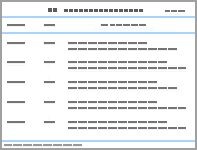
论文部分和主题 项目 描述
方法
测量指标
6 根据研究目的和假设,明确定义主要和次要结局测量指标,解释其选择依据,并注明结局测量指标的测量方法(如评估人员的资历、怎样和何时进行等)和标准(如有否采用公认的金标准),及说明用于提高测量质量的方法(如多次重覆观察、评估人员培训等)。说明评估干预措施安全性的方法和终止试验的原则。
结果
描述结果和效应量估计
17 按照主要和次要结局测量指标顺序描述结果,对效应量及精确度进行描述(如95%可信区间)
结论
解释
20 针对研究假设对结果进行分析,阐述研究的潜在偏倚、不确定因素和导致多样性结果的风险,并根据研究目的和方向说明中药干预措施的疗效和安全性。
[1] Reeve-Irving Research Centre . Anatomy 101: human research.
[2] Wu TX, Li YP, Bian ZX , et al. Consolidated standards for reporting trials of traditional Chinese medicine(CONSORT for TCM)[J]. Zhongguo Xun Zheng Yi Xue Za Zhi, 2007,7(8):601-605
doi: 10.3969/j.issn.1672-2531.2007.08.013
吴泰相, 李幼平, 卞兆祥 , 等. 中医药临床随机对照试验报告规范(征求意见稿)[J]. 中国循证医学杂志, 2007,7(8):601-605
doi: 10.3969/j.issn.1672-2531.2007.08.013
[3] Wu TX, Li YP, Bian ZX , et al. Consolidated standards for reporting trials of traditional Chinese medicine(CONSORT for TCM)[J]. Zhongguo Xun Zheng Yi Xue Za Zhi, 2007,7(8):625-630
[4] Liu JP . Evidence-based medicine approach and traditional Chinese medicine therapeutic evaluation[J]. Shou Du Yi Ke Da Xue Xue Bao, 2007,28(2):212-215
刘建平 . 循证医学方法与中医疗效评价[J]. 首都医科大学学报, 2007,28(2):212-215
[5] Cheng CW, Bian ZX, Li YP , et al. CONSORT serial 1: How to explain the methodological rationale of randomized controlled trials of traditional Chinese medicine?[J]. Zhongguo Xun Zheng Yi Xue Za Zhi, 2008,8(3):152-154
郑颂华, 卞兆祥, 李幼平 , 等. CONSORT系列一: 中医药临床研究报告中应清晰阐述试验设计理念[J]. 中国循证医学杂志, 2008,8(3):152-154
[6] Good PI .A manager's guide to the design and conduct of clinical trials(2nd ed) [M].New Jersey: John Wiley & Sons, Inc, 2006,( 2nd ed):
[7] Ministry of Health of the People's Republic of China. Guidelines of clinical research on Chinese new herbal medicines[M]. Beijing: Medical Science and Technology Publishing House of China, 1993
中华人民共和国卫生部. 中药新药临床研究指导原则[M]. 北京: 中国医药科技出版社, 1993
[8] State Administration of Traditional Chinese Medicine. Diagnostic and therapeutic effect evaluation criteria of diseases and syndromes in traditional Chinese medicine[M]. Nanjing: Nanjing University Press, 1994
国家中医药管理局. 中医病证诊断疗效标准[M]. 南京: 南京大学出版社, 1994
[1] Na Wu , Lu Song , Xin-xin Yang, Jiang-lei Wei , Zhen-guo Liu. Effects of Chinese herbal medicine Tianqi Pingchan Granule on G protein-coupled receptor kinase 6 involved in the prevention of levodopa-induced dyskinesia in rats with Parkinson disease. Journal of Chinese Integrative Medicine, 2012, 10(9): 1018-1024.
[2] Jing-lin Shi, Wan-hong Miao. Effects of acupuncture on lactoferrin content in tears and tear secretion in patients suffering from dry eyes: A randomized controlled trial. Journal of Chinese Integrative Medicine, 2012, 10(9): 1003-1008.
[3] Lu-ming Chen, Hui Yu, Da-rong Wu , Xun Hu , Lan Zheng. Investigation on response of the patient-reported outcome scale of the main-symptoms of chronic obstructive pulmonary disease complicated with pulmonary heart disease. Journal of Chinese Integrative Medicine, 2012, 10(9): 970-974.
[4] Ming T. Tan , Jian-ping Liu , Lixing Lao. Adequate application of quantitative and qualitative statistic analytic methods in acupuncture clinical trials. Journal of Chinese Integrative Medicine, 2012, 10(8): 847-852.
[5] Claudia Maria Sous, Mario Goncalves, Jorge Machado, Thomas Efferth, Tobias Greten , Petra Froeschen , Henry J. Greten. Effects of qigong on performance-related anxiety and physiological stress functions in transverse flute music schoolchildren: A feasibility study. Journal of Chinese Integrative Medicine, 2012, 10(8): 858-865.
[6] Yong Zhang, Xiao-wen Sun, Jian-hua Xu, Hai Lu, Zhong-ze Fan, Jue Sun, Xiao-xiao Zhang. Effects of medicated serum prepared with Chinese herbal medicine Changweiqing on pharmacokinetics of oxaliplatin in colon cancer cells. Journal of Chinese Integrative Medicine, 2012, 10(8): 901-910.
[7] Xin-min Li, Hui Chen, Yan-yan Ren, Yan-li Lu. Effects of Chinese herbal medicine Xifeng Capsule on multidrug resistance-associated protein 1 expression in hippocampus and cortex of rats with lithium-pilocarpine-induced epilepsy. Journal of Chinese Integrative Medicine, 2012, 10(8): 911-917.
[8] Wei-hua Xu, Ze-huai Wen, Wei-xiong Liang, Qi Wang. A review of research on the development of instruments for therapeutic efficacy evaluation of traditional Chinese medicine. Journal of Chinese Integrative Medicine, 2012, 10(7): 726-737.
[9] Lin Wang, Guan-liang Wang, Jia-han Liu, Di Li, De-zeng Zhu, Liang-neng Wu . Effects of ursolic acid in ameliorating insulin resistance in liver of KKAy mice via peroxisome proliferator-activated receptors α and γ. Journal of Chinese Integrative Medicine, 2012, 10(7): 793-799.
[10] Lu Yu, Shui-miao Lin, Ru-qian Zhou, Wei-jun Tang, Pin-xian Huang, Ying Dong, Jian Wang, Zhi-hua Yu, Jiu-lin Chen, Li Wei, San-li Xing, Hui-juan Cao, Hong-bin Zhao. Chinese herbal medicine for patients with mild to moderate Alzheimer disease based on syndrome differentiation: A randomized controlled trial. Journal of Chinese Integrative Medicine, 2012, 10(7): 766-776.
[11] Hui Luo, Jian-ping Liu, Qing Li. Methodological issues and suggestions for improvement in randomized controlled trials of Chinese herbal medicine for recurrent miscarriage. Journal of Chinese Integrative Medicine, 2012, 10(6): 604-614.
[12] Peng Fu , Xue-qiang Huang, Ai-hong Yuan, Guang Yu, Xiao-bin Mei, Ruo-lan Cu. Effects of salvianolate combined with alprostadil and reduced glutathione on progression of chronic renal failure in patients with chronic kidney diseases: a long-term randomized controlled trial. Journal of Chinese Integrative Medicine, 2012, 10(6): 641-646.
[13] C. Matos Luís, J. Goncalves Mário, R. Silva António, G. Mendes Joaquim, P. Machado Jorge, J. Greten Henry. Assessment of Qigong-related effects by infrared thermography: A case study. Journal of Chinese Integrative Medicine, 2012, 10(6): 663-666.
[14] Shui-qiu Deng, Xue-nong Ouyang, Zong-yang Yu, Xi-hu Dai, Xi Chen, Fang-zheng Fang, Wen-wu Wang, Zhi-zhen Liu. Influence of Chinese herbal medicine Feitai Capsule on completion or delay of chemotherapy in patients with stage ⅢB/Ⅳ non-small-cell lung cancer: a Randomized controlled trial. Journal of Chinese Integrative Medicine, 2012, 10(6): 635-640.
[15] Ming-xing Zhao, Zhen-hua Dong, Zhong-hai Yu, Shi-yuan Xiao, Ya-ming Li . Effects of Ginkgo biloba extract in improving episodic memory of patients with mild cognitive impairment: A randomized controlled trial. Journal of Chinese Integrative Medicine, 2012, 10(6): 628-634.
Viewed
Full text


Abstract

Cited

  Shared   
  Discussed   
[1] Wei-xiong Liang. Problems-solving strategies in clinical treatment guideline for traditional Chinese medicine and integrative medicine. Journal of Chinese Integrative Medicine, 2008, 6(1): 1-4
[2] Zhao-guo Li. Discussion on English translation of commonly used sentences in traditional Chinese medicine: part one. Journal of Chinese Integrative Medicine, 2008, 6(1): 107-110
[3] Jun Hu, Jian-ping Liu. Non-invasive physical treatments for chronic/recurrent headache. Journal of Chinese Integrative Medicine, 2008, 6(1): 31
[4] Xue-mei Liu, Qi-fu Huang, Yun-ling Zhang, Jin-li Lou, Hong-sheng Liu, Hong Zheng. Effects of Tribulus terrestris L. saponion on apoptosis of cortical neurons induced by hypoxia-reoxygenation in rats. Journal of Chinese Integrative Medicine, 2008, 6(1): 45-50
[5] . Uniform requirements for manuscripts submitted to biomedical journals: Writing and editing for biomedical publication (Chinese version, part two). Journal of Chinese Integrative Medicine, 2010, 8(11): 1001-1005
[6] Daniel Weber, Janelle M Wheat, Geoffrey M Currie. Inflammation and cancer: Tumor initiation, progression and metastasis,and Chinese botanical medicines. Journal of Chinese Integrative Medicine, 2010, 8(11): 1006-1013
[7] Hong Liu , Guo-liang Zhang, Li Shen , Zhen Zeng, Bao-luo Zhou, Cheng-hai Liu, Guang Nie . Application and evaluation of a pseudotyped virus assay for screening herbs for anti-H5Nl avian influenza virus. Journal of Chinese Integrative Medicine, 2010, 8(11): 1036-1040
[8] Zhao-guo Li . A discussion of English translation of 1995 and 1997 Chinese National Standards of Traditional Chinese Medical Terminologies for Clinical Diagnosis and Treatment. Journal of Chinese Integrative Medicine, 2010, 8(11): 1090-1096
[9] Rui Jin, Bing Zhang. A complexity analysis of Chinese herbal property theory: the multiple formations of herbal property (Part 1). Journal of Chinese Integrative Medicine, 2012, 10(11): 1198-1205
[10] Hui-min Liu, Xian-bo Wang, Yu-juan Chang, Li-li Gu. Systematic review and meta-analysis of randomized controlled trials of integrative medicine therapy for treatment of chronic severe hepatitis. Journal of Chinese Integrative Medicine, 2012, 10(11): 1211-1228
[an error occurred while processing this directive]