[an error occurred while processing this directive]

Journal of Chinese Integrative Medicine ›› 2012, Vol. 10 ›› Issue (10): 1149-1154.doi: 10.3736/jcim20121012

Previous Articles     Next Articles

Molecular docking of chlorogenic acid, 3,4-di-O-caffeoylquinic acid and 3,5-di-O-caffeoylquinic acid with human serum albumin

Jing Zhou1, Hong-yue Ma1, Xin-sheng Fan1(), Wei Xiao2,3(), Tuan-jie Wang2,3   

  1. 1. Jiangsu Key Laboratory for Traditional Chinese Medicine Formulae Research, College of Pharmacy, Nanjing University of Chinese Medicine, Nanjing 210046, Jiangsu Province, China
    2. Jiangsu Kanion Parmaceutical CO. LTD, Lianyungang 222001, Jiangsu Province, China
    3. State Key Laboratory of New-tech for Chinese Medicine Pharmaceutical Process, Lianyungang 222001, Jiangsu Province, China
  • Received:2012-04-13 Accepted:2012-05-18 Online:2012-10-20 Published:2018-10-15
  • Contact: Xin-sheng Fan, Wei Xiao E-mail:fanxsh126@126.com;union_wang@163.com

Objective: To investigate the mechanism of binding of human serum albumin (HSA) with potential sensitinogen, including chlorogenic acid and two isochlorogenic acids (3,4-di-O-caffeoylquinic acid and 3,5-di-O-caffeoylquinic acid). .

Methods: By using the docking algorithm of computer-aided molecular design and the Molegro Virtual Docker, the crystal structures of HSA with warfarin and diazepam (Protein Data Bank ID: 2BXD and 2BXF) were selected as molecular docking receptors of HSA sites Ⅰ and Ⅱ. According to docking scores, key residues and H-bond, the molecular docking mode was selected and confirmed. The molecular docking of chlorogenic acid and two isochlorogenic acids on sites Ⅰ and Ⅱ was compared based on the above design.

Results: The results from molecular docking indicated that chlorogenic acid, 3,4-di-O-caffeoylquinic acid and 3,5-di-O-caffeoylquinic acid could bind to HSA site Ⅰ by high affinity scores of –112.3, –155.3 and –153.1, respectively. They could bind to site Ⅱ on HSA by high affinity scores of –101.7, –138.5 and –133.4, respectively. In site Ⅰ, two isochlorogenic acids interacted with the key apolar side-chains of Leu238 and Ala291 by higher affinity scores than chlorogenic acid. Furthermore, the H-bonds of isochlorogenic acids with polar residues inside the pocket and at the entrance of the pocket were different from chlorogenic acid. Moreover, the second coffee acyl of isochlorogenic acid occupied the right-hand apolar compartment in the pocket of HSA site Ⅰ. In site Ⅱ, the second coffee acyl of isochlorogenic acid formed the H-bonds with polar side-chains, which contributed isochlorogenic acid to binding with site Ⅱ of HSA.

Conclusion: The isochlorogenic acids with two coffee acyls have higher binding abilities with HSA than chlorogenic acid with one coffee acyl, suggesting that isochlorogenic acids binding with HSA may be sensitinogen.

Key words: plant extracts, chlorogenic acid, isochlorogenic acid, human serum albumin, molecular docking, computer-aided design

Table 1

Docking method validation"

Ligand Protein (PDB ID) Site RMSD MD score Rerank score H bond score Key residues
Warfarin HSA (2BXD) Site Ⅰ 0.47 –108.5 –93.2 –7.7 Tyr150, Arg222, His242
Diazepam HSA (2BXF) Site Ⅱ 0.45 –107.9 –91.5 –1.9 Tyr411
Warfarin HSA (2BXF) Site Ⅱ –112.7 –88.9 –0.1
Diazepam HSA (2BXD) Site Ⅰ –80.7 –67.4 –2.1 Tyr150

Table 2

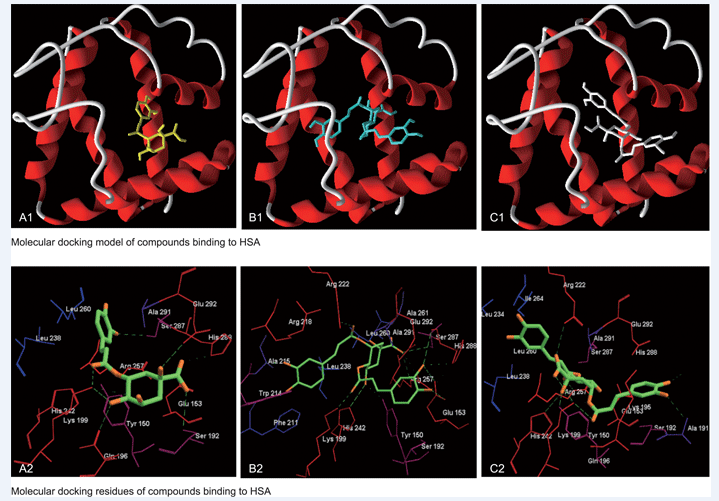
Docking scores and interaction residues of tested compounds binding to HSA (PDB ID: 2BXD) site Ⅰ"

Ligand MD score Rerank score H bond score Key residues (score)
Chlorogenic acid –112.3 –108.1 –12.8 Tyr150 (–16.4), Arg257 (–14.0), Ala291 (–11.7),Lys199 (–11.5), Gln196 (–9.3), Leu238 (–4.4)
3,4-di-O-Caffeoylquinic acid –155.3 –111.4 –12 Ala291 (–17.0), Arg257 (–16.8), Leu238 (–15.4), Tyr150 (–13.6), Lys199 (–11.5), His242 (–10.7), His288 (–10.1)
3,5-di-O-Caffeoylquinic acid –153.1 –128.4 –13.6 Tyr150 (–19.5), Ser192 (–16.0), Lys199 (–15.5), Lys 195 (–14.9), Leu238 (–13.6), Ala291 (–12.8), Arg257 (–10.0), His242 (–8.9); Arg222 (–5.8)

Figure 1

Molecular docking model (A1-C1) and interaction residues (A2-C2) of chlorogenic acid (A), 3,4-di-O-caffeoylquinic acid (B) and 3,5-di-O-caffeoylquinic acid (C) binding to HSA site Ⅰ Apolar chains were marked in blue; semipolar chains were marked in violet; polar chains were marked in red. The H-bonds were marked in green dash line. HSA: human serum albumin. "

Table 3

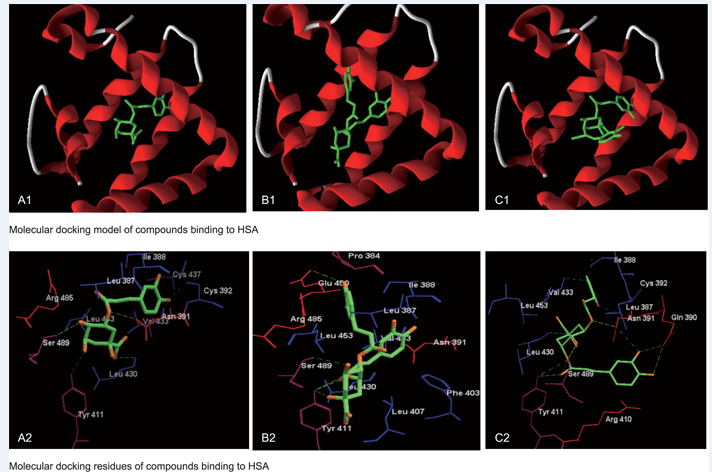
Docking scores and interaction residues of tested compounds binding to HSA (PDB ID: 2BXF) site Ⅱ"

Ligand MD score Rerank score H bond score Key residues (score)
Chlorogenic acid –101.7 –90.4 –9.5 Asn391 (–21.6), Leu387 (–14.9), Ile388 (–14.8), Val433 (–13.7), Leu453 (–9.5), Leu430 (–9.1), Arg485 (–7.1), Tyr411 (–6.8), Ser489 (–6.5)
4-di-O-Caffeoylquinic acid –138.5 –101.7 –5.8 Tyr411 (–20.1), Leu387 (–18.1), Asn391 (–17.4), Arg485 (–13.5), Ile388 (–11.7), Val433 (–10.6), Leu453 (–10.2), Ser489 (–9.2), Pro384 (–7.6), Leu430(–7.0)
3,5-di-O-Caffeoylquinic acid –133.4 –91.7 –13.2 Asn391 (–29.3), Leu387 (–15.8), Ile388 (–14.8), Val433 (–14.4), Tyr411 (–11.4), Gln390 (–10.8), Ser489 (–10.7), Arg410 (–10.3), Leu453 (–10.1), Leu430 (–8.8)

Figure 2

Molecular docking model (A1-C1) and interaction residues (A2-C2) of chlorogenic acid (A), 3,4-di-O-caffeoylquinic acid (B) and 3,5-di-O-caffeoylquinic acid (C) binding to HSA site ⅡApolar chains were marked in blue; semipolar chains were marked in violet; polar chains were marked in red. The H-bonds were marked in green dash line. HSA: human serum albumin."

[1] Zhang RX, Tang NP, Lin HX, Ma J, Xie C, Chen XY . Allergenicity assessment and comparison between chlorogenic acid and Shuanghuanglian Fenzhenji[J]. Shi Jie Ke Xue Ji Shu Zhong Yi Yao Xian Dai Hua, 2010,12(6):1005-1008
doi: 10.11842/wst.2010.6.[sequence]
张瑞霞, 汤纳平, 林海霞, 马璟, 谢岑, 陈笑艳 . 绿原酸和双黄连粉针剂致敏性比较评价[J]. 世界科学技术中医药现代化, 2010,12(6):1005-1008
doi: 10.11842/wst.2010.6.[sequence]
[2] Bi SY, Yan LL, Sun YT . Study on the binding of chlorogenic acid with human serum albumin by spectroscopy[J]. Hua Xue Fen Xi Ji Liang, 2010,19(2):31-33
毕淑云, 闫丽丽, 孙艳涛 . 光谱法研究绿原酸与人血清白蛋白的相互作用[J]. 化学分析计量, 2010,19(2):31-33
[3] Yang B. The pharmacokinetics and metabolism of 1, 5-dicaffeoylquinic acid in vivo and in vitro. Shenyang: Shenyang Pharmaceutical University. 2005. Chinese.
杨波 . 1,5-二咖啡酰奎宁酸的体内外代谢及药代动力学研究. 沈阳药科大学. 2005.
[4] Liu L, Ma H, Tang Y, Chen W, Lu Y, Guo J, Duan JA . Discovery of estrogen receptor α modulators from natural compounds in Si-Wu-Tang series decoctions using estrogen-responsive MCF-7 breast cancer cells[J]. Bioorg Med Chem Lett, 2012,22(1):154-163
doi: 10.1016/j.bmcl.2011.11.041
[5] Ghuman J, Zunszain PA, Petitpas I, Bhattacharya AA, Otagiri M, Curry S . Structural basis of the drug-binding specificity of human serum albumin[J]. J Mol Biol, 2005,353(1):38-52
doi: 10.1016/j.jmb.2005.07.075 pmid: 16169013
[1] Dhirender Kaushik, Ajay Kumar, Pawan Kaushik, Avatar C. Rana. Anticonvulsant activity of alcoholic extract of bark of Pinus roxburghii Sarg. Journal of Chinese Integrative Medicine, 2012, 10(9): 1056-1060.
[2] Chan Chen, Chang-xun Chen, Xi-min Wu, Rui Wang, Yi-ming Li. Effects of extracts of Radix Scrophulariae on blood pressure in spontaneously hypertensive rats and the underlying mechanisms. Journal of Chinese Integrative Medicine, 2012, 10(9): 1009-1017.
[3] Samuel Joshua Pragasam, Vachana Murunikara, Evan Prince Sabina, Mahaboobkhan Rasool. Antiperoxidative potential of p-coumaric acid, a common dietary phenol, in adjuvant-induced arthritis in rats. Journal of Chinese Integrative Medicine, 2012, 10(8): 932-938.
[4] Hong Wang , Jing-tian Ou , Xin Zhao , Ying Guoz , Hao-ping Mao. Vasodilator effect of oroxylin A on thoracic aorta isolated from rats. Journal of Chinese Integrative Medicine, 2012, 10(8): 880-885.
[5] C. Mouli Kalla, Vijaya Tartte, Dattatreya Rao Sirpurkar. Effectiveness of flavonoid-rich leaf extract of Acalypha indica in reversing experimental myocardial ischemia: biochemical and histopathological evidence. Journal of Chinese Integrative Medicine, 2012, 10(7): 784-792.
[6] Surendra Kr. Sharma, Naveen Goyal. Protective effect of Heliotropium eichwaldi against cisplatin-induced nephrotoxicity in mice. Journal of Chinese Integrative Medicine, 2012, 10(5): 555-560.
[7] Yue-hua Wang, Xiao-li He, Xiao-xiu Li, Hai-lin Qin, Guan-hua Du . Effects of the effective component group of Chinese herbal medicine Xiaoxuming Decoction on brain mitochondria in rats with chronic cerebral ischemia. Journal of Chinese Integrative Medicine, 2012, 10(5): 569-576.
[8] V. Patil Vikas, C. Bhangale Shandavi, J. Chaudhari Prashant, P. Chaudhari Kundan, T. Kakade Rajanikant, M. Thakare Vinod, G. Bonde Chandrakant, R. Patil Vijay. Evaluation of the antidiarrheal activity of the plant extracts of Ficus species. Journal of Chinese Integrative Medicine, 2012, 10(3): 347-352.
[9] Dhiman Anju, Nanda Arun, Ahmad Sayeed. A recent update in research on the antihepatotoxic potential of medicinal plants. Journal of Chinese Integrative Medicine, 2012, 10(2): 117-127.
[10] Mao Zhi-min, Song Hai-yan, Yang Li-li, Liu Tao, Li Dong-fei, Zheng Pei-yong, Liu Ping, Ji Guang. Effects of the mixture of Swertia pseudochinensis Hara and Silybum marianum Gaertn extracts on CCl4-induced liver injury in rats with non-alcoholic fatty liver disease. Journal of Chinese Integrative Medicine, 2012, 10(2): 193-199.
[11] Rahmatullah Mohammed, Kanij Hasan Sumaiyah, Ali Zulfiquar, Rahman Shahnaz, Jahan Rownak. Antihyperglycemic and antinociceptive activities of methanolic extract of Euphorbia thymifolia L. whole plants. Journal of Chinese Integrative Medicine, 2012, 10(2): 228-232.
[12] Arul Raj Chinthamony, Sophia Dominic, Ragavendran Paramasivam, Starlin Thangarajan, Ahalliya Rathi Muthian, Kanniappan Gopalakrishnan Velliyur. Leaf extract of Alpinia purpurata (Vieill.) K. Schum screened for its phytochemical constituents and antibacterial and anticancer activities. Journal of Chinese Integrative Medicine, 2012, 10(12): 1460-1464.
[13] Mukherjee Avinaba, Sikdar Sourav, Bishayee Kausik, Paul Avijit, Ghosh Samrat, Boujedaini Naoual, Rahman Khuda-Bukhsh Anisur. Ethanolic extract of Thuja occidentalis blocks proliferation of A549 cells and induces apoptosis in vitro. Journal of Chinese Integrative Medicine, 2012, 10(12): 1451-1459.
[14] Samadder Asmita, Das Jayeeta, Das Sreemanti, Das Durba, De Arnab, Bhadra Kakali, Rahman Khuda-Bukhsh Anisur. Dihydroxy-isosteviol methyl ester of Pulsatilla nigricans extract reduces arsenic-induced DNA damage in testis cells of male mice: Its toxicity, drug-DNA interaction and signaling cascades. Journal of Chinese Integrative Medicine, 2012, 10(12): 1433-1442.
[15] Dao-fang Ding , Song-pu Wei, Xiao-feng Li , Xiao-gang Zhang , Hong-sheng Zhan , Tie-li Duan , Yue-long Cao. Inhibition effect of osthole on proliferation of rat chondrocytes. Journal of Chinese Integrative Medicine, 2012, 10(12): 1413-1418.
Viewed
Full text


Abstract

Cited

  Shared   
  Discussed   
[1] Wei-xiong Liang. Problems-solving strategies in clinical treatment guideline for traditional Chinese medicine and integrative medicine. Journal of Chinese Integrative Medicine, 2008, 6(1): 1-4
[2] Zhao-guo Li. Discussion on English translation of commonly used sentences in traditional Chinese medicine: part one. Journal of Chinese Integrative Medicine, 2008, 6(1): 107-110
[3] Jun Hu, Jian-ping Liu. Non-invasive physical treatments for chronic/recurrent headache. Journal of Chinese Integrative Medicine, 2008, 6(1): 31
[4] Xue-mei Liu, Qi-fu Huang, Yun-ling Zhang, Jin-li Lou, Hong-sheng Liu, Hong Zheng. Effects of Tribulus terrestris L. saponion on apoptosis of cortical neurons induced by hypoxia-reoxygenation in rats. Journal of Chinese Integrative Medicine, 2008, 6(1): 45-50
[5] . Uniform requirements for manuscripts submitted to biomedical journals: Writing and editing for biomedical publication (Chinese version, part two). Journal of Chinese Integrative Medicine, 2010, 8(11): 1001-1005
[6] Daniel Weber, Janelle M Wheat, Geoffrey M Currie. Inflammation and cancer: Tumor initiation, progression and metastasis,and Chinese botanical medicines. Journal of Chinese Integrative Medicine, 2010, 8(11): 1006-1013
[7] Hong Liu , Guo-liang Zhang, Li Shen , Zhen Zeng, Bao-luo Zhou, Cheng-hai Liu, Guang Nie . Application and evaluation of a pseudotyped virus assay for screening herbs for anti-H5Nl avian influenza virus. Journal of Chinese Integrative Medicine, 2010, 8(11): 1036-1040
[8] Zhao-guo Li . A discussion of English translation of 1995 and 1997 Chinese National Standards of Traditional Chinese Medical Terminologies for Clinical Diagnosis and Treatment. Journal of Chinese Integrative Medicine, 2010, 8(11): 1090-1096
[9] Rui Jin, Bing Zhang. A complexity analysis of Chinese herbal property theory: the multiple formations of herbal property (Part 1). Journal of Chinese Integrative Medicine, 2012, 10(11): 1198-1205
[10] Hui-min Liu, Xian-bo Wang, Yu-juan Chang, Li-li Gu. Systematic review and meta-analysis of randomized controlled trials of integrative medicine therapy for treatment of chronic severe hepatitis. Journal of Chinese Integrative Medicine, 2012, 10(11): 1211-1228
[an error occurred while processing this directive]