[an error occurred while processing this directive]

Journal of Chinese Integrative Medicine ›› 2005, Vol. 3 ›› Issue (1): 6-9.doi: 10.3736/jcim20050103

• Expert Forum • Previous Articles     Next Articles

Application and projects approved for fundamental research on integrated traditional Chinese and Western medicine in National Natural Science Foundation of China from 2000 to 2004

Chang-en Wang1,Zong-ran Pang2,Ping Liu3,Shan-shan Zhang4   

  1. 1. Department of Life Sciences, National Natural Science Foundation Committee, Beijing 100085, China
    2. Department of Traditional Chinese Medicine, Chengde Medical College, Chengde, Hebei Province 067000, China
    3. Research Institute for Clinical Pharmacology, General Hospital of People’s Liberation Army, Beijing 100853, China;
    4. Department of Haematology, Xiyuan Hospital, China Academy of Traditional Chinese Medicine, Beijing 100091, China
  • Received:2004-12-29 Online:2005-01-20 Published:2005-01-20
  • Contact: Chang-en Wang E-mail:wangce@mail.nsfc.gov.cn

From 2000 to 2004, the National Natural Science Foundation of China (NSFC) accepted 1 171 applications and funded 160 projects for fundamental research on integrated traditional Chinese and Western medicine. The success rate is 13.64%. Being supported by NSFC, a number of achievements well known in China and abroad have been made, such as acupuncture complementary anaesthesia, treatment of leukemia, viral hepatitis, cardio-cerebrovascular diseases, acute abdomen, burns and fracture with integrated traditional Chinese and Western medicine and their therapeutic mechanisms, and some new concepts and theories have been put forward, such as the theories of activating blood to resolve stagnation, simultaneous treatment of bacteria and toxin, etc. But there still exit some problems in the research of the funded projects. The research ways are mainly combination of different methods instead of integration of both traditional Chinese and Western medicine. The research results are mainly confirmation of traditional Chinese medical theories instead of exploration of their innate regularities. The relationship among disease, syndrome and symptom is not clearly explored. The principal-subordinate relationship between macro- and micro-differentiation of syndromes is not clear. Academic research is short of new ideas. Improper or biased explanation of the theories of traditional Chinese medicine still exists. On analysis of above problems, some preferable aspects of projects for fundamental research on integrated traditional Chinese and Western medicine funded by NSFC in future are suggested in this article.

Key words: National Natural Science Foundation of China, Life sciences, Integrated traditional Chinese and Western medicine

CLC Number: 

  • R2-031

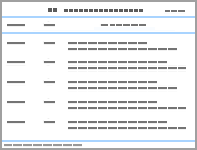
Tab 1

Application and projects approved for fundamental research on integrated traditional Chinese and Western medicine in general program of National Natural Science Foundation of China from 2000 to 2004"

统计项目 年份 5年合计
2000 2001 2002 2003 2004
自由申请项数 108 146 201 194 236 885
青年基金申请项数 24 27 24 32 52 159
地区基金申请项数 1 2 6 6 7 22
合计申请项数 133 175 231 232 295 1066
合计资助项数 13 19 38 35 41 146
资助率(%) 9.77 10.66 16.45 15.09 13.90 13.70
平均资助经费(万元/项) 16.46 18.08 19.52 15.09 20.22 20.48
[1] Yan-bo Zhu , Hideki Origasa, Xiao-xia Luo, Yang-yang Wang , Jie Di , Lin Lin. Responsiveness of three subjective report of outcome measures for chronic heart failure. Journal of Chinese Integrative Medicine, 2012, 10(12): 1375-1381.
[2] Hui-min Liu, Xian-bo Wang, Yu-juan Chang, Li-li Gu. Systematic review and meta-analysis of randomized controlled trials of integrative medicine therapy for treatment of chronic severe hepatitis. Journal of Chinese Integrative Medicine, 2012, 10(11): 1211-1228.
[3] Lei Wang, Li-heng Guo, Jun Zhang, Xu-jie Zhao, Min-zhou Zhang. A study protocol for clinical pathways based on integrative medicine for patients with acute myocardial infarction. Journal of Chinese Integrative Medicine, 2011, 9(7): 725-731.
[4] Li-xin Lang, Xiao-bo Wang, Wei Hou. Successful treatment of adult idiopathic pulmonary hemosiderosis with integrated traditional Chinese and Western medicine: A report of one case. Journal of Chinese Integrative Medicine, 2011, 9(5): 531-532.
[5] Hong-cai Shang, Jin-ling Huang, Li-wei Han, Ling-peng Pei, Lin Guo, Na Lin, Chang-en Wang . Applications and approved projects on traditional Chinese medicine in National Natural Science Foundation of China in 2010. Journal of Chinese Integrative Medicine, 2011, 9(10): 1045-1050.
[6] XQ Yue. Towards better understanding the definition of cancerous toxin. Journal of Chinese Integrative Medicine, 2010, 8(9): 829-831.
[7] the Project Group for Demonstration Study of Syndrome Differentiation Protocol Effect Evaluation of Acute Ischemic Stroke, Yan Huang, Jian-wen Guo. Outcome and safety assessment of an herbal medicine treatment protocol for yin pattern of acute ischemic stroke. Journal of Chinese Integrative Medicine, 2010, 8(5): 417-426.
[8] Hao Li , Long-tao Liu, Wen-ming Zhao, Jian-gang Liu, Ming-jiang Yao, Yong-xiang Han, Yan-peng Shen, Xing-dong Liu, Li Liu, Xue-mei Wang, Lin-lin Cai, Jie Guan. Traditional Chinese versus integrative treatment in elderly patients with isolated systolic hypertension: A multicenter, randomized, double-blind controlled trial. Journal of Chinese Integrative Medicine, 2010, 8(5): 410-416.
[9] Ci-an Zhang, Pin-kang Wei, Yong-jin Li. Discussion of the correlation between phlegm and tumor microenvironment. Journal of Chinese Integrative Medicine, 2010, 8(3): 215-219.
[10] Ni-da Cao, Ai-guang Zhao, Jin-kun Yang. Survival time of advanced gastric cancer patients treated with integrated traditional Chinese and Western medicine therapy. Journal of Chinese Integrative Medicine, 2010, 8(2): 116-120.
[11] Xue-mei You, Xiao Qin, Zhi-yong Dong, Guan-liang Wang. Integrated traditional Chinese and Western medicine versus Western medicine in treatment of arteriosclerosis obliterans: A systematic review of randomized controlled trials. Journal of Chinese Integrative Medicine, 2010, 8(10): 917-927.
[12] Hao Li, Long-tao Liu. Considerations about treatment programs of elderly patients with hypertension. Journal of Chinese Integrative Medicine, 2009, 7(7): 607-610.
[13] Ke-ji Chen, Yue-rong Jiang. Current status and problems in developing clinical guidelines for Chinese medicine and integrative medicine. Journal of Chinese Integrative Medicine, 2009, 7(4): 301-305.
[14] Yue Ma, Zong-wen Huang, Qing Xia, Ping Xue, Jia Guo, Hong-qiang Wei, Yan Chen, Fu-qian He, Zheng-yu Cheng, Zi-qi Lin. Influence of integrated traditional Chinese and Western medicine therapy on serum resistin levels in patients with severe acute pancreatitis: A randomized controlled trial. Journal of Chinese Integrative Medicine, 2009, 7(12): 1134-1138.
[15] Shu-qi Song, Ya-qiang Zhang. Recognition and thoughts for diagnosis and treatment of chronic prostatitis in integrated traditional Chinese and Western medicine. Journal of Chinese Integrative Medicine, 2009, 7(12): 1108-1112.
Viewed
Full text


Abstract

Cited

  Shared   
  Discussed   
[1] Jin-zhou Tian, Jing Shi, Xin-qing Zhang, Qi Bi, Xin Ma, Zhi-liang Wang, Xiao-bin Li, Shu-li Shen, Lin Li, Zhen-yun Wu, Li-yan Fang, Xiao-dong Zhao, Ying-chun Miao, Peng-wen Wang, Ying Ren, Jun-xiang Yin, Yong-yan Wang, Beijing United Study Group on MCI of the Capital Foundation of Medical Developments. An explanation on "guiding principles of clinical research on mild cognitive impairment (protocol)". Journal of Chinese Integrative Medicine, 2008, 6(1): 15-21
[2] Yi-ting He, Qing-lin Zha, Jian-ping Yu, Yong Tan, Cheng Lu, Ai-ping Lv. Principal factor analysis of symptoms of rheumatoid arthritis and their correlations with efficacy of traditional Chinese medicine and Western medicine. Journal of Chinese Integrative Medicine, 2008, 6(1): 32-36
[3] Jun Cai, Hua Wang, Sheng Zhou, Bin Wu, Hua-rong Song, Zheng-rong Xuan. Effect of Sijunzi Decoction and enteral nutrition on T-cell subsets and nutritional status in patients with gastric cancer after operation: A randomized controlled trial. Journal of Chinese Integrative Medicine, 2008, 6(1): 37-40
[4] Wei Zhang, Xiang-feng Lu, Xiao-mei Zhang, Jian-jun Wu, Liang-duo Jiang. A rat model of pulmonary fibrosis induced by infusing bleomycin quickly through tracheal intubation. Journal of Chinese Integrative Medicine, 2008, 6(1): 60-67
[5] A-gao Zhou, Yong Zhang, Gang Kui, De-Yun Kong, Hai-liang Ge, Qiu-hua Ren, Jia-rong Dong, Sheng Hong, Xu-ming Mao, Yin Wang, Hui-zheng Zhang, Shu-jun Wang. Influence of traditional Chinese compound recipes with different efficacy on body weight, tumor weight and immune function in H22 cancer-bearing mice. Journal of Chinese Integrative Medicine, 2008, 6(1): 77-82
[6] Guo-hong Yuan, Xiao-jing Pang, He-chao Ma. Synergic effects of Danggui Buxue Decoction in reducing toxicity of cytoxan in tumor-bearing mice. Journal of Chinese Integrative Medicine, 2008, 6(1): 83-88
[7] Li Zhou, Hong-xing Zhang, Ling-guang Liu, Wen-jun Wan. Effect of electro-acupuncture at Fenglong (GV 16) on nitric oxide and endothelin in rats with hyperlipidemia. Journal of Chinese Integrative Medicine, 2008, 6(1): 89-92
[8] Jin-zhou Tian, Jing Shi, Xin-qing Zhang, Qi Bi, Xin Ma, Zhi-liang Wang, Xiao-bin Li, Shu-li Shen, Lin Li, Zhen-yun Wu, Li-yan Fang, Xiao-dong Zhao, Ying-chun Miao, Peng-wen Wang, Ying Ren, Jun-xiang Yin, Yong-yan Wang, Beijing United Study Group on MCI of the Capital Foundation of Medical Developments. Guiding principles of clinical research on mild cognitive impairment (protocol). Journal of Chinese Integrative Medicine, 2008, 6(1): 9-14
[9] Xin-jun Wang, Ling-ling Wang . A mechanism of endogenous opioid peptides for rapid onset of acupuncture effect in treatment of depression. Journal of Chinese Integrative Medicine, 2010, 8(11): 1014-1017
[10] Bo Wang , Wei Yan , Li-hui Hou, Xiao-ke Wu. Disorder of Tiangui (kidney essence) and reproductive dysfunction in patients with polycystic ovary syndrome. Journal of Chinese Integrative Medicine, 2010, 8(11): 1018-1022
[an error occurred while processing this directive]