[an error occurred while processing this directive]

Journal of Chinese Integrative Medicine ›› 2008, Vol. 6 ›› Issue (6): 576-580.doi: 10.3736/jcim20080606

• Original Clinical Research • Previous Articles     Next Articles

Stage-based treatment of gouty arthritis by combination therapy of traditional Chinese and Western medicines: a randomized controlled trial

Yi-fei Wang, Bo-hua Li, Ming Zhang(), Wen-bin Xu, Rong Zhou, Min Zhou   

  1. Department of Gout, Yueyang Hospital of Integrated Traditional Chinese and Western Medicine, Shanghai University of Traditional Chinese Medicine, Shanghai 200437, China
  • Received:2007-08-17 Online:2008-06-20 Published:2008-06-15
  • Contact: ZHANG Ming E-mail:drzhangming_sh@163.com

Objective: To evaluate the clinical therapeutic effect of the combination therapy of traditional Chinese and Western medicines in treating gouty arthritis based on the stage of disease, and to explore a safe, effective and reasonable therapeutic regimen for prevention and treatment of gouty arthritis.
Methods: One hundred and sixty-six cases of gouty arthritis were divided into three groups randomly, 58 cases in traditional Chinese drug (TCD)-treated group, 56 cases in Western medicine (WM)-treated group and 52 cases in TCD plus WM-treated group. They were all treated for 12 weeks. In the acute stage, patients in TCD-treated group were treated with Huzhang Gout Granule and Jinhuang Ointment, and patients in WM-treated group were treated with diclofenac sodium dual release enteric-coated capsules. In the intermission, patients in TCD-treated group were given Yinlian Gout Granule, and patients in WM-treated group were given benzbromarone or allopurinol. Patients in TCD plus WM-treated group were given both TCD and WM. Clinical symptom score and blood uric acid (BUA) level were measured. The effect initiating time, relapse rate, efficacy rate and the incidence rate of adverse effects were also studied.
Results: There were no significant differences in the efficacy rate and effect initiating time among the three groups in the acute stage. The clinical symptom score and BUA level were obviously reduced in three groups. In the intermission, BUA level in the WM-treated group and TCD plus WM-treated group were obviously reduced. Although there was a drop tendency in the BUA level in TCD-treated group, there was no statistical difference. The relapse rates in TCD-, WM- and TCD plus WM-treated groups were 12.07%, 26.79% and 9.62%, respectively. There was statistical difference in relapse rates among the three groups (P<0.05). The relapse rate was decreased in TCD plus WM-treated group as compared with those in TCD-treated and WM-treated groups. The average clinical symptom scores during recurrence in the three groups were (10.00±3.61), (12.38±1.85) and (10.75±1.89), respectively. The incidence of adverse effects in TCD-treated group (3.45%) was lower than the other two groups (21.43% and 15.38%).
Conclusion: The combination therapy of traditional Chinese and Western medicines based on the stage of disease can control the symptoms of gouty arthritis in the acute stage, improve joint function, and can control the BUA level during the intermission, prevent recurrence and relieve the adverse effects.

Key words: gouty arthritis, integrated traditional Chinese and Western medicine therapy, clinical research, randomized controlled trial

CLC Number: 

  • R684.3

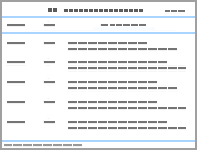
Table 1

BUA levels before and after treatment in three groups ($\bar{x}$±s, μmol/L)"

Group n BUA level
TCD-treated
Pre-treatment 58 513.60±92.65
2-week post-treatment 58 444.67±95.00**
12-week post-treatment 58 423.20±75.22
WM-treated
Pre-treatment 56 537.41±108.63
2-week post-treatment 56 461.07±89.00*
12-week post-treatment 56 379.44±79.16△△
TCD plus WM-treated
Pre-treatment 52 535.38±103.52
2-week post-treatment 52 476.08±85.57*
12-week post-treatment 52 422.76±93.84

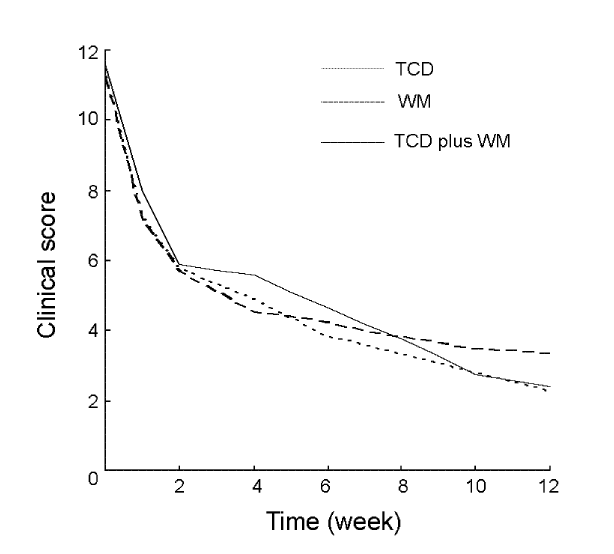
Figure 1

Tendency of changes in clinical score during the period of observation"

[1] Wallace SL, Robinson H, Masi AT , et al. Preliminary criteria for the classification of the acute arthritis of primary gout[J]. Arthritis Rheum, 1977,20(3):895-900
doi: 10.1002/art.1780200320 pmid: 856219
[2] Meng ZH. Gout[M]. Beijing: United Publishing House of Beijing Medical University and Chinese Union Medical University, 1997: 142
孟昭亨 . 痛风[M]. 北京: 北京医科大学中国协和医科大学联合出版社, 1997: 142
[3] Zheng XY. Clinical guideline for new drugs of traditional Chinese medicine(Part 2)[M]. Beijing: Chinese Medical Science and Technology Press, 2002,( Part 2):179-183
郑筱萸 . 中药新药临床研究指导原则(第2辑)[M]. 北京: 中国医药科技出版社, 2002,( 第2辑):179-183
[4] Morris I, Varughese G, Mattingly P . Colchicine in acute gout[J]. BMJ, 2003,327(7426):1275-1276
doi: 10.1136/bmj.327.7426.1275
[5] Zhang M, Jin RM, Wang HM , et al. Anti-inflammatory effect of gout infusion preparation(GIP) on acute gouty arthritis[J]. Tianjin Zhong Yi Yao, 2003,20(4):32-35
doi: 10.3969/j.issn.1672-1519.2003.04.011
张明, 金若敏, 王红梅 , 等. 痛风冲剂对急性痛风性关节炎抗炎作用的研究[J]. 天津中医药, 2003,20(4):32-35
doi: 10.3969/j.issn.1672-1519.2003.04.011
[1] Jing-lin Shi, Wan-hong Miao. Effects of acupuncture on lactoferrin content in tears and tear secretion in patients suffering from dry eyes: A randomized controlled trial. Journal of Chinese Integrative Medicine, 2012, 10(9): 1003-1008.
[2] Lu-ming Chen, Hui Yu, Da-rong Wu , Xun Hu , Lan Zheng. Investigation on response of the patient-reported outcome scale of the main-symptoms of chronic obstructive pulmonary disease complicated with pulmonary heart disease. Journal of Chinese Integrative Medicine, 2012, 10(9): 970-974.
[3] Ming T. Tan , Jian-ping Liu , Lixing Lao. Adequate application of quantitative and qualitative statistic analytic methods in acupuncture clinical trials. Journal of Chinese Integrative Medicine, 2012, 10(8): 847-852.
[4] Lu Yu, Shui-miao Lin, Ru-qian Zhou, Wei-jun Tang, Pin-xian Huang, Ying Dong, Jian Wang, Zhi-hua Yu, Jiu-lin Chen, Li Wei, San-li Xing, Hui-juan Cao, Hong-bin Zhao. Chinese herbal medicine for patients with mild to moderate Alzheimer disease based on syndrome differentiation: A randomized controlled trial. Journal of Chinese Integrative Medicine, 2012, 10(7): 766-776.
[5] Hui Luo, Jian-ping Liu, Qing Li. Methodological issues and suggestions for improvement in randomized controlled trials of Chinese herbal medicine for recurrent miscarriage. Journal of Chinese Integrative Medicine, 2012, 10(6): 604-614.
[6] Peng Fu , Xue-qiang Huang, Ai-hong Yuan, Guang Yu, Xiao-bin Mei, Ruo-lan Cu. Effects of salvianolate combined with alprostadil and reduced glutathione on progression of chronic renal failure in patients with chronic kidney diseases: a long-term randomized controlled trial. Journal of Chinese Integrative Medicine, 2012, 10(6): 641-646.
[7] Shui-qiu Deng, Xue-nong Ouyang, Zong-yang Yu, Xi-hu Dai, Xi Chen, Fang-zheng Fang, Wen-wu Wang, Zhi-zhen Liu. Influence of Chinese herbal medicine Feitai Capsule on completion or delay of chemotherapy in patients with stage ⅢB/Ⅳ non-small-cell lung cancer: a Randomized controlled trial. Journal of Chinese Integrative Medicine, 2012, 10(6): 635-640.
[8] Ming-xing Zhao, Zhen-hua Dong, Zhong-hai Yu, Shi-yuan Xiao, Ya-ming Li . Effects of Ginkgo biloba extract in improving episodic memory of patients with mild cognitive impairment: A randomized controlled trial. Journal of Chinese Integrative Medicine, 2012, 10(6): 628-634.
[9] Ying-chun Miao , Jin-zhou Tian , Jing Shi , Min Mao. Effects of Chinese medicine for tonifying the kidney and resolving phlegm and blood stasis in treating patients with amnestic mild cognitive impairment: A randomized, double-blind and parallel-controlled trial. Journal of Chinese Integrative Medicine, 2012, 10(4): 390-397.
[10] Xiao-hui Sun, Sheng Liu . External Chinese medical therapy for pain associated with hyperplastic disease of the breast: Study protocol of a randomized, double-blind, multicenter, controlled trial. Journal of Chinese Integrative Medicine, 2012, 10(4): 384-389.
[11] Zhu Yan-feng, Luo Hai-ming, Deng Zhong-long, Fu De-yu, Yao Wang, Dai Jian. Effects of the Chinese patent medicine, Honghua Injection, on platelet glycoprotein Ⅱb/Ⅲa receptors in patients with acute coronary syndrome: a randomized controlled trial. Journal of Chinese Integrative Medicine, 2012, 10(3): 318-323.
[12] Li Min, Yang Ming-hui, Liu Yi. Effects of Chinese herbal medicine Bushen Huoxue Granule on quality of life of patients with Parkinson disease: a randomized, double-blinded and placebo-controlled trial. Journal of Chinese Integrative Medicine, 2012, 10(3): 310-317.
[13] Paula de Sousa Fragoso Ana, de Sá Ferreira Arthur. Evaluation of the immediate effects of manual acupuncture on brachial bicep muscle function in healthy individuals and poststroke patients: a study protocol of a parallel-group randomized clinical trial. Journal of Chinese Integrative Medicine, 2012, 10(3): 303-309.
[14] Li-xin Ma, Yu-yi Wang, Xin-xue Li, Jian-ping Liu . Systematic review on methodology of randomized controlled trials of post-marketing Chinese patent drugs for treatment of type 2 diabetes. Journal of Chinese Integrative Medicine, 2012, 10(3): 279-292.
[15] Wang Yun-fei, Que Hua-fa, Xu Jie-nan, Tang Han-jun, Xiang Huan-yu, Liu Xiao-dong, Zhang Zhen, Xing Jie, Shen Liang, Shan Wei, Liu An-min, Qiu Lian-yin, Deng Da-yi, Gao Dan. Assessment of external methods of traditional Chinese medicine in patients with chronic ulcer of the lower extremities: study protocol of a multicenter, randomized, parallel-group, prospective trial. Journal of Chinese Integrative Medicine, 2012, 10(2): 166-175.
Viewed
Full text


Abstract

Cited

  Shared   
  Discussed   
[1] Jin-rong Fu. Establishment of multivariate diagnosis and treatment system of modern gynecology of traditional Chinese medicine. Journal of Chinese Integrative Medicine, 2008, 6(1): 22-24
[2] Hao Li, Ming-jiang Yao, Wen-ming Zhao, Jie Guan, Lin-lin Cai, Ling Cui. A randomized, controlled, double-blind trial of Huannao Yicong capsule in senile patients with mild cognitive impairment. Journal of Chinese Integrative Medicine, 2008, 6(1): 25-31
[3] Zhi-chun Jin. Problems in establishing clinical guideline for integrated traditional Chinese and Western medicine. Journal of Chinese Integrative Medicine, 2008, 6(1): 5-8
[4] SUN Ming-yu, ZUO Jian, DUAN Ji-feng, HAN Jun, FAN Shi-ming, ZHANG Wei, ZHU Li-fang, YAO Ming-hui. Antitumor activities of kushen flavonoids in vivo and in vitro. Journal of Chinese Integrative Medicine, 2008, 6(1): 51-59
[5] Min Cheng, Qiong Feng, Shu-wen Qian, Hui Gao, Cui-qing Zhu. Preliminary assay of p-amyloid binding elements in heart-beneficial recipe. Journal of Chinese Integrative Medicine, 2008, 6(1): 68-72
[6] Ning-qun Wang, Liang-duo Jiang, Zong-xing Li. Research progress in asthma-related quality of life. Journal of Chinese Integrative Medicine, 2008, 6(1): 93-97
[7] Jing-yuan Mao, Chang-xiao Liu, Heng-he Wang, Guang-li Wei , Zhen-peng Zhang, Jie Xing, Wang Xian liang , Ying-fei Bi . Effects of Shenmai Injection on serum concentration and pharmacokinetics of digoxin in dogs with heart failure. Journal of Chinese Integrative Medicine, 2010, 8(11): 1070-1074
[8] Zhi-mei Wang, Bin Zhang. A study on translation of ellipses in Huangdi Neijing from perspective of hermeneutic theory. Journal of Chinese Integrative Medicine, 2010, 8(11): 1097-1100
[9] Gui Yu, Jie Wang. Thinking on building the network cardiovasology of Chinese medicine. Journal of Chinese Integrative Medicine, 2012, 10(11): 1206-1210
[10] Pedro Saganha João, Doenitz Christoph, Greten Tobias, Efferth Thomas, J. Greten Henry. Qigong therapy for physiotherapists suffering from burnout: a preliminary study. Journal of Chinese Integrative Medicine, 2012, 10(11): 1233-1239
[an error occurred while processing this directive]