[an error occurred while processing this directive]

Journal of Chinese Integrative Medicine ›› 2012, Vol. 10 ›› Issue (10): 1135-1139.doi: 10.3736/jcim20121010

Previous Articles     Next Articles

Protective effects of Chinese herbal medicine Naoshuantong on neurovascular unit in rats with cerebral ischemia/reperfusion injury

Qi-hong Shi1,  Jun Xiang2, Xu-ying Zhu3, Ding-fang Cai2()   

  1. 1. Department of Pharmacy, Qidong People’s Hospital, Qidong 226200, Jiangsu Province, China;
    2. Department of Integrative Medicine, Zhongshan Hospital, Fudan University, Shanghai 200032, China
    3. Department of Neurology, Shuguang Hospital, Shanghai University of Traditional Chinese Medicine, Shanghai 200021, China
  • Received:2012-07-06 Accepted:2012-08-25 Online:2012-10-20 Published:2018-10-15
  • Contact: Ding-fang Cai E-mail:dingfangcai@163.com

Objective: To investigate the protective effects of Naoshuantong, a compound traditional Chinese herbal medicine, on the main components of neurovascular unit in rats with cerebral ischemia/reperfusion injury. .

Methods: A total of 30 male Sprague-Dawley rats were randomly divided into sham-operated, ischemia/reperfusion, and ischemia/reperfusion plus Naoshuantong groups. The cerebral ischemia was induced by 1.5 h of middle cerebral artery occlusion, followed by unlocking the thread to induce reperfusion injury. After 24 h of reperfusion, neurological functional deficits were assessed, apoptosis of main components of neurovascular unit was determined by terminal deoxynucleotidyl transferase-mediated deoxyuridine triphosphate-biotin nick end-labeling combined with neuronal nuclei antigen, glial fibrillary acidic protein or CD31 immunofluorescence double staining.

Results: Naoshuantong significantly reduced neurological functional deficits, and reduced neuron, astrocyte and vascular endothelium cell apoptosis induced by ischemia/reperfusion injury in the border zone of ischemic cortex.

Conclusion: Naoshuantong is effective in protecting the neurovascular unit including neurons, astrocytes and vascular endothelium cells against cerebral ischemia/reperfusion-induced apoptosis.

Key words: drugs, Chinese herbal, brain ischemia, reperfusion injury, neurovascular unit, apoptosis, rats

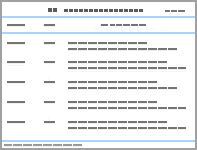
Table 1

Effects of NST on neurological score after 24 h of reperfusion (Mean±standard deviation)"

Group n Neurological score
Sham-operated 10 0.00±0.00
I/R 10 2.50±0.41
NST 10 1.69±0.60*

Figure 1

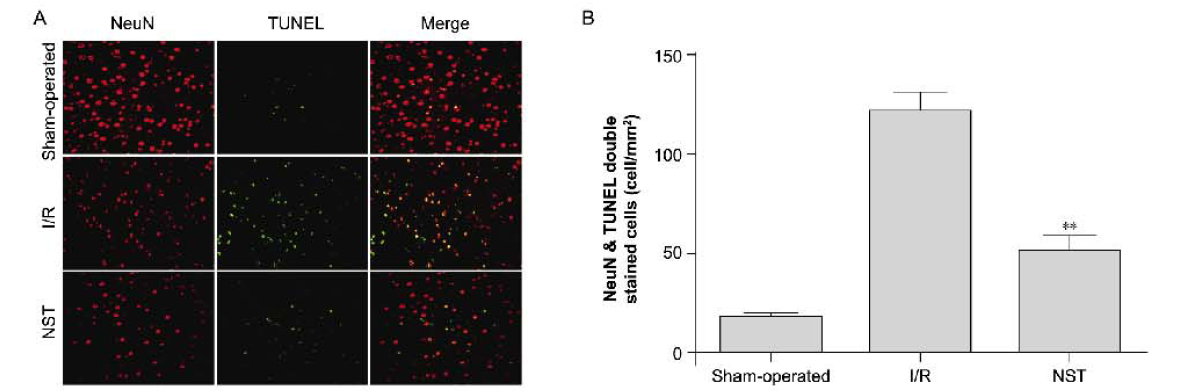
Effects of Naoshuantong on neuron apoptosis observed by TUNEL method (A) Effects of NST on neuron apoptosis after 24 h of reperfusion (fluorescence microscopy, ×400). The neurons appeared red following NeuN staining and apoptotic cells were stained green by TUNEL. Typical apoptosis of neurons were yellow. (B) Quantitative analysis of apoptotic neurons after 24 h of reperfusion (n=5 in each group). Data are represented as mean ± standard deviation; **P<0.01, vs I/R group. I/R: ischemia reperfusion injury; NST: Naoshuantong; NeuN: neuronal nuclei; TUNEL: terminal deoxynucleotidyl transferase-mediated deoxyuridine triphosphate-biotin nick end-labeling."

Figure 2

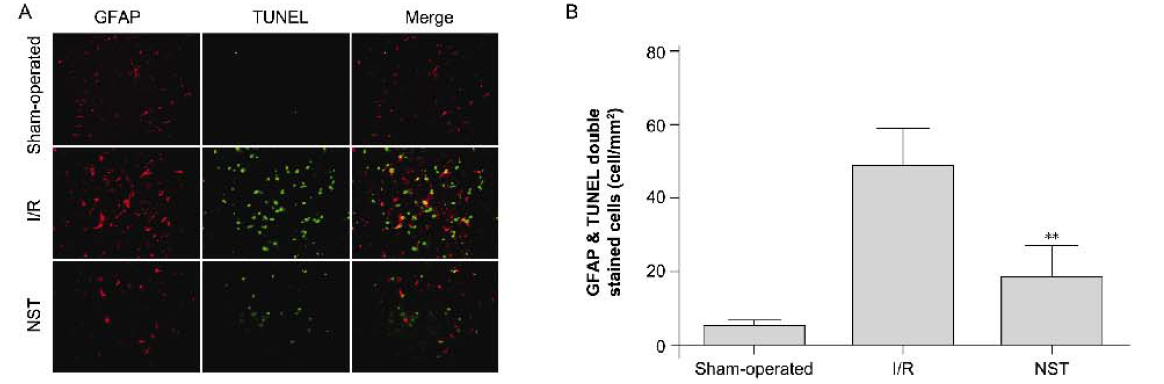
Effects of Naoshuantong on astrocyte apoptosis observed by TUNEL method(A) Effects of NST on astrocyte apoptosis after 24 h of reperfusion (fluorescence microscopy, ×400). The astrocytes appeared red following GFAP staining and apoptotic cells were stained green by TUNEL. Typical apoptotic astrocytes were yellow. (B) Quantitative analysis of apoptotic astrocytes after 24 h of reperfusion (n=5 in each group). Data are represented as mean ± standard deviation; **P<0.01, vs I/R group. I/R: ischemia reperfusion injury; NST: Naoshuantong; GFAP: glial fibrillary acidic protein; TUNEL: terminal deoxynucleotidyl transferase-mediated deoxyuridine triphosphate-biotin nick end-labeling."

Figure 3

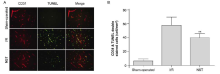
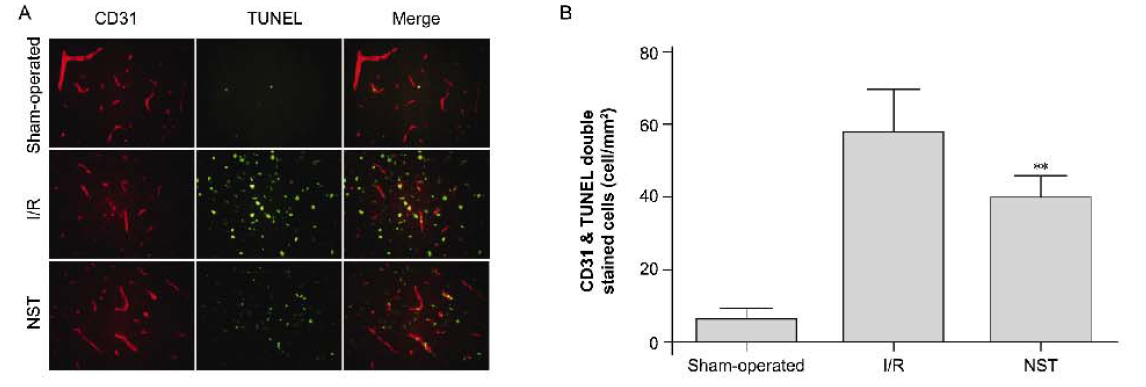
Effects of Naoshuantong on vascular endothelial cell apoptosis observed by TUNEL method (A) Effects of NST on vascular endothelial cell apoptosis after 24 h of reperfusion (fluorescence microscopy, ×400). The vascular endothelial cells appeared red following CD31 staining and apoptotic cells were stained green by TUNEL. Typical apoptotic vascular endothelial cells were yellow. (B) Quantitative analysis of apoptotic vascular endothelial cells after 24 h of reperfusion (n=5 in each group). Data are represented as mean ± standard deviation; **P<0.01, vs I/R group. I/R: ischemia reperfusion injury; NST: Naoshuantong; TUNEL: terminal deoxynucleotidyl transferase-mediated deoxyuridine triphosphate-biotin nick end-labeling."

[1] Xiang J, Tang YP, Wu P, Gao JP, Cai DF . Chinese medicine Nao-Shuan-Tong attenuates cerebral ischemic injury by inhibiting apoptosis in a rat model of stroke[J]. J Ethnopharmacol, 2010,131(1):174-81
doi: 10.1016/j.jep.2010.06.021
[2] Longa EZ, Weinstein PR, Carlson S, Cummins R . Reversible middle cerebral artery occlusion without craniectomy in rats[J]. Stroke, 1989,20(1):84-91
doi: 10.1161/01.STR.20.1.84
[3] del Zoppo GJ . The neurovascular unit in the setting of stroke[J]. J Intern Med, 2010,267(2):156-171
doi: 10.1111/jim.2010.267.issue-2
[4] del Zoppo GJ . Stroke and neurovascular protection[J]. N Engl J Med, 2006,354(6):553-555
doi: 10.1056/NEJMp058312
[5] Iadecola C, Anrather J . Stroke research at a crossroad: asking the brain for directions[J]. Nat Neurosci, 2011,14(11):1363-1368
doi: 10.1038/nn.2953 pmid: 3633153
[6] Lok J, Gupta P, Guo S, Kim WJ , Whalen MJ , van Leyen K ,Lo EH .Cell-cell signaling in the neurovascular unit[J]. Neurochem Res, 2007,32(12):2032-2045
doi: 10.1007/s11064-007-9342-9 pmid: 17457674
[7] Vangilder RL, Rosen CL, Barr TL, Huber JD . Targeting the neurovascular unit for treatment of neurological disorders[J]. Pharmacol Ther, 2011,130(3):239-247
doi: 10.1016/j.pharmthera.2010.12.004 pmid: 21172386
[8] Jung JE, Kim GS, Chen H, Maier CM, Narasimhan P, Song YS, Niizuma K, Katsu M, Okami N, Yoshioka H, Sakata H, Goeders CE, Chan PH . Reperfusion and neurovascular dysfunction in stroke: from basic mechanisms to potential strategies for neuroprotection[J]. Mol Neurobiol, 2010,41(2-3):172-179
doi: 10.1007/s12035-010-8102-z
[1] Na Wu , Lu Song , Xin-xin Yang, Jiang-lei Wei , Zhen-guo Liu. Effects of Chinese herbal medicine Tianqi Pingchan Granule on G protein-coupled receptor kinase 6 involved in the prevention of levodopa-induced dyskinesia in rats with Parkinson disease. Journal of Chinese Integrative Medicine, 2012, 10(9): 1018-1024.
[2] Avijit Paul, Kausik Bishayee, Samrat Ghosh, Avinaba Mukherjee, Sourav Sikdar, Debrup Chakraborty, Naoual Boujedaini, Anisur Rahman Khuda-Bukhsh. Chelidonine isolated from ethanolic extract of Chelidonium majus promotes apoptosis in HeLa cells through p38-p53 and PI3K/AKT signalling pathways. Journal of Chinese Integrative Medicine, 2012, 10(9): 1025-1038.
[3] Lawrence A. Olatunji, Taofeek O. Usman, Joseph O. Adebayo, Victoria A. Olatunji . Effects of aqueous extract of Hibiscus sabdariffa on renal Na+-K+-ATPase and Ca2+-Mg2+-ATPase activities in Wistar rats. Journal of Chinese Integrative Medicine, 2012, 10(9): 1049-1055.
[4] Chan Chen, Chang-xun Chen, Xi-min Wu, Rui Wang, Yi-ming Li. Effects of extracts of Radix Scrophulariae on blood pressure in spontaneously hypertensive rats and the underlying mechanisms. Journal of Chinese Integrative Medicine, 2012, 10(9): 1009-1017.
[5] Dhirender Kaushik, Ajay Kumar, Pawan Kaushik, Avatar C. Rana. Anticonvulsant activity of alcoholic extract of bark of Pinus roxburghii Sarg. Journal of Chinese Integrative Medicine, 2012, 10(9): 1056-1060.
[6] Jian-sheng Li, Ya Li, Su-yun Li, Yuan-yuan Wang, Li Deng, Yan-ge Tian, Su-li Jiang , Ying Wang. Long-term effects of Tiaobu Feishen therapies on systemic and local inflammation responses in rats with stable chronic obstructive pulmonary disease. Journal of Chinese Integrative Medicine, 2012, 10(9): 1039-1048.
[7] Lu Liu, Ying Gao. Study on the correlation between traditional Chinese medicine syndrome and short-term prognosis of ischemic stroke using logistic regression model and repeated-measures analysis of variance. Journal of Chinese Integrative Medicine, 2012, 10(9): 983-990.
[8] Karuna A. Talpate, Uma A. Bhosale, Mandar R. Zambare. Clitorea ternatea, a herb from Indian folklore, improves streptozotocin-induced diabetes and diabetes-induced cognitive decline in rats. Journal of Chinese Integrative Medicine, 2012, 10(8): 939-947.
[9] Samuel Joshua Pragasam, Vachana Murunikara, Evan Prince Sabina, Mahaboobkhan Rasool. Antiperoxidative potential of p-coumaric acid, a common dietary phenol, in adjuvant-induced arthritis in rats. Journal of Chinese Integrative Medicine, 2012, 10(8): 932-938.
[10] Zi-hui Li, Jian Wang, Rong-lin Cai, You-wen Wang, Jian-peng Hu. Establishment and evaluation of a rat model of ulcerative colitis with syndrome of dampness stagnancy due to spleen deficiency. Journal of Chinese Integrative Medicine, 2012, 10(8): 918-924.
[11] Meng Li, Ling Hu, Rong-lin Cai, Zi-jian Wu, Ke-ming Wang. Effects of electro-acupuncture at PC6 and BL15 on nerve electrical activity in spinal dorsal root and norepinephrine and dopamine contents in paraventricular nucleus of hypothalamus in rats with acute myocardial ischemia. Journal of Chinese Integrative Medicine, 2012, 10(8): 874-879.
[12] Hong Wang , Jing-tian Ou , Xin Zhao , Ying Guoz , Hao-ping Mao. Vasodilator effect of oroxylin A on thoracic aorta isolated from rats. Journal of Chinese Integrative Medicine, 2012, 10(8): 880-885.
[13] Xin-min Li, Hui Chen, Yan-yan Ren, Yan-li Lu. Effects of Chinese herbal medicine Xifeng Capsule on multidrug resistance-associated protein 1 expression in hippocampus and cortex of rats with lithium-pilocarpine-induced epilepsy. Journal of Chinese Integrative Medicine, 2012, 10(8): 911-917.
[14] C. Mouli Kalla, Vijaya Tartte, Dattatreya Rao Sirpurkar. Effectiveness of flavonoid-rich leaf extract of Acalypha indica in reversing experimental myocardial ischemia: biochemical and histopathological evidence. Journal of Chinese Integrative Medicine, 2012, 10(7): 784-792.
[15] Mei-jiao Mao, Jun-ping Hu, Cong Wang, Yi-yi Zhang, Ping Liu. Effects of Chinese herbal medicine Guanxinkang on expression of PPARγ-LXRα-ABCA1 pathway in ApoE-knockout mice with atherosclerosis. Journal of Chinese Integrative Medicine, 2012, 10(7): 814-820.
Viewed
Full text


Abstract

Cited

  Shared   
  Discussed   
[1] Wei-xiong Liang. Problems-solving strategies in clinical treatment guideline for traditional Chinese medicine and integrative medicine. Journal of Chinese Integrative Medicine, 2008, 6(1): 1-4
[2] Zhao-guo Li. Discussion on English translation of commonly used sentences in traditional Chinese medicine: part one. Journal of Chinese Integrative Medicine, 2008, 6(1): 107-110
[3] Jun Hu, Jian-ping Liu. Non-invasive physical treatments for chronic/recurrent headache. Journal of Chinese Integrative Medicine, 2008, 6(1): 31
[4] Xue-mei Liu, Qi-fu Huang, Yun-ling Zhang, Jin-li Lou, Hong-sheng Liu, Hong Zheng. Effects of Tribulus terrestris L. saponion on apoptosis of cortical neurons induced by hypoxia-reoxygenation in rats. Journal of Chinese Integrative Medicine, 2008, 6(1): 45-50
[5] . Uniform requirements for manuscripts submitted to biomedical journals: Writing and editing for biomedical publication (Chinese version, part two). Journal of Chinese Integrative Medicine, 2010, 8(11): 1001-1005
[6] Daniel Weber, Janelle M Wheat, Geoffrey M Currie. Inflammation and cancer: Tumor initiation, progression and metastasis,and Chinese botanical medicines. Journal of Chinese Integrative Medicine, 2010, 8(11): 1006-1013
[7] Hong Liu , Guo-liang Zhang, Li Shen , Zhen Zeng, Bao-luo Zhou, Cheng-hai Liu, Guang Nie . Application and evaluation of a pseudotyped virus assay for screening herbs for anti-H5Nl avian influenza virus. Journal of Chinese Integrative Medicine, 2010, 8(11): 1036-1040
[8] Zhao-guo Li . A discussion of English translation of 1995 and 1997 Chinese National Standards of Traditional Chinese Medical Terminologies for Clinical Diagnosis and Treatment. Journal of Chinese Integrative Medicine, 2010, 8(11): 1090-1096
[9] Rui Jin, Bing Zhang. A complexity analysis of Chinese herbal property theory: the multiple formations of herbal property (Part 1). Journal of Chinese Integrative Medicine, 2012, 10(11): 1198-1205
[10] Hui-min Liu, Xian-bo Wang, Yu-juan Chang, Li-li Gu. Systematic review and meta-analysis of randomized controlled trials of integrative medicine therapy for treatment of chronic severe hepatitis. Journal of Chinese Integrative Medicine, 2012, 10(11): 1211-1228
[an error occurred while processing this directive]