[an error occurred while processing this directive]

Journal of Chinese Integrative Medicine ›› 2003, Vol. 1 ›› Issue (4): 262-264.doi: 10.3736/jcim20030409

Previous Articles     Next Articles

An transcranial Doppler ultrasonography and X-ray study of cervical vertigo patients treated by manipulation in supine position

Li Chen1, Hong-sheng Zhan2   

  1. 1. Centre of Rehabilitation, Naval Convalescent Hospital of People’s Liberation Army,Hangzhou,Zhejiang Province 310000,China
    2. Department of Traumatology and Orthopaedics, Shuguang Hospital, Shanghai University of Traditional Chinese Medicine, Shanghai 200021,China
  • Received:2003-08-29 Online:2003-12-20 Published:2003-12-20

Objective

To observe the transcranial Doppler ultrasonography and X-ray changes of cervical vertigo patients caused by cervical instability before and after the manipulation treatment in supine position.


Methods

Sixteen cervical vertigo patients who underwent supine manipulation treament were reviewed retrospectively. After the treatment, the changes of transcranial Doppler ultrasonography of cervical vertebral artery and X-ray of cervical spine were observed.


Results

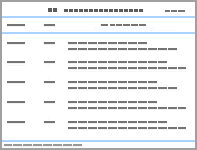
Before the treatment, the mean blood flow velocity of vertebral artery was (48.6±3.1) cm/s, much higher than that of the normal group (P<0.05), the means of the horizontal displacement of C3,4 and C4,5 were (3.18±0.42) mm and 93.46±0.26) mm respectively. After the treatment, the blood flow velocity and the C3,4 horizontal displacement decreased significantly (P<0.05). The effective rate of the manipulation treatment was 100%.


Conclusion

The manipulation treatment is an effective method for cervical vertigo patients caused by cervical instability, and the effect is correlated with the improvement of the blood flow of cervical artery and the restoration of cervical stability.

Key words: manipulation therapy, cervical vertebrae, vertibral artery, ultrasonography, Doppler, transcranial, X-ray diagnostic

CLC Number: 

  • R244.1

"

组 别 n 左侧椎动脉 右侧椎动脉 基底动脉
Vp Vm Vp Vm Vp Vm
正常对照组 16 48.6±5.6 42.3 ±3.4 50.7±4.6 43.4±5.3 52.6±9.4 46.9±8.7
治疗组 16 治疗前 52.3±4.5 48.6±3.1* 54.8±6.2 49.7±4.9* 55±6.7 48.3±7.8
治疗后 44.5±4.3 39.2±3.5 52.9±5.5 41.2±3.6 56.8±7.5 44.5±6.6

"

组 别 n C2,3 C3,4 C4,5 C5,6 C6,7
正常对照组 16 1.06±0.21 1.25±0.33 1.42±0.34 1.64±0.42 1.92±0.36
治疗组 16 治疗前 2.26±0.41 3.18±0.42* 3.46±0.26* 2.03±0.46 1.58±0.47
治疗后 2.01±0.36 2.25±0.35 3.28±0.35 2.15±0.17 1.86±0.42
[1] 于泽生, 刘忠军, 党耕町 . 颈椎不稳致交感型颈椎病的诊断和治疗[J]. 中华外科杂志, 2001,39(4):281-284
[2] 詹红生, 应航, 詹强 , 等. 仰卧整复手法治疗颈椎病的临床观察[J]. 中国中医骨伤科杂志, 2000,8(3):16-18
doi: 10.3969/j.issn.1003-0719.1999.z1.002
[3] 国家中医药管理局. 中医病证诊断疗效标准(第1版)[M]. 南京: 南京大学出版社, 1994,( 第1版):186
[4] 郭品正 . 椎动脉型颈椎病的血液动力学研究[J]. 上海医学, 1993,6(2):93-94
[5] 李淳德, 刘宪义, 马忠泰 , 等. 颈椎节段不稳在交感型颈椎病中的作用[J]. 中华外科杂志, 2002,40(10):730-732
[6] 郑丕舜 . 脊椎脊髓关连病与脊髓病诊断与治疗学(第1版)[M]. 北京: 北京科学技术出版社, 2002,( 第1版):78
[7] 闵合明, 王绍祥, 张谭澄 . 头痛头晕的颈源性病因[J]. 中国脊柱脊髓杂志, 1994,4(2):91-93
[1] Gerhard Litscher. High-tech acupuncture made in Austria — cerebral circulation. Journal of Chinese Integrative Medicine, 2012, 10(4): 362-368.
[2] Jiang Chong-bo, Wang Jun, Zheng Zhi-xin, Hou Jing-shan, Ma Ling, Sun Tong. Efficacy of cervical fixed-point traction manipulation for cervical spondylotic radiculopathy: a randomizedcontrolled trial. Journal of Chinese Integrative Medicine, 2012, 10(1): 54-58.
[3] Li Dong-tao, Li Fu-yu, Wang Jian, Liu Ji-hong, Yan Nan, Cheng Yong-mei, Hu Ai-hua, Jiang Hong-yang, Shi Feng-lei, Zhang Mei-zeng, Li Jie, Wei Ling-bo, Jiang Rong-qin. A study of diagnostic criteria for traditional Chinese medicine syndromes in osteoporosis. Journal of Chinese Integrative Medicine, 2011, 9(12): 1326-1332.
[4] Zhi-rong Zhu, Chang-chun Zeng, Li Yang, Han-ping Liu, Song-hao Liu. Influence of brightness value of supranasal point and apex nasi on dominant wavelength and excitation purity in complexion inspection of healthy adults. Journal of Chinese Integrative Medicine, 2011, 9(12): 1333-1338.
[5] Ju-bao Li, Hong-yun Zhao, Yong-jian Zhao, Quan Zhou, Ning Li, Peng Xu, Qi Shi, Yong-jun Wang. Effects of Chinese herbal medicine Yiqi Huayu Bushen Recipe on expressions of aggrecan and type Ⅹ collagen mRNAs in cells from degenerated human intervertebral discs. Journal of Chinese Integrative Medicine, 2011, 9(10): 1138-1144.
[6] Hsin Hsiu, Wei-Chen Hsu, Shih-Ming Huang, Chia-Ching Lin, Hung-Wen Lin. Assessing the microcirculatory response following oral administration of Liuwei Dihuang formula by spectral analysis of skin-surface laser Doppler signals. Journal of Chinese Integrative Medicine, 2011, 9(10): 1101-1109.
[7] Feng Sheng, Guo-quan Shen, Wu-quan Sun. A review of evaluation scales for therapeutic effect of cervical spondylotic radiculopathy. Journal of Chinese Integrative Medicine, 2010, 8(9): 824-828.
[8] Cai-feng Du , Tian-fang Wang, Xiu-yan Wu, Yan Zhao, Qing-guo Wang. Common syndrome factors of menopausal syndrome based on questionnaire investigation among experts. Journal of Chinese Integrative Medicine, 2010, 8(8): 757-761.
[9] Zhao-guo Li. Comparative study on WHO Western Pacific Region and World Federation of Chinese Medicine Societies international standard terminologies on traditional medicine: Syndrome Differentiation According to Eight Principles (Part three). Journal of Chinese Integrative Medicine, 2010, 8(6): 594-597.
[10] Pin Wang, Hua-yuan Yang, Yi-qin Wang. Impedance characteristics of ear acupoints in identifying excess or deficiency syndrome of stroke. Journal of Chinese Integrative Medicine, 2010, 8(6): 525-529.
[11] Zhao-guo Li. Comparative study on WHO Western Pacific Region and World Federation of Chinese Medicine Societies international standard terminologies on traditional medicine: Syndrome Differentiation According to Eight Principles (Part two). Journal of Chinese Integrative Medicine, 2010, 8(5): 494-499.
[12] Zhao-guo Li. Comparative study on WHO Western Pacific Region and World Federation of Chinese Medicine Societies international standard terminologies on traditional medicine: Syndrome Differentiation According to Eight Principles (Part one). Journal of Chinese Integrative Medicine, 2010, 8(4): 392-398.
[13] Zhao-guo Li. Comparative study on WHO Western Pacific Region and World Federation of Chinese Medicine Societies international standard terminologies on traditional medicine: an analysis of the Diagnostics (Part 7). Journal of Chinese Integrative Medicine, 2010, 8(3): 292-297.
[14] Zhao-guo Li . Comparative study on WHO Western Pacific Region and World Federation of Chinese Medicine Societies international standard terminologies on traditional medicine: An analysis of the Diagnostics (Part 6). Journal of Chinese Integrative Medicine, 2010, 8(2): 190-194.
[15] Kai Qu, Tian-fang Wang, Yan Zhao, Xiao-lin Xue, Xiu-yan Wu, Hua-liang Deng, Lu Yang, Li-liYu , Hong Yue, Qing-guo Wang. Common syndrome factors of traditional Chinese medicine in chronic renal failure based on the questionnaire investigation among experts. Journal of Chinese Integrative Medicine, 2010, 8(12): 1147-1152.
Viewed
Full text


Abstract

Cited

  Shared   
  Discussed   
[1] Yi-ting He, Qing-lin Zha, Jian-ping Yu, Yong Tan, Cheng Lu, Ai-ping Lv. Principal factor analysis of symptoms of rheumatoid arthritis and their correlations with efficacy of traditional Chinese medicine and Western medicine. Journal of Chinese Integrative Medicine, 2008, 6(1): 32-36
[2] Jun Cai, Hua Wang, Sheng Zhou, Bin Wu, Hua-rong Song, Zheng-rong Xuan. Effect of Sijunzi Decoction and enteral nutrition on T-cell subsets and nutritional status in patients with gastric cancer after operation: A randomized controlled trial. Journal of Chinese Integrative Medicine, 2008, 6(1): 37-40
[3] Wei Zhang, Xiang-feng Lu, Xiao-mei Zhang, Jian-jun Wu, Liang-duo Jiang. A rat model of pulmonary fibrosis induced by infusing bleomycin quickly through tracheal intubation. Journal of Chinese Integrative Medicine, 2008, 6(1): 60-67
[4] A-gao Zhou, Yong Zhang, Gang Kui, De-Yun Kong, Hai-liang Ge, Qiu-hua Ren, Jia-rong Dong, Sheng Hong, Xu-ming Mao, Yin Wang, Hui-zheng Zhang, Shu-jun Wang. Influence of traditional Chinese compound recipes with different efficacy on body weight, tumor weight and immune function in H22 cancer-bearing mice. Journal of Chinese Integrative Medicine, 2008, 6(1): 77-82
[5] Guo-hong Yuan, Xiao-jing Pang, He-chao Ma. Synergic effects of Danggui Buxue Decoction in reducing toxicity of cytoxan in tumor-bearing mice. Journal of Chinese Integrative Medicine, 2008, 6(1): 83-88
[6] Li Zhou, Hong-xing Zhang, Ling-guang Liu, Wen-jun Wan. Effect of electro-acupuncture at Fenglong (GV 16) on nitric oxide and endothelin in rats with hyperlipidemia. Journal of Chinese Integrative Medicine, 2008, 6(1): 89-92
[7] Jin-zhou Tian, Jing Shi, Xin-qing Zhang, Qi Bi, Xin Ma, Zhi-liang Wang, Xiao-bin Li, Shu-li Shen, Lin Li, Zhen-yun Wu, Li-yan Fang, Xiao-dong Zhao, Ying-chun Miao, Peng-wen Wang, Ying Ren, Jun-xiang Yin, Yong-yan Wang, Beijing United Study Group on MCI of the Capital Foundation of Medical Developments. Guiding principles of clinical research on mild cognitive impairment (protocol). Journal of Chinese Integrative Medicine, 2008, 6(1): 9-14
[8] Xin-jun Wang, Ling-ling Wang . A mechanism of endogenous opioid peptides for rapid onset of acupuncture effect in treatment of depression. Journal of Chinese Integrative Medicine, 2010, 8(11): 1014-1017
[9] Bo Wang , Wei Yan , Li-hui Hou, Xiao-ke Wu. Disorder of Tiangui (kidney essence) and reproductive dysfunction in patients with polycystic ovary syndrome. Journal of Chinese Integrative Medicine, 2010, 8(11): 1018-1022
[10] Bing Hu , Hong-mei An , Ke-ping Shen , Qin Du. Senescence-inducing effects of Chinese herbal medicine Tenglong Buzhong Decoction on human colon carcinoma LS-174-T cells and the mechanism. Journal of Chinese Integrative Medicine, 2010, 8(11): 1048-1052
[an error occurred while processing this directive]