[an error occurred while processing this directive]

Journal of Chinese Integrative Medicine ›› 2005, Vol. 3 ›› Issue (3): 216-219.doi: 10.3736/jcim20050314

• Original Experimental Research • Previous Articles     Next Articles

Effects of Shengji Huayu Recipe and its decomposed formulas on synthesis of collagen types Ⅰ and Ⅲ in granulation tissue of rats in early wound healing

Bin Li,Zhen-yi Wang,Xiu-li Xiao,Fu-lun Li,Bin Fan   

  1. Department of Chinese Traditional Surgery, Yueyang Hospital of Integrated Traditional Chinese and Western Medicine, Shanghai University of Traditional Chinese Medicine, Shanghai 200437, China
  • Received:2005-03-23 Online:2005-05-20 Published:2005-05-20
  • Contact: Bin Li E-mail:drlibin@hotmail.com

Objective

To study the effects of Shengji Huayu Recipe (a traditional Chinese medicine compound recipe for resolving stagnation and promoting granulation) and its decomposed formulas (Huayu Recipe for resolving stagnation and Shengji Recipe for promoting granulation) on the synthesis of collagen types Ⅰ and Ⅲ in granulation tissue of rats in early wound healing.

Methods

Twenty-four male Sprague-Dawley (SD) rats with full-thickness skin lesion were randomized into 4 groups: Shengji Huayu Recipe-treated group, Shengji Recipe-treated group, Huayu Recipe-treated group and untreated group. Collagen types Ⅰ and Ⅲ in granulation tissue of the rats were tested with immunohistochemical methods and image analysis.

Results

On the third day of wound healing, collagen Ⅰ of the rats in both Shengji Huayu Recipe-treated group and Shengji Recipe-treated group was higher than that in the untreated group, and collagen Ⅰ of the rats in Huayu Recipe-treated group was lower than that in the untreated group (P<0.05). Collagen Ⅲ of the rats in the three treated groups were lower than that in the untreated group (P<0.05). On the seventh day of wound healing, Collagen Ⅰ of the rats in both Shengji Huayu Recipe-treated group and Shengji Recipe-treated group was higher than that in the untreated group (P<0.05), and collagen Ⅲ of the rats in both Shengji Recipe-treated group and Huayu Recipe-treated group was higher than that in the untreated group (P<0.05).

Conclusion

Resolving stagnation and promoting granulation therapy can promote the wound healing in rats.

Key words: Shengji Huayu Recipe, Wound healing, Granulation tissue, Collagen type Ⅰ, Collagen type Ⅲ

CLC Number: 

  • R283.61

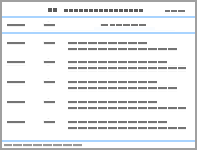
Tab 1

Collagen types Ⅰ and Ⅲ in granulation tissue of the rats in 4 groups 3 days after skin lesion ($\bar{x}$±s, %)"

Group n Collagen Ⅰ Collagen Ⅲ
Untreated group 6 39.0±4.7 54.1±7.8
Shengji Recipe-treated group 6 63.3±3.8* 34.0±5.5*
Huayu Recipe-treated group 6 25.9±4.2* 16.8±3.5*
Shengji Huayu Recipe-treated group 6 69.0±1.9* 41.8±6.4*

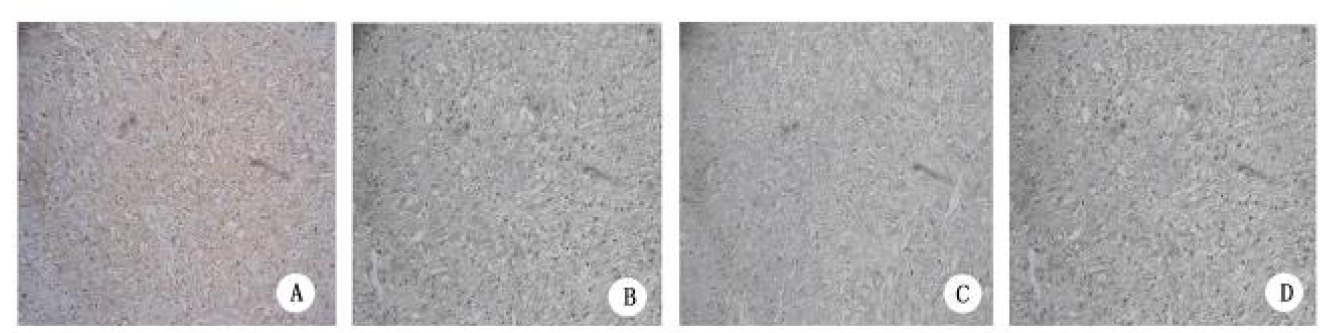
Fig 1

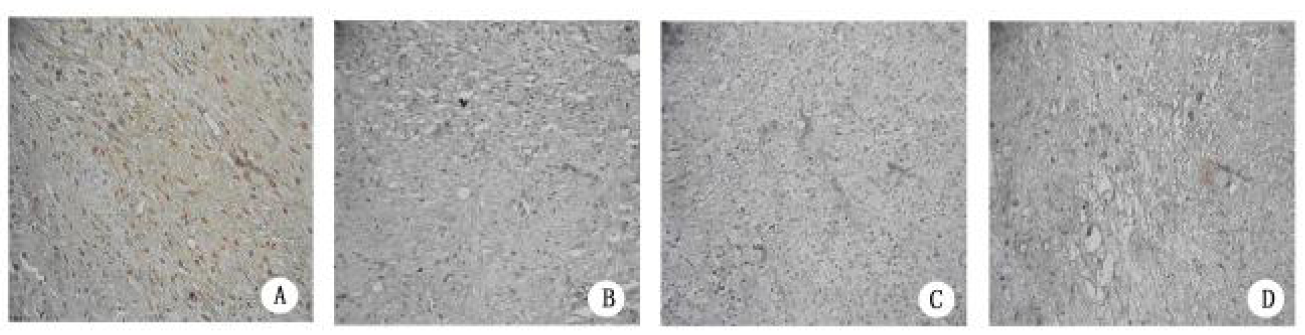
Collagen Ⅰ in granulation tissue of the rats in 4 groups 3 days after skin lesion (SP×40) A: Untreated group; B: Shengji Recipe-treated group; C: Huayu Recipe-treated group; D: Shengji Huayu Recipe-treated group"

Fig 2

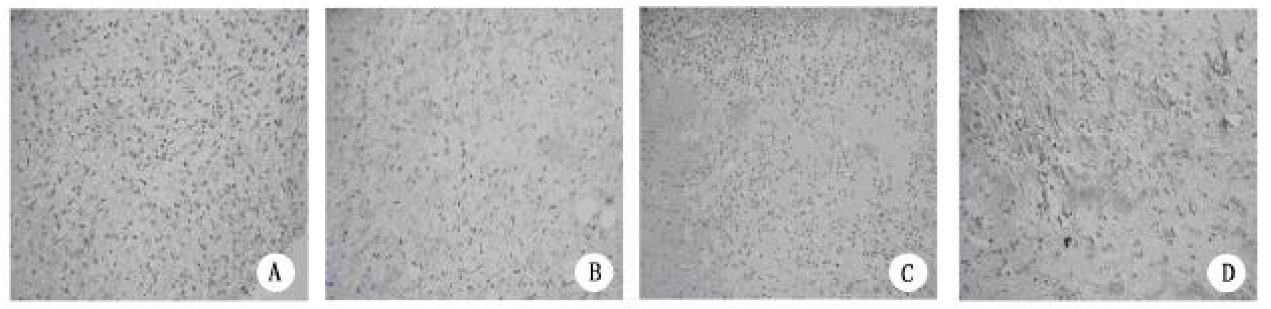
Collagen Ⅲ in granulation tissue of the rats in 4 groups 3 days after skin lesion (SP×40) A: Untreated group; B: Shengji Recipe-treated group; C: Huayu Recipe-treated group; D: Shengji Huayu Recipe-treated group"

Tab 2

Collagen types Ⅰ and Ⅲ in granulation tissue of the rats in 4 groups 7 days after skin lesion ($\bar{x}$±s, %)"

Group n Collagen Ⅰ Collagen Ⅲ
Untreated group 6 14.8±2.5 39.3±9.8
Shengji Recipe-treated group 6 6.0±1.4* 61.4±4.0*
Huayu Recipe-treated group 6 13.2±5.0 56.9±4.1*
Shengji Huayu Recipe-treated group 6 11.0±2.7* 37.9±5.1

Fig 3

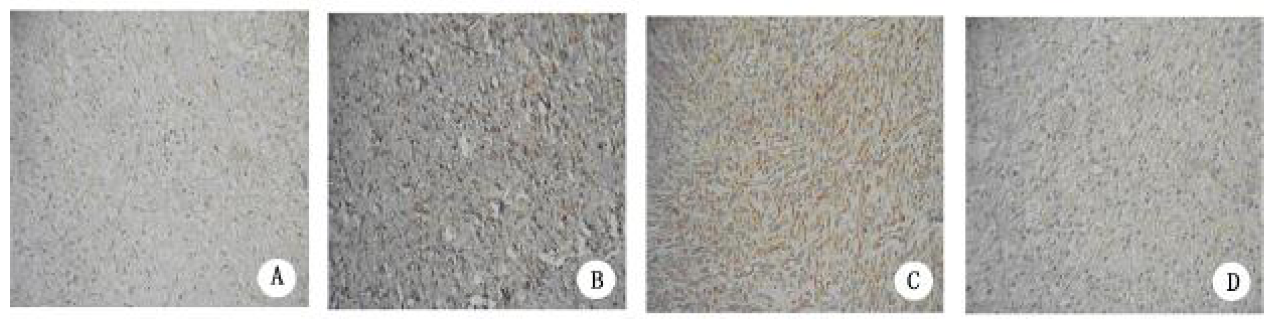
Collagen Ⅰ in granulation tissue of the rats in 4 groups 7 days after skin lesion (SP×40) A: Untreated group; B: Shengji Recipe-treated group; C: Huayu Recipe-treated group; D: Shengji Huayu Recipe-treated group"

Fig 4

Collagen Ⅲ in granulation tissue of the rats in 4 groups 7 days after skin lesion (SP×40) A: Untreated group; B: Shengji Recipe-treated group; C: Huayu Recipe-treated group; D: Shengji Huayu Recipe-treated group"

[1] 傅小兵, 王德文 . 创伤修复基础(第1版)[M]. 北京: 人民军医出版社, 1997,( 第1版):117-119
[2] 蔡景龙, 张宗学 . 现代瘢痕治疗学(第1版)[M]. 北京: 人民卫生出版社, 1998,( 第1版):26
[3] 张剑, 向军, 王志勇 , 等. 真皮“生物模板”对创面愈合中胶原影响的研究[J]. 上海第二医科大学学报, 2003,23(5):393-395
[4] Gallant CL, Olson ME, Hart DA . Molecular, histologic, and gross phenotype of skin wound healing in red Duroc pigs reveals an abnormal healing phenotype of hypercontracted, hyperpigmented scarring[J]. Wound Repair Regen, 2004,12(3):305-319
doi: 10.1111/wrr.2004.12.issue-3
[5] 董莉, 李斌, 章云 , 等. 生肌化瘀方及其拆方对大鼠创面成纤维细胞Ⅰ、Ⅲ型胶原合成的影响[J]. 中国中西医结合杂志, 2002,22(3):200-201
doi: 10.7661/CJIM.2002.3.200
[1] Hua-fa Que, Jie Xing. Effects of reinforcing qi and nourishing blood recipes on vascular endothelial growth factor and microvessel count in granulation tissue in rats with chronic skin ulcers. Journal of Chinese Integrative Medicine, 2008, 6(10): 1049-1053.
[2] Jie Xing, Hua-fa Que, Han-jun Tang. Growth of granulation tissue in wound promoted by Chinese medicinal herbs: a review of recent experimental study. Journal of Chinese Integrative Medicine, 2008, 6(10): 1080-1085.
[3] Xiang Li​, Yuan-fen Liu​, Xiao-ren Xiang​, Yi-biao Zhou​, Zhi-lei Zhang​. Comparative study of the effects of Gypsum Fibrosum and Gypsum Fibrosum Preparatum in promoting granulation. Journal of Chinese Integrative Medicine, 2006, 4(6): 624-627.
[4] Yong-qing Cao, Chun-mei He, Jin-gen Lu. Effects of Wenshen Jianpi Recipe on chronic wound healing in rats. Journal of Chinese Integrative Medicine, 2005, 3(3): 220-223.
Viewed
Full text


Abstract

Cited

  Shared   
  Discussed   
[1] Jin-zhou Tian, Jing Shi, Xin-qing Zhang, Qi Bi, Xin Ma, Zhi-liang Wang, Xiao-bin Li, Shu-li Shen, Lin Li, Zhen-yun Wu, Li-yan Fang, Xiao-dong Zhao, Ying-chun Miao, Peng-wen Wang, Ying Ren, Jun-xiang Yin, Yong-yan Wang, Beijing United Study Group on MCI of the Capital Foundation of Medical Developments. An explanation on "guiding principles of clinical research on mild cognitive impairment (protocol)". Journal of Chinese Integrative Medicine, 2008, 6(1): 15-21
[2] Yi-ting He, Qing-lin Zha, Jian-ping Yu, Yong Tan, Cheng Lu, Ai-ping Lv. Principal factor analysis of symptoms of rheumatoid arthritis and their correlations with efficacy of traditional Chinese medicine and Western medicine. Journal of Chinese Integrative Medicine, 2008, 6(1): 32-36
[3] Jun Cai, Hua Wang, Sheng Zhou, Bin Wu, Hua-rong Song, Zheng-rong Xuan. Effect of Sijunzi Decoction and enteral nutrition on T-cell subsets and nutritional status in patients with gastric cancer after operation: A randomized controlled trial. Journal of Chinese Integrative Medicine, 2008, 6(1): 37-40
[4] Wei Zhang, Xiang-feng Lu, Xiao-mei Zhang, Jian-jun Wu, Liang-duo Jiang. A rat model of pulmonary fibrosis induced by infusing bleomycin quickly through tracheal intubation. Journal of Chinese Integrative Medicine, 2008, 6(1): 60-67
[5] A-gao Zhou, Yong Zhang, Gang Kui, De-Yun Kong, Hai-liang Ge, Qiu-hua Ren, Jia-rong Dong, Sheng Hong, Xu-ming Mao, Yin Wang, Hui-zheng Zhang, Shu-jun Wang. Influence of traditional Chinese compound recipes with different efficacy on body weight, tumor weight and immune function in H22 cancer-bearing mice. Journal of Chinese Integrative Medicine, 2008, 6(1): 77-82
[6] Guo-hong Yuan, Xiao-jing Pang, He-chao Ma. Synergic effects of Danggui Buxue Decoction in reducing toxicity of cytoxan in tumor-bearing mice. Journal of Chinese Integrative Medicine, 2008, 6(1): 83-88
[7] Li Zhou, Hong-xing Zhang, Ling-guang Liu, Wen-jun Wan. Effect of electro-acupuncture at Fenglong (GV 16) on nitric oxide and endothelin in rats with hyperlipidemia. Journal of Chinese Integrative Medicine, 2008, 6(1): 89-92
[8] Jin-zhou Tian, Jing Shi, Xin-qing Zhang, Qi Bi, Xin Ma, Zhi-liang Wang, Xiao-bin Li, Shu-li Shen, Lin Li, Zhen-yun Wu, Li-yan Fang, Xiao-dong Zhao, Ying-chun Miao, Peng-wen Wang, Ying Ren, Jun-xiang Yin, Yong-yan Wang, Beijing United Study Group on MCI of the Capital Foundation of Medical Developments. Guiding principles of clinical research on mild cognitive impairment (protocol). Journal of Chinese Integrative Medicine, 2008, 6(1): 9-14
[9] Xin-jun Wang, Ling-ling Wang . A mechanism of endogenous opioid peptides for rapid onset of acupuncture effect in treatment of depression. Journal of Chinese Integrative Medicine, 2010, 8(11): 1014-1017
[10] Bo Wang , Wei Yan , Li-hui Hou, Xiao-ke Wu. Disorder of Tiangui (kidney essence) and reproductive dysfunction in patients with polycystic ovary syndrome. Journal of Chinese Integrative Medicine, 2010, 8(11): 1018-1022
[an error occurred while processing this directive]