[an error occurred while processing this directive]

Journal of Chinese Integrative Medicine ›› 2006, Vol. 4 ›› Issue (4): 358-362.doi: 10.3736/jcim20060408

• Original Experimental Research • Previous Articles     Next Articles

Effects of Chinese herbal medicines on spontaneous chronic pancreatitis in rats and the pathological relationships between formulas and syndromes

Shi-bing Su1, Yi-qun Li2, Hong-yi Shen1, Yoshiharu Motoo3   

  1. 1. Research Center for Complex System of Traditional Chinese Medicine, Shanghai University of Traditional Chinese Medicine, Shanghai 201203, China
    2. Biochemical Laboratory, CTK Biotechnology Corporation, San Diego 92122, USA; et al.
  • Online:2006-07-31 Published:2006-07-15

Objective

To investigate the effects of Guizhi Decoction, Chaihu Guizhi Decoction, Xiaochaihu Decoction and camostat on rat spontaneous chronic pancreatitis and the pathological relationships between formulas and syndromes.

Methods

Fifty-seven male WBN/Kob rats at age of 4 weeks were divided into five groups: untreated group (n=18), Guizhi Decoction-treated group (n=9), Chaihu Guizhi Decoction-treated group (n=9), Xiaochaihu Decoction-treated group (n=9) and camostat-treated group (n=12). The rats in each group were fed with corresponding drugs for 12 weeks. The pancreatic wet weight and histopathological changes of pancreatic tissue were observed every four weeks. Meanwhile, the expression level of pancreatitis-associated protein (PAP) in pancreas was detected by RT-PCR techique and immunohistochemical method.

Results

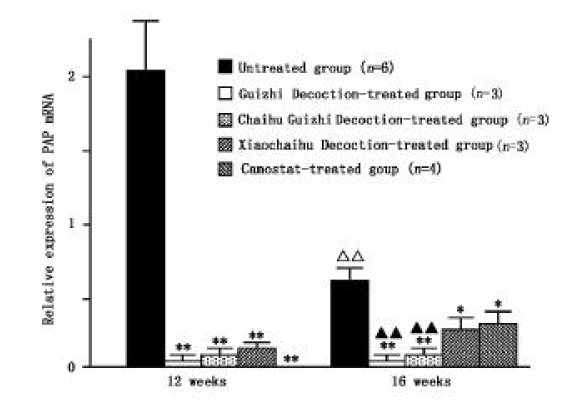
In the untreated group, the histopathological changes in pancreas were observed in rats at 12-week age, while such changes were absent in the Guizhi Decoction-treated group. The histopathological changes in pancreas were quite remarkable in rats at 16-week age in both the Xiaochaihu Decoction-treated and the camostat-treated groups. The expression level of PAP mRNA was lower in the Guizhi Decoction-treated group than those in the other groups. The PAP expressions were absent in rats at 12-week age in the Guizhi Decoction-treated and the Chaihu Guizhi Decocion-treated groups.

Conclusion

Guizhi Decoction, Chaihu Guizhi Decoction, Xiaochaihu Decoction and camostat are all beneficial to prevention and cure of chronic pancreatitis, and Guizhi Decoction is the most effective one. It is speculated that Taiyang exterior syndrome may be the pathogenesis of basic syndrome of spontaneous chronic pancreatitis, and the expression of PAP may be its pathological basis.

Key words: Drugs, Chinese herbal, Pancreatitis, Pancreatitis-associated protein, WBN/Kob rat, Formula-syndrome

CLC Number: 

  • R576.2

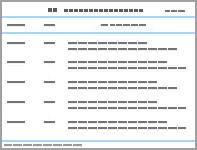
Table 1

Histopathological changes and pancreatic wet weight in WBN/Kob rats with spontaneous chronic pancreatitis in different groups (ヌ±S)"

Group n Score of histopathological changes in pancreatic tissue Pancreatic wet weight
(mg/100 g body weight)
Inflammation Acinar degeneration Fibrosis
Untreated
At 8-week age 6 0 0 0 133.38±9.10
At 12-week age 6 2.50±0.22 1.67±0.33 0.83±0.48 108.23±8.23
At 16-week age 6 2.17±0.31 2.50±0.22 2.50±0.22 95.52±2.85
Guizhi Decoction-treated
At 8-week age 3 0 0 0 146.81±11.45
At 12-week age 3 0** 0** 0** 142.02±8.41*
At 16-week age 3 0** 0** 0** 114.45±3.19*
Chaihu Guizhi Decoction-treated
At 8-week age 3 0 0 0 147.16±5.06
At 12-week age 3 0** 0** 0** 141.26±7.48*
At 16-week age 3 0.67±0.33* 0** 0** 116.05±10.79
Xiaochaihu Decoction-treated
At 8-week age 3 0 0 0 134.59±14.58
At 12-week age 3 0** 0** 0** 111.13±9.03
At 16-week age 3 1.33±0.44* 1.17±0.58* 0.83±0.17** 106.44±9.74
Camostat-treated
At 8-week age 4 0 0 0 268.33±33.46**
At 12-week age 4 0** 0** 0** 240.85±39.18**
At 16-week age 4 1.75±0.25* 1.58±0.52** 1.58±0.52** 174.55±11.62**

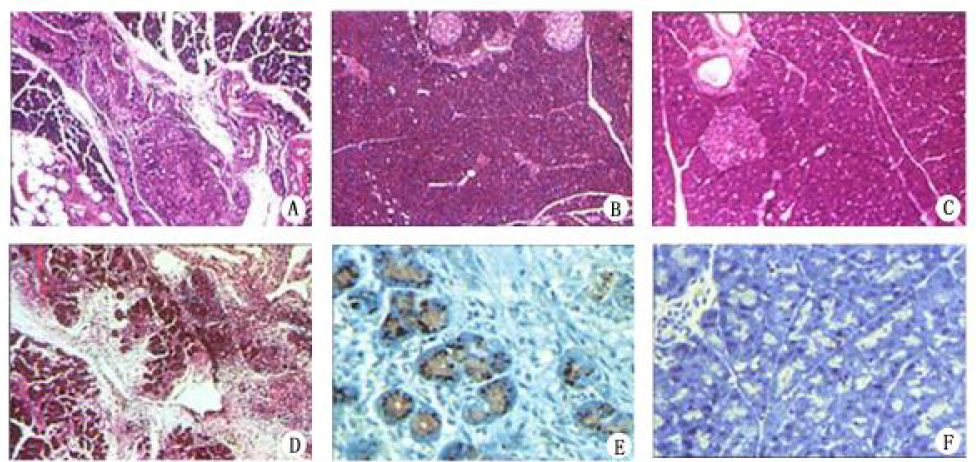
Figure 1

Histopathological changes in pancreatic tissues of WBN/Kob rats at 16-week ageA: Untreated group (HE staining, ×100); B: Guizhi Decoction-treated group (HE staining, ×100); C: Chaihu Guizhi Decoction-treated group (HE staining, ×100); D: Xiaochaihu Decoction-treated group (HE staining, ×100); E: Untreated group (SLAB method, ×200); F: Guizhi Decoction-treated group (SLAB method, ×200)."

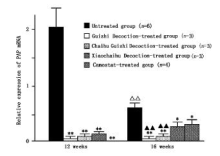
Figure 2

Expressions of PAP mRNA in pancreatic tissues of WBN/Kob rats at 12- and 16-week age*P<0.05, **P<0.01, vs untreated group at the same age; △△P<0.01, vs untreated group at 12-week age; ▲▲P<0.01, vs camostat-treated group at the same age."

[1] Kloppel G, Maillet B . Pathology of acute and chronic pancreatitis[J]. Pancreas, 1993,8(6):659-670
doi: 10.1097/00006676-199311000-00001 pmid: 8255882
[2] Otsuki M, Tani S, Okabayashi Y , et al. Beneficial effects of the synthetic trypsin inhibitor camostate in cerulein-induced acute pancreatitis in rats[J]. Dig Dis Sci, 1990,35(2):242-250
[3] Sugiyama M, Kobori O, Atomi Y , et al. Effect of oral administration of protease inhibitor on pancreatic exocrine function in WBN/Kob rats with chronic pancreatitis[J]. Pancreas, 1996,13(1):71-79
[4] Su SB, Motoo Y, Iovanna JL , et al. Effect of camostat mesilate on the expression of pancreatitis-associated protein(PAP), p8, and cytokines in rat spontaneous chronic pancreatitis[J]. Pancreas, 2001,23(2):134-140
[5] Su SB, Motoo Y, Xie MJ , et al. Expression of pancreatitis-associated protein(PAP) in rat spontaneous chronic pancreatitis: effect of herbal medicine Saiko-keishi-to(TJ-10)[J]. Pancreas, 1999,19(3):239-247
[6] Su SB, Motoo Y, Xie MJ , et al. Antifibrotic effect of the herbal medicine Saiko-keishi-to(TJ-10) on chronic pancreatitis in the WBN/Kob rat[J]. Pancreas, 2001,22(1):8-17
[7] Motoo Y, Su SB, Xie MJ , et al. Effect of herbal medicine keishi-to(TJ-45) and its components on rat pancreatic acinar cell injuries in vivo and in vitro[J]. Pancreatology, 2001,1(2):102-109
[8] Orelle B, Keim V, Masciotra L , et al. Human pancreatitis-associated protein. Messenger RNA cloning and expression in pancreatic diseases[J]. J Clin Invest, 1992,90(6):2284-2291
[9] Motoo Y, Watanabe H, Yamaguchi Y , et al. Pancreatitis-associated protein levels in pancreatic juice from patients with pancreatic diseases[J]. Pancreatology, 2001,1(1):43-47
[10] McCord JM, Fridovich I . Superoxide dismutase. An enzymic function for erythrocuprein(hemocuprein)[J]. J Biol Chem, 1969,244(22):6049-6055
[11] Manna SK, Zhang HJ, Yan T , et al. Overexpression of manganese superoxide dismutase suppresses tumor necrosis factor-induced apoptosis and activation of nuclear transcription factor-kappaB and activated protein-1[J]. J Biol Chem, 1998,273(21):13245-13254
[12] Su SB, Motoo Y, Xie MJ , et al. Superoxide dismutase is induced during rat pancreatic acinar cell injury[J]. Pancreas, 2002,24(2):146-152
doi: 10.1097/00006676-200203000-00005 pmid: 11854619
[13] Su SB, Motoo Y, Xie MJ , et al. Apoptosis in rat spontaneous chronic pancreatis: role of the Fas and Fas ligand system[J]. Dig Dis Sci, 2001,46(1):166-175
doi: 10.1002/(SICI)1097-4644(19991201)75:33.0.CO;2-Z pmid: 11270781
[1] Jian-sheng Li, Ya Li, Su-yun Li, Yuan-yuan Wang, Li Deng, Yan-ge Tian, Su-li Jiang , Ying Wang. Long-term effects of Tiaobu Feishen therapies on systemic and local inflammation responses in rats with stable chronic obstructive pulmonary disease. Journal of Chinese Integrative Medicine, 2012, 10(9): 1039-1048.
[2] Lu Yu, Shui-miao Lin, Ru-qian Zhou, Wei-jun Tang, Pin-xian Huang, Ying Dong, Jian Wang, Zhi-hua Yu, Jiu-lin Chen, Li Wei, San-li Xing, Hui-juan Cao, Hong-bin Zhao. Chinese herbal medicine for patients with mild to moderate Alzheimer disease based on syndrome differentiation: A randomized controlled trial. Journal of Chinese Integrative Medicine, 2012, 10(7): 766-776.
[3] Ling Xu, Qiao-ling Zhou, Jie Han, Dan-ying Zhang, Hui-juan Dong, Zai-long Cai, Chao-qin Yu, Dong-xia Zhai . Effects of Chinese herbal medicine Neiyi Recipe-medicated serum on angiopoiesis of endometriosis in the chick chorioallantoic membrane model. Journal of Chinese Integrative Medicine, 2012, 10(7): 800-806.
[4] Dong-mei Zhang, Li-xia Lou, Ai-ming Wu, Xi-ying Lü, Zhao-juan Hu, Yan-hong Zhang, Hong-fang Liu. Effects of Astragalus membranaceus and Potentilla discolor mixture on insulin resistance and its related mRNA expressions in KKAy mice with type 2 diabetes. Journal of Chinese Integrative Medicine, 2012, 10(7): 821-826.
[5] Mei-jiao Mao, Jun-ping Hu, Cong Wang, Yi-yi Zhang, Ping Liu. Effects of Chinese herbal medicine Guanxinkang on expression of PPARγ-LXRα-ABCA1 pathway in ApoE-knockout mice with atherosclerosis. Journal of Chinese Integrative Medicine, 2012, 10(7): 814-820.
[6] Yi-tao Zhao , Xin-guang Zhang , Li Bai , Li-qing Li , Jian-er Yu . Effects of Chinese herbal medicine Pingchuan Formula on airway inflammation, interferon-γ and interleukin-4 in mice with asthma. Journal of Chinese Integrative Medicine, 2012, 10(7): 807-813.
[7] Shui-qiu Deng, Xue-nong Ouyang, Zong-yang Yu, Xi-hu Dai, Xi Chen, Fang-zheng Fang, Wen-wu Wang, Zhi-zhen Liu. Influence of Chinese herbal medicine Feitai Capsule on completion or delay of chemotherapy in patients with stage ⅢB/Ⅳ non-small-cell lung cancer: a Randomized controlled trial. Journal of Chinese Integrative Medicine, 2012, 10(6): 635-640.
[8] Chuan Chen, Hui-ying Chi, Zhi-hua Yu, Jiu-lin Chen . Effects of Chinese herbal medicine Shoushen Granule on telomere length and telomerase activity of peripheral white blood cells and vascular cells in rats with atherosclerosis. Journal of Chinese Integrative Medicine, 2012, 10(6): 667-673.
[9] Hui Luo, Jian-ping Liu, Qing Li. Methodological issues and suggestions for improvement in randomized controlled trials of Chinese herbal medicine for recurrent miscarriage. Journal of Chinese Integrative Medicine, 2012, 10(6): 604-614.
[10] Daniel A. Weber, Janelle M. Wheat , Geoffrey M. Currie. Cancer stem cells and the impact of Chinese herbs, isolates and other complementary medical botanicals: A review. Journal of Chinese Integrative Medicine, 2012, 10(5): 493-503.
[11] Qing-lan Wang, Yan-yan Tao , Li Shen , Hong-yan Cui , Cheng-hai Liu. Chinese herbal medicine Fuzheng Huayu recipe inhibits liver fibrosis by mediating the transforming growth factor-β1/Smads signaling pathway. Journal of Chinese Integrative Medicine, 2012, 10(5): 561-568.
[12] Jing Guo, Ju-yong Wang, Zhan Zheng, Qing Wang, Chang-sheng Dong . Effects of Chinese herbal medicine Feiyanning Decoction on the ratio of CD4+CD25+ regulatory T cells and expression of transcription factor Foxp3 in mice bearing Lewis lung carcinoma. Journal of Chinese Integrative Medicine, 2012, 10(5): 584-590.
[13] Zhan gheng, Ju-yong Wang, Qing Wang, Ling Xu, Zhen-ye Xu. Effects of Chinese herbal medicine Feiyanning decoction on expressions of nucleosome conformation-regulating factors H3-K56, Rtt109, Asf1 and E2F1 in Lewis-bearing mice. Journal of Chinese Integrative Medicine, 2012, 10(4): 448-453.
[14] Ying-chun Miao , Jin-zhou Tian , Jing Shi , Min Mao. Effects of Chinese medicine for tonifying the kidney and resolving phlegm and blood stasis in treating patients with amnestic mild cognitive impairment: A randomized, double-blind and parallel-controlled trial. Journal of Chinese Integrative Medicine, 2012, 10(4): 390-397.
[15] Na Mu-hai, Yao Cheng-zeng, Yu Xiao-tian, Jiang Mei-xian. Effects of added therapy with Chinese herbal medicine Kanli Granule on skeletal muscle dysfunction in patients with chronic heart failure. Journal of Chinese Integrative Medicine, 2012, 10(3): 324-329.
Viewed
Full text


Abstract

Cited

  Shared   
  Discussed   
[1] Dong Yang, Yong-ping Du, Qing Shen, Wei Chen, Yan Yu, Guang-lei Chen. Expression of alpha-smooth muscle actin in renal tubulointerstitium in patients with kidney collateral stasis. Journal of Chinese Integrative Medicine, 2008, 6(1): 41-44
[2] Hai-feng Wei, Bai-liu Ya, Ling Zhao, Cui-fei Ye, Li Zhang, Lin Li. Evaluation of tongue manifestation of blood stasis syndrome and its relationship with blood rheological disorder in a rat model of transient brain ischemia. Journal of Chinese Integrative Medicine, 2008, 6(1): 73-76
[3] Xi Lin, Jian-ping Liu. Herbal medicines for viral myocarditis. Journal of Chinese Integrative Medicine, 2008, 6(1): 76
[4] Xi Lin, Jian-ping Liu. Tai chi for treating rheumatoid arthritis. Journal of Chinese Integrative Medicine, 2008, 6(1): 82
[5] Liang-ping Hu, Hui Gao. Discrimination of errors in statistical analysis of medical papers published in the first issue of 2006 in Journal of Chinese Integrative Medicine. Journal of Chinese Integrative Medicine, 2008, 6(1): 98-106
[6] Yan-bo Zhu , Qi Wang, Cheng-yu Wu, Guo-ming Pang, Jian-xiong Zhao, Shi-lin Shen, Zhong-yuan Xia , Xue Yan . Logistic regression analysis on relationships between traditional Chinese medicine constitutional types and overweight or obesity. Journal of Chinese Integrative Medicine, 2010, 8(11): 1023-1035
[7] Wei Xu, Meng Shi, Jian-gang Liu, Cheng-long Wang . Collagen protein expressions in ischemic myocardium of rats with acute myocardial infarction and effects of qi-tonifying, yin-tonifying and blood-activating herbs and detoxifying and blood-activating herbs. Journal of Chinese Integrative Medicine, 2010, 8(11): 1041-1047
[8] Tao Wang , Feng Qin. Effects of Chinese herbal medicine Xiaoyao Powder on monoamine neurotransmitters in hippocampus of rats with postpartum depression. Journal of Chinese Integrative Medicine, 2010, 8(11): 1075-1079
[9] Ying Xu , Chang-chun Zeng , Xiu-yu Cai , Rong-ping Guo , Guang Nie , Ying Jin. Chromaticity and optical spectrum colorimetry of the tongue color in different syndromes of primary hepatic carcinoma. Journal of Chinese Integrative Medicine, 2012, 10(11): 1263-1271
[10] Xiang-ying Mao , Qin Bian , Zi-yin Shen. Analysis of the osteogenetic effects exerted on mesenchymal stem cell strain C3H10T1/2 by icariin via MAPK signaling pathway in vitro. Journal of Chinese Integrative Medicine, 2012, 10(11): 1272-1278
[an error occurred while processing this directive]