[an error occurred while processing this directive]

Journal of Chinese Integrative Medicine ›› 2008, Vol. 6 ›› Issue (2): 139-147.doi: 10.3736/jcim20080207

• Original Clinical Research • Previous Articles     Next Articles

A multiple center, randomized, controlled, double-blinded and double-dummy trial of Yiqing Shuangjie Capsule and Tablet in treating acute upper respiratory tract infection with the syndrome of heat attacking the lung and Weifen

Lei Wang1, Rui-ming Zhang1, Yan-ling Zhao2, Guo-xiang Feng3, Ding-ju Pan4, Xi-yuan Huang5, Ting-qian Li1()   

  1. 1. Department of Integrated Chinese and Western Medicine, West China Hospital, Sichuan University, Chengdu, Sichuan Provice 610041,China
    2. The GCP of the First Affiliated Hospital of Hunan University of Traditional Chinese Medicine, Changsha, Hunan Provice 410007, China
    3. The GCP of the Second Affiliated Hospital of Hunan University of Traditional Chinese Medicine, Changsha, Hunan Prov?ince 410005, China;
    4. The GCP of the Hospital of Guiyang College of Traditional Chinese Medicine, Guiyang, Guizhou Province 550001, China
    5. The GCP of the Hospital of Traditional Chinese Medicine of Hainan Province, Haikou, Hainan Province 570203, China
  • Received:2007-07-10 Online:2008-02-20 Published:2008-02-15
  • Contact: LI Ting-qian E-mail:wunglei@hotmail.com

Objective:To evaluate the efficacy and safety of Yiqing Shuangjie Capsule and Tablet in treating acute upper respiratory tract infection with wind-warm syndrome.

Methods:The multiple center, double-blinded, double-dummy and randomized controlled method was conducted. Three hundred and sixty patients were randomly divided into the treatment group A (n=120, treated with Yiqing Shuangjie Capsule and Chaihuang analogues), treatment group B (n=120, treated with Yiqing Shuangjie Tablet and Chaihuang analogues) and the control group (n=120, treated with Chaihuang Tablet and Yiqing Shuangjie Capsule analogues). Every drug was administered 3 pills each time. Patients in the three groups were all treated for 5 days and three times daily. The accumulated scores of syndrome, clinical symptoms, adverse effect and body temperature were recorded before and after the treatment. The safety indexes, such as routine tests of blood, urine and stool, hepatic and renal function tests and electrocardiogram (ECG) were taken before and after the treatment.

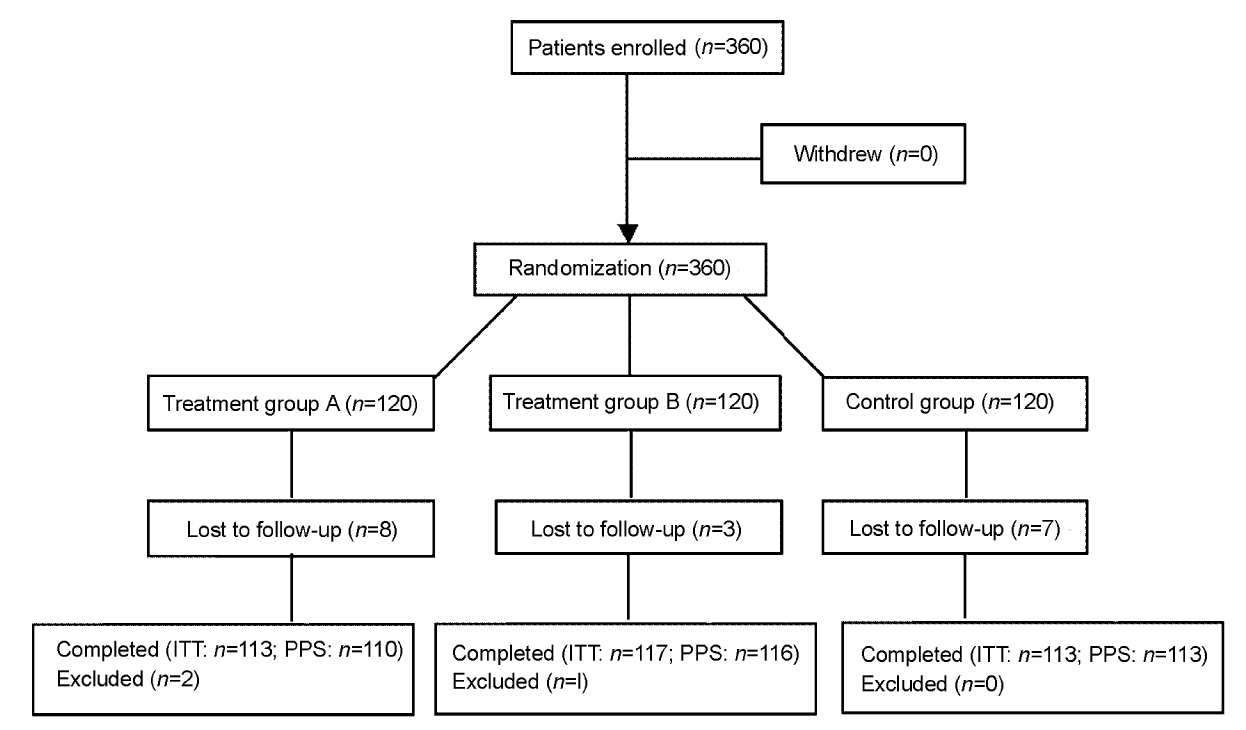
Results:Three cases were excluded and eighteen cases lost to follow-up. There were 343 patients who entered to the intention-to-treat (ITT) analysis and 339 patients fitted in the per-protocol population set (PPS) analysis. After treatment, the therapeutic effects of respiratory tract infection were calculated by ITT and PPS analysis respectively. The rates of total obvious effect were 84.96% and 87.27% respectively in the treatment group A, and the total response rates were 96.46% and 97.27% respectively. The rates of total obvious effect were 85.47% and 86.20% respectively in the treatment group B, and the total response rates were 97.45% and 97.41% respectively. In the control group, the rates of total obvious effect both were 72.57%, and the total response rates both were 99.12%. There was significant difference among the three groups (P<0.05). The effects of traditional Chinese medicine syndrome were also detected by ITT and PPS analysis respectively. In the treatment group A, the total obvious effect rates were 84.07% and 85.46% respectively, and the total response rates were 96.46% and 97.27% respectively. In the treatment group B, the rates of total obvious effect were 88.89% and 89.65% respectively, and the total response rates were 97.44% and 97.41% respectively. In the control group, the rates of total obvious effect both were 72.57%, and total response rates both were 99.12%. There was also statistical significant difference among the three groups (P<0.05). ITT and PPS analysis had the same results. No adverse effect was found in the trial.

Conclusion:Yiqing Shuangjie Capsule and Tablet are effective and safe in treating acute upper respiratory tract infection of wind heat syndrome without obvious adverse effect.

Key words: herbal preparations, randomized controlled trial, double blind method, upper respiratory tract infection, wind-warm syndrome

CLC Number: 

  • R553

Figure 1

The flow diagram of this randomized trial"

Table 1

Basement data of three groups (FAS)"

Item TA TB C Statistic value P
Cases 113 117 113
Sex (M/F) 48/65 59/58 59/54 2.44 0.30
Age($\bar{x}$±s, year) 34.3±12.2 35.8±13.2 34.7±12.3 0.46 0.63
Course ($\bar{x}$±s, h) 14.9±810.3 16.0±10.9 16.7±11.5 0.83 0.44
Body temperature ($\bar{x}$±s, ℃) 37.89±0.39 37.85±0.41 37.92±0.44 0.64 0.53
Severity (mild/moderate/severe) 38/58/17 44/53/20 36/55/22 0.85 0.65
Accumulated score of syndrome ($\bar{x}$±s) 16.02±4.57 15.50±4.69 16.35±5.00 0.93 0.39
Accumulated score of disease ($\bar{x}$±s) 17.76±5.14 17.36±5.31 18.38±5.64 1.05 0.35
Severity of heat syndrome (mild/moderate/severe) 36/59/18 49/52/16 42/49/22 2.17 0.34
Severity of sore throat (mild/moderate/severe) 56/42/15 70/37/10 59/44/10 2.86 0.24
Tongue (normal/abnormal) 8/105 7/110 8/105 0.15 0.93
Pulse condition (normal/abnormal) 36/77 34/83 32/81 0.38 0.83

Table 2

Comparison of therapeutic effects of upper respiratory tract infection among three groups"

Group n Cure
(cases)
Obvious effect
(cases)
Improvement
(cases)
Failure
(cases)
Rate of total obvious
effect (%)
Total response
rate (%)
FAS
TA 113 46 50 13 4 84.96 96.46
TB 117 50 50 14 3 85.47 97.44
C 113 29 53 30 1 72.57 99.12
PPS
TA 110 46 50 11 3 87.27 97.27
TB 116 50 50 13 3 86.21 97.41
C 113 29 53 30 1 72.57 99.12

Table 3

Comparison of therapeutic effects of traditional Chinese medicine symptoms among three groups"

Group n Cure
(cases)
Obvious effect
(cases)
Improvement
(cases)
Failure
(cases)
Rate of total obvious
effect (%)
Total response
rate (%)
FAS
TA 113 48 47 14 4 84.07 96.46
TB 117 54 50 10 3 88.89 97.44
C 113 29 53 30 1 72.57 99.12
PPS
TA 110 48 46 13 3 85.46 97.27
TB 116 54 50 9 3 89.65 97.41
C 113 29 53 30 1 72.57 99.12

Table 4

Comparison of accumulated scores of traditional Chinese medicine symptoms before and after treatment among three groups (PPS) ($\bar{x}$±s)"

Group n Accumulated score Inside group Among groups
Before treatment After treatment Difference t P F P
TA 110 16.02±4.45 2.44±3.32 13.58±4.70 25.67 0.00 1.38 1.38
TB 116 15.58±4.65 2.11±3.01 13.46±4.81 26.19 0.00
C 113 16.35±5.00 3.69±4.06 12.66±3.96 20.89 0.00

Table 5

Comparison of accumulated scores of disease before and after treatment among three groups (PPS) ($\bar{x}$±s)"

Group n Accumulated score Inside group Among groups
Before treatment After treatment Difference t P F P
TA 110 17.76±5.07 2.83±3.74 14.94±5.40 24.86 0.00 1.11 0.33
TB 116 17.44±5.26 2.56±3.43 14.91±5.43 25.52 0.00
C 113 18.38±5.64 4.34±4.76 14.04±4.47 20.22 0.00

Table 6

Comparison of decreasing-time of body temperature among three groups (PPS)"

Group n Failure (cases) Min (h) Max (h) $\bar{x}$±s, h M χ2 P
TA 110 7 0.8 72 9.67±8.80 6
TB 116 7 1 48 10.29±11.80 6 1.28 0.53
C 113 7 1 96 11.73±13.32 6

Table 7

Comparison of resuming-time of body temperature among three groups (PPS)"

Group n Failure (cases) Min (h) Max (h) $\bar{x}$±s, h M χ2 P
TA 110 17 0.5 108 26.17±21.98 12.5
TB 116 21 1 90 25.59±27.92 19 2.03 0.36
C 113 26 1 76 21.97±20.72 15.5

Table 8

Comparison of degree of fever and aversion to cold symptom before and after treatment among three groups (PPS) ($\bar{x}$±s)"

Group n Before treatment (cases) After treatment (cases) Inside group Among groups
- + ++ ++ - + ++ +++ x2 P z P
TA 110 0 36 57 17 101 5 4 0 9.29 0.00
TB 116 0 48 52 16 108 5 3 0 9.53 0.00 7.49 0.024
C 113 0 42 49 22 93 18 1 1 9.47 0.00

Table 9

Comparison of degree of sore throat symptom before and after treatment among three groups (PPS) ($\bar{x}$±s)"

Group n Before treatment (cases) After treatment (cases) Inside group Among groups
- + + + + + - + + + + + + x2 P z P
TA 110 0 54 41 15 73 37 0 0 9.30 0.00
TB 116 0 69 37 10 81 34 1 0 9.29 0.00 9.57 0.008
C 113 0 59 44 10 59 49 4 1 9.14 0.00
[1] Barrett BP, Brown RL, Locken K , et al. Treatment of the common cold with unrefined echinacea. A randomized, double-blind, placebo-controlled trial. Ann Intern Med. 2002; 137(12):939-946.
doi: 10.7326/0003-4819-137-12-200212170-00006
[2] Wat D . The common cold: a review of the literature. Eur J Intern Med. 2004; 15(2):79-88.
doi: 10.1016/j.ejim.2004.01.006 pmid: 15172021
[3] Mossad SB . Treatment of the common cold. BMJ. 1998; 317:33-36.
doi: 10.1136/bmj.317.7150.33 pmid: 1113448
[4] Moher D, Schulz KF, Altman D , et al. The CONSORT statement : revised recommendations for improving the quality of reports of parallel-group randomized trials. JAMA. 2001; 285(15):1987-1991.
doi: 10.1001/jama.285.15.1987
[5] Ye RG, Lu ZY. Internal medicine. 6th ed. Beijing: Peoples Medical Publishing House. 2005: 11-13. Chinese.
叶任高, 陆再英 .内科学 .第六版 .北京: 人民卫生出版社. 2005: 11-13.
[6] Zheng XY. Guiding principles for clinical research on new drugs of traditional Chinese medicine. Beijing: Chinese Medical Science and Technology Press. 2002: 43- 44, 58-60. Chinese.
郑筱萸 . 中药新药临床研究指导原则(试行).北京: 中国医药科技出版社.2002: 43- 44, 58-60.
[7] Liu YX, Yao C, Chen F , et al. Statistical methods for assessing noninferiority/equivalence trials. Zhongguo Lin Chuang Yao Li Xue Yu Zhi Liao Xue. 2000; 5(4):344-349. Chinese.
doi: 10.3969/j.issn.1009-2501.2000.04.017
刘玉秀, 姚晨, 陈峰 , 等. 临床非劣效性/等效性评价的统计学方法.中国临床药理学与治疗学. 2000; 5(4):344-349.
doi: 10.3969/j.issn.1009-2501.2000.04.017
[8] State Drug and Food Administration . . Technology rules about the clinical research of new drug of traditional Chinese medicine. 1999: 34-37. .
国家食品药品监督管理局. .中药新药临床研究的技术要求.1999: 34-37. .
[9] Sun LX, Huang JF. Respirovirus detection and clinical significace. Zhongguo Yi Xue Gong Cheng: 2005; 13(3):325-326. Chinese.
doi: 10.3969/j.issn.1672-2019.2005.03.039
孙丽霞, 黄敬孚 . 呼吸道病毒检测与临床意义.中国医学工程. 2005; 13(3):325-326.
doi: 10.3969/j.issn.1672-2019.2005.03.039
[10] 化学药物和生物制品临床试验的生物统计学技术指导原则课题研究组. .化学药物和生物制品临床试验的生物统计学技术指导原则(第二稿).2004: 21. .
[11] Tyrrell DA, Cohen S, Schlarb JE . Signs and symptoms in common colds. Epidemiol Infect. 1993; 111(1) : 143-156.
doi: 10.1017/S0950268800056764 pmid: 8394240
[12] Gwaltney JM Jr . Rhinovirus infection of the normal human airway. Am J Respir Crit Care Med. 1995; 152(4 Pt 2) : S36-S39.
doi: 10.1164/ajrccm/152.4_Pt_2.S36 pmid: 7551410
[13] Li F, Li JB , Zhang DM. The pharmacological research advance about Radix Bupleuri. Shizhen Guo Yi Guo Yao. 2004; 15(2):120-121. Chinese.
doi: 10.3969/j.issn.1008-0805.2004.02.045
李芳, 李建北, 张东明 . 柴胡的药理研究进展.时珍国医国药. 2004; 15(2):120-121.
doi: 10.3969/j.issn.1008-0805.2004.02.045
[14] Ye XP , Song CQ. The pharmacological research advance on saikosaponin. Zhong Cao Yao. 2004; 35(12) : 1434- 1436. Chinese.
doi: 10.7501/j.issn.0253-2670.2004.12.2004012690
叶晓平, 宋纯清 . 柴胡皂苷药理研究进展.中草药. 2004; 35(12):1434-1436.
doi: 10.7501/j.issn.0253-2670.2004.12.2004012690
[15] Chi GF, Ding L , Chang LM. The present domestic pharmacological advance on Scutellaria baicalensis. Neimonggu Min Zu Da Xue Xue Bao ( Zi Ran Ke Xue Ban). 2005; 20(2):207-209. Chinese with abstract in English.
迟戈夫, 丁丽, 常丽敏 . 目前国内黄芩药理研究进展. 内蒙古民族大学学报(自然科学版). 2005; 20(2):207-209.
[16] Li X, Yu QH, Ai D , et al. A preliminary inquiry into the anti-inflammatory effects and the mechanism of artificial cultivated Calculus bovis. Shenyang Yao Ke Da Xue Xue Bao. 2000; 17(6):431-433. Chinese with abstract in English.
doi: 10.3969/j.issn.1006-2858.2000.06.014
李霞, 于庆海, 艾朋 , 等. 人工培植牛黄抗炎作用及其机制的初步探讨.沈阳药科大学学报. 2000; 17(6):431-433.
doi: 10.3969/j.issn.1006-2858.2000.06.014
[17] Gu KX, Zheng JR, Gao JW , et al. The antiinflammatory of triptolidenol activities. Zhongguo Yao Li Xue Tong Bao. 1994; 10(1):54-57. Chinese with abstract in English.
顾克显, 郑家润, 高纪伟 , 等. 雷醇内醋的抗炎作用. 中国药理学通报. 1994; 10(1):54-57.
[18] Song MX, Guo WJ. State Chinese patent medicine. Beijing: People's Medical Publishing House. 2002: 74. Chinese.
宋民宪, 郭维加 . 新编国家中成药.北京: 人民卫生出版社. 2002: 74.
[1] Jing-lin Shi, Wan-hong Miao. Effects of acupuncture on lactoferrin content in tears and tear secretion in patients suffering from dry eyes: A randomized controlled trial. Journal of Chinese Integrative Medicine, 2012, 10(9): 1003-1008.
[2] Ming T. Tan , Jian-ping Liu , Lixing Lao. Adequate application of quantitative and qualitative statistic analytic methods in acupuncture clinical trials. Journal of Chinese Integrative Medicine, 2012, 10(8): 847-852.
[3] Lu Yu, Shui-miao Lin, Ru-qian Zhou, Wei-jun Tang, Pin-xian Huang, Ying Dong, Jian Wang, Zhi-hua Yu, Jiu-lin Chen, Li Wei, San-li Xing, Hui-juan Cao, Hong-bin Zhao. Chinese herbal medicine for patients with mild to moderate Alzheimer disease based on syndrome differentiation: A randomized controlled trial. Journal of Chinese Integrative Medicine, 2012, 10(7): 766-776.
[4] Peng Fu , Xue-qiang Huang, Ai-hong Yuan, Guang Yu, Xiao-bin Mei, Ruo-lan Cu. Effects of salvianolate combined with alprostadil and reduced glutathione on progression of chronic renal failure in patients with chronic kidney diseases: a long-term randomized controlled trial. Journal of Chinese Integrative Medicine, 2012, 10(6): 641-646.
[5] Hui Luo, Jian-ping Liu, Qing Li. Methodological issues and suggestions for improvement in randomized controlled trials of Chinese herbal medicine for recurrent miscarriage. Journal of Chinese Integrative Medicine, 2012, 10(6): 604-614.
[6] Shui-qiu Deng, Xue-nong Ouyang, Zong-yang Yu, Xi-hu Dai, Xi Chen, Fang-zheng Fang, Wen-wu Wang, Zhi-zhen Liu. Influence of Chinese herbal medicine Feitai Capsule on completion or delay of chemotherapy in patients with stage ⅢB/Ⅳ non-small-cell lung cancer: a Randomized controlled trial. Journal of Chinese Integrative Medicine, 2012, 10(6): 635-640.
[7] Ming-xing Zhao, Zhen-hua Dong, Zhong-hai Yu, Shi-yuan Xiao, Ya-ming Li . Effects of Ginkgo biloba extract in improving episodic memory of patients with mild cognitive impairment: A randomized controlled trial. Journal of Chinese Integrative Medicine, 2012, 10(6): 628-634.
[8] Ying-chun Miao , Jin-zhou Tian , Jing Shi , Min Mao. Effects of Chinese medicine for tonifying the kidney and resolving phlegm and blood stasis in treating patients with amnestic mild cognitive impairment: A randomized, double-blind and parallel-controlled trial. Journal of Chinese Integrative Medicine, 2012, 10(4): 390-397.
[9] Xiao-hui Sun, Sheng Liu . External Chinese medical therapy for pain associated with hyperplastic disease of the breast: Study protocol of a randomized, double-blind, multicenter, controlled trial. Journal of Chinese Integrative Medicine, 2012, 10(4): 384-389.
[10] Zhu Yan-feng, Luo Hai-ming, Deng Zhong-long, Fu De-yu, Yao Wang, Dai Jian. Effects of the Chinese patent medicine, Honghua Injection, on platelet glycoprotein Ⅱb/Ⅲa receptors in patients with acute coronary syndrome: a randomized controlled trial. Journal of Chinese Integrative Medicine, 2012, 10(3): 318-323.
[11] Li Min, Yang Ming-hui, Liu Yi. Effects of Chinese herbal medicine Bushen Huoxue Granule on quality of life of patients with Parkinson disease: a randomized, double-blinded and placebo-controlled trial. Journal of Chinese Integrative Medicine, 2012, 10(3): 310-317.
[12] Paula de Sousa Fragoso Ana, de Sá Ferreira Arthur. Evaluation of the immediate effects of manual acupuncture on brachial bicep muscle function in healthy individuals and poststroke patients: a study protocol of a parallel-group randomized clinical trial. Journal of Chinese Integrative Medicine, 2012, 10(3): 303-309.
[13] Li-xin Ma, Yu-yi Wang, Xin-xue Li, Jian-ping Liu . Systematic review on methodology of randomized controlled trials of post-marketing Chinese patent drugs for treatment of type 2 diabetes. Journal of Chinese Integrative Medicine, 2012, 10(3): 279-292.
[14] Wang Yun-fei, Que Hua-fa, Xu Jie-nan, Tang Han-jun, Xiang Huan-yu, Liu Xiao-dong, Zhang Zhen, Xing Jie, Shen Liang, Shan Wei, Liu An-min, Qiu Lian-yin, Deng Da-yi, Gao Dan. Assessment of external methods of traditional Chinese medicine in patients with chronic ulcer of the lower extremities: study protocol of a multicenter, randomized, parallel-group, prospective trial. Journal of Chinese Integrative Medicine, 2012, 10(2): 166-175.
[15] Liu Jian, Gao Ying, Kan Bao-hong, Zhou Li. Systematic review and meta-analysis of randomized controlled trials of Chinese herbal medicine in treatment of multiple sclerosis. Journal of Chinese Integrative Medicine, 2012, 10(2): 141-153.
Viewed
Full text


Abstract

Cited

  Shared   
  Discussed   
[1] Jin-rong Fu. Establishment of multivariate diagnosis and treatment system of modern gynecology of traditional Chinese medicine. Journal of Chinese Integrative Medicine, 2008, 6(1): 22-24
[2] Hao Li, Ming-jiang Yao, Wen-ming Zhao, Jie Guan, Lin-lin Cai, Ling Cui. A randomized, controlled, double-blind trial of Huannao Yicong capsule in senile patients with mild cognitive impairment. Journal of Chinese Integrative Medicine, 2008, 6(1): 25-31
[3] Zhi-chun Jin. Problems in establishing clinical guideline for integrated traditional Chinese and Western medicine. Journal of Chinese Integrative Medicine, 2008, 6(1): 5-8
[4] SUN Ming-yu, ZUO Jian, DUAN Ji-feng, HAN Jun, FAN Shi-ming, ZHANG Wei, ZHU Li-fang, YAO Ming-hui. Antitumor activities of kushen flavonoids in vivo and in vitro. Journal of Chinese Integrative Medicine, 2008, 6(1): 51-59
[5] Min Cheng, Qiong Feng, Shu-wen Qian, Hui Gao, Cui-qing Zhu. Preliminary assay of p-amyloid binding elements in heart-beneficial recipe. Journal of Chinese Integrative Medicine, 2008, 6(1): 68-72
[6] Ning-qun Wang, Liang-duo Jiang, Zong-xing Li. Research progress in asthma-related quality of life. Journal of Chinese Integrative Medicine, 2008, 6(1): 93-97
[7] Jing-yuan Mao, Chang-xiao Liu, Heng-he Wang, Guang-li Wei , Zhen-peng Zhang, Jie Xing, Wang Xian liang , Ying-fei Bi . Effects of Shenmai Injection on serum concentration and pharmacokinetics of digoxin in dogs with heart failure. Journal of Chinese Integrative Medicine, 2010, 8(11): 1070-1074
[8] Zhi-mei Wang, Bin Zhang. A study on translation of ellipses in Huangdi Neijing from perspective of hermeneutic theory. Journal of Chinese Integrative Medicine, 2010, 8(11): 1097-1100
[9] Gui Yu, Jie Wang. Thinking on building the network cardiovasology of Chinese medicine. Journal of Chinese Integrative Medicine, 2012, 10(11): 1206-1210
[10] Pedro Saganha João, Doenitz Christoph, Greten Tobias, Efferth Thomas, J. Greten Henry. Qigong therapy for physiotherapists suffering from burnout: a preliminary study. Journal of Chinese Integrative Medicine, 2012, 10(11): 1233-1239
[an error occurred while processing this directive]