[an error occurred while processing this directive]

Journal of Chinese Integrative Medicine ›› 2008, Vol. 6 ›› Issue (7): 682-689.doi: 10.3736/jcim20080705

Special Issue: Traditional Chinese Medicine

• Original Clinical Research • Previous Articles     Next Articles

Reliability and validity of Health Scale of Traditional Chinese Medicine

Da-rong Wu1, Shi-long Lai1,2(), Xin-feng Guo2, Ze-huai Wen2, Wei-xiong Liang2   

  1. 1. Applied Clinical Epidemiology Research Unit, the Second Affiliated Hospital, Guangzhou University of Chinese Medicine, Guangzhou, Guangdong Province 510120, China
    2. DME Center, Guangzhou University of Chinese Medicine, Guangzhou, Guangdong Province 510405, China
  • Received:2007-12-03 Online:2008-07-20 Published:2008-07-15
  • Contact: LAI Shi-long E-mail:gzxuntcm@pub.guangzhou.gd.cn

Objective: To test the reliability and validity of Health Scale of Traditional Chinese Medicine (HSTCM) by means of questionnaires.
Methods: A cross-sectional survey was conducted at Liwan Community of Guangzhou, Old People's Home in Guangzhou and Outpatient Department of the Second Affiliated Hospital of Guangzhou University of Chinese Medicine. A total of 652 Chinese individuals (over 18 years old) were assessed with the 88-item version of HSTCM and World Health Organization Quality of Life Measure-Abbreviated Version (WHOQOL-BREF), which were randomly delivered to them. Some socioeconomic characteristics were registered.
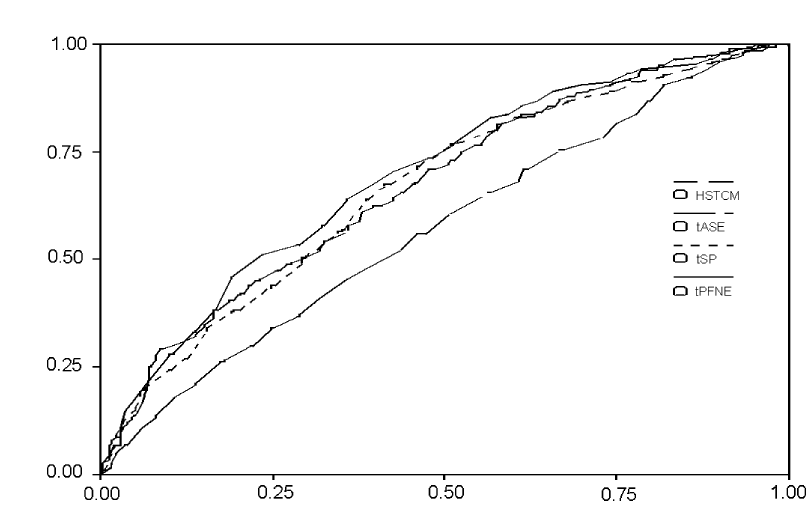
Results: A test-retest reliability (15-day interval) was found among the 76 persons who completed the questionnaires by themselves. Intra-class correlation coefficient (ICC) was 0.93. Associated 95% confidence interval (CI) was 0.89-0.96. Split-half reliability was 0.79. Inter-investigator reliability (0.93) was also good, and the ICC of HSTCM was 0.90 (95%CI 0.67-0.97). The correlation between HSTCM and WHOQOL-BREF was –0.66. The correlations of HSTCM and questionnaire deliver order, investigator, interview date and interview time were 0.06, –0.12, –0.17 and 0.20 respectively. The correlation between HSTCM and self-rated health (0.46) was greater than that between HSTCM and chronic illness (0.28). Divided by individuals with or without chronic illness, area under the ROC (receiver operator characteristic) curve for HSTCM was 0.67 (95%CI 0.63-0.71).
Conclusion: It indicates that the HSTCM is conceptually valid with satisfactory psychometric properties and forms a basis for further applications in clinical research of traditional or integrative medicine.

Key words: traditional Chinese medicine, health surveys, scale, reliability, validity

CLC Number: 

  • R-31

Table 1

Internal consistency of Health Scale of Traditional Chinese Medicine"

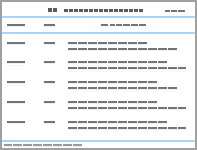
Domain and facet scale Cronbach's coefficient α Number of items
Health Scale of Traditional Chinese Medicine 0.93 45
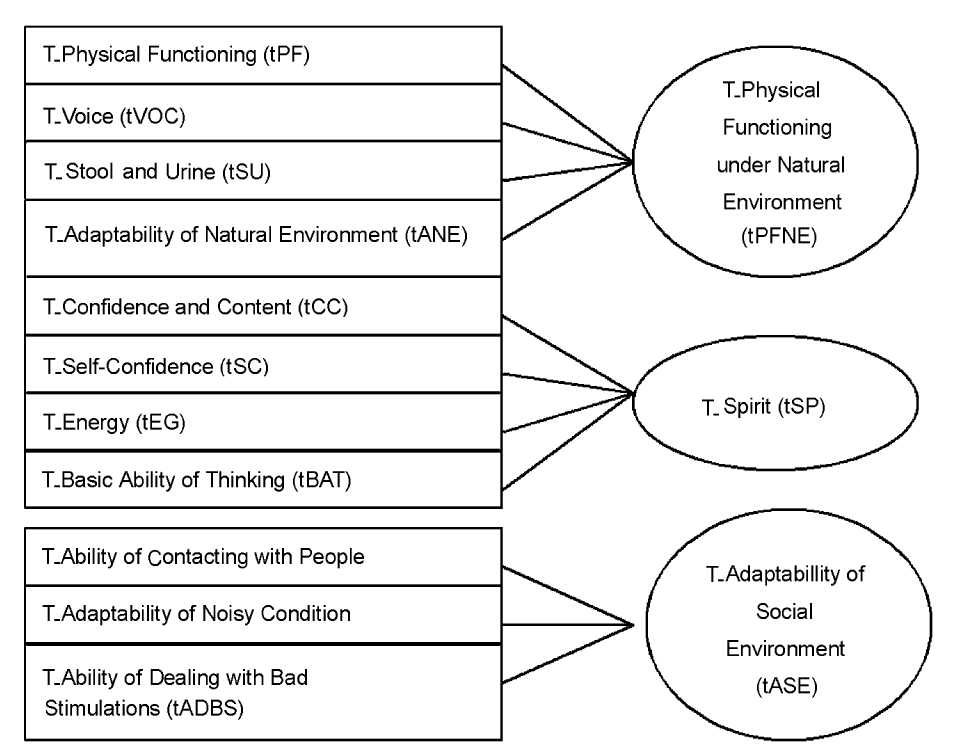
T_Physical Functioning under Natural Environment (tPFNE) 0.89 18
T_Physical Functioning (tPF) 0.89 9
T_Voice (tVOC) 0.68 2
T_Stool and Urine (tSU) 0.67 2
T_Adaptability of Natural Environment (tANE) 0.71 5
T_Spirit (tSP) 0.84 14
T_Confidence and Content (tCC) 0.83 6
T_Self-confidence (tSC) 0.87 2
T_Energy (tEG) 0.71 4
T_Basic Ability of Thinking (tBAT) 0.49 2
T_Adaptability of Social Environment (tASE) 0.89 13
T_Ability of Contacting with People (tACP) 0.79 2
T_Adaptability of Noisy Condition (tANC) 0.57 2
T_Ability of Dealing with Bad Stimulations (tADBS) 0.89 9

Table 2

Divergent construct validity of Health Scale of Traditional Chinese Medicine"

tPFNE tSP tASE HSTCM
Scale delivering order 0.07** 0.02** 0.06** 0.06**
Interviewer –0.14* –0.07** –0.08** –0.12*
Date –0.15* –0.18* –0.08* –0.17*
Time 0.11* 0.30* 0.13* 0.20*

Table 3

Discriminant validity of Health Scale of Traditional Chinese Medicine"

tPFNE tSP tASE HSTCM
Chronic disease 0.32 0.27 0.11 0.28
Self-reported health status 0.39 0.54 0.25 0.46

Table 4

The areas under ROC curves"

Variable Area Standard error Significant level 95% CI
Lower bound Upper bound
tPFNE 0.69 0.02 0.00 0.65 0.74
tSP 0.67 0.02 0.00 0.62 0.71
tASE 0.57 0.02 0.00 0.53 0.62
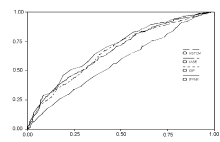
T_45 0.67 0.02 0.00 0.63 0.71

Figure 1

ROC curves of Health Scale of Traditional Chinese Medicine in comparing different samples of whether having chronic disease or not"

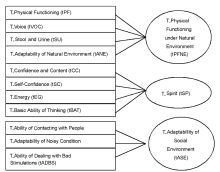
Figure 2

Structure model of Health Scale of Traditional Chinese Medicine"

Table 5

Demographic characteristics of overall scores of Health Scale of Traditional Chinese Medicine"

Characteristics n x±s 95% CI
Age
18-34 years old 153 90.0±18.63 87.0-93.0
35-44 years old 138 96.9±22.32 93.1-100.6
45-54 years old 139 100.2±25.34 96.0-104.5
≥55 years old 190 93.9±21.34 90.9-97.0
Number of missing value 3 - -
Chronic disease
No 362 89.0±19.36 87.1-91.2
Yes 252 102.9±23.38 100.2-106.1
Number of missing value 9 - -
Self-reported health status
Poor 100 110.0±24.71 105.2-115.2
Neither poor nor good 240 100.7±20.19 98.1-103.4
Good 283 84.7±17.60 82.5-86.6
Number of missing value 0 - -
Self-reported health status change
Worse 236 106.4±22.59 103.5-109.4
No change 270 87.1±18.31 84.6-89.1
Better 115 89.9±19.74 86.1-93.5
Number of missing value 2 - -
Medical care need
A good many 106 110.0±26.21 105.0-115.2
A moderate amount 135 100.0±19.90 96.4-103.3
Few 375 88.9±19.17 86.8-90.8
Number of missing value 7 - -

Table 6

Demographic characteristics of domain scores of Health Scale of Traditional Chinese Medicine"

Chracteristics n tPFNE tSP tASE
$\bar{x}$±s 95% CI $\bar{x}$±s 95% CI $\bar{x}$±s 95% CI
Age
18-34 years old 153 32.7±8.57 31.3-34.1 29.0±6.35 27.9-30.0 28.4±7.87 27.1-29.6
35-44 years old 138 34.8±10.34 33.1-36.6 31.5±7.69 30.2-32.8 30.6±8.82 29.1-32.0
45-54 years old 139 36.0±11.55 34.1-37.9 32.4±8.27 31.0-33.8 31.8±9.43 30.2-33.4
≥55 years old 190 33.2±10.14 31.8-34.7 33.3±7.23 32.3-34.4 27.4±8.60 26.2-28.6
Number of missing value 3 - - - - - -
Chronic disease
No 362 31.1±8.50 30.2-32.0 29.7±6.93 29.0-30.5 28.2±8.39 27.3-29.0
Yes 252 38.1±11.07 36.7-39.5 34.1±7.67 33.2-35.1 30.7±9.30 29.5-31.8
Number of missing value 9 - - - - - -
Self-reported health status
Poor 100 40.1±11.91 37.8-42.5 37.4±8.46 35.7-39.1 32.5±9.52 30.6-34.4
Neither poor nor good 240 36.0±9.79 34.7-37.2 34.2±6.02 33.4-35.0 30.5±8.78 29.4-31.6
Good 283 30.3±8.26 29.3-31.3 27.4±5.83 26.7-28.1 27.1±8.09 26.1-28.0
Number of missing value 0 - - - - - -
Self-reported health status change
Worse 236 38.3±11.04 36.9-39.7 35.9±7.06 35.0-36.8 32.3±9.09 31.1-33.5
No change 270 30.5±8.29 29.6-31.5 29.6±6.40 28.8-30.3 27.0±8.15 26.0-28.0
Better 115 33.6±9.30 31.9-35.3 27.8±6.95 26.5-29.1 28.5±8.19 27.0-30.0
Number of missing value 2 - - - - - -
Medical care need
A good many 106 40.2±12.59 37.8-42.7 36.1±9.06 34.3-37.8 33.6±10.38 31.6-35.6
A moderate amount 135 37.0±9.38 35.4-38.6 33.1±7.19 31.9-34.3 29.9±8.06 28.5-31.3
Few 375 31.3±8.60 30.4-32.2 29.8±6.48 29.1-30.4 27.8±8.23 27.0-28.6
Number of missing value 7 - - - - - -
[1] Wu DR, Lai SL . Exploration on health concept of TCM and the operationalization of its measurement[J]. Zhongguo Zhong Xi Yi Jie He Za Zhi, 2007,27(2):174-177
doi: 10.3321/j.issn:1003-5370.2007.02.025
吴大嵘, 赖世隆 . 中医学健康概念及其测量操作化探讨[J]. 中国中西医结合杂志, 2007,27(2):174-177
doi: 10.3321/j.issn:1003-5370.2007.02.025
[2] Wu DR, Lai SL, Guo XF , et al. Establishment and initial evaluation of Health Scale of Traditional Chinese Medicine[J]. Zhongguo Zhong Xi Yi Jie He Za Zhi, 2007,27(9):847-850
doi: 10.3321/j.issn:1003-5370.2007.09.024
吴大嵘, 赖世隆, 郭新峰 , 等. 中医健康量表的建立和初步评价[J]. 中国中西医结合杂志, 2007,27(9):847-850
doi: 10.3321/j.issn:1003-5370.2007.09.024
[3] Ministry of Health of the People's Republic of China. Quality of life assessment instrument. The People's Republic of China Health Profession Standard WS/T119-1999. 1999: 11-14. Chinese
中华人民共和国卫生部. 生存质量测定量表. 中华人民共和国卫生行业标准WS/T119-1999. 1999: 11-14
[4] Wang JL. Clinical epidemiology: design measurement and evaluation of clinical research(2nd ed)[M]. Shanghai: Shanghai Scientific and Technical Publishers, 2001,( 2nd ed):363-367
王家良 . 临床流行病学——临床科研设计、衡量与评价(第2版)[M]. 上海: 上海科学技术出版社, 2001,( 第2版):363-367
[5] David LS, Geoffrey RN. Health measurement scales: a practical guide to their development and use[M]. New York: Oxford University Press,1989: 8-9
[6] Essink-Bot ML, Krabbe PF, Bonsel GJ , et al. An empirical comparison of four generic health status measures. The Nottingham Health Profile, the Medical Outcomes Study 36-item Short-Form Health Survey, the COOP/WONCA charts, and the EuroQol instrument[J]. Med Care, 1997,35(5):522-537
doi: 10.1097/00005650-199705000-00008
[7] Hays RD, Hadorn D . Responsiveness to change: an aspect of validity, not a separate dimension[J]. Qual Life Res, 1992,1(1):73-75
doi: 10.1007/BF00435438
[1] Zhang-ling Zhou, Cheng-xin Li, Yue-bo Jiang, Cong Zuo, Yun Cai, Rui Wang. Correlation between facial nerve functional evaluation and efficacy evaluation of acupuncture treatment for Bell’s palsy. Journal of Chinese Integrative Medicine, 2012, 10(9): 997-1002.
[2] Lu-ming Chen, Hui Yu, Da-rong Wu , Xun Hu , Lan Zheng. Investigation on response of the patient-reported outcome scale of the main-symptoms of chronic obstructive pulmonary disease complicated with pulmonary heart disease. Journal of Chinese Integrative Medicine, 2012, 10(9): 970-974.
[3] Claudia Maria Sous, Mario Goncalves, Jorge Machado, Thomas Efferth, Tobias Greten , Petra Froeschen , Henry J. Greten. Effects of qigong on performance-related anxiety and physiological stress functions in transverse flute music schoolchildren: A feasibility study. Journal of Chinese Integrative Medicine, 2012, 10(8): 858-865.
[4] C. Matos Luís, J. Goncalves Mário, R. Silva António, G. Mendes Joaquim, P. Machado Jorge, J. Greten Henry. Assessment of Qigong-related effects by infrared thermography: A case study. Journal of Chinese Integrative Medicine, 2012, 10(6): 663-666.
[5] Xiao-ling Jiang, Ying Zhang, Ying Lei, Gui-fang Hu, Zheng-gang Zhang, Zhong-ju Xiao. Case-control study on the association between qi-stagnation and insomnia. Journal of Chinese Integrative Medicine, 2012, 10(6): 655-662.
[6] Christoph A. Doenitz, Ana Anjos, Thomas Efferth , Tobias Greten, Henry J. Greten. Can heat and cold be parameterized? Clinical data of a preliminary study. Journal of Chinese Integrative Medicine, 2012, 10(5): 532-537.
[7] Ying-chun Miao , Jin-zhou Tian , Jing Shi , Min Mao. Effects of Chinese medicine for tonifying the kidney and resolving phlegm and blood stasis in treating patients with amnestic mild cognitive impairment: A randomized, double-blind and parallel-controlled trial. Journal of Chinese Integrative Medicine, 2012, 10(4): 390-397.
[8] Hanjo Lehmann. A Westerner’s question about traditional Chinese medicine: are the Yinyang concept and the Wuxing concept of equal philosophical and medical rank?. Journal of Chinese Integrative Medicine, 2012, 10(3): 237-248.
[9] Yan-bo Zhu , Hideki Origasa, Xiao-xia Luo, Yang-yang Wang , Jie Di , Lin Lin. Responsiveness of three subjective report of outcome measures for chronic heart failure. Journal of Chinese Integrative Medicine, 2012, 10(12): 1375-1381.
[10] Dong-tao Li, Jian Wang , Hong-yang Jiang , Feng-lei Shi , Fu-yu Li , Ji-hong Liu , Yong-mei Cheng , Nan Yan , Ai-hua Hu, Mei-zeng Zhang , Jie Li, Ling-bo Wei , Rong-qin Jiang. Quantitative evaluation of the degrees of traditional Chinese medicine qualitative syndromes of osteoporosis. Journal of Chinese Integrative Medicine, 2012, 10(11): 1254-1262.
[11] Yan-ming Xie, Xing Liao, Yong-yan Wang. Introduce the idea of comparative effectiveness research to clinical research of Chinese medicine. Journal of Chinese Integrative Medicine, 2011, 9(8): 813-818.
[12] Patricia Ronan, Nicola Robinson, Dominic Harbinson, Douglas Maclnnes. A case study exploration of the value of acupuncture as an adjunct treatment for patients diagnosed with schizophrenia: Results and future study design. Journal of Chinese Integrative Medicine, 2011, 9(5): 503-514.
[13] Zheng-kun Hou, Feng-bin Liu, Ying-yu Liang, Kun-hai Zhuang, Chu-hua Lin, Li-juan Li . On the necessity of developing quality of life instruments in traditional Chinese medicine. Journal of Chinese Integrative Medicine, 2011, 9(5): 468-482.
[14] Yan-bo Zhu, Qi Wang, Ke-fan Chen, Yu-e Wu, Wei-li Hong, Li Liu. Stratified analysis of the relationship between traditional Chinese medicine constitutional types and health status in the general population based on data of 8448 cases. Journal of Chinese Integrative Medicine, 2011, 9(4): 382-389.
[15] Mei-jun Lü, Hui-yong Zhang, Zhe Zhang, Guan-lin Yang. Measurement of health-related quality of life in coronary heart disease: A review. Journal of Chinese Integrative Medicine, 2011, 9(12): 1277-1285.
Viewed
Full text


Abstract

Cited

  Shared   
  Discussed   
[1] Jin-rong Fu. Establishment of multivariate diagnosis and treatment system of modern gynecology of traditional Chinese medicine. Journal of Chinese Integrative Medicine, 2008, 6(1): 22-24
[2] Hao Li, Ming-jiang Yao, Wen-ming Zhao, Jie Guan, Lin-lin Cai, Ling Cui. A randomized, controlled, double-blind trial of Huannao Yicong capsule in senile patients with mild cognitive impairment. Journal of Chinese Integrative Medicine, 2008, 6(1): 25-31
[3] Zhi-chun Jin. Problems in establishing clinical guideline for integrated traditional Chinese and Western medicine. Journal of Chinese Integrative Medicine, 2008, 6(1): 5-8
[4] SUN Ming-yu, ZUO Jian, DUAN Ji-feng, HAN Jun, FAN Shi-ming, ZHANG Wei, ZHU Li-fang, YAO Ming-hui. Antitumor activities of kushen flavonoids in vivo and in vitro. Journal of Chinese Integrative Medicine, 2008, 6(1): 51-59
[5] Min Cheng, Qiong Feng, Shu-wen Qian, Hui Gao, Cui-qing Zhu. Preliminary assay of p-amyloid binding elements in heart-beneficial recipe. Journal of Chinese Integrative Medicine, 2008, 6(1): 68-72
[6] Ning-qun Wang, Liang-duo Jiang, Zong-xing Li. Research progress in asthma-related quality of life. Journal of Chinese Integrative Medicine, 2008, 6(1): 93-97
[7] Jing-yuan Mao, Chang-xiao Liu, Heng-he Wang, Guang-li Wei , Zhen-peng Zhang, Jie Xing, Wang Xian liang , Ying-fei Bi . Effects of Shenmai Injection on serum concentration and pharmacokinetics of digoxin in dogs with heart failure. Journal of Chinese Integrative Medicine, 2010, 8(11): 1070-1074
[8] Zhi-mei Wang, Bin Zhang. A study on translation of ellipses in Huangdi Neijing from perspective of hermeneutic theory. Journal of Chinese Integrative Medicine, 2010, 8(11): 1097-1100
[9] Gui Yu, Jie Wang. Thinking on building the network cardiovasology of Chinese medicine. Journal of Chinese Integrative Medicine, 2012, 10(11): 1206-1210
[10] Pedro Saganha João, Doenitz Christoph, Greten Tobias, Efferth Thomas, J. Greten Henry. Qigong therapy for physiotherapists suffering from burnout: a preliminary study. Journal of Chinese Integrative Medicine, 2012, 10(11): 1233-1239
[an error occurred while processing this directive]