[an error occurred while processing this directive]

Journal of Chinese Integrative Medicine ›› 2008, Vol. 6 ›› Issue (11): 1152-1158.doi: 10.3736/jcim20081109

• Original Experimental Research • Previous Articles     Next Articles

Establishment of a rat model of cervical syndrome with qi deficiency, blood stasis and kidney deficiency

Yong-jun Wang1(), Qi Shi1, Jian-chun Jiang1, Qian-qian Liang1, Qin Bian1, Chen-guang Li1, Quan Zhou1, Xue-jun Cui1, Min Huang2, Qing-gao Liu1, Sheng Lu1, Chong-jian Zhou1   

  1. 1. Institute of Spine Disease, Longhua Hospital, Shanghai University of Traditional Chinese Medicine, Shanghai 200032, China
    2. Health Service Center of the Bund Community, Huangpu District, Shanghai 200001, China
  • Received:2008-05-27 Online:2008-11-20 Published:2008-11-15

Objective: To establish a rat model of cervical syndrome with qi deficiency, blood stasis and kidney deficiency.
Methods: A total of 30 three-month-old female Sprague-Dawley rats were randomly divided into normal group, cervical syndrome group and cervical syndrome with qi deficiency, blood stasis and kidney deficiency group (combined group), with 10 rats in each group. Rats in the normal group received no treatment, rats in cervical syndrome group underwent resection of cervical muscles and ligaments as unbalanced dynamic and static animal model, and rats in combined group underwent resection of both cervical muscles and ovaries, swimming and irregular diet, and injection of adrenal cortex hormone and adrenaline two and a half months after resection as combined model. The qi deficiency, blood stasis and kidney deficiency were determined by observing behaviors and physical signs of the rats, detecting the contents of plasma cyclic adenosine monophosphate (cAMP) and cyclic guanosine monophosphate (cGMP), the hemorrheology, the expression of alpha-granular membrane protein (CD62p) and the serum estradiol (E2) content. The aggrecan-1, type Ⅱ procollagen gene (Col2a1), matrix metalloproteinases-13 (MMP-13) and tissue inhibitor of metalloproteinases-1 (TIMP-1) mRNAs in cervical intervertebral discs were detected by histopathology, immunohistochemistry and real-time polymerase chain reaction. The cataplasia of the intervertebral discs was determined by detecting the histopathology, the expressions of type Ⅱ collagen and type Ⅹ collegen proteins, and the expressions of aggrecan-1 (Agc1), type Ⅱ procollagen gene (Col2a1), matrix metalloproteinase-13 (MMP-13) and tissue inhibitor of metalloproteinase-1 (TIMP-1) mRNAs.
Results: Compared with those in the normal group and cervical syndrome group, the rats in the combined group were noted with obvious signs of deficiency of vital energy, such as depression, tiredness, ptosis, obvious weight loss and blue tail. And the ratio of cAMP/cGMP was decreased; the reducing viscosity was significantly up-regulated; the expression of CD62p was increased; the content of serum E2 was decreased; the intervertebral disc structure was destructed; the cervical intervertebral disc was more seriously deteriorated. There exhibited a decrease in type Ⅱ collagen protein expression, an increase in type Ⅹ collagen protein expression, as well as decreases of Agc1, Col2a1 and TIMP-1 mRNA expressions in intervertebral disc, and the expression of MMP-13 mRNA was noted an increase.
Conclusion: The rat model of cervical syndrome with qi-deficiency, blood stasis and kidney deficiency is established. Qi deficiency, blood stasis and kidney deficiency can aggravate cervical intervertebral disc degeneration.

Key words: qi deficiency, blood stasis, kidney deficiency, cervical spondylosis, combining disease and syndrome, disease model, animals, rats

CLC Number: 

  • R681.531

Table 1

Observation of behaviors and physical signs in the combined group when making qi deficiency model"

Symptom Combined group
3rd day 6th day 9th day 13th day 15th day
Spirit + ++ +++ +++ +++
Skin and pelage + + ++ ++ +++
Nose and tail - + ++ ++ ++
Stool - + + + +
Shrinking shoulders and extrados none none have have have

Table 2

Weight changes in the combined group when making qi deficiency model(x±s, g)"

Group n Body weight
Before making model 3rd day 6th day 9th day 13th day 15th day
Normal 10 328.9±28.8 340.0±16.0 343.0±18.3 347.5±17.2 349.3±19.1 353.7±19.6
Cervical syndrome 10 325.5±21.5 341.3±16.9 342.2±18.9 350.0±20.5 351.9±26.3 357.0±23.1
Combined 8 431.1±31.2**△△ 421.7±55.1**△△ 389.0±46.4**△△ 387.5±58.1 387.9±54.8 358.9±52.8

Table 3

Contents of cAMP, cGMP and ratio of cAMP/cGMP in three groups (x±s)"

Group n cAMP (nmol/L) cGMP (nmol/L) cAMP/cGMP
Normal 8 129.35±60.52 17.87±9.51 8.10±3.27
Cervical syndrome 8 217.51±117.37 23.36±19.91 11.97±4.56
Combined 8 165.06±56.56 44.28±32.88 4.77±1.77△△

Table 4

Changes of hemorrheological parameters in three groups (x±s, mPa·s)"

Group n Whole blood low-shear viscosity Plasma viscosity Reducing blood viscosity Aggregation index
Normal 8 13.22±1.38 1.09±0.02 25.68±2.22 2.30±0.15
Cervical syndrome 8 12.70±1.06 1.12±0.08 24.99±1.72 2.30±0.12
Combined 8 13.85±1.24 1.37±0.38 27.81±2.13*△△ 2.58±0.15

Table 5

Expression of CD62p and content of serum E2 in three groups (x±s)"

Group n CD62p (%) E2 (μg/L)
Normal 8 2.89±0.90 3.15±0.68
Cervical syndrome 8 8.16±1.85 2.69±0.32
Combined 8 51.80±11.50**△△ 1.12±0.83**△△

Figure 1

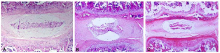
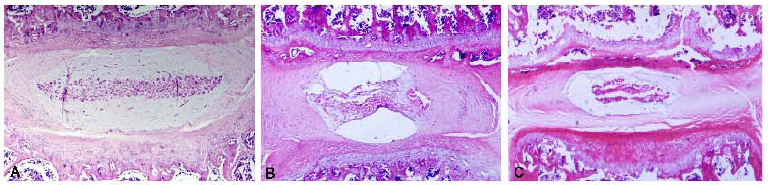
HE staining of cervical intervertebral disc (Light microscopy, ×40) A: Normal group; B: Cervical syndrome group; C: Combined group"

Figure 2

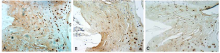
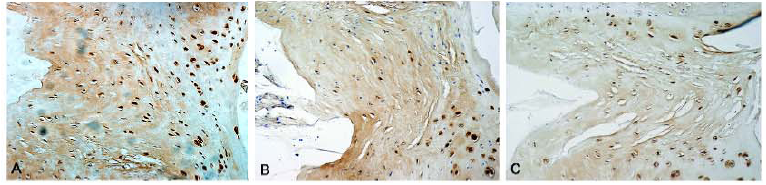
Immunohistochemical staining of type Ⅱ collagen in annular fibrosus of cervical intervertebral disc (Light microscopy, ×200) A: Normal group; B: Cervical syndrome group; C: Combined group."

Figure 3

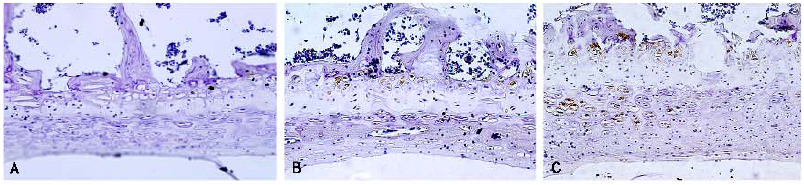
Immunohistochemical staining of type Ⅹ collagen of cervical intervertebral disc (Light microscopy, ×200) A: Normal group; B: Cervical syndrome group; C: Combined group."

Table 6

Expressions of Agc1, Col2a1, MMP-13 and TIMP-1 mRNAs of cervical intervertebral disc in three groups(x±s)"

Group n Agc1/β-actin Col2a1/β-actin MMP-13/β-actin TIMP-1/β-actin
Normal 6 1.00±0.31 1.00±0.34 1.00±0.25 1.00±0.43
Cervical syndrome 6 0.06±0.04** 0.58±0.01 1.69±0.30* 0.41±0.08
Combined 6 0.02±0.01** 0.30±0.20* 2.25±0.21** 0.76±0.24
[1] Chen Q. Technology of research on pharmacology of traditional Chinese medicine[M]. Beijing: People's Medical Publishing House,1994:1004, 1007, 1011, 1018
陈奇 . 中药药理研究方法学[M]. 北京: 人民卫生出版社,1994:1004, 1007, 1011, 1018
[2] Chen XY. Practical animal models of traditional Chinese medicine syndromes[M]. Beijing: Joint Publishing House of Peking Medical University and Peking Union Medical University,1993: 210-213
陈小野 . 实用中医证候动物模型学[M]. 北京: 北京医科大学中国协和医科大学联合出版社,1993: 210-213
[3] Xu SJ, Lu AP, Zhang CY , et al. Effect of kidney-asthenia caused by ovariectomy on the contents of IL-2 and IL-6 in type Ⅱ collagen induced arthritis(CIA)[J]. Zhongguo Zhong Yi Ji Chu Yi Xue Za Zhi, 1998,4(10):33-35
徐世杰, 吕爱平, 张春英 , 等. 切除卵巢所致肾虚对Ⅱ型胶原诱导的关节炎小鼠IL-2和IL-6含量的影响[J]. 中国中医基础医学杂志, 1998,4(10):33-35
[4] Wang YJ, Shi Q, Lu WW , et al. Cervical intervertebral disc degeneration induced by unbalanced dynamic and static forces: a novel in vivo rat model[J]. Spine, 2006,31(14):1532-1538
doi: 10.1097/01.brs.0000222019.84095.23
[5] Cheng ZQ, Wu YF, Tang YX , et al. Establishment and evaluation of the animal model of heart-qi deficiency syndrome of SD rats[J]. Shi Yan Dong Wu Ke Xue Yu Guan Li, 2003,20(3):1-6
程志清, 吴玉芙, 唐烨霞 , 等. SD大鼠心气虚证动物模型的建立与评价[J]. 实验动物科学与管理, 2003,20(3):1-6
[6] Jiang JC, Li CG, Liang QQ , et al. Establishment of a rat model of cervical syndrome with kidney deficiency[J]. Zhong Xi Yi Jie He Xue Bao, 2008,6(10):1034-1039
江建春, 李晨光, 梁倩倩 , 等. 大鼠肾虚型颈椎病模型的建立[J]. 中西医结合学报, 2008,6(10):1034-1039
[7] Ai JL, Lu AP, Xu SJ , et al. Experimental study of generating mechanism of sexual gland dysfunction type kidney deficiency arthromyodynia[J]. Zhongguo Zhong Yi Ji Chu Yi Xue Za Zhi, 1995,1(1):42-44
艾景录, 吕爱平, 徐世杰 , 等. 性腺功能异常型肾虚痹证发生机理的实验研究[J]. 中国中医基础医学杂志, 1995,1(1):42-44
[8] Chen XY. Practical animal models of traditional Chinese medicine syndromes[M]. Beijing: Joint Publishing House of Peking Medical University and Peking Union Medical University,1993: 47-58
陈小野 . 实用中医证候动物模型学[M]. 北京: 北京医科大学中国协和医科大学联合出版社,1993: 47-58
[9] Li XX, Li DX . Observation of spleen qi deficiency and Na+, K+-ATPase activity[J]. Zhongguo Yi Yao Xue Bao, 1996,11(2):48
李晓霞, 李德新 . 脾气虚与Na+、K+-ATPase活性的观察[J]. 中国医药学报, 1996,11(2):48
[10] Yang WY, Liang R, Chen JX , et al. Experimental study on the relationship between spleen qi deficiency syndrome and exocrine pancreas[J]. Zhongguo Zhong Yi Ji Chu Yi Xue Za Zhi, 1995,1(4):41-42
杨维益, 梁嵘, 陈家旭 , 等. 脾气虚证与胰腺外分泌功能关系的实验研究[J]. 中国中医基础医学杂志, 1995,1(4):41-42
[11] Liu JL, Song JN . Research on essence of blood stasis syndrome[J]. Liaoning Zhong Yi Za Zhi, 2006,33(9):1091-1093
doi: 10.3969/j.issn.1000-1719.2006.09.020
刘军莲, 宋剑南 . 中医血瘀证本质研究概况[J]. 辽宁中医杂志, 2006,33(9):1091-1093
doi: 10.3969/j.issn.1000-1719.2006.09.020
[12] Chen YB . Research advance on blood-stasis syndrome associated with activation of platelet[J]. Zhongguo Zhong Yi Ji Chu Yi Xue Za Zhi, 2004,10(11):70-72
陈永斌 . 血瘀证与血小板活化关联的研究进展[J]. 中国中医基础医学杂志, 2004,10(11):70-72
[13] Liu HQ, Qin JJ . Discussion on the relationship between renal deficiency blood stasis and postmenopausal osteoporosis[J]. Zhong Yi Yao Dao Bao, 2006,12(10):3-4, 29
doi: 10.3969/j.issn.1672-951X.2006.10.002
刘海全, 秦佳佳 . 论肾虚血瘀与绝经后骨质疏松症的关系[J]. 中医药导报, 2006,12(10):3-4, 29
doi: 10.3969/j.issn.1672-951X.2006.10.002
[1] Na Wu , Lu Song , Xin-xin Yang, Jiang-lei Wei , Zhen-guo Liu. Effects of Chinese herbal medicine Tianqi Pingchan Granule on G protein-coupled receptor kinase 6 involved in the prevention of levodopa-induced dyskinesia in rats with Parkinson disease. Journal of Chinese Integrative Medicine, 2012, 10(9): 1018-1024.
[2] Lawrence A. Olatunji, Taofeek O. Usman, Joseph O. Adebayo, Victoria A. Olatunji . Effects of aqueous extract of Hibiscus sabdariffa on renal Na+-K+-ATPase and Ca2+-Mg2+-ATPase activities in Wistar rats. Journal of Chinese Integrative Medicine, 2012, 10(9): 1049-1055.
[3] Dhirender Kaushik, Ajay Kumar, Pawan Kaushik, Avatar C. Rana. Anticonvulsant activity of alcoholic extract of bark of Pinus roxburghii Sarg. Journal of Chinese Integrative Medicine, 2012, 10(9): 1056-1060.
[4] Chan Chen, Chang-xun Chen, Xi-min Wu, Rui Wang, Yi-ming Li. Effects of extracts of Radix Scrophulariae on blood pressure in spontaneously hypertensive rats and the underlying mechanisms. Journal of Chinese Integrative Medicine, 2012, 10(9): 1009-1017.
[5] Jian-sheng Li, Ya Li, Su-yun Li, Yuan-yuan Wang, Li Deng, Yan-ge Tian, Su-li Jiang , Ying Wang. Long-term effects of Tiaobu Feishen therapies on systemic and local inflammation responses in rats with stable chronic obstructive pulmonary disease. Journal of Chinese Integrative Medicine, 2012, 10(9): 1039-1048.
[6] Karuna A. Talpate, Uma A. Bhosale, Mandar R. Zambare. Clitorea ternatea, a herb from Indian folklore, improves streptozotocin-induced diabetes and diabetes-induced cognitive decline in rats. Journal of Chinese Integrative Medicine, 2012, 10(8): 939-947.
[7] Samuel Joshua Pragasam, Vachana Murunikara, Evan Prince Sabina, Mahaboobkhan Rasool. Antiperoxidative potential of p-coumaric acid, a common dietary phenol, in adjuvant-induced arthritis in rats. Journal of Chinese Integrative Medicine, 2012, 10(8): 932-938.
[8] Zi-hui Li, Jian Wang, Rong-lin Cai, You-wen Wang, Jian-peng Hu. Establishment and evaluation of a rat model of ulcerative colitis with syndrome of dampness stagnancy due to spleen deficiency. Journal of Chinese Integrative Medicine, 2012, 10(8): 918-924.
[9] Meng Li, Ling Hu, Rong-lin Cai, Zi-jian Wu, Ke-ming Wang. Effects of electro-acupuncture at PC6 and BL15 on nerve electrical activity in spinal dorsal root and norepinephrine and dopamine contents in paraventricular nucleus of hypothalamus in rats with acute myocardial ischemia. Journal of Chinese Integrative Medicine, 2012, 10(8): 874-879.
[10] Xin-min Li, Hui Chen, Yan-yan Ren, Yan-li Lu. Effects of Chinese herbal medicine Xifeng Capsule on multidrug resistance-associated protein 1 expression in hippocampus and cortex of rats with lithium-pilocarpine-induced epilepsy. Journal of Chinese Integrative Medicine, 2012, 10(8): 911-917.
[11] Hong Wang , Jing-tian Ou , Xin Zhao , Ying Guoz , Hao-ping Mao. Vasodilator effect of oroxylin A on thoracic aorta isolated from rats. Journal of Chinese Integrative Medicine, 2012, 10(8): 880-885.
[12] C. Mouli Kalla, Vijaya Tartte, Dattatreya Rao Sirpurkar. Effectiveness of flavonoid-rich leaf extract of Acalypha indica in reversing experimental myocardial ischemia: biochemical and histopathological evidence. Journal of Chinese Integrative Medicine, 2012, 10(7): 784-792.
[13] Feng Xin-ying, Zhu Min, Zhang Qi-qi, Chen Yi-ping, Li Wen-wei. Selective protection of nigral dopaminergic neurons by echinacoside in a rat model of Parkinson disease induced by rotenone. Journal of Chinese Integrative Medicine, 2012, 10(7): 777-783.
[14] Chuan Chen, Hui-ying Chi, Zhi-hua Yu, Jiu-lin Chen . Effects of Chinese herbal medicine Shoushen Granule on telomere length and telomerase activity of peripheral white blood cells and vascular cells in rats with atherosclerosis. Journal of Chinese Integrative Medicine, 2012, 10(6): 667-673.
[15] Hui-qing Zhang , Zi-fei Yin , Jia-yu Sheng , Zhu-qian Jiang , Bao-yu Wu , Yong-hua Su. A comparison study of pharmacokinetics between bufalin-loaded bovine serum albumin nanoparticles and bufalin in rats. Journal of Chinese Integrative Medicine, 2012, 10(6): 674-680.
Viewed
Full text


Abstract

Cited

  Shared   
  Discussed   
[1] Wei-xiong Liang. Problems-solving strategies in clinical treatment guideline for traditional Chinese medicine and integrative medicine. Journal of Chinese Integrative Medicine, 2008, 6(1): 1-4
[2] Zhao-guo Li. Discussion on English translation of commonly used sentences in traditional Chinese medicine: part one. Journal of Chinese Integrative Medicine, 2008, 6(1): 107-110
[3] Jun Hu, Jian-ping Liu. Non-invasive physical treatments for chronic/recurrent headache. Journal of Chinese Integrative Medicine, 2008, 6(1): 31
[4] Xue-mei Liu, Qi-fu Huang, Yun-ling Zhang, Jin-li Lou, Hong-sheng Liu, Hong Zheng. Effects of Tribulus terrestris L. saponion on apoptosis of cortical neurons induced by hypoxia-reoxygenation in rats. Journal of Chinese Integrative Medicine, 2008, 6(1): 45-50
[5] . Uniform requirements for manuscripts submitted to biomedical journals: Writing and editing for biomedical publication (Chinese version, part two). Journal of Chinese Integrative Medicine, 2010, 8(11): 1001-1005
[6] Daniel Weber, Janelle M Wheat, Geoffrey M Currie. Inflammation and cancer: Tumor initiation, progression and metastasis,and Chinese botanical medicines. Journal of Chinese Integrative Medicine, 2010, 8(11): 1006-1013
[7] Hong Liu , Guo-liang Zhang, Li Shen , Zhen Zeng, Bao-luo Zhou, Cheng-hai Liu, Guang Nie . Application and evaluation of a pseudotyped virus assay for screening herbs for anti-H5Nl avian influenza virus. Journal of Chinese Integrative Medicine, 2010, 8(11): 1036-1040
[8] Zhao-guo Li . A discussion of English translation of 1995 and 1997 Chinese National Standards of Traditional Chinese Medical Terminologies for Clinical Diagnosis and Treatment. Journal of Chinese Integrative Medicine, 2010, 8(11): 1090-1096
[9] Rui Jin, Bing Zhang. A complexity analysis of Chinese herbal property theory: the multiple formations of herbal property (Part 1). Journal of Chinese Integrative Medicine, 2012, 10(11): 1198-1205
[10] Hui-min Liu, Xian-bo Wang, Yu-juan Chang, Li-li Gu. Systematic review and meta-analysis of randomized controlled trials of integrative medicine therapy for treatment of chronic severe hepatitis. Journal of Chinese Integrative Medicine, 2012, 10(11): 1211-1228
[an error occurred while processing this directive]