[an error occurred while processing this directive]

Journal of Chinese Integrative Medicine ›› 2009, Vol. 7 ›› Issue (5): 411-417.doi: 10.3736/jcim20090503

• Original Clinical Research • Previous Articles     Next Articles

Distribution pattern of traditional Chinese medicine syndromes in 793 patients with fatty liver disease

 Hua-feng Weia,Tao Liua,Lian-jun Xinga,Pei-yong Zhenga,Guang Jia,b   

  1. a Institute of Digestive Diseases and Department of Gastroenterology, Longhua Hospital, Shanghai University of Traditional Chinese Medicine, Shanghai 200032, China
    b E-institute of Traditional Chinese Medicine Internal Medicine,Shanghai University of Traditional Chinese Medicine, Shanghai 201203, China
  • Received:2008-10-13 Accepted:2009-02-17 Online:2009-05-20 Published:2009-05-15

Objective

To study the distribution pattern of traditional Chinese medicine (TCM) syndromes in fatty liver disease.
Methods

A multicenter and large sample survey was carried out by adopting the model of "combining disease with syndrome". A TCM syndrome information database was established by EPidata 3.1 software. The distribution pattern of TCM syndromes in fatty liver was studied by factor analysis and cluster analysis methods with SPSS 13.0 software.
Results

The basic syndromes of fatty liver included insufficiency of liver and kidney, flaring fire due to yin deficiency, liver-qi stagnation and spleen deficiency, spleen deficiency, spleen deficiency and dampness stagnation, mild syndrome of internal accumulation of damp-heat, blood stasis, severe syndrome of internal accumulation of damp-heat, and internal stagnation of phlegm-dampness. Single syndrome and combination of two to four basic syndromes were common in fatty liver disease. The syndrome of spleen deficiency and dampness stagnation was the most frequent one when its pathogenesis was simple, while the syndrome of insufficiency of liver and kidney was most frequent one when the pathogenesis was complicated. A total of 108 patients (13.6%) had no obvious symptoms, 46 patients (5.8%) were classified into the pattern of non-categorization, and the other patients were classified into five syndromes including phlegm accumulating with stagnation due to spleen deficiency (11.5%, 91/793), yin deficiency of liver and kidney (18.5%, 147/793), retention of phlegmatic dampness due to spleen deficiency (32.0%, 254/793), internal accumulation of damp-heat due to spleen deficiency (10.2%, 81/793), and damp obstruction due to liver-qi stagnation and spleen deficiency (8.3%, 66/793).
Conclusion

Multi-element analysis reveals the distribution pattern of TCM syndromes in fatty liver disease, which is worthy of further study. The basic pathogenesis is spleen deficiency, and has a close correlation with the liver and kidney. The main pathogenesis factors are phlegm, dampness, blood stasis, heat and liver-qi stagnation. Yin deficiency of liver and kidney is a typical syndrome in fatty liver disease.

Key words: Fatty liver, Syndrome, Epidemiological method, Multivariate analysis

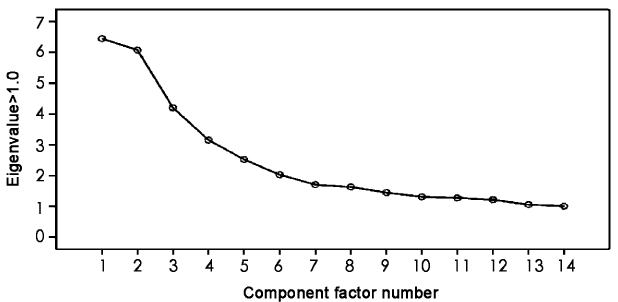
Figure 1

Scree plot of the initial factor analysis"

Table 1

Main symptoms of load values over 0.4 in the 10 common factors extracted from the second factor analysis"

Symptom Component
1 2 3 4 5 6 7 8 9 10
Afternoon fever 0.744
Hectic fever and tidal fever 0.851
Night sweats 0.577
Yellowish body and eyes 0.873
Tinnitus and deafness 0.678
Distending pain in hypochondrium 0.545
Dull pain of hypochondrium 0.420
Wandering pain 0.659
Fixed pain 0.909
Abdominal pain 0.880
Fullness of stomach and abdomen 0.475 0.568
Abdominal distension 0.623
Nausea and vomiting 0.642
Sour regurgitation 0.871
Belching 0.893
Anorexia 0.707
Tired of grease 0.434
Fatigue and weakness 0.459 0.520
Expectoration 0.823
Aching and weakness of waist and knees 0.729
Heel pain 0.732
Reddish swollen and painful eyes 0.885
Blurred vision 0.775
Dryness of eyes 0.762
Depression and sighing 0.695
Surprise and fear readily 0.616
Forgetfulness 0.715
Yellow urine 0.797
Frequent urination 0.585 0.404
Loose stools 0.436 0.441
Constipation 0.738
Halitosis 0.792
Pale-grayish complexion 0.538 0.534
Red face 0.570
Sallow complexion 0.740
Tongue with ecchymoses 0.865
Thin, whitish and greasy tongue fur 0.416 0.495
Thin, yellowish and greasy tongue fur 0.513 0.445
Yellow greasy fur 0.563
Scanty fur 0.517 0.600
Tongue with scanty fluid 0.401
Corpulent and tender tongue 0.836
Teeth-marked tongue 0.873
Prickled tongue 0.767
Thin tongue 0.668

Table 2

Combination of the basic syndrome factors in 631 cases"

Syndrome factor combination Factor 1 Factor 2 Factor 3 Factor 4 Factor 5 Factor 6 Factor 7 Factor 8 Factor 9
One factor 16 12 8 19 37 6 18 8 12
Two factors 64 40 45 26 84 37 34 33 29
Three factors 83 65 68 29 75 53 29 40 44
Four factors 79 48 54 20 48 45 46 48 48
Five factors 20 19 18 3 13 18 16 7 11
Six factors 3 3 3 0 1 3 3 0 2
Total 265 187 196 97 258 162 146 136 146

Table 3

Last cluster center after 25-time iteration"

Cluster Regression factor score
1 2 3 4 5
Regression factor score 1 for analysis 1 0.41 1.07 0.33 0.14 0.59
Regression factor score 2 for analysis 1 0.33 0.77 0.15 0.31 0.36
Regression factor score 3 for analysis 1 0.15 0.19 0.21 0.51 2.32
Regression factor score 4 for analysis 1 0.31 0.22 0.46 0.83 0.61
Regression factor score 5 for analysis 1 0.70 0.35 0.22 1.94 0.73
Regression factor score 6 for analysis 1 0.35 0.27 0.32 0.69 0.30
Regression factor score 7 for analysis 1 2.25 0.12 0.09 0.02 0.20
Regression factor score 8 for analysis 1 0.36 0.49 0.28 0.56 0.29
Regression factor score 9 for analysis 1 0.69 0.53 0.47 0.78 0.36
Regression factor score 10 for analysis 1 0.47 1.39 0.20 0.64 0.59
[1] Wei HF, Ji G, Xing LJ . Rudimental investigation on fatty liver syndrome differentiation typing law[J]. Liaoning Zhong Yi Za Zhi, 2002,29(11):655-656
魏华凤, 季光, 邢练军 . 脂肪肝辨证分型规律的初步研究[J]. 辽宁中医杂志, 2002,29(11):655-656
[2] Feng MH, Du FB . Study progress and thinking about Chinese medicine for the treatment of fatty liver[J]. Hunan Zhong Yi Yao Dao Bao, 2004,10(5):61-63
冯明辉, 杜发斌 . 脂肪肝中医药研究现状和思考[J]. 湖南中医药导报, 2004,10(5):61-63
[3] Wang BX. Hepatobiliary diseases of traditional Chinese medicine[M]. Beijing: China Medical-Pharmaceutical Science and Technology Publishing House,1993: 438
王伯祥 . 中医肝胆病学[M]. 北京: 中国医药科技出版社,1993: 438
[4] Fatty Liver and Alcoholic Liver Committee of Chinese Society of Hepatology. Diagnostic criteria for non-alcoholic fatty liver[J]. Gan Zang, 2004,7(4):W002
中华肝脏病学会脂肪肝和酒精性肝病学组. 非酒精性脂肪肝诊断标准[J]. 肝脏, 2004,7(4):W002
[5] Wang JL. Clinical epidemiology(2nd ed)[M]. Shanghai: Shanghai Scientific and Technical Publishers, 2001,( 2nd ed):202
王家良 . 临床流行病学(第2版)[M]. 上海: 上海科学技术出版社, 2001,( 第2版):202
[6] Wang YY. Internal medicine of traditional Chinese medicine(2nd ed)[M]. Shanghai: Shanghai Scientific and Technical Publishers,1997,(2nd ed)
王永炎 . 中医内科学(第2版)[M]. 上海: 上海科学技术出版社,1997,(第2版)
[7] Deng TT. Diagnostics of traditional Chinese medicine[M]. Shanghai: Shanghai Scientific and Technical Publishers,1984
邓铁涛 . 中医内科学[M]. 上海: 上海科学技术出版社,1984
[8] Chen XY, Huang BQ, Zhu WF . Characteristics of syndrome factors in the diseases with energy deficiency[J]. Zhongguo Zhong Yi Yao Za Zhi, 2005,3(9):911-914
陈新宇, 黄碧群, 朱文锋 . 正虚类病性证素的特征[J]. 中国中医药杂志, 2005,3(9):911-914
[9] Wang YY, Zhang QM, Zhang ZB . The induction of syndrome factor and affecting target[J]. Shandong Zhong Yi Yao Da Xue Xue Bao, 2006,30(1):6-7
王永炎, 张启明, 张志斌 . 证候要素及其靶位的提取[J]. 山东中医药大学学报, 2006,30(1):6-7
[1] Qi-sheng Tang, Wen-jun Sun, Miao Qu, Dong-fang Guo. Analysis of syndrome discipline of generalized anxiety disorder using data mining techniques. Journal of Chinese Integrative Medicine, 2012, 10(9): 975-982.
[2] Lu Liu, Ying Gao. Study on the correlation between traditional Chinese medicine syndrome and short-term prognosis of ischemic stroke using logistic regression model and repeated-measures analysis of variance. Journal of Chinese Integrative Medicine, 2012, 10(9): 983-990.
[3] Yan Guan , Hui Zhang, Wei Zhang, Shi-bing Su . Analysis of differential gene expression profile in peripheral blood of patients with chronic hepatitis B and syndromes of dual deficiency of liver and kidney yin and accumulation of dampness heat. Journal of Chinese Integrative Medicine, 2012, 10(7): 751-756.
[4] Ying-fei Bi , Jing-yuan Mao , Xian-liang Wang , Ya-zhu Hou , Yi-zhu Lu , Shan Bin Soh , Bo-li Zhang. Clinical epidemiology survey of the traditional Chinese medicine etiology and syndrome differentiation of coronary artery disease: Study protocol of a multicenter trial. Journal of Chinese Integrative Medicine, 2012, 10(6): 619-627.
[5] Qing-bo Lang, Dong-xia Zhai , Feng Huang, Jian-guo Chen, Yong-hui Zhang, Qun Liu, Xiao-feng Zhai , Bai Li, Chang-quan Ling. Investigation on traditional Chinese medicine syndrome distribution of 4 618 hepatitis B virus infection subjects in Qidong of Jiangsu Province, China. Journal of Chinese Integrative Medicine, 2012, 10(5): 525-531.
[6] Jia-jia Wang , Tian-fang Wang , Xiu-yan WU , Yah Zhao , Xiao-lin Xue , Qing-guo Wang. Weighting coefficients of symptoms and signs in the diagnosis of corresponding TCM syndrome elements of ulcerative colitis based on expert questionnaire investigation. Journal of Chinese Integrative Medicine, 2012, 10(4): 398-405.
[7] Mao Zhi-min, Song Hai-yan, Yang Li-li, Liu Tao, Li Dong-fei, Zheng Pei-yong, Liu Ping, Ji Guang. Effects of the mixture of Swertia pseudochinensis Hara and Silybum marianum Gaertn extracts on CCl4-induced liver injury in rats with non-alcoholic fatty liver disease. Journal of Chinese Integrative Medicine, 2012, 10(2): 193-199.
[8] Hu Xiao-Yu, Zhang Yang, Chen Guo, Zhong Sen, Fan Xin-Jian. A prospective cohort study on the influence of high doses of herbs for clearing heat and resolving stasis on survival rates in patients with hepatitis B-related acute-on-chronic liver failure. Journal of Chinese Integrative Medicine, 2012, 10(2): 176-185.
[9] Yu Zhao, Jing-hua Peng , Xue-mei Li , Qi-lin Fu, Tuan Cui , Qi Li, Ya-jun Tang , Qin Feng , Hua Zhang , Hua Zhou , Yi-yang Hu. Diagnostic value of clinical indices in syndrome differentiation of chronic hepatitis B: an exploration based on receiver operating characteristic curves and stepwise discriminant analysis. Journal of Chinese Integrative Medicine, 2012, 10(12): 1382-1387.
[10] Dong-tao Li, Jian Wang , Hong-yang Jiang , Feng-lei Shi , Fu-yu Li , Ji-hong Liu , Yong-mei Cheng , Nan Yan , Ai-hua Hu, Mei-zeng Zhang , Jie Li, Ling-bo Wei , Rong-qin Jiang. Quantitative evaluation of the degrees of traditional Chinese medicine qualitative syndromes of osteoporosis. Journal of Chinese Integrative Medicine, 2012, 10(11): 1254-1262.
[11] Tao Liu , Li-li Yang , Li Zhang, Hai-yan Song , Dong-fei Li , Guang li. Comparative study on the effects of different therapeutic methods in preventing and treating nonalcoholic fatty liver in rats. Journal of Chinese Integrative Medicine, 2012, 10(10): 1120-1126.
[12] Jing Zhang , Long Liu , Xin Yan , Xiao-qiang Yue. Study of the syndromes of traditional Chinese medicine in terms of metabonomics technology: The current situation and considerations. Journal of Chinese Integrative Medicine, 2012, 10(10): 1069-1076.
[13] Gui-xiang Chu, Qing-guang Chen, Jia-tuo Xu , Bo Yu , Min Zhang , Long-tao Cui , Hong-jin Wu , Zhao-fu Fei. Analysis on pulse diagram characteristics of subjects with subhealth state. Journal of Chinese Integrative Medicine, 2012, 10(10): 1099-1105.
[14] Liu Yue, Xie Ming, Zhang Ye. Dynamic changes of laboratory parameters of rats with type 2 diabetes and insulin resistance: defining their role in development of traditional Chinese medicine syndrome. Journal of Chinese Integrative Medicine, 2012, 10(1): 100-108.
[15] Li-li Yang, Miao Wang, Tao Liu, Hai-yan Song, Dong-fei Li, Pei-yong Zheng, Ping Liu, Guang Ji. Effects of Chinese herbal medicine Jiangzhi Granule on expressions of liver X receptor α and sterol regulatory element-binding protein-1c in a rat model of non-alcoholic fatty liver disease. Journal of Chinese Integrative Medicine, 2011, 9(9): 998-1004.
Viewed
Full text


Abstract

Cited

  Shared   
  Discussed   
[1] Wei-xiong Liang. Problems-solving strategies in clinical treatment guideline for traditional Chinese medicine and integrative medicine. Journal of Chinese Integrative Medicine, 2008, 6(1): 1-4
[2] Zhao-guo Li. Discussion on English translation of commonly used sentences in traditional Chinese medicine: part one. Journal of Chinese Integrative Medicine, 2008, 6(1): 107-110
[3] Jun Hu, Jian-ping Liu. Non-invasive physical treatments for chronic/recurrent headache. Journal of Chinese Integrative Medicine, 2008, 6(1): 31
[4] Xue-mei Liu, Qi-fu Huang, Yun-ling Zhang, Jin-li Lou, Hong-sheng Liu, Hong Zheng. Effects of Tribulus terrestris L. saponion on apoptosis of cortical neurons induced by hypoxia-reoxygenation in rats. Journal of Chinese Integrative Medicine, 2008, 6(1): 45-50
[5] . Uniform requirements for manuscripts submitted to biomedical journals: Writing and editing for biomedical publication (Chinese version, part two). Journal of Chinese Integrative Medicine, 2010, 8(11): 1001-1005
[6] Daniel Weber, Janelle M Wheat, Geoffrey M Currie. Inflammation and cancer: Tumor initiation, progression and metastasis,and Chinese botanical medicines. Journal of Chinese Integrative Medicine, 2010, 8(11): 1006-1013
[7] Hong Liu , Guo-liang Zhang, Li Shen , Zhen Zeng, Bao-luo Zhou, Cheng-hai Liu, Guang Nie . Application and evaluation of a pseudotyped virus assay for screening herbs for anti-H5Nl avian influenza virus. Journal of Chinese Integrative Medicine, 2010, 8(11): 1036-1040
[8] Zhao-guo Li . A discussion of English translation of 1995 and 1997 Chinese National Standards of Traditional Chinese Medical Terminologies for Clinical Diagnosis and Treatment. Journal of Chinese Integrative Medicine, 2010, 8(11): 1090-1096
[9] Rui Jin, Bing Zhang. A complexity analysis of Chinese herbal property theory: the multiple formations of herbal property (Part 1). Journal of Chinese Integrative Medicine, 2012, 10(11): 1198-1205
[10] Hui-min Liu, Xian-bo Wang, Yu-juan Chang, Li-li Gu. Systematic review and meta-analysis of randomized controlled trials of integrative medicine therapy for treatment of chronic severe hepatitis. Journal of Chinese Integrative Medicine, 2012, 10(11): 1211-1228
[an error occurred while processing this directive]