[an error occurred while processing this directive]

Journal of Chinese Integrative Medicine ›› 2011, Vol. 9 ›› Issue (11): 1242-1247.doi: 10.3736/jcim20111113

• Original Experimental Research • Previous Articles     Next Articles

Crohn disease in rats induced by different concentrations of trinitrobenzenesulfonic acid and ethanol

Shu Yang, Xin-yue Wang(), Shan Jing, Xue Yang, Yi-hua Sheng, Xin Yan   

  1. Department of Digestive Diseases, Dongzhimen Hospital, Beijing University of Chinese Medicine, Beijing 100700, China
  • Received:2011-06-28 Accepted:2011-08-01 Online:2011-11-20 Published:2011-11-15

Objective: To induce Crohn disease in rats by intraluminal instillations of different concentrations of 2,4,6-trinitrobenzenesulfonic acid (TNBS) and ethanol.
Methods: Crohn disease in rats was induced with enema containing TNBS and 50% ethanol with volume ratio of 2∶1 (experimental group 1) or 1∶1 (experimental group 2), or solution containing TNBS and anhydrous ethanol with volume ratio of 2∶1 (experimental group 3) or 1∶1 (experimental group 4). Equivalent volume of normal saline was used to set as the normal saline control, and rats without any treatment were set as the normal control group. The rats were killed at various time points (3, 7, 14 and 21 d) respectively. Colonic inflammation and damage were assessed macroscopically and histologically.
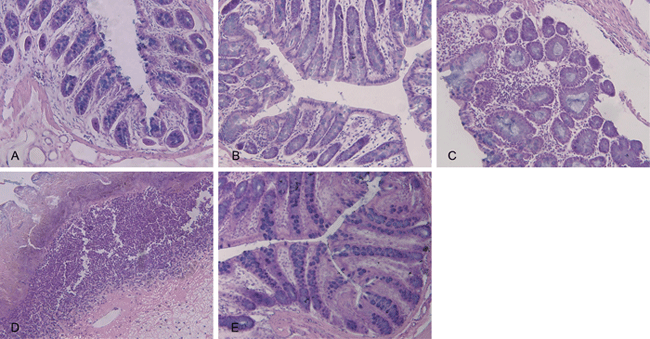
Results: In the colon of rats in the experimental group 3, discontinuous erosion, ulceration and infiltration of neutrophils occurred after one week; pebble sign and even segmental inflammation appeared on day 14. On day 21, it appeared improvement in the colon tissue and obviously thickened bowel wall, but the inflammation was easily observed under the light microscope. Experimental group 1 was similar to experimental group 3 in appearance of the colon on days 3 and 7; on day 14, colonic inflammation and damage were improved as compared with the experimental group 3, but there were obvious individual differences in histological findings among rats in group 1. In the experimental group 2, the intestinal wall turned to be normal on day 14. In the experimental group 4, there were high mortality and extensive damage of colon tissues, and the pathological characteristics were quite different from Crohn disease in humans.
Conclusion: The characteristics of the rat model of Crohn disease induced with a enema containing TNBS and anhydrous ethanol with volume ratio of 2∶1 are similar to the clinical features of human Crohn disease, including typical pathological characteristics and long duration of inflammation. It may be an ideal experimental model for studying pathogenesis of Crohn disease and for evaluating treatment effects.

Key words: Crohn's disease, disease models, animal, trinitrobenzenesulfonic acid, ethanol, rats

Table 1

Body weight of rats in each group at different time points (x±s, g)"

Day 1 Day 3 Day 7 Day 14 Day 21
Group n Body weight n Body weight n Body weight n Body weight n Body weight

Normal control
30
171.767±5.367

6

182.333±2.251

6
212.500±5.244
9

262.444±6.616

9
336.111±5.862

Saline control
30
172.600±5.360

6

185.000±4.472

6
213.333±7.528
9

260.556±8.457

9
334.778±6.648

Experimental 1
30
171.333±5.371

6

161.333±
3.830**△△

6
140.833±
2.041**△△▲▲■■

8

183.125±
3.720**△△▲▲□□■■

9
245.333±
5.895**△△▲▲□□■■

Experimental 2
30
171.467±5.964

6

162.167±
4.708**△△

6
191.667±
4.082**△△□□■■

9

233.333±
4.330**△△□□■■

9
303.667±
5.788**△△□□■■

Experimental 3
30
171.400±5.411

6

161.667±
4.502**△△

6
141.667±
2.582**△△■■

7

173.571±
3.505**△△■■

8
211.250±
2.315**△△■■

Experimental 4
30
170.800±5.307

6

160.500±
5.244**△△

6
133.333±
4.082**△△

6

153.667±
6.218**△△

6
187.667±
4.546**△△

Table 2

Microscopic evaluation of rats in each group at different time points (x±s)"


Group

Day 3

Day 7
Day 14 Day21
n
Macroscopic grade

n

Macroscopic grade

n
Macroscopic grade n Macroscopic grade

Saline control

6

0.183±0.117

6

0.100±0.110

9

0.056±0.073

9
0.033±0.050

Experimental 1

6

8.333±
1.080△△▲▲■■

6

7.500±
1.095△△▲▲■■

8

6.250±
0.655△△▲▲□□■■

9

5.167±
0.500△△▲□□■■

Experimental 2

6

7.000±
0.775△△□□■■

6

5.750±
0.987△△□□■■

9

5.111±
0.220△△□□■■

9

4.722±
0.441△△□□■■

Experimental 3

6

8.667±
0.516△△

6

7.767±
0.408△△■

7

7.657±
0.690△△■

8

6.575±
0.403△△■

Experimental 4

6

9.417±
0.376△△

6

8.750±
0.274△△

6

8.250±
0.274△△

6

7.083±
0.376△△

Table 3

Histological evaluation of rats in each experimental group at different time points (x±s)"


Group
Day 3 Day 7 Day 14 Day 21

n

Histological grade

n

Histological grade

n

Histological grade

n

Histological grade

Saline control

6

0.083±0.098

6

0.050±0.055

9

0.056±0.053

9
0.056±0.073

Experimental 1

6

5.667±
0.683△△▲■■

6

5.250±
0.274△△▲■■

8

4.638±
0.619△△□□■■

9
4.222±
0.441△△□■■

Experimental 2

6

5.000±
0.447△△□□■■

6

4.667±
0.516△△□□■■

9

4.456±
0.442△△□□■■

9
3.800±
0.557△△□□■■

Experimental 3

6

6.133±
0.432△△■■

6

5.650±
0.288△△■■

7

5.457±
0.408△△■■

8
4.750±
0.598△△■■

Experimental 4

6

7.500±
0.775△△

6

7.417±
0.585△△

6

6.767±
0.606△△

6
5.500±
0.447△△

Figure 1

Changes of intestinal tissues in each group observed by hematoxylin and eosin staining on day 14 after modeling (Light microscopy, ×200) A: Experimental group 1; B: Experimental group 2; C: Experimental group 3; D: Experimental group 4; E: Saline control group."

[1] Masselli G, Brizi MG, Menchini L, Minordi L, Vecchioli Scaldazza A . Magnetic Eesonance Enteroclysis imaging of Crohn’s. Radiol Med. 2005; 110(3):221-233.
[2] Yu LH, Si JM . Situation and prospect in modeling of experimental inflammatory bowel disease. Quan Ke Yi Xue Lin Chuang Yu Jiao Yu. 2007; 5(5): 392-394. Chinese.
虞玲华, 姒健敏 . 实验性炎症性肠病模型的制作现状与展望.全科医学临床与教育. 2007; 5(5):392-394.
[3] Morris GP, Beck PL, Herridge MS, Depew WT, Szewczuk MR, Wallace JL . Hapten-induced model of chronic inflammation and ulceration in the rat colon. Gastroenterology. 1989; 96(3):795-803.
doi: 10.1016/0016-5085(89)90904-9 pmid: 2914642
[4] Anthony D, Savage F, Sams V, Boulos P . The characterization of a rabbit model of inflammatory bowel disease. [J] Int Exp Pathol. 1995; 76(3):215-224.
doi: 10.1016/0046-8177(95)90183-3 pmid: 7547433
[5] Zheng L, Gao ZQ, Wang SX . A chronic ulcerative colitis model in the rat. Zhongguo Yao Li Xue Tong Bao. 1998; 14(4) : 370-372. Chinese with abstract in English.
doi: 10.3969/j.issn.1671-038X.2006.04.009
郑礼, 髙振强, 王淑仙 . 大鼠溃疡性结肠炎模型的实验研究.中国药理学通报. 1998; 14(4):370-372.
doi: 10.3969/j.issn.1671-038X.2006.04.009
[6] Wang H, Ouyang Q, Hu RW . Establishment of rat colitis model induced by trinitrobenzenesulfonic acid. Wei Chang Bing Xue. 2001; 6(1) : 7-10. Chinese with abstract in English.
doi: 10.3969/j.issn.1008-7125.2001.01.003
王皓, 欧阳钦, 胡仁伟 . 三硝基苯磺酸结肠炎动物模型的建立.胃肠病学. 2001; 6(1):7-10.
doi: 10.3969/j.issn.1008-7125.2001.01.003
[7] Mahadeva U, Martin JP, Patel NK, Price AB . Granulomatous ulcerative colitis : a re-appraisal of the mucosal granuloma in the distinction of Crohn’s disease from ulcerative colitis. Histopathology. 2002; 41(1):50-55.
doi: 10.1046/j.1365-2559.2002.01416.x
[8] Mei Q, Xu JM, Xiang L . Establishment of rat colon injury model with acetic acid in vitro and the protective effect of melatonin. Zhongguo Yao Li Xue Tong Bao. 2006; 22(1) : 117-120. Chinese with abstract in English.
梅俏, 许建明, 项立 . 乙酸体外损伤大鼠结肠模型的建立及褪黑素的影响.中国药理学通报. 2006; 22(1):117-120.
[9] Zhang YF, Chen RS, Wu ZZ, Yang M . Establishment and evaluation of colitis in mice induced by dextrin sulfate sodium. Shenzhen Zhong Xi Yi Jie He Za Zhi. 2005; 15(5): 268-270. Chinese.
张永锋, 陈如山, 吴正治, 杨敏 . 葡聚糖硫酸钠致小鼠结肠炎模型的建立与评价.深圳中西医结合杂志. 2005; 15(5) : 268-270.
[10] Zhang YL, Wang CD . Model establishing methods, characteristics and influencing factors of colitis model induced by dextrin sulfate sodium. Wei Chang Bing Xue. 2006; 11(1): 56-58. Chinese.
doi: 10.3969/j.issn.1008-7125.2006.01.017
张艳丽, 王承党 . 葡聚糖硫酸钠结肠炎模型的制作方法、特点和影响因素.胃肠病学. 2006; 11(1):56-58.
doi: 10.3969/j.issn.1008-7125.2006.01.017
[11] Zhao Y, Yang SZ, Tan Y, Jiang Z, Wang L, Fang YQ . The level of Thl/Th2 type cytokines mRNA in spleen of TNBS and OXZ colitis mice. Zhongguo Lao Nian Xue Za Zhi. 2006; 11(26): 1501-1502. Chinese with abstract in English.
赵颖, 杨世忠, 谭岩, 姜喆, 王岚, 方艳秋 . 三硝基苯磺酸和恶唑酮诱导肠炎小鼠脾脏中Thl/Th2类细胞因子基因表达的动态研究.中国老年学杂志. 2006; 26(11) : 1501-1502.
[12] John MF . Induction of hapten-specific immunological tolerance and immunity in B lymphocytes; W. Correlation between trinitrobenzenesulfonic acid administration, serum trinitrophenyl content, and level of tolerance. Cell Immunol. 1985; 94(1) : 285-291.
doi: 10.1016/0008-8749(85)90106-6
[13] Chen YQ, Dong FL, Ma GT . Experimental study of ulcerative colitis in rats induced by trinitrobenzene sulfonic acid. Tong Ji Da Xue Xue Bao Yi Xue Ban. 2006; 27 (6) : 31-33. Chinese with abstract in English.
doi: 10.3969/j.issn.1008-0392.2006.06.008
陈英群, 董福轮, 马贵同 . 三硝基苯磺酸诱导大鼠溃疡性结肠炎的实验研究. 同济大学学报(医学版). 2006; 27(6):31-33.
doi: 10.3969/j.issn.1008-0392.2006.06.008
[14] Long YM, Chen K, Lan L, Wang H . Improvement of establishing Crohn 5 s disease model in rats. Guangdong Yi Xue Yuan Xue Bao. 2004; 22(1): 4-7. Chinese with abstract in English.
龙友明, 陈垦, 兰雷, 王晖 . 大鼠Crohn病模型制备的改进.广东医学院学报. 2004; 22(1):4-7.
[1] Na Wu , Lu Song , Xin-xin Yang, Jiang-lei Wei , Zhen-guo Liu. Effects of Chinese herbal medicine Tianqi Pingchan Granule on G protein-coupled receptor kinase 6 involved in the prevention of levodopa-induced dyskinesia in rats with Parkinson disease. Journal of Chinese Integrative Medicine, 2012, 10(9): 1018-1024.
[2] Lawrence A. Olatunji, Taofeek O. Usman, Joseph O. Adebayo, Victoria A. Olatunji . Effects of aqueous extract of Hibiscus sabdariffa on renal Na+-K+-ATPase and Ca2+-Mg2+-ATPase activities in Wistar rats. Journal of Chinese Integrative Medicine, 2012, 10(9): 1049-1055.
[3] Dhirender Kaushik, Ajay Kumar, Pawan Kaushik, Avatar C. Rana. Anticonvulsant activity of alcoholic extract of bark of Pinus roxburghii Sarg. Journal of Chinese Integrative Medicine, 2012, 10(9): 1056-1060.
[4] Chan Chen, Chang-xun Chen, Xi-min Wu, Rui Wang, Yi-ming Li. Effects of extracts of Radix Scrophulariae on blood pressure in spontaneously hypertensive rats and the underlying mechanisms. Journal of Chinese Integrative Medicine, 2012, 10(9): 1009-1017.
[5] Jian-sheng Li, Ya Li, Su-yun Li, Yuan-yuan Wang, Li Deng, Yan-ge Tian, Su-li Jiang , Ying Wang. Long-term effects of Tiaobu Feishen therapies on systemic and local inflammation responses in rats with stable chronic obstructive pulmonary disease. Journal of Chinese Integrative Medicine, 2012, 10(9): 1039-1048.
[6] Karuna A. Talpate, Uma A. Bhosale, Mandar R. Zambare. Clitorea ternatea, a herb from Indian folklore, improves streptozotocin-induced diabetes and diabetes-induced cognitive decline in rats. Journal of Chinese Integrative Medicine, 2012, 10(8): 939-947.
[7] Samuel Joshua Pragasam, Vachana Murunikara, Evan Prince Sabina, Mahaboobkhan Rasool. Antiperoxidative potential of p-coumaric acid, a common dietary phenol, in adjuvant-induced arthritis in rats. Journal of Chinese Integrative Medicine, 2012, 10(8): 932-938.
[8] Zi-hui Li, Jian Wang, Rong-lin Cai, You-wen Wang, Jian-peng Hu. Establishment and evaluation of a rat model of ulcerative colitis with syndrome of dampness stagnancy due to spleen deficiency. Journal of Chinese Integrative Medicine, 2012, 10(8): 918-924.
[9] Meng Li, Ling Hu, Rong-lin Cai, Zi-jian Wu, Ke-ming Wang. Effects of electro-acupuncture at PC6 and BL15 on nerve electrical activity in spinal dorsal root and norepinephrine and dopamine contents in paraventricular nucleus of hypothalamus in rats with acute myocardial ischemia. Journal of Chinese Integrative Medicine, 2012, 10(8): 874-879.
[10] Hong Wang , Jing-tian Ou , Xin Zhao , Ying Guoz , Hao-ping Mao. Vasodilator effect of oroxylin A on thoracic aorta isolated from rats. Journal of Chinese Integrative Medicine, 2012, 10(8): 880-885.
[11] Xin-min Li, Hui Chen, Yan-yan Ren, Yan-li Lu. Effects of Chinese herbal medicine Xifeng Capsule on multidrug resistance-associated protein 1 expression in hippocampus and cortex of rats with lithium-pilocarpine-induced epilepsy. Journal of Chinese Integrative Medicine, 2012, 10(8): 911-917.
[12] C. Mouli Kalla, Vijaya Tartte, Dattatreya Rao Sirpurkar. Effectiveness of flavonoid-rich leaf extract of Acalypha indica in reversing experimental myocardial ischemia: biochemical and histopathological evidence. Journal of Chinese Integrative Medicine, 2012, 10(7): 784-792.
[13] Feng Xin-ying, Zhu Min, Zhang Qi-qi, Chen Yi-ping, Li Wen-wei. Selective protection of nigral dopaminergic neurons by echinacoside in a rat model of Parkinson disease induced by rotenone. Journal of Chinese Integrative Medicine, 2012, 10(7): 777-783.
[14] Chuan Chen, Hui-ying Chi, Zhi-hua Yu, Jiu-lin Chen . Effects of Chinese herbal medicine Shoushen Granule on telomere length and telomerase activity of peripheral white blood cells and vascular cells in rats with atherosclerosis. Journal of Chinese Integrative Medicine, 2012, 10(6): 667-673.
[15] Hui-qing Zhang , Zi-fei Yin , Jia-yu Sheng , Zhu-qian Jiang , Bao-yu Wu , Yong-hua Su. A comparison study of pharmacokinetics between bufalin-loaded bovine serum albumin nanoparticles and bufalin in rats. Journal of Chinese Integrative Medicine, 2012, 10(6): 674-680.
Viewed
Full text


Abstract

Cited

  Shared   
  Discussed   
[1] Wei-xiong Liang. Problems-solving strategies in clinical treatment guideline for traditional Chinese medicine and integrative medicine. Journal of Chinese Integrative Medicine, 2008, 6(1): 1-4
[2] Zhao-guo Li. Discussion on English translation of commonly used sentences in traditional Chinese medicine: part one. Journal of Chinese Integrative Medicine, 2008, 6(1): 107-110
[3] Jun Hu, Jian-ping Liu. Non-invasive physical treatments for chronic/recurrent headache. Journal of Chinese Integrative Medicine, 2008, 6(1): 31
[4] Xue-mei Liu, Qi-fu Huang, Yun-ling Zhang, Jin-li Lou, Hong-sheng Liu, Hong Zheng. Effects of Tribulus terrestris L. saponion on apoptosis of cortical neurons induced by hypoxia-reoxygenation in rats. Journal of Chinese Integrative Medicine, 2008, 6(1): 45-50
[5] . Uniform requirements for manuscripts submitted to biomedical journals: Writing and editing for biomedical publication (Chinese version, part two). Journal of Chinese Integrative Medicine, 2010, 8(11): 1001-1005
[6] Daniel Weber, Janelle M Wheat, Geoffrey M Currie. Inflammation and cancer: Tumor initiation, progression and metastasis,and Chinese botanical medicines. Journal of Chinese Integrative Medicine, 2010, 8(11): 1006-1013
[7] Hong Liu , Guo-liang Zhang, Li Shen , Zhen Zeng, Bao-luo Zhou, Cheng-hai Liu, Guang Nie . Application and evaluation of a pseudotyped virus assay for screening herbs for anti-H5Nl avian influenza virus. Journal of Chinese Integrative Medicine, 2010, 8(11): 1036-1040
[8] Zhao-guo Li . A discussion of English translation of 1995 and 1997 Chinese National Standards of Traditional Chinese Medical Terminologies for Clinical Diagnosis and Treatment. Journal of Chinese Integrative Medicine, 2010, 8(11): 1090-1096
[9] Rui Jin, Bing Zhang. A complexity analysis of Chinese herbal property theory: the multiple formations of herbal property (Part 1). Journal of Chinese Integrative Medicine, 2012, 10(11): 1198-1205
[10] Hui-min Liu, Xian-bo Wang, Yu-juan Chang, Li-li Gu. Systematic review and meta-analysis of randomized controlled trials of integrative medicine therapy for treatment of chronic severe hepatitis. Journal of Chinese Integrative Medicine, 2012, 10(11): 1211-1228
[an error occurred while processing this directive]