[an error occurred while processing this directive]

Journal of Chinese Integrative Medicine ›› 2012, Vol. 10 ›› Issue (10): 1099-1105.doi: 10.3736/jcim20121006

Previous Articles     Next Articles

Analysis on pulse diagram characteristics of subjects with subhealth state

Gui-xiang Chu1, Qing-guang Chen2, Jia-tuo Xu1(), Bo Yu1, Min Zhang1, Long-tao Cui1, Hong-jin Wu1, Zhao-fu Fei1   

  1. 1. Fei Zhaofu Teacher Research, Shanghai University of Traditional Chinese Medicine, Shanghai 201203, China
    2. Department of Endocrinology, Shuguang Hospital, Shanghai University of Traditional Chinese Medicine, Shanghai 201203, China
  • Received:2012-08-19 Accepted:2012-08-31 Online:2012-10-20 Published:2018-10-15
  • Contact: Xu Jia-tuo E-mail:xjt@fudan.edu.cn

Objective: To study the pulse diagram parameters of subjects with subhealth state and to find the pulse parameters for subhealth state evaluation. .

Conclusion: A total of 1 275 subjects without diagnosed diseases were recruited and their health conditions were assessed with Health Evaluating Questionnaire H20 V2009. The subjects were assigned to health group or subhealth group according to the scale score. Subjects’ syndrome in the subhealth group was differentiated using score of “subhealth state of syndrome differentiation V2010”. Another 121 patients with cardiovascular diseases were enrolled as a control. The pulse information was collected with YJJ-101 subhealth pulse monitoring system and the parameters include amplitude of main wave (h1), amplitude of repeat wave (h5) and its front wave (h3), 1/3 or 1/5 width of main wave (w1) or (w2), time of rapid ejection phase (t2), period of pulse (t), pulse pressure (Pp), square (S), area in systole (As) and area in diastole (Ad) of pulse diagram and ratios of h3/h1, h5/h1, w1/t, w2/t and h1/t1.

Results: Pulse diagram analysis showed significant differences among health, subhealth and disease group in Pp, h1, S and As and ratios of h5/h1 and w2/t. Compared with the health group, the values of w1/t and w2/t of the subhealth group increased (P<0.05), and Pp, h1, h5, h5/h1, S, As and Ad decreased (P<0.05). Compared with health group, the parameters of pulse of the subhealth group were increased in Pp and h5/h1 (P<0.05) and decreased in h1, w2/t, S and As (P<0.05). Compared with health group, pulse parameters h3/h1, w1, w1/t, w2/t of excess and deficiency syndrome group increased, and h1, h5, h1/t1 and h5/h1 decreased. Among different syndromes of subhealth state, pulse diagram parameters h1, h5, h3/h1, h5/h1 and w1/t of yin deficiency, qi deficiency, liver stagnation and excess heat group were significantly different (P<0.05) from the health group, for example, pulse parameters h1 and h5 of stagnation, yin deficiency, qi deficiency and excess heat group declined in order, and pulse parameters h3/h1 and w1/t of liver stagnation, excess heat, yin deficiency and qi deficiency group increased in order. Pulse index h1 in the kidney deficiency group was higher than that in the health group and the other syndrome groups.

Conclusion: Results of analyzing sphygmogram parameters showed different characteristics among different health status and the subhealth state due to different syndromes. Sphygmogram parameters may be used for objective evaluation of health status or subhealth syndrome differentiation.

Key words: subhealth status, pulse presentations, sphygmogram, symptom complex, syndrome differentiation, clinical trial

Table 1

Pulse diagram parameters of different health status ($\overline{x}$±s)"

Group n Pp (g) h1 (mm) h5 (mm) h5/h1 w1/t
Health 488 137.39±22.24 14.18±3.29 0.61±0.92 0.04±0.06 0.20±0.06
Subhealth 476 133.84±24.16** 12.50±3.64** 0.24±0.76** 0.02±0.06** 0.22±0.06**
Disease 121 126.07±27.09**△ 15.24±4.46*△△ 0.10±0.10** 0.01±0.06**△△ 0.23±0.04**
Group n w2/t S (mm2) As (mm2) Ad (mm2)
Health 488 0.14±0.05 4.19±1.25 2.75±0.79 1.43±0.59
Subhealth 476 0.15±0.05** 3.84±1.25** 2.56±0.81** 1.28±0.57
Disease 121 0.17±0.04**△△ 4.53±1.55**△△ 3.13±0.99**△ 1.39±0.75

Figure 1

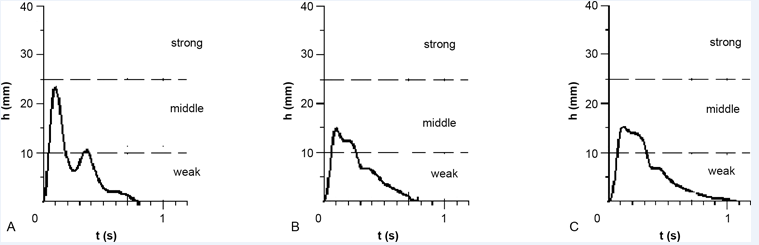
Pulse diagrams of health group (A), subhealth group (B) and disease group (C) "

Table 2

Pulse diagram parameters of different types of subhealth status ($\overline{x}$±s)"

Group n h1 (mm) h5 (mm) h1/t1 h3/h1 h5/h1 w1 (s)
Health 488 14.18±3.29 0.61±0.92 125.67±33.56 0.59±0.18 0.04±0.06 0.16±0.05
Excess syndrome 124 12.62±3.48* 0.28±0.94* 108.20±31.67* 0.64±0.18* 0.02±0.07* 0.17±0.05*
Deficiency syndrome 73 12.76±4.19* 0.22±0.59* 110.76±37.68* 0.70±0.18*▲ 0.02±0.04* 0.18±0.06*
Group n w1/t w2/t S (mm2) As (mm2) Ad (mm2)
Health 488 0.20±0.06 0.14±0.05 4.19±1.25 2.75±0.79 1.43±0.59
Excess syndrome 124 0.22±0.05* 0.15±0.05* 3.78±1.25* 2.58±0.83* 1.21±0.53*
Deficiency syndrome 73 0.23±0.06* 0.16±0.06* 3.95±1.30 2.59±0.82 1.36±0.67

Table 3

Pulse diagram parameters of subhealth group with different syndromes ($\overline{x}$±s)"

Group n h1 (mm) h5 (mm) h3/h1 h5/h1 w1 (s)
Health 488 14.18±3.29 0.61±0.92 0.59±0.18 0.04±0.06 0.16±0.05
Qi deficiency 28 11.95±3.04* 0.19±0.49* 0.72±0.22* 0.02±0.04* 0.19±0.07*
Yin deficiency 27 12.37±4.14* 0.23±0.79* 0.72±0.18* 0.01±0.05* 0.18±0.04*
Kidney deficiency 18 14.59±5.33□■ 0.24±0.33 0.63±0.11 0.02±0.03 0.16±0.05
Liver stagnation 103 12.78±3.61*☆ 0.31±1.01* 0.63±0.18*□■ 0.03±0.07* 0.17±0.05*□
Excess heat 21 11.82±2.73*☆ 0.16±0.48* 0.69±0.13* 0.01±0.04* 0.17±0.05
Group n w1/t w2/t S (mm2) As (mm2) Ad (mm2)
Health 488 0.20±0.06 0.14±0.05 4.19±1.25 2.75±0.79 1.43±0.59
Qi deficiency 28 0.24±0.07* 0.16±0.07* 3.89±1.15 2.58±0.74 1.31±0.49
Yin deficiency 27 0.23±0.05* 0.16±0.05* 3.73±1.27 2.44±0.85* 1.29±0.75
Kidney deficiency 18 0.21±0.06 0.15±0.06 4.39±1.54 2.85±0.87 1.55±0.79
Liver stagnation 103 0.22±0.05* 0.15±0.05* 3.83±1.30* 2.62±0.86 1.21±0.54*☆
Excess heat 21 0.23±0.06* 0.15±0.05 3.55±1.00*☆ 2.37±0.65* 1.18±0.47
[1] Wang GH, Wang Q, Xue JH, Feng XQ, Xu XY, Zhang XY, Jia YL, Nie ZW . Current status and progress of subhealth intervention[J]. Shi Jie Zhong Xi Yi Jie He Za Zhi, 2010,5(10):908-913
王光辉, 王琦, 薛俊宏, 冯秀芹, 徐西元, 张新元, 贾玉立, 聂兆伟 . 亚健康干预的现状与进展[J]. 世界中西医结合杂志, 2010,5(10):908-913
[2] Shi HF, Zou J, Cai YM, Zhao HR . Research on diagnosis criteria for quantization of subhealth syndrome[J]. Zhong Yi Za Zhi, 2008,49(6):554-556
doi: 10.3321/j.issn:1001-1668.2008.06.034
石鹤峰, 邹杰, 蔡永敏, 赵会茹 . 亚健康证候量化诊断标准研究[J]. 中医杂志, 2008,49(6):554-556
doi: 10.3321/j.issn:1001-1668.2008.06.034
[3] Fei ZF. Modern pulse diagnosis of traditional Chinese medicine[M]. Beijing: People’s Medical Publishing House, 2003,15, 164
费兆馥 . 现代中医脉诊学[M]. 北京: 人民卫生出版社, 2003,15, 164
[4] Fu L, Chi HJ . Evaluation of heart rate variability[J]. Zhongguo Shi Yong Nei Ke Za Zhi, 2001,21(5):269-271
doi: 10.3969/j.issn.1005-2194.2001.05.008
富路, 池洪杰 . 心率变异性的应用及评价[J]. 中国实用内科杂志, 2001,21(5):269-271
doi: 10.3969/j.issn.1005-2194.2001.05.008
[5] Wang JL. Clinical epidemiology[M]. Shanghai: Shanghai Scientific and Technical Press, 2001,155
王家良 . 临床流行病学[M]. 上海: 上海科学技术出版社, 2001,155
[6] Zhu HH, Zhang ZF, Chen X, Fei ZF, Xu JT.Design and evaluation of simple health assessment questionnaire H20. The Conference Proceeding of the Fourth National Symposium on Traditional Chinese and Western Medicine Diagnosis . 2010, 153-156. Chinese.
朱红红, 张志枫, 陈晓, 费兆馥, 许家佗 . 健康状态简单评估问卷H20的设计与评价. 第四次全国中西医结合诊断学术研讨会论文集. 2010, 153-156.
[7] Fei ZF . Main physiological indexes and comprehensive imaging evaluation of sub-health state[J]. Shanghai Zhong Yi Yao Da Xue Xue Bao, 2008,22(4):6-11
doi: 10.3969/j.issn.1008-861X.2008.04.002
费兆馥 . 亚健康状态的主要生理指标及图像法综合评估[J]. 上海中医药大学学报, 2008,22(4):6-11
doi: 10.3969/j.issn.1008-861X.2008.04.002
[8] Wang LM, Zhao X, Chen JX, Yue LF, Xue FF, Zhao H . Application prospect of data mining in research of subhealth status[J]. Beijing Zhong Yi Yao Da Xue Xue Bao, 2010,33(9):585-587
王利敏, 赵歆, 陈家旭, 岳利峰, 薛飞飞, 赵晖 . 数据挖掘在亚健康状态研究中的应用展望[J]. 北京中医药大学学报, 2010,33(9):585-587
[9] Chinese project training of Mars-500: foreign volunteers loving traditional basic Chinese medicine. China News of Traditional Chinese Medicine. 2010 -5-26 (1). Chinese.
火星-500进行中医项目培训:外国志愿者“钟情”中医望闻问切. 中国中医药报. 2010 -5-26 (1).
[10] Zhu R . Interpretation of Clinical Guidelines of Chinese Medicine on Subhealth[J]. Zhongguo Zhong Yi Yao Xian Dai Yuan Cheng Jiao Yu, 2009,7(2):5-6
朱嵘 . 《亚健康中医临床指南》解读[J]. 中国中医药现代远程教育, 2009,7(2):5-6
[1] Qi-sheng Tang, Wen-jun Sun, Miao Qu, Dong-fang Guo. Analysis of syndrome discipline of generalized anxiety disorder using data mining techniques. Journal of Chinese Integrative Medicine, 2012, 10(9): 975-982.
[2] Zhang-ling Zhou, Cheng-xin Li, Yue-bo Jiang, Cong Zuo, Yun Cai, Rui Wang. Correlation between facial nerve functional evaluation and efficacy evaluation of acupuncture treatment for Bell’s palsy. Journal of Chinese Integrative Medicine, 2012, 10(9): 997-1002.
[3] Lu Liu, Ying Gao. Study on the correlation between traditional Chinese medicine syndrome and short-term prognosis of ischemic stroke using logistic regression model and repeated-measures analysis of variance. Journal of Chinese Integrative Medicine, 2012, 10(9): 983-990.
[4] Oing-na Li , Xiu-ling Huang , Rui Gao , Fang Lu. Discussion on developing a data management plan and its key factors in clinical study based on electronic data capture system. Journal of Chinese Integrative Medicine, 2012, 10(8): 841-846.
[5] Chen Xia , Qun-bang Zhu, Feng Huang, Jing-hui Huang, Hong-da Chen, Ming-jun Chen, Wei Gu, Bai Li, Fan-fu Fang, Liang-neng Wu . Traditional Chinese medicine constitution types in 127 elderly patients with insomnia: An investigation in communities of Yangpu District, Shanghai. Journal of Chinese Integrative Medicine, 2012, 10(8): 866-873.
[6] Yan Guan , Hui Zhang, Wei Zhang, Shi-bing Su . Analysis of differential gene expression profile in peripheral blood of patients with chronic hepatitis B and syndromes of dual deficiency of liver and kidney yin and accumulation of dampness heat. Journal of Chinese Integrative Medicine, 2012, 10(7): 751-756.
[7] Ying-fei Bi , Jing-yuan Mao , Xian-liang Wang , Ya-zhu Hou , Yi-zhu Lu , Shan Bin Soh , Bo-li Zhang. Clinical epidemiology survey of the traditional Chinese medicine etiology and syndrome differentiation of coronary artery disease: Study protocol of a multicenter trial. Journal of Chinese Integrative Medicine, 2012, 10(6): 619-627.
[8] Qin-hui Fu, Jian Pei, Qi Jia, Yi Song, Yue-hua Gu, Xiao-xin You . Acupuncture treatment programs for post-stroke motor rehabilitation in community hospitals: Study protocol of a multicenter, randomized, controlled trial. Journal of Chinese Integrative Medicine, 2012, 10(5): 516-524.
[9] Qing-bo Lang, Dong-xia Zhai , Feng Huang, Jian-guo Chen, Yong-hui Zhang, Qun Liu, Xiao-feng Zhai , Bai Li, Chang-quan Ling. Investigation on traditional Chinese medicine syndrome distribution of 4 618 hepatitis B virus infection subjects in Qidong of Jiangsu Province, China. Journal of Chinese Integrative Medicine, 2012, 10(5): 525-531.
[10] Christoph A. Doenitz, Ana Anjos, Thomas Efferth , Tobias Greten, Henry J. Greten. Can heat and cold be parameterized? Clinical data of a preliminary study. Journal of Chinese Integrative Medicine, 2012, 10(5): 532-537.
[11] Jia-jia Wang , Tian-fang Wang , Xiu-yan WU , Yah Zhao , Xiao-lin Xue , Qing-guo Wang. Weighting coefficients of symptoms and signs in the diagnosis of corresponding TCM syndrome elements of ulcerative colitis based on expert questionnaire investigation. Journal of Chinese Integrative Medicine, 2012, 10(4): 398-405.
[12] Hong-bo Cao, Hong-cai Shang . Connotations and extensions of comparative effectiveness research and feasibility analysis for clinical evaluation in traditional Chinese medicine. Journal of Chinese Integrative Medicine, 2012, 10(4): 369-374.
[13] Li Zhao-guo. Comparative study on WHO Western Pacific Region and World Federation of Chinese Medicine Societies international standard terminologies on traditional medicine: Triple Energizer Pattern Identification/Syndromes Differentiation. Journal of Chinese Integrative Medicine, 2012, 10(3): 353-356.
[14] Li Zhao-guo. Comparative study on WHO Western Pacific Region and World Federation of Chinese Medicine Societies international standard terminologies on traditional medicine: Defense, Qi, Nutrient and Blood Pattern Identification/Syndrome Differentiation (Part 2). Journal of Chinese Integrative Medicine, 2012, 10(2): 233-236.
[15] Hu Xiao-Yu, Zhang Yang, Chen Guo, Zhong Sen, Fan Xin-Jian. A prospective cohort study on the influence of high doses of herbs for clearing heat and resolving stasis on survival rates in patients with hepatitis B-related acute-on-chronic liver failure. Journal of Chinese Integrative Medicine, 2012, 10(2): 176-185.
Viewed
Full text


Abstract

Cited

  Shared   
  Discussed   
[1] Wei-xiong Liang. Problems-solving strategies in clinical treatment guideline for traditional Chinese medicine and integrative medicine. Journal of Chinese Integrative Medicine, 2008, 6(1): 1-4
[2] Zhao-guo Li. Discussion on English translation of commonly used sentences in traditional Chinese medicine: part one. Journal of Chinese Integrative Medicine, 2008, 6(1): 107-110
[3] Jun Hu, Jian-ping Liu. Non-invasive physical treatments for chronic/recurrent headache. Journal of Chinese Integrative Medicine, 2008, 6(1): 31
[4] Xue-mei Liu, Qi-fu Huang, Yun-ling Zhang, Jin-li Lou, Hong-sheng Liu, Hong Zheng. Effects of Tribulus terrestris L. saponion on apoptosis of cortical neurons induced by hypoxia-reoxygenation in rats. Journal of Chinese Integrative Medicine, 2008, 6(1): 45-50
[5] . Uniform requirements for manuscripts submitted to biomedical journals: Writing and editing for biomedical publication (Chinese version, part two). Journal of Chinese Integrative Medicine, 2010, 8(11): 1001-1005
[6] Daniel Weber, Janelle M Wheat, Geoffrey M Currie. Inflammation and cancer: Tumor initiation, progression and metastasis,and Chinese botanical medicines. Journal of Chinese Integrative Medicine, 2010, 8(11): 1006-1013
[7] Hong Liu , Guo-liang Zhang, Li Shen , Zhen Zeng, Bao-luo Zhou, Cheng-hai Liu, Guang Nie . Application and evaluation of a pseudotyped virus assay for screening herbs for anti-H5Nl avian influenza virus. Journal of Chinese Integrative Medicine, 2010, 8(11): 1036-1040
[8] Zhao-guo Li . A discussion of English translation of 1995 and 1997 Chinese National Standards of Traditional Chinese Medical Terminologies for Clinical Diagnosis and Treatment. Journal of Chinese Integrative Medicine, 2010, 8(11): 1090-1096
[9] Rui Jin, Bing Zhang. A complexity analysis of Chinese herbal property theory: the multiple formations of herbal property (Part 1). Journal of Chinese Integrative Medicine, 2012, 10(11): 1198-1205
[10] Hui-min Liu, Xian-bo Wang, Yu-juan Chang, Li-li Gu. Systematic review and meta-analysis of randomized controlled trials of integrative medicine therapy for treatment of chronic severe hepatitis. Journal of Chinese Integrative Medicine, 2012, 10(11): 1211-1228
[an error occurred while processing this directive]