[an error occurred while processing this directive]

Journal of Chinese Integrative Medicine ›› 2007, Vol. 5 ›› Issue (5): 510-513.doi: 10.3736/jcim20070506

Special Issue: Traditional Chinese Medicine

• Original Clinical Research • Previous Articles     Next Articles

Multifactor analysis of syndrome differentiation in traditional Chinese medicine and clinical correlative factors in gastric cancer

Li Tao, Jin-kun Yang   

  1. First Department of Tumor , Longhua Hospital ,Shanghai University of Traditional Chinese Medicine , Shanghai 200032,China
  • Online:2007-09-20 Published:2007-09-15

Objective: The research is aimed at investigating the developing rule and the relationship between syndrome differentiation in traditional Chinese Medicine (TCM) and clinical factors of gastric cancer so as to guide clinical work and indicate prognosis.Methods: We collected the medical records and the information of four diagnostic methods of 325 cases of gastric cancer sufferers in the way of clinical epidemiological survey, and divided them into 6 syndromes including dysfunction of spleen, disharmony of liver and stomach, blood stagnation in stomach, yin deficiency of stomach, phlegm dampness stagnation and deficiency of both qi and blood. Then we used logistic regression analysis to analyze the relationship between syndrome differentiation and clinical-related factors such as age, gender, Karnofsky score and clinical stage, etc.Results: The syndrome spleen dysfunction is a dominant one among the syndromes of stomach cancer. Disharmony of liver and stomach always happens in early stage of stomach cancer and is frequently seen in women. Patients with syndrome of phlegm dampness stagnation or deficiency of both qi and blood have lower Karnofsky score and poorer living quality. Syndromes of blood stagnation in stomach and yin deficiency of stomach show no relationship with the clinical factors in this research.Conclusion: >Syndrome differentiation in TCM of gastric cancer is related to some clinical factors to a certain extent.

Key words: gastric cancer, traditional Chinese medicine, clinical factor, logistic regression analysis

CLC Number: 

  • R735.2

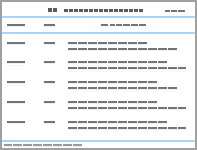
Table 1

Logistic regression analysis of dysfunction of spleen"

Variable B Std. Error Wald Sig Exp (B)
KPS score –0.118 0.026 19.990 0.000 0.889
Suffering time –0.135 0.450 0.090 0.764 0.874
Surgical mode 1.697 1.865 0.828 0.363 5.459
Course of chemotherapy 0.181 0.291 0.388 0.533 1.199
Metastasis –5.700 3.177 3.220 0.073 0.003

Table 2

Logistic regression analysis of disharmony of liver and stomach"

Variable B Std. Error Wald Sig Exp (B)
Sex –0.834 0.419 3.958 0.047 0.434
Clinical stage 0.694 0.245 8.005 0.005 2.002
Surgical mode 14.797 3 035.240 0.000 0.996 2 668 188.125
Metastasis 13.238 3 762.011 0.000 0.997 561 166.319

Table 3

Logistic regression analysis of blood stagnation in stomach"

Variable B Std. Error Wald Sig Exp (B)
KPS score 0.045 0.087 0.266 0.606 1.046
Clinical stage –1.385 1.631 0.721 0.396 0.250
Surgical mode –0.121 20 943.250 0.000 1.000 0.886
Suffering time 16.063 5 551.222 0.000 0.998 9 461 739
Metastasis 19.607 34 756.010 0.000 1.000 330 000 000

Table 4

Logistic regression analysis of phlegm dampness stagnation"

Variable B Std. Error Wald Sig Exp (B)
KPS score 0.031 0.015 4.180 0.041 1.032
Clinical stage –0.295 0.219 1.810 0.178 0.745

Table 5

Logistic regression analysis of deficiency of qi and blood"

Variable B Std. Error Wald Sig Exp (B)
KPS score 0.240 0.101 5.640 0.018 1.272
Clinical stage –1.388 5.375 0.067 0.796 0.249
Surgical mode –5.070 4.178 1.473 0.225 0.006
Course of chemotherapy –1.432 2.044 0.491 0.483 0.239
Suffering time 13.838 5 036.177 0.000 0.998 1 022 294
Relapse 0.052 35.530 0.000 0.999 1.053
Metastasis 7.950 8.065 0.972 0.324 2 835.003
[1] 中国抗癌协会. 新编常见恶性肿瘤诊治规范[M]. 北京: 中国协和医科大学出版社,1999 1-94
Chinese Anti-cancer Association . New criteria for diagnosis and treatment of common malignant tumors[M]. Beijing: Beijing Union Medical University Press,1999 1-94
[2] 陶丽, 杨金坤 . 胃癌中医辨证分型的文献分析[J]. 中医药学刊, 2006,24(4):684-686
Tao L, Yang JK . Analysis on the literature about syndrome differentiation of gastric cancer in traditional Chinese medicine[J]. Zhong Yi Yao Xue Kan, 2006,24(4):684-686
[3] 国家技术监督局. 中华人民共和国国家标准·中医临床诊疗术语证候部分[M]. 北京: 中国标准出版社,1997 1-38
The State Bureau of Technology Supervision. National Standards of People's Republic of China: Syndrome part of terminology of traditional Chinese medicine clinical diagnosis and treatment[M]. Beijing: Standards Press of China,1997 1-38
[4] 中华人民共和国卫生部. 中药新药临床研究指导原则(第三辑). 1997: 78-81.
Ministry of Health of the People's Republic of China. Guiding principle of clinical research on new drugs. Part 3. 1997: 78-81. Chinese.
[5] 上海市卫生局. 上海市中医病证诊疗常规(第2版)[M]. 上海: 上海中医药大学出版社, 2003,( 第2版):129-131
Shanghai Municipal Health Bureau . Criteria for diagnosis and treatment of traditional Chinese medicine syndromes in Shanghai(2nd ed)[M]. Shanghai: Shanghai University of Traditional Chinese Medicine Press, 2003,( 2nd ed):129-131
[6] 中国中医研究院广安门医院. 中医诊疗常规[M]. 北京: 中医古籍出版社,1989 297-299
Guang'anmen Hospital affiliated to China Academy of Traditional Chinese Medicine. Criteria for traditional Chinese medicine diagnosis and treatment[M]. Beijing: Publishing House of Ancient Books of Traditional Chinese Medicine,1989 297-299
[7] 邓铁涛, 郭振球 . 中医诊断学(第5版)[M]. 上海: 上海科学技术出版社,1984,(第5版):114- 117, 124-128
Deng TT, Guo ZQ.Traditional Chinese medicine diagnostics( 5th ed) [M].Shanghai: Shanghai Scientific and Technical Publishers , 1984,( 5th ed):114- 117, 124-128
[8] 陶丽, 杨金坤 . 胃癌中医证型与临床相关因素的单因素分析[J]. 中西医结合学报, 2007,5(4):398-402
Tao L, Yang JK . Univariate analysis of syndrome differentiation in traditional Chinese medicine and clinical correlative factors in gastric cancer[J]. Zhong Xi Yi Jie He Xue Bao, 2007,5(4):398-402
[1] Zhao-guo Li , Rui-qiang Liu. Comparative study on WHO Western Pacific Region and World Federation of Chinese Medicine Societies international standard terminologies on traditional medicine: Diseases in Internal Medicine (Part 5). Journal of Chinese Integrative Medicine, 2012, 10(9): 1061-1065.
[2] Zhao-lan Liu, Qing Li , Yu-jie Mu , Ying Gao, Jian-ping Liu. Using nested case-control study to appraise the effectiveness of Chinese medicines in the treatment of diabetic nephropathy. Journal of Chinese Integrative Medicine, 2012, 10(9): 991-996.
[3] Chen Xia , Qun-bang Zhu, Feng Huang, Jing-hui Huang, Hong-da Chen, Ming-jun Chen, Wei Gu, Bai Li, Fan-fu Fang, Liang-neng Wu . Traditional Chinese medicine constitution types in 127 elderly patients with insomnia: An investigation in communities of Yangpu District, Shanghai. Journal of Chinese Integrative Medicine, 2012, 10(8): 866-873.
[4] Claudia Maria Sous, Mario Goncalves, Jorge Machado, Thomas Efferth, Tobias Greten , Petra Froeschen , Henry J. Greten. Effects of qigong on performance-related anxiety and physiological stress functions in transverse flute music schoolchildren: A feasibility study. Journal of Chinese Integrative Medicine, 2012, 10(8): 858-865.
[5] Zhao-guo Li . Comparative study on WHO Western Pacific Region and World Federation of Chinese Medicine Societies international standard terminologies on traditional medicine: Diseases in Internal Medicine (Part 4). Journal of Chinese Integrative Medicine, 2012, 10(8): 948-952.
[6] Zhao-guo Li. Comparative study on WHO Western Pacific Region and World Federation of Chinese Medicine Societies international standard terminologies on traditional medicine: Diseases in Internal Medicine (Part 3). Journal of Chinese Integrative Medicine, 2012, 10(7): 827-831.
[7] Wei-hua Xu, Ze-huai Wen, Wei-xiong Liang, Qi Wang. A review of research on the development of instruments for therapeutic efficacy evaluation of traditional Chinese medicine. Journal of Chinese Integrative Medicine, 2012, 10(7): 726-737.
[8] Ping Li, Yun-zhong Shi . A study on English translation of antithesis in Neijing. Journal of Chinese Integrative Medicine, 2012, 10(7): 832-836.
[9] Ming-xing Zhao, Zhen-hua Dong, Zhong-hai Yu, Shi-yuan Xiao, Ya-ming Li . Effects of Ginkgo biloba extract in improving episodic memory of patients with mild cognitive impairment: A randomized controlled trial. Journal of Chinese Integrative Medicine, 2012, 10(6): 628-634.
[10] Ying-fei Bi , Jing-yuan Mao , Xian-liang Wang , Ya-zhu Hou , Yi-zhu Lu , Shan Bin Soh , Bo-li Zhang. Clinical epidemiology survey of the traditional Chinese medicine etiology and syndrome differentiation of coronary artery disease: Study protocol of a multicenter trial. Journal of Chinese Integrative Medicine, 2012, 10(6): 619-627.
[11] Zhao-guo Li . Comparative study on WHO Western Pacific Region and World Federation of Chinese Medicine Societies international standard terminologies on traditional medicine: Diseases in Internal Medicine (Part 2). Journal of Chinese Integrative Medicine, 2012, 10(6): 712-716.
[12] C. Matos Luís, J. Goncalves Mário, R. Silva António, G. Mendes Joaquim, P. Machado Jorge, J. Greten Henry. Assessment of Qigong-related effects by infrared thermography: A case study. Journal of Chinese Integrative Medicine, 2012, 10(6): 663-666.
[13] Christoph A. Doenitz, Ana Anjos, Thomas Efferth , Tobias Greten, Henry J. Greten. Can heat and cold be parameterized? Clinical data of a preliminary study. Journal of Chinese Integrative Medicine, 2012, 10(5): 532-537.
[14] Zhao-guo Li . Issues on translation of terms in traditional Chinese medicine clinical practice. Journal of Chinese Integrative Medicine, 2012, 10(5): 591-596.
[15] Shi-lin Yao, Zu-zhi Zhang , Xin-sheng Yang, Xia Xu, Jian Cao, Guang-yan Xie, Qian Zhang. Analysis of composite traditional Chinese medicine constitution: An investigation of 974 volunteers. Journal of Chinese Integrative Medicine, 2012, 10(5): 508-515.
Viewed
Full text


Abstract

Cited

  Shared   
  Discussed   
[1] Jin-rong Fu. Establishment of multivariate diagnosis and treatment system of modern gynecology of traditional Chinese medicine. Journal of Chinese Integrative Medicine, 2008, 6(1): 22-24
[2] Hao Li, Ming-jiang Yao, Wen-ming Zhao, Jie Guan, Lin-lin Cai, Ling Cui. A randomized, controlled, double-blind trial of Huannao Yicong capsule in senile patients with mild cognitive impairment. Journal of Chinese Integrative Medicine, 2008, 6(1): 25-31
[3] Zhi-chun Jin. Problems in establishing clinical guideline for integrated traditional Chinese and Western medicine. Journal of Chinese Integrative Medicine, 2008, 6(1): 5-8
[4] SUN Ming-yu, ZUO Jian, DUAN Ji-feng, HAN Jun, FAN Shi-ming, ZHANG Wei, ZHU Li-fang, YAO Ming-hui. Antitumor activities of kushen flavonoids in vivo and in vitro. Journal of Chinese Integrative Medicine, 2008, 6(1): 51-59
[5] Min Cheng, Qiong Feng, Shu-wen Qian, Hui Gao, Cui-qing Zhu. Preliminary assay of p-amyloid binding elements in heart-beneficial recipe. Journal of Chinese Integrative Medicine, 2008, 6(1): 68-72
[6] Ning-qun Wang, Liang-duo Jiang, Zong-xing Li. Research progress in asthma-related quality of life. Journal of Chinese Integrative Medicine, 2008, 6(1): 93-97
[7] Jing-yuan Mao, Chang-xiao Liu, Heng-he Wang, Guang-li Wei , Zhen-peng Zhang, Jie Xing, Wang Xian liang , Ying-fei Bi . Effects of Shenmai Injection on serum concentration and pharmacokinetics of digoxin in dogs with heart failure. Journal of Chinese Integrative Medicine, 2010, 8(11): 1070-1074
[8] Zhi-mei Wang, Bin Zhang. A study on translation of ellipses in Huangdi Neijing from perspective of hermeneutic theory. Journal of Chinese Integrative Medicine, 2010, 8(11): 1097-1100
[9] Gui Yu, Jie Wang. Thinking on building the network cardiovasology of Chinese medicine. Journal of Chinese Integrative Medicine, 2012, 10(11): 1206-1210
[10] Pedro Saganha João, Doenitz Christoph, Greten Tobias, Efferth Thomas, J. Greten Henry. Qigong therapy for physiotherapists suffering from burnout: a preliminary study. Journal of Chinese Integrative Medicine, 2012, 10(11): 1233-1239
[an error occurred while processing this directive]