[an error occurred while processing this directive]

Journal of Chinese Integrative Medicine ›› 2009, Vol. 7 ›› Issue (3): 268-272.doi: 10.3736/jcim20090313

• Literature Research • Previous Articles     Next Articles

Dose-response patterns of Radix Glycyrrhizae in Shanghan Lun

 Xue Yanga, Xiang-liang Kongb, Xiao-qiang Yuea   

  1. a Department of Classics, School of Traditional Chinese Medicine, Second Military Medical University, Shanghai 200433, China
    b Department of Treatise on Febrile Diseases, School of Basic Medical Sciences, Shanghai University of Traditional Chinese Medicine, Shanghai 201203, China
  • Received:2008-11-12 Accepted:2009-01-07 Online:2009-03-20 Published:2009-03-15

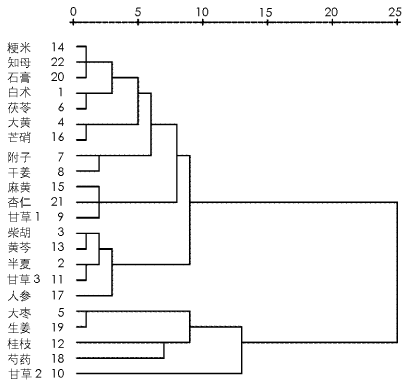
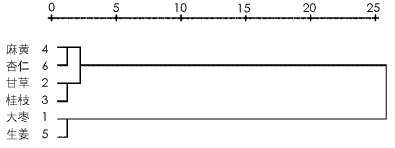
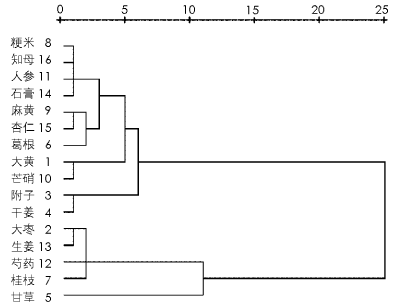
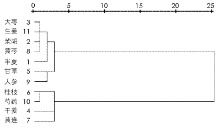
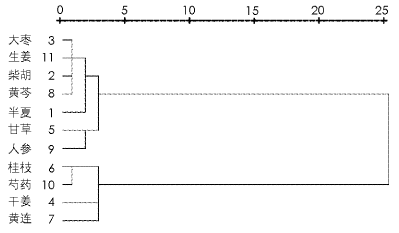
In order to explore the dose-response patterns of Gancao (Radix Glycyrrhizae) in Shanghan Lun (Treatise on Febrile Diseases), all prescriptions containing Gancao in Shanghan Lun were analyzed by frequency and hierarchical clustering analysis. The doses of Gancao used in Shanghan Lun ranged from six zhu (Chinese unit, and one zhu is equal to 0.65 g) to four liang (Chinese unit, and one liang is equal to 15.625 g). Doses of one, two, three or four liang were commonly used. One liang Gancao as juvantia was usually matched with Mahuang (Herba Ephedrae), Xingren (Semen Armeniacae) and Guizhi (Ramulus Cinnamomi) for restricting the excessive diaphoresis of Mahuang. Two liang Gancao was often matched with some couple drugs, such as Guizhi and Shaoyao (Radix Paeoniae), Shigao (Gypsum Fibrosum) and Zhimu (Rhizoma Anemarrhenae), Fuzi (Radix Aconiti Lateralis) and Ganjiang (Rhizoma Zingiberis), for warming yang to supplement qi, nourishing yin, detoxifying Fuzi, and preventing qi impairment from heat evil. Three liang Gancao was mainly matched with Banxia (Rhizoma Pinelliae) or Renshen (Radix Ginseng) for treating middle energizer emesis. Four liang Gancao was matched with Ganjiang or tonifying herbs for invigorating vital qi and relieving spasm in deficiency syndromes with contraction, palpitation or diarrhea. Gancao is used for treating many syndromes in Shanghan Lun. It is frequently used to treat excess or heat syndromes with one or two liang in a dose and deficiency or cold syndromes with three or four liang in a dose.

Key words: Shanghai Lun , Radix Glycyrrhizae, Compatibility, Dose-response relationship, Drug

"

甘草用量 方剂名称(方次) 合计方数(方次)
6铢 麻黄升麻汤(1) 1 (1)
1两 麻黄汤(9) 茯苓甘草汤(2) 桂枝麻黄各半汤(1) 6 (15)
柴胡桂枝汤(1) 柴胡加芒硝汤(1) 栀子柏皮汤(1)
1两2铢 桂枝二麻黄一汤(1) 桂枝二越婢一汤(1) 2(2)
2两 桂枝汤(19) 桂枝甘草龙骨牡蛎汤(1) 桂枝附子汤(1) 45 (92)
四逆汤(11) 桂枝去桂加茯苓白术汤(1) 茯苓四逆汤(1)
调胃承气汤(8) 桂枝救逆汤(1) 甘草附子汤(1)
白虎加人参汤(5) 桂枝新加汤(1) 当归四逆汤(1)
白虎汤(3) 葛根黄芩黄连汤(1) 桃核承气汤(1)
桂枝加厚朴杏子汤(2) 桂枝加芍药汤(1) 甘草汤(1)
葛根汤(2) 桂枝去芍药汤(1) 桔梗汤(1)
大青龙汤(2) 麻黄附子甘草汤(1) 黄芩汤(1)
麻杏甘石汤(2) 桂枝去芍药加附子汤(1) 竹叶石膏汤(1)
小建中汤(2) 当归四逆加吴茱萸生姜汤(1) 四逆加人参汤(1)
通脉四逆汤(2) 厚朴生姜半夏甘草人参汤(1) 桂枝甘草汤(1)
桂枝加大黄汤(1) 黄芩加半夏生姜汤(1) 葛根加半夏汤(1)
茯苓桂枝白术甘草汤(1) 通脉四逆加猪胆汁汤(1) 白术附子汤(1)
茯苓桂枝甘草大枣汤(1) 麻黄连轺赤小豆汤(1) 桂枝加桂汤(1)
桂枝加葛根汤(1) 柴胡桂枝干姜汤(1) 栀子甘草豉汤(1)
3两 小柴胡汤(13) 小青龙汤(2) 理中丸(2) 9(23)
桂枝加附子汤(1) 黄连汤(1) 芍药甘草附子汤(1)
生姜泻心汤(1) 半夏泻心汤(1) 旋覆代赭汤(1)
4两 甘草干姜汤(1) 桂枝人参汤(1) 甘草泻心汤(1) 5(5)
芍药甘草汤(1) 炙甘草汤(1)
等分 半夏散及汤(1) 四逆散(1) 2(2)

"

"

"

"

"

[1] Qian CH, Hao WS. Necessarily serial for clinic of traditional Chinese medicine: Shang Han Lun[M]. Beijing: People’s Medical Publishing House,2005
钱超尘, 郝万山 . 中医临床必读丛书·伤寒论[M]. 北京: 人民卫生出版社,2005
[2] Ke XF. Serial of modern research and application of traditional Chinese medicine: Shang Han Lun and Jin Gui Yao Lue[M]. Shanghai: Shanghai University of Traditional Chinese Medicine Press,1995
柯雪帆 . 现代中医药应用与研究大系·伤寒与金匮[M]. 上海: 上海中医药大学出版社,1995
[1] Thomas Efferth, Henry Johannes Greten. The European directive on traditional herbal medicinal products: friend or foe for plant-based therapies?. Journal of Chinese Integrative Medicine, 2012, 10(4): 357-361.
[2] Bao Yan-ju, Hua Bao-jin. Discussion on six errors of formulas corresponding to syndromes in using the classic formulas. Journal of Chinese Integrative Medicine, 2012, 10(12): 1363-1370.
[3] Xiao-ping Huang , Xiao-dan Liu , Chang-qing Deng . Effects of the combination of active component extracts from Astragalus membranaceus and Panax notoginseng on apoptosis, reactive oxygen species and mitochondrial membrane potential of PC12 cells with oxidative injury. Journal of Chinese Integrative Medicine, 2012, 10(10): 1127-1134.
[4] Agung E. Nugroho, Adam Hermawan, Dyaningtyas D. P. Putri, E. dY Meiyanto, Lukman Hakim . Synergistic effects of ethyl acetate fraction of Ficus septica Burm. f. and doxorubicin chemotherapy on T47D human breast cancer cell line. Journal of Chinese Integrative Medicine, 2012, 10(10): 1162-1170.
[5] Jie-ning Wang, Sheng Ye, Dong-hai Yu, Hui Zhao, Le-yi Du. Practice and exploration on clinical evaluations of hospital-made Chinese herbal formulas in the Pudong New Area of Shanghai. Journal of Chinese Integrative Medicine, 2012, 10(10): 1084-1087.
[6] Han Xiang-hui, Ye Yi-yi, Guo Bao-feng, Liu Sheng. Effects of platycodin D in combination with different active ingredients of Chinese herbs on proliferation and invasion of 4T1 and MDA-MB-231 breast cancer cell lines. Journal of Chinese Integrative Medicine, 2012, 10(1): 67-75.
[7] Jong-Min Kim, Kyung-Soon Kim, Yeon-Weol Lee, Chong-Kwan Cho, Hwa-Seung Yoo, Ji-Young Bang, Eung-Yoon Kim, In-Cheol Kang. Anti-angiogenic effects of water extract of a formula consisting of Pulsatilla koreana, Panax ginseng and Glycyrrhiza uralensis. Journal of Chinese Integrative Medicine, 2011, 9(9): 1005-1013.
[8] Hao Dai, Jun Gu, Ling-zhi Li, Li-mei Yang, Hui Liu, Jian-yu Li. Scutellarin benzyl ester partially secured the ischemic injury by its anti-apoptosis mechanism in cardiomyocytes of neonatal rats. Journal of Chinese Integrative Medicine, 2011, 9(9): 1014-1021.
[9] Da-wei Pan, Li-guo Chen. Mathematical modeling of sign-and-symptom-oriented diagnostic procedure in traditional Chinese medicine based on the analytic hierarchy process: Indications of Guizhi Decoction and its varieties in the Shanghanlun. Journal of Chinese Integrative Medicine, 2011, 9(4): 354-360.
[10] Liang-ping Hu, Xiao-lei Bao. General issues and precautions in the design for clinical trials of investigational new drugs. Journal of Chinese Integrative Medicine, 2011, 9(2): 138-142.
[11] Qi-lin Fu, Yi-yang Hu, Qin Feng, Xiao-ning Wang, Jing-hua Peng, Tuan Cui. Analysis of major herbs in Chinese herbal formula Jianpi Huoxue Decoction for improving intestinal permeability based on uniform design. Journal of Chinese Integrative Medicine, 2011, 9(11): 1234-1241.
[12] Wei-yi Gong , Xin-min Zhang, Zi-yin Shen, Guo-rang Hu, Su-qin Zhang, Run-hong Liu, Wei-dong Zhang, Jing-cheng Dong. Optimal combination of baicalin, icariin and Astragalus saponin Ⅰ from a Chinese herbal compound Biminne. Journal of Chinese Integrative Medicine, 2010, 8(6): 541-547.
[13] Xiao-bing Li, Xiao-juan He, Biao Liu, Li Xu, Da-hong Ju, Miao Jiang, Ai-ping Lu. Immunoregulatory function of Radix Glycyrrhizae polysaccharide in tumor-bearing mice. Journal of Chinese Integrative Medicine, 2010, 8(4): 363-367.
[14] Feng Tian , Yan-ming Xie. Real-world study: A potential new approach to effectiveness evaluation of traditional Chinese medicine interventions. Journal of Chinese Integrative Medicine, 2010, 8(4): 301-306.
[15] Zhu-ye Gao, Jing-chun Zhang, Hao Xu, Da-zhuo Shi, Chang-geng Fu, Dan Qu, Xue-zhong Zhou. Analysis of relationships among syndrome, therapeutic treatment, and Chinese herbal medicine in patients with coronary artery disease based on complex networks. Journal of Chinese Integrative Medicine, 2010, 8(3): 238-243.
Viewed
Full text


Abstract

Cited

  Shared   
  Discussed   
[1] Dong Yang, Yong-ping Du, Qing Shen, Wei Chen, Yan Yu, Guang-lei Chen. Expression of alpha-smooth muscle actin in renal tubulointerstitium in patients with kidney collateral stasis. Journal of Chinese Integrative Medicine, 2008, 6(1): 41-44
[2] Hai-feng Wei, Bai-liu Ya, Ling Zhao, Cui-fei Ye, Li Zhang, Lin Li. Evaluation of tongue manifestation of blood stasis syndrome and its relationship with blood rheological disorder in a rat model of transient brain ischemia. Journal of Chinese Integrative Medicine, 2008, 6(1): 73-76
[3] Xi Lin, Jian-ping Liu. Herbal medicines for viral myocarditis. Journal of Chinese Integrative Medicine, 2008, 6(1): 76
[4] Xi Lin, Jian-ping Liu. Tai chi for treating rheumatoid arthritis. Journal of Chinese Integrative Medicine, 2008, 6(1): 82
[5] Liang-ping Hu, Hui Gao. Discrimination of errors in statistical analysis of medical papers published in the first issue of 2006 in Journal of Chinese Integrative Medicine. Journal of Chinese Integrative Medicine, 2008, 6(1): 98-106
[6] Yan-bo Zhu , Qi Wang, Cheng-yu Wu, Guo-ming Pang, Jian-xiong Zhao, Shi-lin Shen, Zhong-yuan Xia , Xue Yan . Logistic regression analysis on relationships between traditional Chinese medicine constitutional types and overweight or obesity. Journal of Chinese Integrative Medicine, 2010, 8(11): 1023-1035
[7] Wei Xu, Meng Shi, Jian-gang Liu, Cheng-long Wang . Collagen protein expressions in ischemic myocardium of rats with acute myocardial infarction and effects of qi-tonifying, yin-tonifying and blood-activating herbs and detoxifying and blood-activating herbs. Journal of Chinese Integrative Medicine, 2010, 8(11): 1041-1047
[8] Tao Wang , Feng Qin. Effects of Chinese herbal medicine Xiaoyao Powder on monoamine neurotransmitters in hippocampus of rats with postpartum depression. Journal of Chinese Integrative Medicine, 2010, 8(11): 1075-1079
[9] Ying Xu , Chang-chun Zeng , Xiu-yu Cai , Rong-ping Guo , Guang Nie , Ying Jin. Chromaticity and optical spectrum colorimetry of the tongue color in different syndromes of primary hepatic carcinoma. Journal of Chinese Integrative Medicine, 2012, 10(11): 1263-1271
[10] Xiang-ying Mao , Qin Bian , Zi-yin Shen. Analysis of the osteogenetic effects exerted on mesenchymal stem cell strain C3H10T1/2 by icariin via MAPK signaling pathway in vitro. Journal of Chinese Integrative Medicine, 2012, 10(11): 1272-1278
[an error occurred while processing this directive]