[an error occurred while processing this directive]

Journal of Chinese Integrative Medicine ›› 2009, Vol. 7 ›› Issue (12): 1123-1129.doi: 10.3736/jcim20091206

• Original Clinical Research • Previous Articles     Next Articles

Yunchang Capsule in treatment of functional constipation: A randomized, double-blinded controlled, multicenter trial

Jia Guoa,Rui-ming Zhanga,Zong-wen Huanga,Lei Wanga,Song-shan Liub,Jun-cheng Diaoc,Si-yuan Hud,Bing-hui Line   

  1. a Department of Integrated Traditional Chinese and Western Medicine, West China Hospital, Sichuan University, Chengdu 610041, Sichuan Province, China
    b Department of Gastroenterology, Affiliated Hospital, Chengdu University of Traditional Chinese Medicine,Chengdu 611137,Sichuan Province, China
    c Department of Gastroenterology, Affiliated Hospital, Jiangxi University of Traditional Chinese Medicine,Nanchang 330006, Jiangxi Province, China
    d Department of Gastroenterology, the First Affiliated Hospital, Tianjin University of Traditional Chinese Medicine, Tianjin 300150, China
    e Department of Gastroenterology, Fujian Academy of Traditional Chinese Medicine, Fuzhou 350108, Fujian Province, China
  • Received:2009-08-28 Accepted:2009-11-15 Online:2009-12-20 Published:2009-12-15
  • Contact: Zong-wen Huang E-mail:huangzongwen@medmail.com.cn

Background

Although there are some Chinese herbal medicines in treatment of constipation, but no multi-center randomized controlled trials have been carried out to prove their effectiveness.
Objective

To evaluate the safety and efficacy of Yunchang Capsule in treatment of functional constipation with deficiency of both qi and yin and internal accumulation of poisonous pathogenic factors syndrome, and to explore the clinical dosage.Design, setting, participants and interventions: A randomized, double-blinded controlled, multicenter trial was conducted. A total of 240 patients with functional constipation from West China Hospital of Sichuan University, Affiliated Hospital of Chengdu University of Traditional Chinese Medicine, Affiliated Hospital of Jiangxi University of Traditional Chinese Medicine, the First Affiliated Hospital of Tianjing University of Traditional Chinese Medicine and Fujian Academy of Traditional Chinese Medicine were randomly divided into three groups: low dose group (80 cases), high dose group (80 cases) and control group (80 cases). Patients in the low dose group were treated with two pills (0.35 g/pill) of Yunchang Capsule and one pill of Yunchang Capsule simulant for three times daily; patients in the high dose group were treated with three pills (0.35 g/pill) of Yunchang Capsule for three times daily; and patients in the control group were treated with three pills (0.35 g/pill) of Biantong Capsule for three times daily. The therapeutic course was 14 days. Main outcome measures: Clinical symptoms, syndromes, and adverse effects were observed before and after the treatment, and blood, urine and stool tests, hepatorenal function and electrocardiogram were also examined.
Results

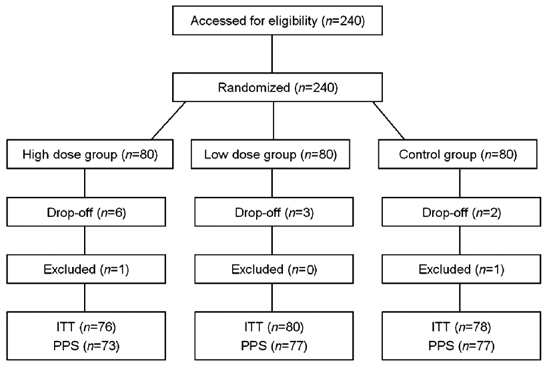
Two cases were excluded, eleven cases were lost to follow-up, and there were 234 patients entered to intention-to-treat (ITT) analysis. After the treatment, the therapeutic effects were calculated by full analysis set (FAS) and per-protocol population set (PPS) analysis respectively. The effects on functional constipation in FAS showed the response rates in the low dose, high dose and control groups were 86.25% (69/80), 82.90% (63/76), and 70.52% (55/78) respectively, and PPS analysis showed the response rates were 85.71% (66/77), 83.56% (61/73), and 70.13% (54/77) respectively. There were no significant differences among the three groups (P>0.05). The effects on traditional Chinese medicine syndrome in FAS showed the response rates in the low dose, high dose and control groups were 78.75% (63/80), 69.74% (53/76), and 67.95% (53/78) respectively, and PPS analysis showed the response rates were 77.92% (60/77), 69.87% (51/73), and 67.53% (52/77) respectively. There were also no significant differences among the three groups (P>0.05). No severe adverse events were observed.
Conclusion

Both low dose and high dose of Yunchang Capsule are effective and safe in treatment of functional constipation with deficiency of both qi and yin and internal accumulation of poisonous pathogenic factors syndrome.

Key words: Chinese herbal drugs, Constipation, Deficiency of both qi and yin, Internal accumulation of poisonous pathogenic factors, Double-blind method, Randomized controlled trial

Figure 1

Diagram of the randomized trial"

"

Items Control group Low dose group High dose group χ2/F P
Cases (Male/Female) 78 (26/52) 80 (21/59) 76 (19/57) 1.550 0.461
Mean age ($\bar{x}$±s, years) 41.69±13.98 41.04±14.16 41.72±13.80 0.060 0.941
Body weight ($\bar{x}$±s, kg) 57.49±8.87 57.46±7.58 58.16±9.33 0.160 0.848
Body height ($\bar{x}$±s, cm) 162.49±6.58 162.16±5.98 162.28±6.67 0.050 0.949
Duration ($\bar{x}$±s, d) 41.32±40.54 41.68±64.68 39.00±38.77 0.070 0.936
Score of primary symptoms ($\bar{x}$±s) 10.33±3.28 9.38±3.08 9.29±2.84 2.770 0.065
Accumulated score of TCM symptoms ($\bar{x}$±s) 15.62±4.19 14.58±3.96 14.50±3.50 1.990 0.139

Table 2

Effect analysis of functional constipation in three groups [Cases (%)]"

Group n Cure Obvious effect Improvement No improvement CMH χ2 P
FAS
Control 78 37 (47.44) 18 (23.08) 14 (17.95) 9 (11.54)
Low dose 80 40 (50.00) 29 (36.25) 9 (11.25) 2 (2.50) 1.975 0.160
High dose 76 41 (53.95) 22 (28.95) 10 (13.16) 3 (3.94)
PPS
Control 77 36 (46.75) 18 (23.38) 14 (18.18) 9 (11.69)
Low dose 77 39 (50.65) 27 (35.04) 9 (11.69) 2 (2.60) 2.018 0.149
High dose 73 39 (53.42) 22 (30.14) 10 (13.70) 2 (2.74)

Table 3

Effect analysis of syndrome of traditional Chinese medicine in three groups [Cases (%)]"

Group n Cure Obvious effect Improvement No improvement CMH χ2 P
FAS
Control 78 26 (33.33) 27 (34.62) 16 (20.51) 9 (11.54)
Low dose 80 36 (45.00) 27 (33.75) 15 (18.75) 2 (2.50) 1.548 0.214
High dose 76 34 (44.74) 19 (25.00) 20 (26.32) 3 (3.95)
PPS
Control 77 25 (32.47) 27 (35.06) 16 (20.78) 9 (11.69)
Low dose 77 35 (45.45) 25 (32.47) 15 (19.48) 2 (2.60) 2.063 0.151
High dose 73 33 (45.21) 18 (24.66) 20 (27.40) 2 (2.74)
[1] Wei XQ, Chen MH . The epidemiology of functional constipation of Guangzhou residents[J]. Wei Chang Bing Xue He Gan Bing Xue Za Zhi, 2001,10(2):150-151, 155
doi: 10.3969/j.issn.1006-5709.2001.02.015
尉秀清, 陈旻湖 . 广州市居民功能性便秘流行病学调查[J]. 胃肠病学和肝病学杂志, 2001,10(2):150-151, 155
doi: 10.3969/j.issn.1006-5709.2001.02.015
[2] Xiang GC, Long QL, Liu L, Sun YZ , Fang DC.The epidemic investigation of residents with constipation in Chongqing[J]. Chongqing Yi Xue, 2004, 33(10): 1541, 1543
doi: 10.3969/j.issn.1671-8348.2004.10.047
向国春, 龙庆林, 刘利, 孙英姿, 房殿春 . 重庆市人群便秘患病率流行病学研究[J].重庆医学, 2004, 33(10): 1541, 1543
doi: 10.3969/j.issn.1671-8348.2004.10.047
[3] Guo XF, Ke MY, Pan GZ, Han SM, Fang XC, Lu SC, Guo HP . A stratified, randomized epidemiological investigation and related factor analysis of adult chronic constipation in Beijing area[J]. Zhonghua Xiao Hua Za Zhi, 2002,22(10):637-638
doi: 10.3760/j.issn:0254-1432.2002.10.025
郭晓峰, 柯美云, 潘国宗, 韩少梅, 方秀才, 鲁素彩, 郭慧平 . 北京地区成人慢性便秘整群、分层、随机流行病学调查及其相关因素分析[J]. 中华消化杂志, 2002,22(10):637-638
doi: 10.3760/j.issn:0254-1432.2002.10.025
[4] Liu ZY, Yang GG, Shen Z, He WY, He F, Yuan YM . Epidemiology of constipation in Hangzhou city[J]. Zhonghua Xiao Hua Za Zhi, 2004,24(7):435-436
刘智勇, 杨关根, 沈忠, 何文英, 何芳, 袁玥旻 . 杭州市城区便秘流行病学调查[J]. 中华消化杂志, 2004,24(7):435-436
[5] Bleser S, Brunton S, Carmichael B, Olden K, Rasch R, Steege J . Management of chronic constipation: recommendations from a consensus panel[J]. J Fam Pract, 2005,54(8):691-698
doi: 10.1007/BF03002743 pmid: 16061057
[6] Thompson WG, Longstreth GF, Drossman DA, Heaton KW, Irvine EJ, Müller-Lissner SA .Functional bowel disorders and functional abdominal pain[J].Gut , 1999, 45(Suppl 2):Ⅱ43-Ⅱ47
doi: 10.1136/gut.45.2008.ii43 pmid: 1766683
[7] Ministry of Health of the People’s Republic of China. Guidelines for clinical research on Chinese new herbal medicines[M]. Beijing: Medical Science and Technology Publishing House of China, 1993: 131-133
中华人民共和国卫生部. 中药新药临床研究指导原则[M]. 北京: 中国医药科技出版社, 1993: 131-133
[8] Chinese Pharmacopoeia Commission. The Pharma-copoeia of People’s Republic of China[M]. Beijing: Chemical Industry Press, 2005: 112-113
国家药典委员会. 中华人民共和国药典[M]. 北京: 化学工业出版社, 2005: 112-113
[9] Ou C, Ge QX, Zhao JC . Syndrome differentiation and treatment of functional constipation[J]. Xian Dai Zhong Xi Yi Jie He Za Zhi, 2008,17(16):2493-2494
doi: 10.3969/j.issn.1008-8849.2008.16.042
欧春, 葛琼翔, 赵军超 . 功能性便秘的辨证分型与证治[J]. 现代中西医结合杂志, 2008,17(16):2493-2494
doi: 10.3969/j.issn.1008-8849.2008.16.042
[10] Su HQ, Chen ZJ , . Study progress of pharmacology of tuber fleeceflower root[J]. Zhong Yao Cai, 1993,16(2):34-37
苏焕群, 陈再今 . 何首乌药理研究进展[J]. 中药材, 1993,16(2):34-37
[11] Bleser S, Brunton S, Carmichael B, Olden K, Rasch R, Steege J . Constipation and the preached trio: diet, fluid intake, exercise[J]. Int J Nurs Stud, 2003,40(8):843-852
doi: 10.1016/S0020-7489(03)00075-0 pmid: 14568365
[12] Evans JM, Fleming KC, Talley NJ, Schleck CD, Zinsmeister AR , Melton LJ 3rd.Relation of colonic transit to functional bowel disease in older people: a population-based study[J]. J Am Geriatr Soc, 1998,46(1):83-87
doi: 10.1111/jgs.1998.46.issue-1
[13] Chung BD, Parekh U, Sellin JH . Effect of increased fluid intake on stool output in normal healthy volunteers[J]. J Clin Gastroenterol, 1999,28(1):29-32
doi: 10.1097/00004836-199901000-00006 pmid: 9916661
[14] Meshkinpour H, Selod S, Movahedi H, Nami N, James N, Wilson A . Effects of regular exercise in management of chronic idiopathic constipation[J]. Dig Dis Sci, 1998,43(11):2379-2383
doi: 10.1023/A:1026609610466
[15] Corazziari E, Badiali D, Bazzocchi G, Bassotti G, Roselli P, Mastropaolo G, Lucà MG, Galeazzi R, Peruzzi E . Long term efficacy, safety, and tolerabilitity of low daily doses of isosmotic polyethylene glycol electrolyte balanced solution(PMF-100) in the treatment of functional chronic constipation[J]. Gut, 2000,46(4):522-526
doi: 10.1136/gut.46.4.522
[1] Na Wu , Lu Song , Xin-xin Yang, Jiang-lei Wei , Zhen-guo Liu. Effects of Chinese herbal medicine Tianqi Pingchan Granule on G protein-coupled receptor kinase 6 involved in the prevention of levodopa-induced dyskinesia in rats with Parkinson disease. Journal of Chinese Integrative Medicine, 2012, 10(9): 1018-1024.
[2] Jing-lin Shi, Wan-hong Miao. Effects of acupuncture on lactoferrin content in tears and tear secretion in patients suffering from dry eyes: A randomized controlled trial. Journal of Chinese Integrative Medicine, 2012, 10(9): 1003-1008.
[3] Ming T. Tan , Jian-ping Liu , Lixing Lao. Adequate application of quantitative and qualitative statistic analytic methods in acupuncture clinical trials. Journal of Chinese Integrative Medicine, 2012, 10(8): 847-852.
[4] Xin-min Li, Hui Chen, Yan-yan Ren, Yan-li Lu. Effects of Chinese herbal medicine Xifeng Capsule on multidrug resistance-associated protein 1 expression in hippocampus and cortex of rats with lithium-pilocarpine-induced epilepsy. Journal of Chinese Integrative Medicine, 2012, 10(8): 911-917.
[5] Yong Zhang, Xiao-wen Sun, Jian-hua Xu, Hai Lu, Zhong-ze Fan, Jue Sun, Xiao-xiao Zhang. Effects of medicated serum prepared with Chinese herbal medicine Changweiqing on pharmacokinetics of oxaliplatin in colon cancer cells. Journal of Chinese Integrative Medicine, 2012, 10(8): 901-910.
[6] Wei-hua Xu, Ze-huai Wen, Wei-xiong Liang, Qi Wang. A review of research on the development of instruments for therapeutic efficacy evaluation of traditional Chinese medicine. Journal of Chinese Integrative Medicine, 2012, 10(7): 726-737.
[7] Lin Wang, Guan-liang Wang, Jia-han Liu, Di Li, De-zeng Zhu, Liang-neng Wu . Effects of ursolic acid in ameliorating insulin resistance in liver of KKAy mice via peroxisome proliferator-activated receptors α and γ. Journal of Chinese Integrative Medicine, 2012, 10(7): 793-799.
[8] Lu Yu, Shui-miao Lin, Ru-qian Zhou, Wei-jun Tang, Pin-xian Huang, Ying Dong, Jian Wang, Zhi-hua Yu, Jiu-lin Chen, Li Wei, San-li Xing, Hui-juan Cao, Hong-bin Zhao. Chinese herbal medicine for patients with mild to moderate Alzheimer disease based on syndrome differentiation: A randomized controlled trial. Journal of Chinese Integrative Medicine, 2012, 10(7): 766-776.
[9] Hui Luo, Jian-ping Liu, Qing Li. Methodological issues and suggestions for improvement in randomized controlled trials of Chinese herbal medicine for recurrent miscarriage. Journal of Chinese Integrative Medicine, 2012, 10(6): 604-614.
[10] Peng Fu , Xue-qiang Huang, Ai-hong Yuan, Guang Yu, Xiao-bin Mei, Ruo-lan Cu. Effects of salvianolate combined with alprostadil and reduced glutathione on progression of chronic renal failure in patients with chronic kidney diseases: a long-term randomized controlled trial. Journal of Chinese Integrative Medicine, 2012, 10(6): 641-646.
[11] Shui-qiu Deng, Xue-nong Ouyang, Zong-yang Yu, Xi-hu Dai, Xi Chen, Fang-zheng Fang, Wen-wu Wang, Zhi-zhen Liu. Influence of Chinese herbal medicine Feitai Capsule on completion or delay of chemotherapy in patients with stage ⅢB/Ⅳ non-small-cell lung cancer: a Randomized controlled trial. Journal of Chinese Integrative Medicine, 2012, 10(6): 635-640.
[12] Ming-xing Zhao, Zhen-hua Dong, Zhong-hai Yu, Shi-yuan Xiao, Ya-ming Li . Effects of Ginkgo biloba extract in improving episodic memory of patients with mild cognitive impairment: A randomized controlled trial. Journal of Chinese Integrative Medicine, 2012, 10(6): 628-634.
[13] Ying-chun Miao , Jin-zhou Tian , Jing Shi , Min Mao. Effects of Chinese medicine for tonifying the kidney and resolving phlegm and blood stasis in treating patients with amnestic mild cognitive impairment: A randomized, double-blind and parallel-controlled trial. Journal of Chinese Integrative Medicine, 2012, 10(4): 390-397.
[14] Xiao-hui Sun, Sheng Liu . External Chinese medical therapy for pain associated with hyperplastic disease of the breast: Study protocol of a randomized, double-blind, multicenter, controlled trial. Journal of Chinese Integrative Medicine, 2012, 10(4): 384-389.
[15] Zhu Yan-feng, Luo Hai-ming, Deng Zhong-long, Fu De-yu, Yao Wang, Dai Jian. Effects of the Chinese patent medicine, Honghua Injection, on platelet glycoprotein Ⅱb/Ⅲa receptors in patients with acute coronary syndrome: a randomized controlled trial. Journal of Chinese Integrative Medicine, 2012, 10(3): 318-323.
Viewed
Full text


Abstract

Cited

  Shared   
  Discussed   
[1] Dong Yang, Yong-ping Du, Qing Shen, Wei Chen, Yan Yu, Guang-lei Chen. Expression of alpha-smooth muscle actin in renal tubulointerstitium in patients with kidney collateral stasis. Journal of Chinese Integrative Medicine, 2008, 6(1): 41-44
[2] Hai-feng Wei, Bai-liu Ya, Ling Zhao, Cui-fei Ye, Li Zhang, Lin Li. Evaluation of tongue manifestation of blood stasis syndrome and its relationship with blood rheological disorder in a rat model of transient brain ischemia. Journal of Chinese Integrative Medicine, 2008, 6(1): 73-76
[3] Xi Lin, Jian-ping Liu. Herbal medicines for viral myocarditis. Journal of Chinese Integrative Medicine, 2008, 6(1): 76
[4] Xi Lin, Jian-ping Liu. Tai chi for treating rheumatoid arthritis. Journal of Chinese Integrative Medicine, 2008, 6(1): 82
[5] Liang-ping Hu, Hui Gao. Discrimination of errors in statistical analysis of medical papers published in the first issue of 2006 in Journal of Chinese Integrative Medicine. Journal of Chinese Integrative Medicine, 2008, 6(1): 98-106
[6] Yan-bo Zhu , Qi Wang, Cheng-yu Wu, Guo-ming Pang, Jian-xiong Zhao, Shi-lin Shen, Zhong-yuan Xia , Xue Yan . Logistic regression analysis on relationships between traditional Chinese medicine constitutional types and overweight or obesity. Journal of Chinese Integrative Medicine, 2010, 8(11): 1023-1035
[7] Wei Xu, Meng Shi, Jian-gang Liu, Cheng-long Wang . Collagen protein expressions in ischemic myocardium of rats with acute myocardial infarction and effects of qi-tonifying, yin-tonifying and blood-activating herbs and detoxifying and blood-activating herbs. Journal of Chinese Integrative Medicine, 2010, 8(11): 1041-1047
[8] Tao Wang , Feng Qin. Effects of Chinese herbal medicine Xiaoyao Powder on monoamine neurotransmitters in hippocampus of rats with postpartum depression. Journal of Chinese Integrative Medicine, 2010, 8(11): 1075-1079
[9] Ying Xu , Chang-chun Zeng , Xiu-yu Cai , Rong-ping Guo , Guang Nie , Ying Jin. Chromaticity and optical spectrum colorimetry of the tongue color in different syndromes of primary hepatic carcinoma. Journal of Chinese Integrative Medicine, 2012, 10(11): 1263-1271
[10] Xiang-ying Mao , Qin Bian , Zi-yin Shen. Analysis of the osteogenetic effects exerted on mesenchymal stem cell strain C3H10T1/2 by icariin via MAPK signaling pathway in vitro. Journal of Chinese Integrative Medicine, 2012, 10(11): 1272-1278
[an error occurred while processing this directive]