[an error occurred while processing this directive]

Journal of Chinese Integrative Medicine ›› 2010, Vol. 8 ›› Issue (4): 328-331.doi: 10.3736/jcim20100405

• Original Clinical Research • Previous Articles     Next Articles

Effects of Qingshen Granule on serum interleukin-8 and -18 levels in patients with a sharp deterioration of chronic renal failure and dampness-heat syndrome: A randomized controlled trial

Fei Wang, Yi-ping Wang,Dong Wang, Wan Cheng, Shun-jin Hu, Yong Lu, Ling Liu   

  1. Department of Endocrinology, the First Affiliated Hospital, Anhui College of Traditional Chinese Medicine, Hefei 230031, Anhui Province, China
  • Received:2009-09-27 Accepted:2010-01-21 Online:2010-04-20 Published:2010-04-15
  • Contact: Yi-ping Wang E-mail:Wypwyp54@yahoo.com.cn

Background

Dampness-heat syndrome is a major syndrome type in patients with a sharp deterioration of chronic renal failure (CRF). Qingshen Decoction, a compound traditional Chinese herbal medicine, could relieve the clinical symptoms of CRF patients, and was considered to have a certain reversal effect on rapid deterioration of renal function.
Objective

To observe the changes of serum interleukin-8 (IL-8) and IL-18 levels in CRF patients with a sharp deterioration and dampness-heat syndrome, and to explore the curative efficacy of Qingshen Granule.Design, setting, participants and interventions: Sixty CRF patients with a sharp deterioration and dampness-heat syndrome from Department of Nephrology, the First Affiliated Hospital of Anhui College of Traditional Chinese Medicine, were randomly divided into treatment group (30 cases) and control group (30 cases), with another 20 healthy individuals as normal control. The patients in the treatment and control groups were all treated with Jiedu Xiezhuo Ⅱ, a compound traditional Chinese herbal medicine, given as retention enema. Qingshen Granule was additionally administered to the patients in the treatment group with 1 dosage each time and 3 times a day. The treatment course was one month.Main outcome measures: The levels of serum IL-8 and IL-18 in the normal individuals and before and after treatment in the treatment and control groups were detected.
Results

The total response rates of treatment group in clinical efficacy assessment and assessment of syndrome of traditional Chinese medicine (86.67% and 86.67%) were higher than those of the control group (56.67% and 60%), and there were significant differences between the two groups (P<0.05). The levels of serum IL-8 and IL-18 in CRF patients before treatment were obviously higher than those in the healthy individuals (P<0.01), and there were no differences in the levels of IL-8 and IL-18 before treatment between the treatment group and control group (P>0.05). After one-month treatment, the levels of serum IL-8 and IL-18 were markedly decreased in the two groups (P<0.01), and the levels of serum IL-8 and IL-18 in the treatment group were markedly lower than those in the control group (P<0.05). There were differences in decreased degrees of IL-8 and IL-18 levels between the two groups (P<0.05).
Conclusion

CRF patients with a sharp deterioration and dampness-heat syndrome have high serum IL-8 and IL-18 levels. Qingshen Granule can reduce the levels of serum IL-8 and IL-18, and improve the renal function and ameliorate the clinical symptoms.

Key words: Chronic renal failure, Dampness-heat, Interleukin-8, Interleukin-18, Chinese herbal drug, Randomized controlled trial

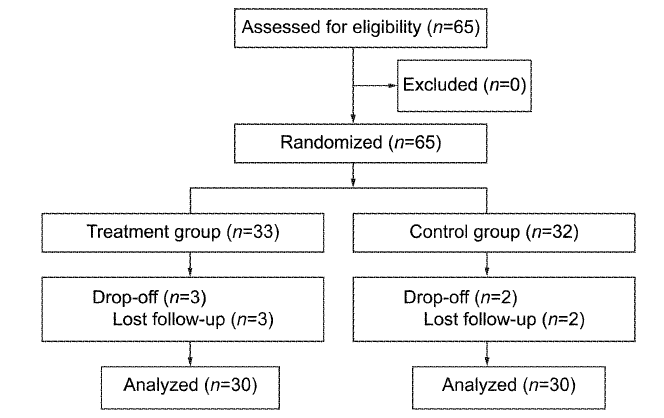
Figure 1

Flow diagram of this randomized trial"

Table 1

Contents of IL-8 and IL-18 in two groups before and after treatment ($\bar{x}$±s, ng/L)"

Group n IL-8 IL-18
Normal
Before treatment 20 42.45±5.83 76.12±9.73
After treatment 20
Control
Before treatment 30 116.34±20.72△△ 249.14±69.94△△
After treatment 30 105.63±23.05** 227.48±71.47**
Difference 30 10.75±2.31 21.66±1.52
Treatment
Before treatment 30 115.63±20.12△△ 247.18±68.04△△
After treatment 30 93.24±18.36**▲ 193.78±57.22**▲
Difference 30 22.42±1.82 53.4±11.81

Table 2

Serum creatinine and glomerular filtration rate in two groups before and after treatment"

Group n Serum creatinine
(mol/L)
Glomerular filtration
rate (mL/min)
Control
Before treatment 30 412.08±195.49 35.41±24.62
After treatment 30 390.21±191.30 43.34±25.74
Difference 30 22.84±4.10 0.94±1.03
Treatment
Before treatment 30 411.30±274.61 34.45±21.29
After treatment 30 293.72±197.62**▲▲ 60.47±25.76**▲▲
Difference 30 117.42±76.84▲▲ 26.01±4.42▲▲
[1] Wang YP, Cao EZ, Lu Y, Liu JS . Observations on curative efficacy in treatment for sharp deterioration damp-heat syndrome of chronic renal failure with Qingshen Decoction[J]. Zhong Xi Yi Jie He Shi Yong Lin Chuang Ji Jiu, 1999,6(4):154-156
王亿平, 曹恩泽, 吕勇, 刘家生 . 清肾汤治疗慢性肾功能衰竭急剧加重湿热证的疗效观察[J]. 中西医结合实用临床急救, 1999,6(4):154-156
[2] Wang YP, Cao EZ, Lu Y, Liu JS . Clinical observation on state of blood stasis in sharp deterioration dampness-heat syndrome of chronic renal failure and curative efficacy in treatment with Qingshen decoction[J]. Zhongguo Zhong Xi Yi Jie He Ji Jiu Za Zhi, 2000,7(4):203-205
王亿平, 曹恩泽, 吕勇, 刘家生 . 慢性肾功能衰竭急剧加重湿热证血瘀状态及清肾汤干预作用的临床观察[J]. 中国中西医结合急救杂志, 2000,7(4):203-205
[3] National Kidney Foundation . K/DOQI clinical practice guidelines for chronic kidney disease: evaluation, classification, and stratification[J]. Am J Kidney Dis, 2002,39(2 Suppl 1):S1-S266
[4] Shen QF. Clinical nephrology of traditional Chinese medicine[M]. Shanghai: Shanghai Science and Technology Literature Press, 1997: 305-325
沈庆法 . 中医临床肾脏病学[M]. 上海: 上海科学技术文献出版社, 1997: 305-325
[5] Zheng XY. Guidelines for clinical research on Chinese new herbal medicines(trial implementation)[M]. Beijing: Medical Science and Technology Publishing House of China, 2002: 163-168
郑筱萸 . 中药新药临床研究指导原则(试行)[M]. 北京: 中国医药科技出版社, 2002: 163-168
[6] Ma BR. Medical statistics(3rd ed)[M]. Beijing: People's Medical Publishing House, 2001,( 3rd ed):212
马斌荣 . 医学统计学(第3版)[M]. 北京: 人民卫生出版社, 2001,( 第3版):212
[7] Liu HF, Chen XW . Interleukin-18 and immunological renal injury[J]. Guo Wai Yi Xue Mi Niao Xi Tong Fen Ce, 2000,20(6):244
刘华锋, 陈孝文 . 白细胞介素-18与免疫性肾损伤[J]. 国外医学泌尿系统分册, 2000,20(6):244
[1] Na Wu , Lu Song , Xin-xin Yang, Jiang-lei Wei , Zhen-guo Liu. Effects of Chinese herbal medicine Tianqi Pingchan Granule on G protein-coupled receptor kinase 6 involved in the prevention of levodopa-induced dyskinesia in rats with Parkinson disease. Journal of Chinese Integrative Medicine, 2012, 10(9): 1018-1024.
[2] Jing-lin Shi, Wan-hong Miao. Effects of acupuncture on lactoferrin content in tears and tear secretion in patients suffering from dry eyes: A randomized controlled trial. Journal of Chinese Integrative Medicine, 2012, 10(9): 1003-1008.
[3] Ming T. Tan , Jian-ping Liu , Lixing Lao. Adequate application of quantitative and qualitative statistic analytic methods in acupuncture clinical trials. Journal of Chinese Integrative Medicine, 2012, 10(8): 847-852.
[4] Xin-min Li, Hui Chen, Yan-yan Ren, Yan-li Lu. Effects of Chinese herbal medicine Xifeng Capsule on multidrug resistance-associated protein 1 expression in hippocampus and cortex of rats with lithium-pilocarpine-induced epilepsy. Journal of Chinese Integrative Medicine, 2012, 10(8): 911-917.
[5] Yong Zhang, Xiao-wen Sun, Jian-hua Xu, Hai Lu, Zhong-ze Fan, Jue Sun, Xiao-xiao Zhang. Effects of medicated serum prepared with Chinese herbal medicine Changweiqing on pharmacokinetics of oxaliplatin in colon cancer cells. Journal of Chinese Integrative Medicine, 2012, 10(8): 901-910.
[6] Wei-hua Xu, Ze-huai Wen, Wei-xiong Liang, Qi Wang. A review of research on the development of instruments for therapeutic efficacy evaluation of traditional Chinese medicine. Journal of Chinese Integrative Medicine, 2012, 10(7): 726-737.
[7] Yan Guan , Hui Zhang, Wei Zhang, Shi-bing Su . Analysis of differential gene expression profile in peripheral blood of patients with chronic hepatitis B and syndromes of dual deficiency of liver and kidney yin and accumulation of dampness heat. Journal of Chinese Integrative Medicine, 2012, 10(7): 751-756.
[8] Lin Wang, Guan-liang Wang, Jia-han Liu, Di Li, De-zeng Zhu, Liang-neng Wu . Effects of ursolic acid in ameliorating insulin resistance in liver of KKAy mice via peroxisome proliferator-activated receptors α and γ. Journal of Chinese Integrative Medicine, 2012, 10(7): 793-799.
[9] Lu Yu, Shui-miao Lin, Ru-qian Zhou, Wei-jun Tang, Pin-xian Huang, Ying Dong, Jian Wang, Zhi-hua Yu, Jiu-lin Chen, Li Wei, San-li Xing, Hui-juan Cao, Hong-bin Zhao. Chinese herbal medicine for patients with mild to moderate Alzheimer disease based on syndrome differentiation: A randomized controlled trial. Journal of Chinese Integrative Medicine, 2012, 10(7): 766-776.
[10] Hui Luo, Jian-ping Liu, Qing Li. Methodological issues and suggestions for improvement in randomized controlled trials of Chinese herbal medicine for recurrent miscarriage. Journal of Chinese Integrative Medicine, 2012, 10(6): 604-614.
[11] Peng Fu , Xue-qiang Huang, Ai-hong Yuan, Guang Yu, Xiao-bin Mei, Ruo-lan Cu. Effects of salvianolate combined with alprostadil and reduced glutathione on progression of chronic renal failure in patients with chronic kidney diseases: a long-term randomized controlled trial. Journal of Chinese Integrative Medicine, 2012, 10(6): 641-646.
[12] Shui-qiu Deng, Xue-nong Ouyang, Zong-yang Yu, Xi-hu Dai, Xi Chen, Fang-zheng Fang, Wen-wu Wang, Zhi-zhen Liu. Influence of Chinese herbal medicine Feitai Capsule on completion or delay of chemotherapy in patients with stage ⅢB/Ⅳ non-small-cell lung cancer: a Randomized controlled trial. Journal of Chinese Integrative Medicine, 2012, 10(6): 635-640.
[13] Ming-xing Zhao, Zhen-hua Dong, Zhong-hai Yu, Shi-yuan Xiao, Ya-ming Li . Effects of Ginkgo biloba extract in improving episodic memory of patients with mild cognitive impairment: A randomized controlled trial. Journal of Chinese Integrative Medicine, 2012, 10(6): 628-634.
[14] Ying-chun Miao , Jin-zhou Tian , Jing Shi , Min Mao. Effects of Chinese medicine for tonifying the kidney and resolving phlegm and blood stasis in treating patients with amnestic mild cognitive impairment: A randomized, double-blind and parallel-controlled trial. Journal of Chinese Integrative Medicine, 2012, 10(4): 390-397.
[15] Xiao-hui Sun, Sheng Liu . External Chinese medical therapy for pain associated with hyperplastic disease of the breast: Study protocol of a randomized, double-blind, multicenter, controlled trial. Journal of Chinese Integrative Medicine, 2012, 10(4): 384-389.
Viewed
Full text


Abstract

Cited

  Shared   
  Discussed   
[1] Jin-zhou Tian, Jing Shi, Xin-qing Zhang, Qi Bi, Xin Ma, Zhi-liang Wang, Xiao-bin Li, Shu-li Shen, Lin Li, Zhen-yun Wu, Li-yan Fang, Xiao-dong Zhao, Ying-chun Miao, Peng-wen Wang, Ying Ren, Jun-xiang Yin, Yong-yan Wang, Beijing United Study Group on MCI of the Capital Foundation of Medical Developments. An explanation on "guiding principles of clinical research on mild cognitive impairment (protocol)". Journal of Chinese Integrative Medicine, 2008, 6(1): 15-21
[2] Yi-ting He, Qing-lin Zha, Jian-ping Yu, Yong Tan, Cheng Lu, Ai-ping Lv. Principal factor analysis of symptoms of rheumatoid arthritis and their correlations with efficacy of traditional Chinese medicine and Western medicine. Journal of Chinese Integrative Medicine, 2008, 6(1): 32-36
[3] Jun Cai, Hua Wang, Sheng Zhou, Bin Wu, Hua-rong Song, Zheng-rong Xuan. Effect of Sijunzi Decoction and enteral nutrition on T-cell subsets and nutritional status in patients with gastric cancer after operation: A randomized controlled trial. Journal of Chinese Integrative Medicine, 2008, 6(1): 37-40
[4] Wei Zhang, Xiang-feng Lu, Xiao-mei Zhang, Jian-jun Wu, Liang-duo Jiang. A rat model of pulmonary fibrosis induced by infusing bleomycin quickly through tracheal intubation. Journal of Chinese Integrative Medicine, 2008, 6(1): 60-67
[5] A-gao Zhou, Yong Zhang, Gang Kui, De-Yun Kong, Hai-liang Ge, Qiu-hua Ren, Jia-rong Dong, Sheng Hong, Xu-ming Mao, Yin Wang, Hui-zheng Zhang, Shu-jun Wang. Influence of traditional Chinese compound recipes with different efficacy on body weight, tumor weight and immune function in H22 cancer-bearing mice. Journal of Chinese Integrative Medicine, 2008, 6(1): 77-82
[6] Guo-hong Yuan, Xiao-jing Pang, He-chao Ma. Synergic effects of Danggui Buxue Decoction in reducing toxicity of cytoxan in tumor-bearing mice. Journal of Chinese Integrative Medicine, 2008, 6(1): 83-88
[7] Li Zhou, Hong-xing Zhang, Ling-guang Liu, Wen-jun Wan. Effect of electro-acupuncture at Fenglong (GV 16) on nitric oxide and endothelin in rats with hyperlipidemia. Journal of Chinese Integrative Medicine, 2008, 6(1): 89-92
[8] Jin-zhou Tian, Jing Shi, Xin-qing Zhang, Qi Bi, Xin Ma, Zhi-liang Wang, Xiao-bin Li, Shu-li Shen, Lin Li, Zhen-yun Wu, Li-yan Fang, Xiao-dong Zhao, Ying-chun Miao, Peng-wen Wang, Ying Ren, Jun-xiang Yin, Yong-yan Wang, Beijing United Study Group on MCI of the Capital Foundation of Medical Developments. Guiding principles of clinical research on mild cognitive impairment (protocol). Journal of Chinese Integrative Medicine, 2008, 6(1): 9-14
[9] Xin-jun Wang, Ling-ling Wang . A mechanism of endogenous opioid peptides for rapid onset of acupuncture effect in treatment of depression. Journal of Chinese Integrative Medicine, 2010, 8(11): 1014-1017
[10] Bo Wang , Wei Yan , Li-hui Hou, Xiao-ke Wu. Disorder of Tiangui (kidney essence) and reproductive dysfunction in patients with polycystic ovary syndrome. Journal of Chinese Integrative Medicine, 2010, 8(11): 1018-1022
[an error occurred while processing this directive]