[an error occurred while processing this directive]

Journal of Chinese Integrative Medicine ›› 2011, Vol. 9 ›› Issue (5): 515-524.doi: 10.3736/jcim20110508

• Original Clinical Research • Previous Articles     Next Articles

Effects of Xiaopi Yishen herbal extract granules in treatment of fatigue-predominant subhealth due to liver-qi stagnation and spleen-qi deficiency: A prospective, randomized, placebo-controlled and double-blind clinical trial

Tian-fang Wang1(), Xiao-lin Xue1, Ya-jing Zhang1, Ping Han2, Zhen Li3, Wen-ping Wang4, Jian-min Xing5, Qing-bo Wang6, Yu Tang7, Li Li8, Jia-jia Wang1, Guan-ru Li1, Shao-liang Ji1, Liu-xin Wu9, Yan Zhao1, Xiu-yan Wu1, Run-shuan Zhao2   

  1. 1. Department of Diagnostics of Traditional Chinese Medicine, Preclinical School, Beijing University of Chinese Medicine, Beijing, 100029, China
    2. Health Examination Center, Beijing Xiaotangshan Hospital, Beijing 102211, China
    3. Department of Endocrinology, the First Affiliated Hospital of Henan University of Traditional Chinese Medicine, Zhengzhou 450000, Henan Province, China
    4. Clinical Trial Institution, the Affiliated Hospital of Liaoning University of Traditional Chinese Medicine, Shenyang 110032, Liaoning Province, China
    5. Center of Evidence-based Medicine,Preclinical School, Beijing University of Chinese Medicine, Beijing 100029, China
    6. Department of Acupuncture and Moxibustion, the First Affiliated Hospital of Henan University of Traditional Chinese Medicine, Zhengzhou 450000, Henan Province, China
    7. Department of Rehabilitation Medicine, the Affiliated Hospital of Liaoning University of Traditional Chinese Medicine, Shenyang 110032, Liaoning Province, China
    8. Preventive Treatment and Health Management Center, the First Affiliated Hospital of Henan University of Traditional Chinese Medicine, Zhengzhou 450000, Henan Province, China
    9. Aeromedicine Institute of Peopled Liberation Army, Beijing 100142, China
  • Received:2010-12-15 Accepted:2010-12-28 Online:2011-05-20 Published:2011-05-15
  • Contact: Wang Tian-fang E-mail:tianfangwang2000@yahoo.com.cn

Background: The demand for effective intervention for subhealth conditions is growing with increasing numbers of people being in a state of subhealth with a poor quality of life. Future research and evaluation of the treatment methods for subhealth conditions from the perspective of traditional Chinese medicine (TCM) may provide an important direction for developing effective management of these conditions.
Objective: To evaluate the efficacy and safety of Xiaopi Yishen herbal extract granules (XPYS-HEG), a compound traditional Chinese herbal medicine for relieving fatigue and promoting a cheerful spirit for the treatment of people with fatigue-predominant subhealth due to liver-qi stagnation and spleen-qi deficiency.
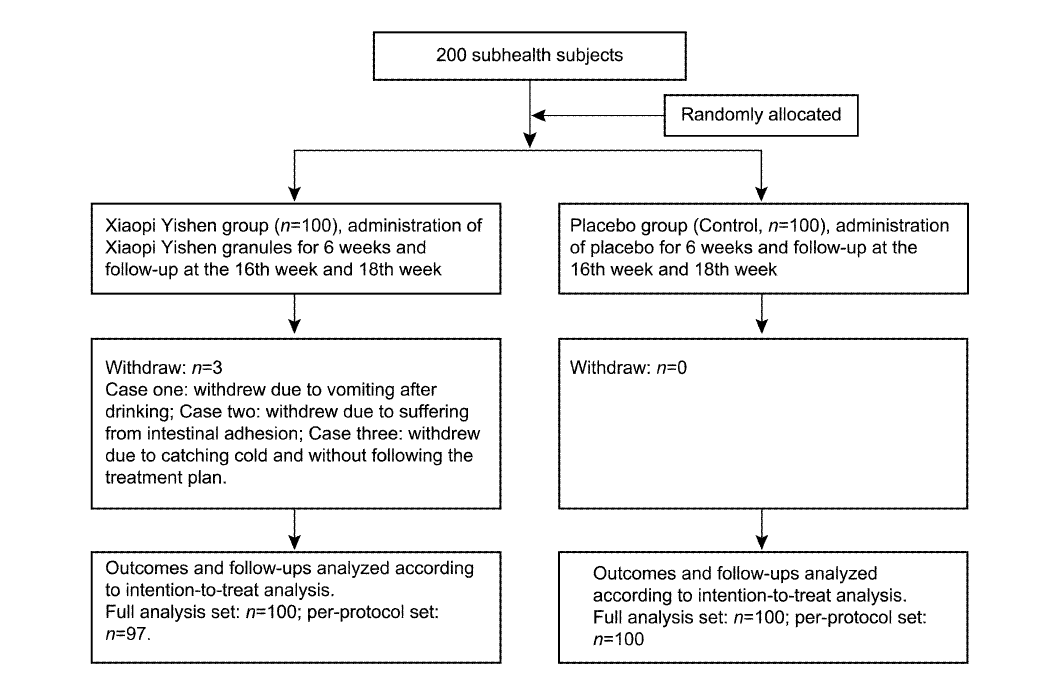
Design, setting participants and interventions: A multi-center, randomized, double-blinded, placebo-controlled clinical study was undertaken. The study period was 18 weeks, including 6 weeks for intervention and 12 weeks for follow-up. Participants were recruited from medical center and outpatient clinics of three hospitals in China, i.e. Xiaotangshan Hospital of Beijing, the First Affiliated Hospital of Henan University of TCM and the Affiliated Hospital of Liaoning University of TCM. Two hundred participants who met the criteria of fatigue-predominant subhealth and liver-qi stagnation and spleen-qi deficiency in TCM were allocated randomly to the treatment group (XPYS, n=100) and control group (placebo, n=100).
Main outcome measures: The total score of Fatigue Scale-14 (FS-14) was used to evaluate the fatigue status of subjects and the extent of liver-qi stagnation and spleen-qi deficiency syndrome was also recorded.
Results: Three cases in the XPYS group withdrew from the trial. There were 200 subjects who entered to full analysis set (FAS) analysis and 197 subjects fitted in the per-protocol set (PPS) analysis. (1) According to the score changes of FS-14, the effectiveness rates in the XPYS and placebo group were as follows: 14.0% vs 9.0% (FAS) and 14.4% vs 9.0% (PPS) for complete remission, 19.0% vs 15.0% (FAS) and 19.6% vs 15.0% (PPS) for obvious effects, 39.0% vs 26.0% (FAS) and 39.2% vs 26.0% (PPS) for effective, and 72.0% vs 50.0% (FAS) and 73.2% vs 50.0% (PPS) for complete efficacy. The efficacy of XPYS-HEG was superior to the placebo statistically (P<0.05). (2) According to the score changes of TCM syndrome, the effectiveness rates in the XPYS group and placebo group were as follows: 1.0% vs 0.0% (FAS) and 1.0% vs 0.0% (PPS) for complete remission, 20.0% vs 7.0% (FAS) and 19.6% vs 7.0% (PPS) for obvious effects, 29.0%vs 24.0% (FAS) and 29.9% vs 24.0% (PPS) for effective, and 50.0% vs 31.0% (FAS) and 50.5% vs 31.0% (PPS) for complete efficacy. The efficacy of XPYS-HEG was superior to that of placebo statistically (P<0.05). (3) The follow-up results at 12 weeks and 18 weeks showed that the efficacy of XPYS-HEG was superior to that of placebo statistically (P<0.05). (4) No adverse effects were found in the XPYS group.
Conclusion: It can be concluded that XPYS-HEG is effective and safe for the treatment of people with fatigue-predominant subhealth due to liver-qi stagnation and spleen-qi deficiency.

Key words: drugs,Chinese herbal, fatigue, subhealth, symptom complex, randomized controlled trial, double-blind method, placebo, prospective studies

Figure 1

Flow chart of this randomized trial"

"

"

"

"

"

"

[1] China Association of Chinese Medicine. Clinical guidelines for Chinese medicine on subhealth[M]. Beijing: China Press of Traditional Chinese Medicine, 2006: 1
中华中医药学会. 亚健康中医临床指南[M]. 北京: 中国中医药出版社, 2006: 1
[2] Zhang YJ, Wang TF, Xue XL, Wang JJ, Li GR . Exploration on diagnostic standardization of fatigue-predominant subhealth in integrated traditional Chinese and Western medicine[J]. Beijing Zhong Yi Yao, 2009,28(4):269-270
张雅静, 王天芳, 薛晓琳, 王佳佳, 李冠儒 . 中西医结合疲劳性亚健康判定标准的探讨[J]. 北京中医药, 2009,28(4):269-270
[3] Zhang YJ, Wang TF, Xue XL, Wang JJ, Li GR, Han P . Characteristics of traditional Chinese medicine syndromes and their element distributions in subhealth status: a modern literature review[J]. J Chin Integr Med, 2008,6(12):1290-1293
doi: 10.3736/jcim20081216
张雅静, 王天芳, 薛晓琳, 王佳佳, 李冠儒, 韩萍 . 亚健康状态中医证候及证候要素分布特点的现代文献分析[J]. 中西医结合学报, 2008,6(12):1290-1293
doi: 10.3736/jcim20081216
[4] Wang TF, Wang JJ, Xue XL, Han P, Zhang YJ, Li GR, Wu XY, Zhao Y, Tang LL, Liu YY, Sui CL, Fu C, Shang YM, Zhou B . Distribution characteristics of traditional Chinese medicine syndromes and their elements in people with subhealth fatigue[J]. J Chin Integr Med, 2010,8(3):220-223
王天芳, 王佳佳, 薛晓琳, 韩萍, 张雅静, 李冠儒, 吴秀艳, 赵燕, 唐利龙, 刘豫玥, 睢丛璐, 付晨, 尚永梅, 周波 . 疲劳性亚健康状态中医证候及证候要素分布特点[J]. 中西医结合学报, 2010,8(3):220-223
[5] Chalder T, Berelowitz G, Pawlikowska T, Watts L, Wessely S, Wright D, Wallace EP . Development of a fatigue scale[J]. J Psychosom Res, 1993,37(2):147-153
doi: 10.1016/0022-3999(93)90081-P pmid: 8463991
[6] Wang TF, Zhang CZ . Fatigue scale-14[J]. Zhongguo Xing Wei Yi Xue Ke Xue, 2001,10(S):61
王天芳, 张翠珍 . 疲劳量表-14[J]. 中国行为医学科学, 2001,10(特刊):61
[7] . World Medical Association Declaration of Helsinki: ethical principles for medical research involving human subjects[J]. JAMA, 2000,284(23):3043-3045
doi: 10.1007/BF02811094
[8] Jiang QJ . Psychosocial stress survey for groups[J]. Zhongguo Xing Wei Yi Xue Ke Xue, 2001,10(S):40-41
姜乾金 . 团体用心理社会应激调查表[J]. 中国行为医学科学, 2001,10(特刊):40-41
[9] Wang TF, Sun T . Exploration on the concept and category of sub-health and Chinese medicine “treating pre-disease” doctrine and the relationship between them[J]. Zhongguo Zhong Xi Yi Jie He Za Zhi, 2009,29(10):929-933
王天芳, 孙涛 . 亚健康与“治未病”的概念、范畴及其相互关系的探讨[J]. 中国中西医结合杂志, 2009,29(10):929-933
[10] Xu WJ, Wang TF, Li L, Xue XL, Zhang YJ, Wang JJ, Li GR, Zhao Y . Advantages of researching sub-health state by Chinese medicine[J]. Beijing Zhong Yi Yao Da Xue Xue Bao, 2008,31(1):7-9
徐雯洁, 王天芳, 李力, 薛晓琳, 张雅静, 王佳佳, 李冠儒, 赵燕 . 试论中医研究亚健康状态的优势[J]. 北京中医药大学学报, 2008,31(1):7-9
[11] Xue XL, Wang TF, Zhang YJ, Wang JJ, Li GR, Zheng MS, Zhao Y, Wu XY . Construction of effectiveness evaluation system for traditional Chinese medicine interventions in subhealth[J]. J Chin Integr Med, 2009,7(3):201-204
薛晓琳, 王天芳, 张雅静, 王佳佳, 李冠儒, 郑孟姗, 赵燕, 吴秀艳 . 亚健康中医药干预效果评价体系的构建思路[J]. 中西医结合学报, 2009,7(3):201-204
[12] Wang TF, Zhang CZ, Ji SL, Liu YF, Jiao Y, Zhang B, Wang L, Zheng JF, Yao JQ . The characteristics of fatigue of patients with chronic fatigue syndrome and the therapeutic effect of Chinese medicine[J]. Zhongguo Yi Yao Xue Bao, 2000,15(4):58-60
王天芳, 张翠珍, 季绍良, 刘雁峰, 焦扬, 张冰, 王琳, 郑君芳, 姚俊清 . 慢性疲劳综合征病人的疲劳特征及中药的治疗作用[J]. 中国医药学报, 2000,15(4):58-60
[1] Qi-sheng Tang, Wen-jun Sun, Miao Qu, Dong-fang Guo. Analysis of syndrome discipline of generalized anxiety disorder using data mining techniques. Journal of Chinese Integrative Medicine, 2012, 10(9): 975-982.
[2] Jing-lin Shi, Wan-hong Miao. Effects of acupuncture on lactoferrin content in tears and tear secretion in patients suffering from dry eyes: A randomized controlled trial. Journal of Chinese Integrative Medicine, 2012, 10(9): 1003-1008.
[3] Jian-sheng Li, Ya Li, Su-yun Li, Yuan-yuan Wang, Li Deng, Yan-ge Tian, Su-li Jiang , Ying Wang. Long-term effects of Tiaobu Feishen therapies on systemic and local inflammation responses in rats with stable chronic obstructive pulmonary disease. Journal of Chinese Integrative Medicine, 2012, 10(9): 1039-1048.
[4] Lu Liu, Ying Gao. Study on the correlation between traditional Chinese medicine syndrome and short-term prognosis of ischemic stroke using logistic regression model and repeated-measures analysis of variance. Journal of Chinese Integrative Medicine, 2012, 10(9): 983-990.
[5] Ming T. Tan , Jian-ping Liu , Lixing Lao. Adequate application of quantitative and qualitative statistic analytic methods in acupuncture clinical trials. Journal of Chinese Integrative Medicine, 2012, 10(8): 847-852.
[6] Lu Yu, Shui-miao Lin, Ru-qian Zhou, Wei-jun Tang, Pin-xian Huang, Ying Dong, Jian Wang, Zhi-hua Yu, Jiu-lin Chen, Li Wei, San-li Xing, Hui-juan Cao, Hong-bin Zhao. Chinese herbal medicine for patients with mild to moderate Alzheimer disease based on syndrome differentiation: A randomized controlled trial. Journal of Chinese Integrative Medicine, 2012, 10(7): 766-776.
[7] Ling Xu, Qiao-ling Zhou, Jie Han, Dan-ying Zhang, Hui-juan Dong, Zai-long Cai, Chao-qin Yu, Dong-xia Zhai . Effects of Chinese herbal medicine Neiyi Recipe-medicated serum on angiopoiesis of endometriosis in the chick chorioallantoic membrane model. Journal of Chinese Integrative Medicine, 2012, 10(7): 800-806.
[8] Dong-mei Zhang, Li-xia Lou, Ai-ming Wu, Xi-ying Lü, Zhao-juan Hu, Yan-hong Zhang, Hong-fang Liu. Effects of Astragalus membranaceus and Potentilla discolor mixture on insulin resistance and its related mRNA expressions in KKAy mice with type 2 diabetes. Journal of Chinese Integrative Medicine, 2012, 10(7): 821-826.
[9] Yan Guan , Hui Zhang, Wei Zhang, Shi-bing Su . Analysis of differential gene expression profile in peripheral blood of patients with chronic hepatitis B and syndromes of dual deficiency of liver and kidney yin and accumulation of dampness heat. Journal of Chinese Integrative Medicine, 2012, 10(7): 751-756.
[10] Mei-jiao Mao, Jun-ping Hu, Cong Wang, Yi-yi Zhang, Ping Liu. Effects of Chinese herbal medicine Guanxinkang on expression of PPARγ-LXRα-ABCA1 pathway in ApoE-knockout mice with atherosclerosis. Journal of Chinese Integrative Medicine, 2012, 10(7): 814-820.
[11] Yi-tao Zhao , Xin-guang Zhang , Li Bai , Li-qing Li , Jian-er Yu . Effects of Chinese herbal medicine Pingchuan Formula on airway inflammation, interferon-γ and interleukin-4 in mice with asthma. Journal of Chinese Integrative Medicine, 2012, 10(7): 807-813.
[12] Ming-xing Zhao, Zhen-hua Dong, Zhong-hai Yu, Shi-yuan Xiao, Ya-ming Li . Effects of Ginkgo biloba extract in improving episodic memory of patients with mild cognitive impairment: A randomized controlled trial. Journal of Chinese Integrative Medicine, 2012, 10(6): 628-634.
[13] Ying-fei Bi , Jing-yuan Mao , Xian-liang Wang , Ya-zhu Hou , Yi-zhu Lu , Shan Bin Soh , Bo-li Zhang. Clinical epidemiology survey of the traditional Chinese medicine etiology and syndrome differentiation of coronary artery disease: Study protocol of a multicenter trial. Journal of Chinese Integrative Medicine, 2012, 10(6): 619-627.
[14] Shui-qiu Deng, Xue-nong Ouyang, Zong-yang Yu, Xi-hu Dai, Xi Chen, Fang-zheng Fang, Wen-wu Wang, Zhi-zhen Liu. Influence of Chinese herbal medicine Feitai Capsule on completion or delay of chemotherapy in patients with stage ⅢB/Ⅳ non-small-cell lung cancer: a Randomized controlled trial. Journal of Chinese Integrative Medicine, 2012, 10(6): 635-640.
[15] Chuan Chen, Hui-ying Chi, Zhi-hua Yu, Jiu-lin Chen . Effects of Chinese herbal medicine Shoushen Granule on telomere length and telomerase activity of peripheral white blood cells and vascular cells in rats with atherosclerosis. Journal of Chinese Integrative Medicine, 2012, 10(6): 667-673.
Viewed
Full text


Abstract

Cited

  Shared   
  Discussed   
[1] Wei-xiong Liang. Problems-solving strategies in clinical treatment guideline for traditional Chinese medicine and integrative medicine. Journal of Chinese Integrative Medicine, 2008, 6(1): 1-4
[2] Zhao-guo Li. Discussion on English translation of commonly used sentences in traditional Chinese medicine: part one. Journal of Chinese Integrative Medicine, 2008, 6(1): 107-110
[3] Jun Hu, Jian-ping Liu. Non-invasive physical treatments for chronic/recurrent headache. Journal of Chinese Integrative Medicine, 2008, 6(1): 31
[4] Xue-mei Liu, Qi-fu Huang, Yun-ling Zhang, Jin-li Lou, Hong-sheng Liu, Hong Zheng. Effects of Tribulus terrestris L. saponion on apoptosis of cortical neurons induced by hypoxia-reoxygenation in rats. Journal of Chinese Integrative Medicine, 2008, 6(1): 45-50
[5] . Uniform requirements for manuscripts submitted to biomedical journals: Writing and editing for biomedical publication (Chinese version, part two). Journal of Chinese Integrative Medicine, 2010, 8(11): 1001-1005
[6] Daniel Weber, Janelle M Wheat, Geoffrey M Currie. Inflammation and cancer: Tumor initiation, progression and metastasis,and Chinese botanical medicines. Journal of Chinese Integrative Medicine, 2010, 8(11): 1006-1013
[7] Hong Liu , Guo-liang Zhang, Li Shen , Zhen Zeng, Bao-luo Zhou, Cheng-hai Liu, Guang Nie . Application and evaluation of a pseudotyped virus assay for screening herbs for anti-H5Nl avian influenza virus. Journal of Chinese Integrative Medicine, 2010, 8(11): 1036-1040
[8] Zhao-guo Li . A discussion of English translation of 1995 and 1997 Chinese National Standards of Traditional Chinese Medical Terminologies for Clinical Diagnosis and Treatment. Journal of Chinese Integrative Medicine, 2010, 8(11): 1090-1096
[9] Rui Jin, Bing Zhang. A complexity analysis of Chinese herbal property theory: the multiple formations of herbal property (Part 1). Journal of Chinese Integrative Medicine, 2012, 10(11): 1198-1205
[10] Hui-min Liu, Xian-bo Wang, Yu-juan Chang, Li-li Gu. Systematic review and meta-analysis of randomized controlled trials of integrative medicine therapy for treatment of chronic severe hepatitis. Journal of Chinese Integrative Medicine, 2012, 10(11): 1211-1228
[an error occurred while processing this directive]