[an error occurred while processing this directive]

Journal of Chinese Integrative Medicine ›› 2011, Vol. 9 ›› Issue (8): 847-856.doi: 10.3736/jcim20110806

Special Issue: Acupuncture & Moxibustion

• Original Clinical Research • Previous Articles     Next Articles

Usage of alternative medical systems,acupuncture, homeopathy and anthroposophic medicine, by older German adults

Arndt Büssing1,2(), Thomas Ostermann2,3, Peter Heusser2, Peter F. Matthiessen2   

  1. 1. Quality of Life, Spirituality and Coping, Center for Integrative Medicine, Faculty of Health, University of Witten/ Herdecke, Gerhard-Kienle-Weg 4, 58313 Herdecke, Germany
    2. Integrative and Anthroposophic Medicine, Faculty of Health, University of Witten/Herdecke, Gerhard-Kienle-Weg 4, 58313 Herdecke, Germany
    3. Research Methodology and Information Systems, Center for Integrative Medicine, Faculty of Health, University of Witten/ Herdecke, Gerhard-Kienle-Weg 4, 58313 Herdecke, Germany
  • Received:2011-03-31 Accepted:2011-06-07 Online:2011-08-20 Published:2011-08-15

Objective: The manifold studies on the usage of complementary and alternative medicine (CAM) indicate that its utilization differs with respect to socio-cultural background, gender, age and underlying disease. This study intended to analyze the usage of specific CAM practices among a population of older German adults with health insurance coverage.
Methods: Data of 5 830 older individuals who participated in an anonymous cross sectional survey among German insurance beneficiaries were analyzed with respect to usage of CAM treatments applied by medical doctors or non-medical practitioners within the last 5 years.
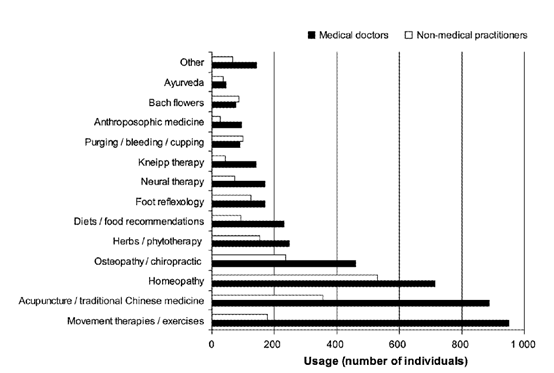
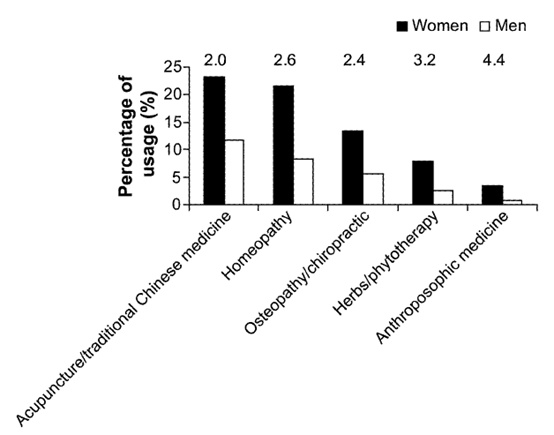
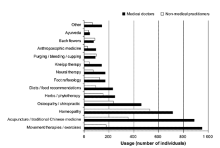
Results: The most frequently used approaches were acupuncture/traditional Chinese medicine (21%), homeopathy (21%), movement therapies/physical exercises (19%), osteopathy/chiropractic (12%), herbs/phytotherapy (7%), diets/specific food recommendations (6%) and foot reflexology (5%). Anthroposophic medicine was used only to a minor degree. Acupuncture and homeopathy users were likely to choose more than one CAM treatment simultaneously, particularly the combination of homeopathy and acupuncture. Moreover, this study can confirm significant differences between women and men in the use of the main relevant CAM interventions.
Conclusion: The relative proportion of acupuncture usage was similar to homeopathy, which is an alternative whole medical system originating from Western Europe. This means that an Eastern alternative system is established also in Germany. In several cases not only one CAM treatment was used but distinct combinations existed (particularly homeopathy and acupuncture); thus one should be cautious to draw predictive conclusions from studies with broad and unspecific CAM categories, for among them there are several therapies which should not be regarded as CAM.

Key words: complementary therapies, acupucture therapy, homeopathy, marketing of health services, questionnaires, Germany, aged

"

Variable Women Men
Gender1 29.8% 70.2%
Age2** (mean±SD, years) 62.5±13.0 65.7±14.4
Family status1*
Living with partner 53% 88%
Divorced 8% 4%
Single 12% 3%
Widowed 27% 5%
Education level1*
Elementary school 14% 20%
Middle school 19% 22%
High school 61% 50%
Other 5% 8%
Smoking1
Yes 11% 10%
No 89% 90%
Employment status1*
Full time 20% 24%
Half time 19% 4%
Home work 16% 0%
Not working 12% 18%
Retired 33% 54%
Feeling ill1*
Yes 55% 59%
No 45% 41%
Disease category1*
Healthy 69% 67%
Acute diseases 7% 10%
Chronic diseases 15% 14%
Cancer 9% 9%
Health-related quality of life (SF-12)§
Physical health2** (mean±SD) 46.0±10.7 48.0±8.9
Mental health2** (mean±SD) 50.7±9.6 54.1±7.2
Days of treatment during the past year2
Hospital stay (mean±SD, d) 6.3±12.3 7.5±17.6
MD treatment (mean±SD, d) 15.0±39.3 12.8±36.8
NMP treatment (mean±SD, d)** 5.2±11.5 1.9±6.4

Figure 1

Complementary and alternative medicine usage within the last 2 years (n=5 830)"

"

Treatment usage n Homeopathy (%) Osteopathy/
chiropractic (%)
Anthroposophic
medicine (%)
Herbs/
phytotherapy (%)
Acupuncture
(%)
- + - + - + - + - +
Acupuncture - 4 944 92 8 94 5 99 1 97 3
+ 886 66 34 77 23 96 4 89 11
Homeopathy - 5 117 94 6 99 1 98 2 88 12
+ 713 78 22 91 9 80 20 58 42

Figure 2

Differences between men and women with respect to the usage of complementary and alternative medicine treatments applied by medical doctors The values above the columns indicate the usage ratio women/men. All differences were significant at P≤0.001 (Pearson’s Chi square test)."

"

User Hospital stay (d) MD treatment (d) NMP treatment (d)
Non-acupuncture/homeopathy users
Women 6.3±13.2 (400) 12.6±38.0 (742) 4.2±10.2 (358)
Men 7.5±18.1 (1 241) 11.2±34.1 (2 346) 1.5±6.1 (829)
All users 7.2±17.0 (1 641) 11.6±35.1 (3 088) 2.3±7.6 (1 187)
F-value 1.6 0.9 31.0
P-value n.s. n.s. <0.001
Acupuncture/TCM users
Women 7.1±11.2 (170) 21.0±41.9 (303) 7.3±12.7 (159)
Men 7.7±16.3 (206) 23.1±53.2 (388) 2.3±4.6 (167)
All users 7.4±14.2 (376) 22.2±45.6 (691) 4.7±9.8 (326)
F-value 0.1 0.3 22.7
P-value n.s. n.s. <0.001
Homeopathy users
Women 4.9±7.5 (130) 16.2±33.5 (273) 7.7±14.7 (165)
Men 5.5±10.1 (137) 14.9±40.1 (278) 3.9±8.5 (145)
All users 5.2±9.0 (267) 15.6±36.9 (551) 5.9±12.3 (310)
F-value 0.3 0.2 7.7
P-value n.s. n.s. 0.006
Osteopathy/chiropractic users
Women 6.2±8.9 (90) 18.4±34.2 (175) 9.0±17.6 (94)
Men 6.7±12.6 (102) 21.4±55.8 (195) 3.3±5.7 (90)
All users 6.5±11.0 (192) 20.0±46.8 (370) 6.2±13.5 (184)
F-value 0.1 0.4 8.6
P-value n.s. n.s. 0.004
Phytotherapy users
Women 6.0±15.7 (46) 14.9±31.8 (102) 8.5±17.0 (62)
Men 6.6±10.8 (42) 22.8±56.3 (90) 3.8±5.7 (37)
All users 6.3±13.5 (88) 18.6±45.0 (192) 6.8±14.0 (99)
F-value 0.0 1.5 2.7
P-value n.s. n.s. n.s.
Anthroposophic medicine users
Women 3.4±5.7 (21) 11.8±12.6 (44) 9.5±17.4 (26)
Men 6.9±9.8 (16) 10.4±13.5 (25) 4.0±6.3 (11)
All users 5.0±7.8 (37) 11.3±12.9 (69) 7.9±15.1 (37)
F-value 1.9 0.2 1.0
P-value n.s. n.s. n.s.
[1] Astin JA, Pelletier KR, Marie A, Haskell WL . Complementary and alternative medicine use among elderly persons: one-year analysis of a Blue Shield Medicare supplement[J]. J Gerontol A Biol Sci Med Sci, 2000,55(1):M4-M9
doi: 10.1093/gerona/55.1.M4
[2] Barnes PM, Powell-Griner E, McFann K, Nahin RL .Complementary and alternative medicine use among adults: United States, 2002[J]. Adv Data, 2004,( 343):1-19
[3] Barnes PM, Bloom B, Nahin RL . Complementary and alternative medicine use among adults and children: United States, 2007[J]. Natl Health Stat Report, 2008,( 12):1-23
[4] Huber R, Koch D, Beiser I, Zschocke I, Luedtke R . Experience and attitudes towards CAM — a survey of internal and psychosomatic patients in a German university hospital[J]. Altern Ther Health Med, 2004,10(1):32-36
[5] Molassiotis A, Fernadez-Ortega P, Pud D, Ozden G, Scott JA, Panteli V, Margulies A, Browall M, Magri M, Selvekerova S, Madsen E, Milovics L, Bruyns I, Gudmundsdottir G, Hummerston S, Ahmad AM, Platin N, Kearney N, Patiraki E . Use of complementary and alternative medicine in cancer patients: a European survey[J]. Ann Oncol, 2005,16(4):655-663
doi: 10.1093/annonc/mdi110
[6] Bell RA, Suerken CK, Grzywacz JG, Lang W, Quandt SA, Arcury TA . CAM use among older adults age 65 or older with hypertension in the United States: general use and disease treatment[J]. J Altern Complement Med, 2006,12(9):903-909
doi: 10.1089/acm.2006.12.903
[7] Grzywacz JG, Suerken CK, Quandt SA, Bell RA, Lang W, Arcury TA . Older adults’ use of complementary and alternative medicine for mental health: findings from the 2002 National Health Interview Survey[J]. J Altern Complement Med, 2006,12(5):467-473
doi: 10.1089/acm.2006.12.467
[8] Cheung CK, Wyman JF, Halcon LL . Use of complementary and alternative therapies in community-dwelling older adults[J]. J Altern Complement Med, 2007,13(9):997-1006
doi: 10.1089/acm.2007.0527 pmid: 18047447
[9] Büssing A, Ostermann T, Matthiessen PF . Inanspruchnahme unterstützender komplementürmedizinischer Verfahren bei Tumorpatienten in der spteren Phase[J]. DZO, 2007,39(4):162-168
doi: 10.1055/s-2007-986022
[10] Ndao-Brumblay SK, Green CR . Predictors of complementary and alternative medicine use in chronic pain patients[J]. Pain Med, 2010,11(1):16-24
doi: 10.1111/j.1526-4637.2009.00767.x pmid: 20447293
[11] Kang E, Yang EJ, Kim SM, Chung IY, Han SA, Ku DH, Nam SJ, Yang JH, Kim SW.Complementary and alternative medicine use and assessment of quality of life in Korean breast cancer patients: a descriptive study.Support Care Cancer. 2011 Jan 28. [Epub ahead of print]
[12] Richardson MA, Sanders T, Palmer JL, Greisinger A, Singletary SE . Complementary/alternative medicine use in a comprehensive cancer center and the implications for oncology[J]. J Clin Oncol, 2000,18(13):2505-2514
doi: 10.1200/JCO.2000.18.13.2505
[13] Henderson JW, Donatelle RJ . Complementary and alternative medicine use by women after completion of allopathic treatment for breast cancer[J]. Altern Ther Health Med, 2004,10(1):52-57
[14] Fouladbakhsh JM, Stommel M, Given BA, Given CW . Predictors of use of complementary and alternative therapies among patients with cancer[J]. Oncol Nurs Forum, 2005,32(6):1115-1122
doi: 10.1188/05.ONF.1115-1122 pmid: 16270107
[15] Kalder M, Knoblauch K, Hrgovic I, Münstedt K . Use of complementary and alternative medicine during pregnancy and delivery[J]. Arch Gynecol Obstet, 2011,283(3):475-482
doi: 10.1007/s00404-010-1388-2 pmid: 20177901
[16] Foster DF, Phillips RS, Hamel MB, Eisenberg DM . Alternative medicine use in older Americans[J]. J Am Geriatr Soc, 2000,48(12):1560-1565
doi: 10.1046/j.1532-5415.2001.4911262.x pmid: 11890608
[17] Cohen RJ, Ek K, Pan CX . Complementary and alternative medicine(CAM) use by older adults: a comparison of self-report and physician chart documentation[J]. J Gerontol A Biol Sci Med Sci, 2002,57(4):M223-M227
doi: 10.1093/gerona/57.4.M223
[18] Arcury TA, Suerken CK, Grzywacz JG, Bell RA, Lang W, Quandt SA . Complementary and alternative medicine use among older adults: ethnic variation[J]. Ethn Dis, 2006,16(3):723-731
doi: 10.1017/S0950268805005285 pmid: 16937611
[19] Flaherty JH, Takahashi R, Teoh J, Kim JI, Habib S, Ito M, Matsushita S . Use of alternative therapies in older outpatients in the United States and Japan: prevalence, reporting patterns, and perceived effectiveness[J]. J Gerontol A Biol Sci Med Sci, 2001,56(10):M650-M655
doi: 10.1093/gerona/56.10.M650
[20] Hedderson MM, Patterson RE, Neuhouser ML, Schwartz SM, Bowen DJ, Standish LJ, Marshall LM . Sex differences in motives for use of complementary and alternative medicine among cancer patients[J]. Altern Ther Health Med, 2004,10(5):58-64
[21] Cherniack EP, Senzel RS, Pan CX . Correlates of use of alternative medicine by the elderly in an urban population[J]. J Altern Complement Med, 2001,7(3):277-280
doi: 10.1089/107628001753312112 pmid: 11439850
[22] Nagel G, Hoyer H, Katenkamp D . Use of complementary and alternative medicine by patients with breast cancer: observations from a health-care survey[J]. Support Care Cancer, 2004,12(11):789-796
doi: 10.1007/s00520-004-0675-5
[23] Kim S, Hohrmann JL, Clark S, Munoz KN, Braun JE, Doshi A, Radeos MS, Camargo CA Jr . A multicenter study of complementary and alternative medicine usage among ED patients[J]. Acad Emerg Med, 2005,12(4):377-380
doi: 10.1197/j.aem.2005.02.008 pmid: 15805333
[24] Pedersen CG, Christensen S, Jensen AB, Zachariae R . Prevalence, socio-demographic and clinical predictors of post-diagnostic utilisation of different types of complementary and alternative medicine(CAM) in a nationwide cohort of Danish women treated for primary breast cancer[J]. Eur J Cancer, 2009,45(18):3172-3181
doi: 10.1016/j.ejca.2009.09.005
[25] National Center for Complementary and Alternative Medicine . What is complementary and alternative medicine? NCCAM Publication No. D347. (2010-11)[ 2011-02-17].
[26] Schlaeppi MR, Büssing A, Müller-Hübenthal B, Heusser P . Anthroposophische Medizin in der Onkologie[J]. Der Onkologe, 2010,16(9):901-905
doi: 10.1007/s00761-010-1891-x
[27] Heusser P, Kienle G. Anthroposophic medicine, integrative oncology, and mistletoe therapy of cancer. In: Abrams D, Weil A. Integrative oncology[M]. New York: Oxford University Press, 2009: 322-340
[28] Büssing A, Ostermann T, Raak C, Matthiessen PF . Adaptive coping strategies and attitudes toward health and healing in German homeopathy and acupuncture users[J]. Explore (NY), 2010,6(4):237-245
doi: 10.1016/j.explore.2010.04.002
[29] Ware J Jr, Kosinski M, Keller SD . A 12-Item Short-Form Health Survey: construction of scales and preliminary tests of reliability and validity[J]. Med Care, 1996,34(3):220-233
doi: 10.1097/00005650-199603000-00003
[30] Marstedt G, Moebus S . Gesundheitsberichterstattung des Bundes Heft 9: Inanspruchnahme alternativer Methoden in der Medizin[M]. Berlin: Robert Koch-Institute, 2002
[31] Harzing AW . Response rates in international mail surveys: results of a 22 country study[J]. Int Bus Rev, 1997,6(6):641-665
doi: 10.1016/S0969-5931(97)00040-1
[32] Büssing A. Overview on Viscum album L. products. In: Büssing A. Mistletoe: the genus Viscum. Medicinal and aromatic plants — industrial profiles. Amsterdam: Harwood Academic Publishers. 2000: 209-221
[33] Büssing A. Mistletoe extracts from the anthroposophical point of view. In: Beuth J, Moss RW. Complementary oncology. Stuttgart: Thieme-Verlag. 2005: 197-206
[34] Büssing A, Michalsen A, Balzat HJ, Grünther RA, Ostermann T, Neugebauer EA, Matthiessen PF . Are spirituality and religiosity resources for patients with chronic pain conditions?[J]. Pain Med, 2009,10(2):327-339
doi: 10.1111/j.1526-4637.2009.00572.x pmid: 19284487
[35] Büssing A, Fischer J, Ostermann T, Matthiessen PF . Reliance on God’s help, depression and fatigue in female cancer patients[J]. Int J Psychiatry Med, 2008,38(3):357-372
doi: 10.2190/PM.38.3.j pmid: 19069578
[36] Büssing A, Fischer J, Ostermann T, Matthiessen PF . Reliance on God’s help as a measure of intrinsic religiosity in healthy elderly and patients with chronic diseases — correlations with health-related quality of life?[J]. Appl Res Qual Life, 2009,4(1):77-90
doi: 10.1007/s11482-009-9068-8
[1] Qi-sheng Tang, Wen-jun Sun, Miao Qu, Dong-fang Guo. Analysis of syndrome discipline of generalized anxiety disorder using data mining techniques. Journal of Chinese Integrative Medicine, 2012, 10(9): 975-982.
[2] Zhang-ling Zhou, Cheng-xin Li, Yue-bo Jiang, Cong Zuo, Yun Cai, Rui Wang. Correlation between facial nerve functional evaluation and efficacy evaluation of acupuncture treatment for Bell’s palsy. Journal of Chinese Integrative Medicine, 2012, 10(9): 997-1002.
[3] Ming T. Tan , Jian-ping Liu , Lixing Lao. Adequate application of quantitative and qualitative statistic analytic methods in acupuncture clinical trials. Journal of Chinese Integrative Medicine, 2012, 10(8): 847-852.
[4] Wei-hua Xu, Ze-huai Wen, Wei-xiong Liang, Qi Wang. A review of research on the development of instruments for therapeutic efficacy evaluation of traditional Chinese medicine. Journal of Chinese Integrative Medicine, 2012, 10(7): 726-737.
[5] Ying-fei Bi , Jing-yuan Mao , Xian-liang Wang , Ya-zhu Hou , Yi-zhu Lu , Shan Bin Soh , Bo-li Zhang. Clinical epidemiology survey of the traditional Chinese medicine etiology and syndrome differentiation of coronary artery disease: Study protocol of a multicenter trial. Journal of Chinese Integrative Medicine, 2012, 10(6): 619-627.
[6] Yuan-yuan Tong, Wei He, Ce Yang, Bin Zhang, Jian Du, Ying-kai Zhao. Analysis of the status and trends of international research in complementary and alternative medicine based on literature mining. Journal of Chinese Integrative Medicine, 2012, 10(6): 597-603.
[7] Soumya Sundar Bhattacharyya, Jayeeta Das, Sreemanti Das, Asmita Samadder, Durba Das, Arnab De, Saili Paul, Anisur Rahman Khuda-Bukhsh. Rapid green synthesis of silver nanoparticles from silver nitrate by a homeopathic mother tincture Phytolacca Decandra. Journal of Chinese Integrative Medicine, 2012, 10(5): 546-554.
[8] Christoph A. Doenitz, Ana Anjos, Thomas Efferth , Tobias Greten, Henry J. Greten. Can heat and cold be parameterized? Clinical data of a preliminary study. Journal of Chinese Integrative Medicine, 2012, 10(5): 532-537.
[9] Jia-jia Wang , Tian-fang Wang , Xiu-yan WU , Yah Zhao , Xiao-lin Xue , Qing-guo Wang. Weighting coefficients of symptoms and signs in the diagnosis of corresponding TCM syndrome elements of ulcerative colitis based on expert questionnaire investigation. Journal of Chinese Integrative Medicine, 2012, 10(4): 398-405.
[10] Santu Kumar Saha, Sreemanti Das, Anisur Rahman Khuda-Bukhsh. Phenotypic evidence of ultra-highly diluted homeopathic remedies acting at gene expression level: A novel probe on experimental phage infectivity in bacteria. Journal of Chinese Integrative Medicine, 2012, 10(4): 462-470.
[11] Thomas Efferth, Henry Johannes Greten. The European directive on traditional herbal medicinal products: friend or foe for plant-based therapies?. Journal of Chinese Integrative Medicine, 2012, 10(4): 357-361.
[12] De-bo Qi, Wei-min Li. Effects of electroacupuncture on expression of c-fos protein and N-methyl-D-aspartate receptor 1 in the rostral ventromedia medulla of rats with chronic visceral hyperalgesia. Journal of Chinese Integrative Medicine, 2012, 10(4): 416-423.
[13] Paula de Sousa Fragoso Ana, de Sá Ferreira Arthur. Evaluation of the immediate effects of manual acupuncture on brachial bicep muscle function in healthy individuals and poststroke patients: a study protocol of a parallel-group randomized clinical trial. Journal of Chinese Integrative Medicine, 2012, 10(3): 303-309.
[14] Das Sreemanti, Kumar Saha Santu, De Arnab, Das Durba, Rahman Khuda-Bukhsh Anisur. Potential of the homeopathic remedy, Arnica Montana 30C, to reduce DNA damage in Escherichia coli exposed to ultraviolet irradiation through up-regulation of nucleotide excision repair genes. Journal of Chinese Integrative Medicine, 2012, 10(3): 337-246.
[15] De Arnab, Das Durba, Dutta Suman, Chakraborty Debrup, Boujedaini Naoual, Rahman Khuda-Bukhsh Anisur. Potentized homeopathic drug Arsenicum Album 30C inhibits intracellular reactive oxygen species generation and up-regulates expression of arsenic resistance gene in arsenite-exposed bacteria Escherichia coli. Journal of Chinese Integrative Medicine, 2012, 10(2): 210-227.
Viewed
Full text


Abstract

Cited

  Shared   
  Discussed   
[1] Jin-rong Fu. Establishment of multivariate diagnosis and treatment system of modern gynecology of traditional Chinese medicine. Journal of Chinese Integrative Medicine, 2008, 6(1): 22-24
[2] Hao Li, Ming-jiang Yao, Wen-ming Zhao, Jie Guan, Lin-lin Cai, Ling Cui. A randomized, controlled, double-blind trial of Huannao Yicong capsule in senile patients with mild cognitive impairment. Journal of Chinese Integrative Medicine, 2008, 6(1): 25-31
[3] Zhi-chun Jin. Problems in establishing clinical guideline for integrated traditional Chinese and Western medicine. Journal of Chinese Integrative Medicine, 2008, 6(1): 5-8
[4] SUN Ming-yu, ZUO Jian, DUAN Ji-feng, HAN Jun, FAN Shi-ming, ZHANG Wei, ZHU Li-fang, YAO Ming-hui. Antitumor activities of kushen flavonoids in vivo and in vitro. Journal of Chinese Integrative Medicine, 2008, 6(1): 51-59
[5] Min Cheng, Qiong Feng, Shu-wen Qian, Hui Gao, Cui-qing Zhu. Preliminary assay of p-amyloid binding elements in heart-beneficial recipe. Journal of Chinese Integrative Medicine, 2008, 6(1): 68-72
[6] Ning-qun Wang, Liang-duo Jiang, Zong-xing Li. Research progress in asthma-related quality of life. Journal of Chinese Integrative Medicine, 2008, 6(1): 93-97
[7] Jing-yuan Mao, Chang-xiao Liu, Heng-he Wang, Guang-li Wei , Zhen-peng Zhang, Jie Xing, Wang Xian liang , Ying-fei Bi . Effects of Shenmai Injection on serum concentration and pharmacokinetics of digoxin in dogs with heart failure. Journal of Chinese Integrative Medicine, 2010, 8(11): 1070-1074
[8] Zhi-mei Wang, Bin Zhang. A study on translation of ellipses in Huangdi Neijing from perspective of hermeneutic theory. Journal of Chinese Integrative Medicine, 2010, 8(11): 1097-1100
[9] Gui Yu, Jie Wang. Thinking on building the network cardiovasology of Chinese medicine. Journal of Chinese Integrative Medicine, 2012, 10(11): 1206-1210
[10] Pedro Saganha João, Doenitz Christoph, Greten Tobias, Efferth Thomas, J. Greten Henry. Qigong therapy for physiotherapists suffering from burnout: a preliminary study. Journal of Chinese Integrative Medicine, 2012, 10(11): 1233-1239
[an error occurred while processing this directive]