[an error occurred while processing this directive]

Journal of Chinese Integrative Medicine ›› 2012, Vol. 10 ›› Issue (1): 54-58.doi: 10.3736/jcim20120109

• Original Clinical Research • Previous Articles     Next Articles

Efficacy of cervical fixed-point traction manipulation for cervical spondylotic radiculopathy: a randomizedcontrolled trial

Jiang Chong-bo1,2,Wang Jun1(),Zheng Zhi-xin1,Hou Jing-shan1,Ma Ling1,Sun Tong1   

  1. 1. Department of Rehabilitation, Division of Medical Technology, Chinese PLA General Hospital, Beijing 100853, China
    2. Health Team of PLA Unit 96212, Puning 515347, Guangdong Province, China
  • Received:2011-07-29 Accepted:2011-08-28 Online:2012-01-20 Published:2018-09-21
  • Contact: Wang Jun E-mail:wangjunkf@hotmail.com

BACKGROUND: Cervical spondylotic radiculopathy is a commonly encountered and frequently occurring disease. Traditional Chinese osteopathic manipulations may have better therapeutic efficacy than that of other methods in treating patients with cervical spondylotic radiculopathy.OBJECTIVE: To evaluate the clinical therapeutic effects of cervical fixed-point traction manipulation in treating patients with cervical spondylotic radiculopathy.DESIGN, SETTING, PARTICIPANTS AND INTERVENTIONS: A prospective, randomized controlled trial was adopted. Eighty-four patients with cervical spondylotic radiculopathy were randomly divided into treatment group (n=42) and control group (n=42). All patients were enrolled from the outpatient service of Department of Rehabilitation of Chinese PLA General Hospital of China. Patients received oral and written information about clinical procedures before giving their written informed consent. The patients were treated with cervical fixed-point traction manipulation (treatment group) or cervical computer traction (control group). Cervical fixed-point traction was performed once every other day for a total of seven treatment periods and cervical computer traction was performed 30 min, once per day for 14 d.MAIN OUTCOME MEASURES: Before and after treatment, visual analogue scale (VAS) score and temperature of upper limb skin (normal limb and abnormal limb) detected by infrared thermal imaging system were contrastively analyzed.RESULTS: Five patients were lost to follow-up, one patient in the treatment group and four patients in the control group. There were significant differences in VAS score and temperature difference between the normal and abnormal upper limbs of infrared thermal imaging in the treatment group (t=28.652, P<0.01; t=64.214, P<0.01) or in the control group (t=14.484, P<0.05; t=84.425, P<0.05) compared between before and after treatment. After treatment, the changes in VAS score and temperature difference of normal and abnormal upper limbs in the treatment group were more obvious compared with the control group (t=7.494, P<0.01; t=5.321, P<0.01).CONCLUSION: Cervical fixed-point traction manipulation has better efficacy than cervical computer traction in treating patients with cervical spondylotic radiculopathy.

Key words: cervical fixed-point traction manipulation, manipulation, osteopathic, traction, cervical spondylosis, randomized controlled trial

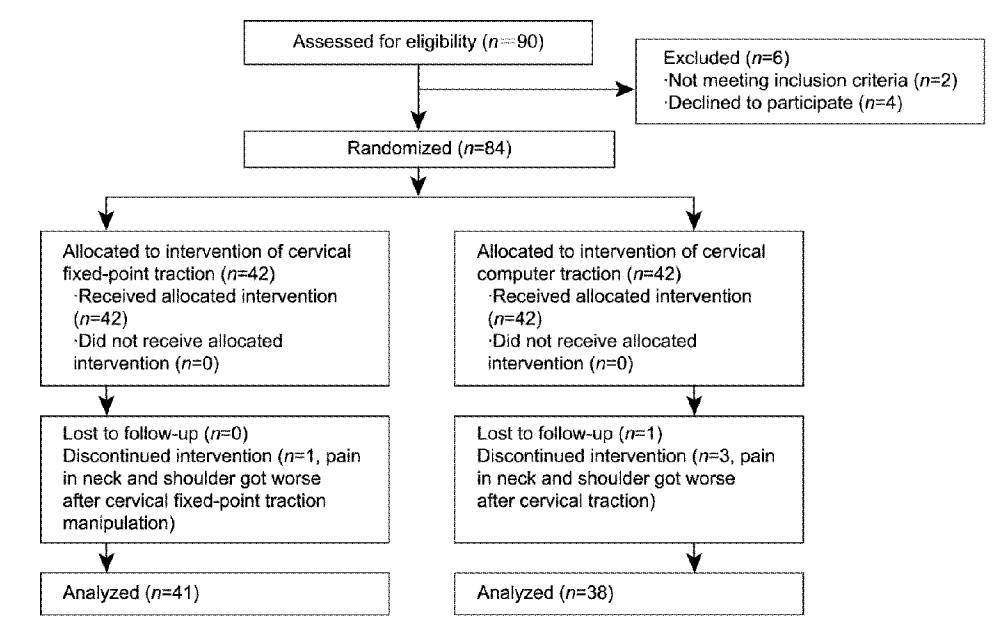
Figure 1

Flow diagram of this randomized trial"

Table 1

Score of visual analogue scale before and after treatment ($\bar{x}$±s)"

Group n Score of visual analogue scale
Before treatment After treatment Difference
Control 38 5.76±0.86 3.96±0.95* 1.80±0.76
Treatment 41 5.75±0.86 2.74±0.90** 3.01±0.67△△

Table 2

Temperature difference of infrared thermal imaging for upper limbs (normal limb and abnormal limb) before and after treatment ($\bar{x}$±s, ℃)"

Group n Temperature difference
Before treatment After treatment Difference
Control 38 1.30±0.04 0.50±0.04* 0.80±0.06
Treatment 41 1.30±0.08 0.41±0.06** 0.90±0.09△△
[1] Zhu QS, Gu R. Level diagnosis and therapy of cervical spondylotic radiculopathy. Zhongguo Ji Zhu Ji Sui Za Zhi. 2007; 17(2):93-95. Chinese.
朱庆三, 顾锐 . 神经根型颈椎病的定位诊断与治疗方法.中国脊柱脊髓杂志. 2007; 17(2):93-95.
[2] LiaoJ, ChenSJ, Xu T, Wang XC , Wang SZ. Efficacy of Tongduqiangji technique in treating cervical spondylotic radiculopathy — A randomized, controlled and single- blinded trial. Shizhen Guo Yi Guo Yao. 2011 ; 22(2) : 445-447. Chinese with abstract in English.
廖军, 陈水金, 徐腾, 王心城, 王诗忠 . 通督强脊手法治疗神经根型颈椎病随机对照研究.时珍国医国药. 2011; 22(2) : 445-447.
[3] State Administration of Traditional Chinese Medicine. Diagnostic and therapeutic effect evaluation criteria for diseases and syndromes in traditional Chinese medicine. Nanjing: Nanjing University Press. 1994: 186. Chinese.
国家中医药管理局. 中医病证诊断疗效标准.南京: 南京大学出版社. 1994: 186.
[4] Tanaka Y, Kokubun S, Sato T . Cervical radiculopathy and its unsolved problems. Current Orthopaedics. 1998; 12(1) : 1-6.
doi: 10.1016/S0268-0890(98)90001-9
[5] Huang SR, Shi YY , Shi GT. Pathogenic factors of blood circulation disturbance in lumbar intervertebral disc herniation and mechanism of Tuina manipulation in promoting circulation. J Chin Integr Med. 2003; 1(4):255-258. Chinese with abstract in English.
黄仕荣, 石印玉, 石关桐 . 腰椎间盘突出症患者腰腿痛的血循环障碍因素与推拿手法的促循环作用机制.中西医结合学报. 2003; 1(4):255-258.
[6] Wang J, Wang FG , He JB, Hou JS. Biomechanic study in manipulation therapy in treatment of dynamic canal stenosis. Yi Yong Sheng Wu Li Xue. 1996; 11(4):255-257. Chinese.
王军, 王福根, 和静彬, 侯京山 . 手法治疗动力型颈椎管狭窄症的生物力学研究.医用生物力学. 1996; 11(4):255-257.
[7] Devulder J . Thermograms and the vasomotor reflex. Pain Clinic. 2000; 12(3):233-236.
doi: 10.1163/156856900750232588
[8] Gong QJ, Lu ZH, Chen JS, Huang QD, Bo CJ, Luo XY, Liu SY , Chen HH. ITI findings of lumbar disc herniation combined with soft tissue lesion. Zhongguo Teng Tong Yi Xue Za Zhi. 2011; 17(6):340-344. Chinese with abstract in English.
宫庆娟, 卢振和, 陈金生, 黄乔东, 薄存菊, 罗秀英, 刘少颜, 陈惠华 . 腰椎间盘突出症合并软组织损害性病变的红外热成像.中国疼痛医学杂志. 2011; 17(6):340-344.
[1] Jing-lin Shi, Wan-hong Miao. Effects of acupuncture on lactoferrin content in tears and tear secretion in patients suffering from dry eyes: A randomized controlled trial. Journal of Chinese Integrative Medicine, 2012, 10(9): 1003-1008.
[2] Ming T. Tan , Jian-ping Liu , Lixing Lao. Adequate application of quantitative and qualitative statistic analytic methods in acupuncture clinical trials. Journal of Chinese Integrative Medicine, 2012, 10(8): 847-852.
[3] Lu Yu, Shui-miao Lin, Ru-qian Zhou, Wei-jun Tang, Pin-xian Huang, Ying Dong, Jian Wang, Zhi-hua Yu, Jiu-lin Chen, Li Wei, San-li Xing, Hui-juan Cao, Hong-bin Zhao. Chinese herbal medicine for patients with mild to moderate Alzheimer disease based on syndrome differentiation: A randomized controlled trial. Journal of Chinese Integrative Medicine, 2012, 10(7): 766-776.
[4] Peng Fu , Xue-qiang Huang, Ai-hong Yuan, Guang Yu, Xiao-bin Mei, Ruo-lan Cu. Effects of salvianolate combined with alprostadil and reduced glutathione on progression of chronic renal failure in patients with chronic kidney diseases: a long-term randomized controlled trial. Journal of Chinese Integrative Medicine, 2012, 10(6): 641-646.
[5] Hui Luo, Jian-ping Liu, Qing Li. Methodological issues and suggestions for improvement in randomized controlled trials of Chinese herbal medicine for recurrent miscarriage. Journal of Chinese Integrative Medicine, 2012, 10(6): 604-614.
[6] Shui-qiu Deng, Xue-nong Ouyang, Zong-yang Yu, Xi-hu Dai, Xi Chen, Fang-zheng Fang, Wen-wu Wang, Zhi-zhen Liu. Influence of Chinese herbal medicine Feitai Capsule on completion or delay of chemotherapy in patients with stage ⅢB/Ⅳ non-small-cell lung cancer: a Randomized controlled trial. Journal of Chinese Integrative Medicine, 2012, 10(6): 635-640.
[7] Ming-xing Zhao, Zhen-hua Dong, Zhong-hai Yu, Shi-yuan Xiao, Ya-ming Li . Effects of Ginkgo biloba extract in improving episodic memory of patients with mild cognitive impairment: A randomized controlled trial. Journal of Chinese Integrative Medicine, 2012, 10(6): 628-634.
[8] Ying-chun Miao , Jin-zhou Tian , Jing Shi , Min Mao. Effects of Chinese medicine for tonifying the kidney and resolving phlegm and blood stasis in treating patients with amnestic mild cognitive impairment: A randomized, double-blind and parallel-controlled trial. Journal of Chinese Integrative Medicine, 2012, 10(4): 390-397.
[9] Xiao-hui Sun, Sheng Liu . External Chinese medical therapy for pain associated with hyperplastic disease of the breast: Study protocol of a randomized, double-blind, multicenter, controlled trial. Journal of Chinese Integrative Medicine, 2012, 10(4): 384-389.
[10] Zhu Yan-feng, Luo Hai-ming, Deng Zhong-long, Fu De-yu, Yao Wang, Dai Jian. Effects of the Chinese patent medicine, Honghua Injection, on platelet glycoprotein Ⅱb/Ⅲa receptors in patients with acute coronary syndrome: a randomized controlled trial. Journal of Chinese Integrative Medicine, 2012, 10(3): 318-323.
[11] Li Min, Yang Ming-hui, Liu Yi. Effects of Chinese herbal medicine Bushen Huoxue Granule on quality of life of patients with Parkinson disease: a randomized, double-blinded and placebo-controlled trial. Journal of Chinese Integrative Medicine, 2012, 10(3): 310-317.
[12] Paula de Sousa Fragoso Ana, de Sá Ferreira Arthur. Evaluation of the immediate effects of manual acupuncture on brachial bicep muscle function in healthy individuals and poststroke patients: a study protocol of a parallel-group randomized clinical trial. Journal of Chinese Integrative Medicine, 2012, 10(3): 303-309.
[13] Li-xin Ma, Yu-yi Wang, Xin-xue Li, Jian-ping Liu . Systematic review on methodology of randomized controlled trials of post-marketing Chinese patent drugs for treatment of type 2 diabetes. Journal of Chinese Integrative Medicine, 2012, 10(3): 279-292.
[14] Wang Yun-fei, Que Hua-fa, Xu Jie-nan, Tang Han-jun, Xiang Huan-yu, Liu Xiao-dong, Zhang Zhen, Xing Jie, Shen Liang, Shan Wei, Liu An-min, Qiu Lian-yin, Deng Da-yi, Gao Dan. Assessment of external methods of traditional Chinese medicine in patients with chronic ulcer of the lower extremities: study protocol of a multicenter, randomized, parallel-group, prospective trial. Journal of Chinese Integrative Medicine, 2012, 10(2): 166-175.
[15] Liu Jian, Gao Ying, Kan Bao-hong, Zhou Li. Systematic review and meta-analysis of randomized controlled trials of Chinese herbal medicine in treatment of multiple sclerosis. Journal of Chinese Integrative Medicine, 2012, 10(2): 141-153.
Viewed
Full text


Abstract

Cited

  Shared   
  Discussed   
[1] Jin-zhou Tian, Jing Shi, Xin-qing Zhang, Qi Bi, Xin Ma, Zhi-liang Wang, Xiao-bin Li, Shu-li Shen, Lin Li, Zhen-yun Wu, Li-yan Fang, Xiao-dong Zhao, Ying-chun Miao, Peng-wen Wang, Ying Ren, Jun-xiang Yin, Yong-yan Wang, Beijing United Study Group on MCI of the Capital Foundation of Medical Developments. An explanation on "guiding principles of clinical research on mild cognitive impairment (protocol)". Journal of Chinese Integrative Medicine, 2008, 6(1): 15-21
[2] Yi-ting He, Qing-lin Zha, Jian-ping Yu, Yong Tan, Cheng Lu, Ai-ping Lv. Principal factor analysis of symptoms of rheumatoid arthritis and their correlations with efficacy of traditional Chinese medicine and Western medicine. Journal of Chinese Integrative Medicine, 2008, 6(1): 32-36
[3] Jun Cai, Hua Wang, Sheng Zhou, Bin Wu, Hua-rong Song, Zheng-rong Xuan. Effect of Sijunzi Decoction and enteral nutrition on T-cell subsets and nutritional status in patients with gastric cancer after operation: A randomized controlled trial. Journal of Chinese Integrative Medicine, 2008, 6(1): 37-40
[4] Wei Zhang, Xiang-feng Lu, Xiao-mei Zhang, Jian-jun Wu, Liang-duo Jiang. A rat model of pulmonary fibrosis induced by infusing bleomycin quickly through tracheal intubation. Journal of Chinese Integrative Medicine, 2008, 6(1): 60-67
[5] A-gao Zhou, Yong Zhang, Gang Kui, De-Yun Kong, Hai-liang Ge, Qiu-hua Ren, Jia-rong Dong, Sheng Hong, Xu-ming Mao, Yin Wang, Hui-zheng Zhang, Shu-jun Wang. Influence of traditional Chinese compound recipes with different efficacy on body weight, tumor weight and immune function in H22 cancer-bearing mice. Journal of Chinese Integrative Medicine, 2008, 6(1): 77-82
[6] Guo-hong Yuan, Xiao-jing Pang, He-chao Ma. Synergic effects of Danggui Buxue Decoction in reducing toxicity of cytoxan in tumor-bearing mice. Journal of Chinese Integrative Medicine, 2008, 6(1): 83-88
[7] Li Zhou, Hong-xing Zhang, Ling-guang Liu, Wen-jun Wan. Effect of electro-acupuncture at Fenglong (GV 16) on nitric oxide and endothelin in rats with hyperlipidemia. Journal of Chinese Integrative Medicine, 2008, 6(1): 89-92
[8] Jin-zhou Tian, Jing Shi, Xin-qing Zhang, Qi Bi, Xin Ma, Zhi-liang Wang, Xiao-bin Li, Shu-li Shen, Lin Li, Zhen-yun Wu, Li-yan Fang, Xiao-dong Zhao, Ying-chun Miao, Peng-wen Wang, Ying Ren, Jun-xiang Yin, Yong-yan Wang, Beijing United Study Group on MCI of the Capital Foundation of Medical Developments. Guiding principles of clinical research on mild cognitive impairment (protocol). Journal of Chinese Integrative Medicine, 2008, 6(1): 9-14
[9] Xin-jun Wang, Ling-ling Wang . A mechanism of endogenous opioid peptides for rapid onset of acupuncture effect in treatment of depression. Journal of Chinese Integrative Medicine, 2010, 8(11): 1014-1017
[10] Bo Wang , Wei Yan , Li-hui Hou, Xiao-ke Wu. Disorder of Tiangui (kidney essence) and reproductive dysfunction in patients with polycystic ovary syndrome. Journal of Chinese Integrative Medicine, 2010, 8(11): 1018-1022
[an error occurred while processing this directive]