[an error occurred while processing this directive]

Journal of Chinese Integrative Medicine ›› 2006, Vol. 4 ›› Issue (4): 413-417.doi: 10.3736/jcim20060419

• Original Experimental Research • Previous Articles     Next Articles

Protective effects of glycyrrhizin on adriamycin nephropathy in rats

Li-na Wang, Li Yu, Lei Zhang, Zhi-hong Hao, Dan Zhao, You-xiang Zhang   

  1. Department of Pediatrics, First People’s Hospital, Guangzhou, Guangdong Province 510180, China
  • Online:2006-07-31 Published:2006-07-15

Objective

To observe the effects of glycyrrhizin on laminin (LN) expression in kidney tissue and excretory quantity of urine protein of rats with adriamycin nephropathy, and to explore the protective effects of glycyrrhizin on glomerulosclerosis.

Methods

Eighteen SD rats were randomly divided into 3 groups: normal control group (n=6), untreated group (n=6) and glycyrrhizin-treated group (n=6). Adriamycin nephropathy was induced in rats in the last two groups by intravenous injection of adriamycin. The rats in the glycyrrhizin-treated group were fed glycyrrhizin for eight weeks, whereas the rats in the normal control group and untreated group were fed normal saline solution for eight weeks too. The levels of 24 h urine protein (Upr), serum creatinine (sCr), blood urea nitrogen (BUN) and serum cholesterol (Ch) of rats in each group were examined before treatment and after the treatment for four and eight weeks. The renal morphological changes were observed unders a microscope. The expression level of LN in renal tissue was detected by streptavidin-biotin peroxidase complex (SABC) method.

Results

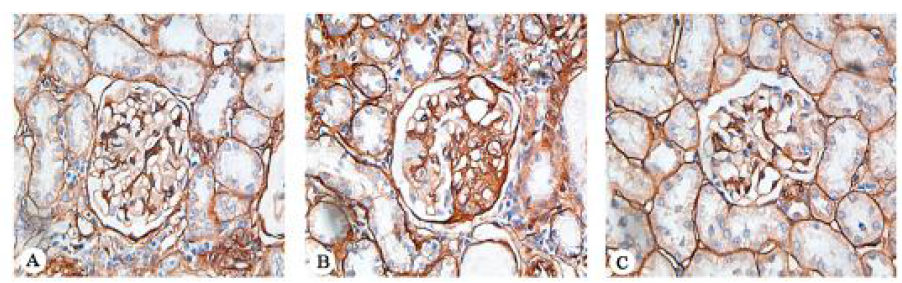
The levels of 24 h Upr after the treatment for four and eight weeks in the glycyrrhizin-treated group were both significantly decreased as compared with those in the untreated group. The pathological morphological changes of renal tissue in the glycyrrhizin-treated group were remarkably alleviated, and the expression level of LN in renal tissue was also decreased in the glycyrrhizin-treated group as compared with those in the untreated group.

Conclusion

The glycyrrhizin exerts certain protective effects on adriamycin nephropathy in rats by reducing excretory quantity of urine protein, decreasing expression level of LN in renal tissue, improving renal function and lessening the severity degree of glomerulosclerosis so as to retard the development of glomerulosclerosis.

Key words: Glycyrrhizin, Adriamycin, Glomerulosclerosis, Laminin, Rats

CLC Number: 

  • R692.6

Table 1

24 h urine protein of rats in different groups (ヌ±S, mg/24 h)"

Group n 24 h urine protein
Pre-treatment Treatment for 4 weeks Treatment for 8 weeks
Normal control 6 16.23±2.97 16.73±3.79 16.84±2.84
Untreated 6 16.78±3.23 60.62±4.68** 88.59±12.29**
Glycyrrhizin-treated 6 16.15±2.71 46.41±8.28**△△ 54.45±4.94**△△

Table 21

Serum levels of Cr, BUN and Ch of rats in different groups (ヌ±S)"

Group n Cr (μmol/L) BUN (mmol/L) Ch (mmol/L)
Normal control 6 35.3±6.9 5.2±0.6 1.62±0.32
Untreated 6 98.1±9.3** 23.2±3.5** 14.76±3.12**
Glycyrrhizin-treated 6 72.6±6.0**△△ 12.0±2.0**△△ 5.50±1.07**△△

Figure 1

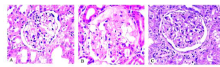
Histopathologic changes of renal tissue in rats in different groups (HE staining, ×400) A: Glycyrrhizin-treated group; B: Untreated group; C: Normal control group."

Figure 2

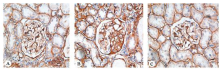
Expression of LN in renal tissue of rats in different groups (SABC method, ×400) A: Glycyrrhizin-treated group; B: Untreated group; C: Normal control group."

Table 3

Expression levels of LN in renal tissue of rats in different groups(Cases)"

Group n Expression level of LN
+ ++ +++
Normal control 6 1 4 1 0
Untreated 6 0 1 2 3
Glycyrrhizin-treated 6 0 2 3 1
[1] Na Wu , Lu Song , Xin-xin Yang, Jiang-lei Wei , Zhen-guo Liu. Effects of Chinese herbal medicine Tianqi Pingchan Granule on G protein-coupled receptor kinase 6 involved in the prevention of levodopa-induced dyskinesia in rats with Parkinson disease. Journal of Chinese Integrative Medicine, 2012, 10(9): 1018-1024.
[2] Lawrence A. Olatunji, Taofeek O. Usman, Joseph O. Adebayo, Victoria A. Olatunji . Effects of aqueous extract of Hibiscus sabdariffa on renal Na+-K+-ATPase and Ca2+-Mg2+-ATPase activities in Wistar rats. Journal of Chinese Integrative Medicine, 2012, 10(9): 1049-1055.
[3] Dhirender Kaushik, Ajay Kumar, Pawan Kaushik, Avatar C. Rana. Anticonvulsant activity of alcoholic extract of bark of Pinus roxburghii Sarg. Journal of Chinese Integrative Medicine, 2012, 10(9): 1056-1060.
[4] Chan Chen, Chang-xun Chen, Xi-min Wu, Rui Wang, Yi-ming Li. Effects of extracts of Radix Scrophulariae on blood pressure in spontaneously hypertensive rats and the underlying mechanisms. Journal of Chinese Integrative Medicine, 2012, 10(9): 1009-1017.
[5] Jian-sheng Li, Ya Li, Su-yun Li, Yuan-yuan Wang, Li Deng, Yan-ge Tian, Su-li Jiang , Ying Wang. Long-term effects of Tiaobu Feishen therapies on systemic and local inflammation responses in rats with stable chronic obstructive pulmonary disease. Journal of Chinese Integrative Medicine, 2012, 10(9): 1039-1048.
[6] Karuna A. Talpate, Uma A. Bhosale, Mandar R. Zambare. Clitorea ternatea, a herb from Indian folklore, improves streptozotocin-induced diabetes and diabetes-induced cognitive decline in rats. Journal of Chinese Integrative Medicine, 2012, 10(8): 939-947.
[7] Samuel Joshua Pragasam, Vachana Murunikara, Evan Prince Sabina, Mahaboobkhan Rasool. Antiperoxidative potential of p-coumaric acid, a common dietary phenol, in adjuvant-induced arthritis in rats. Journal of Chinese Integrative Medicine, 2012, 10(8): 932-938.
[8] Zi-hui Li, Jian Wang, Rong-lin Cai, You-wen Wang, Jian-peng Hu. Establishment and evaluation of a rat model of ulcerative colitis with syndrome of dampness stagnancy due to spleen deficiency. Journal of Chinese Integrative Medicine, 2012, 10(8): 918-924.
[9] Meng Li, Ling Hu, Rong-lin Cai, Zi-jian Wu, Ke-ming Wang. Effects of electro-acupuncture at PC6 and BL15 on nerve electrical activity in spinal dorsal root and norepinephrine and dopamine contents in paraventricular nucleus of hypothalamus in rats with acute myocardial ischemia. Journal of Chinese Integrative Medicine, 2012, 10(8): 874-879.
[10] Xin-min Li, Hui Chen, Yan-yan Ren, Yan-li Lu. Effects of Chinese herbal medicine Xifeng Capsule on multidrug resistance-associated protein 1 expression in hippocampus and cortex of rats with lithium-pilocarpine-induced epilepsy. Journal of Chinese Integrative Medicine, 2012, 10(8): 911-917.
[11] Hong Wang , Jing-tian Ou , Xin Zhao , Ying Guoz , Hao-ping Mao. Vasodilator effect of oroxylin A on thoracic aorta isolated from rats. Journal of Chinese Integrative Medicine, 2012, 10(8): 880-885.
[12] C. Mouli Kalla, Vijaya Tartte, Dattatreya Rao Sirpurkar. Effectiveness of flavonoid-rich leaf extract of Acalypha indica in reversing experimental myocardial ischemia: biochemical and histopathological evidence. Journal of Chinese Integrative Medicine, 2012, 10(7): 784-792.
[13] Feng Xin-ying, Zhu Min, Zhang Qi-qi, Chen Yi-ping, Li Wen-wei. Selective protection of nigral dopaminergic neurons by echinacoside in a rat model of Parkinson disease induced by rotenone. Journal of Chinese Integrative Medicine, 2012, 10(7): 777-783.
[14] Chuan Chen, Hui-ying Chi, Zhi-hua Yu, Jiu-lin Chen . Effects of Chinese herbal medicine Shoushen Granule on telomere length and telomerase activity of peripheral white blood cells and vascular cells in rats with atherosclerosis. Journal of Chinese Integrative Medicine, 2012, 10(6): 667-673.
[15] Hui-qing Zhang , Zi-fei Yin , Jia-yu Sheng , Zhu-qian Jiang , Bao-yu Wu , Yong-hua Su. A comparison study of pharmacokinetics between bufalin-loaded bovine serum albumin nanoparticles and bufalin in rats. Journal of Chinese Integrative Medicine, 2012, 10(6): 674-680.
Viewed
Full text


Abstract

Cited

  Shared   
  Discussed   
[1] Wei-xiong Liang. Problems-solving strategies in clinical treatment guideline for traditional Chinese medicine and integrative medicine. Journal of Chinese Integrative Medicine, 2008, 6(1): 1-4
[2] Zhao-guo Li. Discussion on English translation of commonly used sentences in traditional Chinese medicine: part one. Journal of Chinese Integrative Medicine, 2008, 6(1): 107-110
[3] Jun Hu, Jian-ping Liu. Non-invasive physical treatments for chronic/recurrent headache. Journal of Chinese Integrative Medicine, 2008, 6(1): 31
[4] Xue-mei Liu, Qi-fu Huang, Yun-ling Zhang, Jin-li Lou, Hong-sheng Liu, Hong Zheng. Effects of Tribulus terrestris L. saponion on apoptosis of cortical neurons induced by hypoxia-reoxygenation in rats. Journal of Chinese Integrative Medicine, 2008, 6(1): 45-50
[5] . Uniform requirements for manuscripts submitted to biomedical journals: Writing and editing for biomedical publication (Chinese version, part two). Journal of Chinese Integrative Medicine, 2010, 8(11): 1001-1005
[6] Daniel Weber, Janelle M Wheat, Geoffrey M Currie. Inflammation and cancer: Tumor initiation, progression and metastasis,and Chinese botanical medicines. Journal of Chinese Integrative Medicine, 2010, 8(11): 1006-1013
[7] Hong Liu , Guo-liang Zhang, Li Shen , Zhen Zeng, Bao-luo Zhou, Cheng-hai Liu, Guang Nie . Application and evaluation of a pseudotyped virus assay for screening herbs for anti-H5Nl avian influenza virus. Journal of Chinese Integrative Medicine, 2010, 8(11): 1036-1040
[8] Zhao-guo Li . A discussion of English translation of 1995 and 1997 Chinese National Standards of Traditional Chinese Medical Terminologies for Clinical Diagnosis and Treatment. Journal of Chinese Integrative Medicine, 2010, 8(11): 1090-1096
[9] Rui Jin, Bing Zhang. A complexity analysis of Chinese herbal property theory: the multiple formations of herbal property (Part 1). Journal of Chinese Integrative Medicine, 2012, 10(11): 1198-1205
[10] Hui-min Liu, Xian-bo Wang, Yu-juan Chang, Li-li Gu. Systematic review and meta-analysis of randomized controlled trials of integrative medicine therapy for treatment of chronic severe hepatitis. Journal of Chinese Integrative Medicine, 2012, 10(11): 1211-1228
[an error occurred while processing this directive]