[an error occurred while processing this directive]

Journal of Chinese Integrative Medicine ›› 2007, Vol. 5 ›› Issue (6): 616-620.doi: 10.3736/jcim20070603

• Original Clinical Research • Previous Articles     Next Articles

Extraction, combination and distribution regularity of syndrome elements in patients with variant angina pectoris

Zhen-hua Jia1, Ye-shuang Li1, Yi-ling Wu1, Huai-lin Gao1, Jing Chen2, Jian-xin Chen2, Chun-hua Gu1, Guo-qiang Yuan1, Xiang-chun Wu1, Cong Wei1   

  1. 1. Research Room of Luobing Theory,Yiling Medical Institute of Hebei,Shijiazhuang,Hebei Province 050035,China
    2. Key Laboratory of Complex System and Intelligence Science,Institute of Automation,Chinese Academy of Sciences,Beijing 100080,China
  • Online:2007-11-20 Published:2007-11-15

Objective: To explore the pathogenesis characteristics of variant angina pectoris (VAP) by extracting its syndrome elements and analyzing the combination and distribution regularity of the syndrome elements.Methods: One hundred and seventy-five case files of VAP patients were collected. The extraction of syndrome elements and symptom contribution to syndrome was completed by the partition method of complex system based on entropy theory. Diagnostic threshold was established by receiver operator characteristic curve. According to the results diagnosed by diagnostic criteria for syndrome element with quantitation, the combination and distribution regularity of the syndrome elements in patients with VAP was analyzed.Results: The basic syndrome elements in the patients with VAP were qi deficiency, qi stagnation, blood stasis, phlegm turbidity, phlegm-heat, stagnation-heat, yin deficiency and yang deficiency syndromes. It showed that the combination types of syndrome elements could be made up of one syndrome, two, three, four or more than four syndromes. Qi deficiency, yin deficiency, qi stagnation, blood stasis and phlegm turbidity syndromes had the higher frequency than other syndrome elements in the patients with VAP.Conclusion: The partition method of complex system based on entropy theory can be used in extracting the syndrome elements of the patients with VAP. It is found that VAP has complicated pathogenesis according to the combination and distribution regularity of syndrome elements. Qi deficiency, qi stagnation, blood stasis, phlegm turbidity and yin deficiency syndromes are the main syndrome elements.

Key words: angina pectoris, variant, syndrome, entropy, pathogenesis, TCM

CLC Number: 

  • R541.42

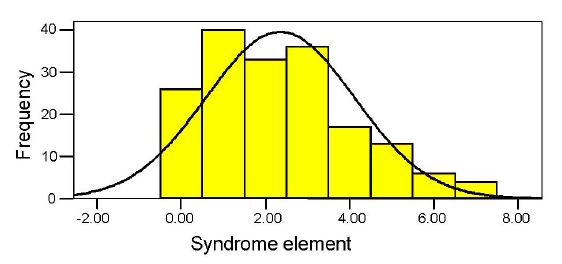
Figure 1

Distribution of syndrome elements in 175 cases of VAP"

[1] 叶任高 .内科学( 第5版)[M]. 北京: 人民卫生出版社, 2002,( 第5版):289
Ye RG. Internal medicine(5th ed)[M]. Beijing: People's Medical Publishing House, 2002,( 5th ed):289
[2] 吴启富, 顾关良 . 冠心病变异性心绞痛中医证型研究[J]. 云南中医中药杂志, 1995,16(2):14-16
Wu QF, Gu GL . Research of syndrome of Traditional Chinese Medicine in variant angina pectoris of coronary heart disease[J]. un Nan Zhong Yi Zhong Yao Za Zhi, 1995,16(2):14-16
[3] 赵瑞华 . 从肝主疏泄论治变异型心绞痛[J]. 中国中医药信息杂志, 2000,7(8):76
Zhao RH . From Liver Treatment Shuxie variant angina[J]. Zhongguo Zhong Yi Yao Xin Xi Za Zhi, 2000,7(8):76
[4] 朱文锋 . 常见症状中医鉴别诊疗学[M]. 北京: 人民卫生出版社,2002,(): 104
Zhu WF. Common symptoms of TCM clinics learn to identify[M]. Beijing: People's Medical Publishing House,2002,(): 104
[5] 衷敬柏, 董绍英, 王阶 , 等. 2689例冠心病心绞痛证候要素的文献统计分析[J]. 中国中医药信息杂志, 2006,13(5):100-101
Zhong JB, Dong SY, Wang J , et al. 2,689 cases Angina Syndrome elements of the statistical analysis of literature[J]. Zhongguo Zhong Yi Yao Xin Xi Za Zhi, 2006,13(5):100-101
[6] 李林, 李晓冬, 宋剑南 , 等. 应用匹配矩阵、因子分析和聚类分析法研究冠心病痰瘀证候特征[J]. 中西医结合学报, 2006,4(4):343-347
Li L, Li XD, Song JN , et al. Applying matching matrix, factor analysis and clustering analysis to investigation of characteristics of syndromes of phlegm and blood BRVO in patients with coronary heart disease[J]. Zhong Xi Yi Jie He Xue Bao, 2006,4(4):343-347
[7] 欧阳涛, 宋剑南, 苗阳 , 等. 冠心病痰瘀证与载脂蛋白E基因多态性关系的研究[J]. 中西医结合学报, 2005,3(6):438-442
Ouyang T, Song JN, Miao Y , et al. Study on relationship between polymorphism of apolipoprotein E gene and syndromes of phlegm and blood BRVO in patients with coronary heart disease[J]. Zhong Xi Yi Jie He Xue Bao, 2005,3(6):438-442
[8] 张志斌, 王永炎 . 证候名称及分类研究的回顾与假设的提出[J]. 北京中医药大学学报, 2003,26(2):1-5
Zhang ZB, Wang YY . Research on TCM Syndrome Nomenclature and Classification : Review and Hypojournal[J]. Beijing Zhong Yi Yao Da Xue Xue Bao, 2003,26(2):1-5
[9] 袁世宏, 张连文, 王米渠 , 等. 数理统计思想及方法在辨证规范化研究中的应用及思考[J]. 中国中医基础医学杂志, 2003,9(4):15-21
Yuan SH, Zhang LW, Wang MQ , et al. Applyication of the Idea and Method of Mathematic Statistics in Standardization of Differentiation Syndrome[J]. Zhongguo Zhong Yi Ji Chu Yi Xue Za Zhi, 2003,9(4):15-21
[10] 西广成 . 复杂系统分划的熵方法[J]. 自动化学报, 1987,13(3):216-220
Xi GC . Entropy-method of partition of complex system[J]. Zi Dong Hua Xue Bao, 1987,13(3):216-220
[11] 西广成 . 生态经济区划的熵方法[J]. 自动化学报, 1990,16(2):170-173
Xi GC . The entropy-method for ecologico-economical regionalization[J]. Zi Dong Hua Xue Bao, 1990,16(2):170-173
[12] 陈静, 西广成, 易建强 , 等. 中医复杂系统中两类分划方法的比较[J]. 烟台大学学报(自然科学与工程版), 2006,19(专集):430-434.
Chen J, Xi GC, Yi JQ , et al. Comparision of two partition methods on TCM complex system[J]. Yantai Da Xu Xu Bao(Natual Science and Engineering), 2006,19(special):430-434
[1] Qi-sheng Tang, Wen-jun Sun, Miao Qu, Dong-fang Guo. Analysis of syndrome discipline of generalized anxiety disorder using data mining techniques. Journal of Chinese Integrative Medicine, 2012, 10(9): 975-982.
[2] Lu Liu, Ying Gao. Study on the correlation between traditional Chinese medicine syndrome and short-term prognosis of ischemic stroke using logistic regression model and repeated-measures analysis of variance. Journal of Chinese Integrative Medicine, 2012, 10(9): 983-990.
[3] Yan Guan , Hui Zhang, Wei Zhang, Shi-bing Su . Analysis of differential gene expression profile in peripheral blood of patients with chronic hepatitis B and syndromes of dual deficiency of liver and kidney yin and accumulation of dampness heat. Journal of Chinese Integrative Medicine, 2012, 10(7): 751-756.
[4] Ying-fei Bi , Jing-yuan Mao , Xian-liang Wang , Ya-zhu Hou , Yi-zhu Lu , Shan Bin Soh , Bo-li Zhang. Clinical epidemiology survey of the traditional Chinese medicine etiology and syndrome differentiation of coronary artery disease: Study protocol of a multicenter trial. Journal of Chinese Integrative Medicine, 2012, 10(6): 619-627.
[5] Qing-bo Lang, Dong-xia Zhai , Feng Huang, Jian-guo Chen, Yong-hui Zhang, Qun Liu, Xiao-feng Zhai , Bai Li, Chang-quan Ling. Investigation on traditional Chinese medicine syndrome distribution of 4 618 hepatitis B virus infection subjects in Qidong of Jiangsu Province, China. Journal of Chinese Integrative Medicine, 2012, 10(5): 525-531.
[6] Jia-jia Wang , Tian-fang Wang , Xiu-yan WU , Yah Zhao , Xiao-lin Xue , Qing-guo Wang. Weighting coefficients of symptoms and signs in the diagnosis of corresponding TCM syndrome elements of ulcerative colitis based on expert questionnaire investigation. Journal of Chinese Integrative Medicine, 2012, 10(4): 398-405.
[7] Hu Xiao-Yu, Zhang Yang, Chen Guo, Zhong Sen, Fan Xin-Jian. A prospective cohort study on the influence of high doses of herbs for clearing heat and resolving stasis on survival rates in patients with hepatitis B-related acute-on-chronic liver failure. Journal of Chinese Integrative Medicine, 2012, 10(2): 176-185.
[8] Yu Zhao, Jing-hua Peng , Xue-mei Li , Qi-lin Fu, Tuan Cui , Qi Li, Ya-jun Tang , Qin Feng , Hua Zhang , Hua Zhou , Yi-yang Hu. Diagnostic value of clinical indices in syndrome differentiation of chronic hepatitis B: an exploration based on receiver operating characteristic curves and stepwise discriminant analysis. Journal of Chinese Integrative Medicine, 2012, 10(12): 1382-1387.
[9] Dong-tao Li, Jian Wang , Hong-yang Jiang , Feng-lei Shi , Fu-yu Li , Ji-hong Liu , Yong-mei Cheng , Nan Yan , Ai-hua Hu, Mei-zeng Zhang , Jie Li, Ling-bo Wei , Rong-qin Jiang. Quantitative evaluation of the degrees of traditional Chinese medicine qualitative syndromes of osteoporosis. Journal of Chinese Integrative Medicine, 2012, 10(11): 1254-1262.
[10] Jing Zhang , Long Liu , Xin Yan , Xiao-qiang Yue. Study of the syndromes of traditional Chinese medicine in terms of metabonomics technology: The current situation and considerations. Journal of Chinese Integrative Medicine, 2012, 10(10): 1069-1076.
[11] Gui-xiang Chu, Qing-guang Chen, Jia-tuo Xu , Bo Yu , Min Zhang , Long-tao Cui , Hong-jin Wu , Zhao-fu Fei. Analysis on pulse diagram characteristics of subjects with subhealth state. Journal of Chinese Integrative Medicine, 2012, 10(10): 1099-1105.
[12] Liu Yue, Xie Ming, Zhang Ye. Dynamic changes of laboratory parameters of rats with type 2 diabetes and insulin resistance: defining their role in development of traditional Chinese medicine syndrome. Journal of Chinese Integrative Medicine, 2012, 10(1): 100-108.
[13] Sui Yue Hu, Su E Wang, Chun Hu Zhang. Relationship between symptom stratification and syndrome differentiation of traditional Chinese medicine for depressive episode. Journal of Chinese Integrative Medicine, 2011, 9(9): 933-936.
[14] Xing-jiang Xiong, Hai-xia Li . Experience on clinical application of Chinese herbal medicine Yi Guan Jian decoction. Journal of Chinese Integrative Medicine, 2011, 9(8): 920-923.
[15] Ji Sun, Sheng-liang Zhu, Shu-ying Ma, Xiao-su Wang, Jing Kong. Clinical characteristics of patients with reflux esophagitis exhibiting gallbladder heat attacking the stomach or stagnant heat of the liver and stomach syndrome. Journal of Chinese Integrative Medicine, 2011, 9(7): 732-736.
Viewed
Full text


Abstract

Cited

  Shared   
  Discussed   
[1] Dong Yang, Yong-ping Du, Qing Shen, Wei Chen, Yan Yu, Guang-lei Chen. Expression of alpha-smooth muscle actin in renal tubulointerstitium in patients with kidney collateral stasis. Journal of Chinese Integrative Medicine, 2008, 6(1): 41-44
[2] Hai-feng Wei, Bai-liu Ya, Ling Zhao, Cui-fei Ye, Li Zhang, Lin Li. Evaluation of tongue manifestation of blood stasis syndrome and its relationship with blood rheological disorder in a rat model of transient brain ischemia. Journal of Chinese Integrative Medicine, 2008, 6(1): 73-76
[3] Xi Lin, Jian-ping Liu. Herbal medicines for viral myocarditis. Journal of Chinese Integrative Medicine, 2008, 6(1): 76
[4] Xi Lin, Jian-ping Liu. Tai chi for treating rheumatoid arthritis. Journal of Chinese Integrative Medicine, 2008, 6(1): 82
[5] Liang-ping Hu, Hui Gao. Discrimination of errors in statistical analysis of medical papers published in the first issue of 2006 in Journal of Chinese Integrative Medicine. Journal of Chinese Integrative Medicine, 2008, 6(1): 98-106
[6] Yan-bo Zhu , Qi Wang, Cheng-yu Wu, Guo-ming Pang, Jian-xiong Zhao, Shi-lin Shen, Zhong-yuan Xia , Xue Yan . Logistic regression analysis on relationships between traditional Chinese medicine constitutional types and overweight or obesity. Journal of Chinese Integrative Medicine, 2010, 8(11): 1023-1035
[7] Wei Xu, Meng Shi, Jian-gang Liu, Cheng-long Wang . Collagen protein expressions in ischemic myocardium of rats with acute myocardial infarction and effects of qi-tonifying, yin-tonifying and blood-activating herbs and detoxifying and blood-activating herbs. Journal of Chinese Integrative Medicine, 2010, 8(11): 1041-1047
[8] Tao Wang , Feng Qin. Effects of Chinese herbal medicine Xiaoyao Powder on monoamine neurotransmitters in hippocampus of rats with postpartum depression. Journal of Chinese Integrative Medicine, 2010, 8(11): 1075-1079
[9] Ying Xu , Chang-chun Zeng , Xiu-yu Cai , Rong-ping Guo , Guang Nie , Ying Jin. Chromaticity and optical spectrum colorimetry of the tongue color in different syndromes of primary hepatic carcinoma. Journal of Chinese Integrative Medicine, 2012, 10(11): 1263-1271
[10] Xiang-ying Mao , Qin Bian , Zi-yin Shen. Analysis of the osteogenetic effects exerted on mesenchymal stem cell strain C3H10T1/2 by icariin via MAPK signaling pathway in vitro. Journal of Chinese Integrative Medicine, 2012, 10(11): 1272-1278
[an error occurred while processing this directive]