[an error occurred while processing this directive]

Journal of Chinese Integrative Medicine ›› 2008, Vol. 6 ›› Issue (2): 171-174.doi: 10.3736/jcim20080213

• Original Experimental Research • Previous Articles     Next Articles

Variabilities of the impacts of cold pathogen and cold-dampness pathogen on fractalkine mRNA expression in lung tissues of rats

Wei Zhang1(), Hai-yu Liu2   

  1. 1. Department of Respiratory Medicine, Affiliated Hospital, Shandong University of Traditional Chinese Medicine, Jinan, Shandong Province 250011, China
    2. Clinical College, Shandong University of Traditional Chinese Medicine, Jinan, Shandong Province 250014, China
  • Received:2007-04-26 Online:2008-02-20 Published:2008-02-15
  • Contact: ZHANG Wei E-mail:05320835zh@sina.com

Objective:To study the variabilities of the effects of cold pathogen and cold-dampness pathogen on the fractalkine (FKN) mRNA expression in lung tissues of rats.

Methods:Twenty-four Wistar rats of SPF grade were randomly divided into 3 groups: normal temperature group, cold pathogen group and cold-dampness pathogen group. There were 8 rats in each group. Rats in normal temperature group were bred at (20±2)℃ and under normal humidity (50%-55%) for 2 h. Rats in cold pathogen group were bred at –10℃ and under normal humidity (50%-55%) for 2 h, and the rats in cold-dampness pathogen group were bred at –10℃ and under high humidity (90%-100%) for 2 h. Rats in the three groups were bred in thermostats under the corresponding conditions on the first day of experiment, and then the rats in different groups were all bred at normal temperature. Lung specimens in 3 groups were gathered four days later. The behavior and the pathological changes in the lung tissues of rats in different groups were observed. The content of interleukin-6 (IL-6) and tumor necrosis factor-α (TNF-α) in lung homogenate was detected by radioimmunoassay (RIA) method. Expression of FKN mRNA in lung homogenate was detected by reverse transcription-polymerase chain reaction (RT-PCR).

Results:The lung tissues of rats in both cold pathogen group and cold-dampness pathogen group had various degrees of pathological changes. Compared with normal temperature group, the content of IL-6 and TNF-α was increased obviously in lung homogenate of rats in both cold pathogen group and cold-dampness pathogen group (P<0.01). The content of IL-6 and TNF-α in lung homogenate of rats in cold-dampness pathogen group was obviously higher than that in cold pathogen group (P<0.01). The RT-PCR results showed a low expression of FKN mRNA in lung tissues of rats in normal temperature group. If the injured lung tissues were aggravated, the expression of FKN mRNA in the lung tissues was elevated. Compared with normal temperature group, FKN mRNA expressions in both cold pathogen group and cold-dampness pathogen group were increased obviously (P<0.01). FKN mRNA expression in lung homogenate of rats in cold-dampness pathogen group was also obviously higher than that in cold pathogen group (P<0.01).

Conclusion:Cold pathogen can induce lung injury and up-regulate the FKN mRNA expression in lung tissue. Dampness pathogen can up-regulate the FKN mRNA expression through aggravating the injury of lung tissues caused by cold pathogen. FKN has a close relationship with the lung injury.

Key words: pathogenic cold, pathogenic dampness, lung, CX3C chemokines, rats

CLC Number: 

  • R563

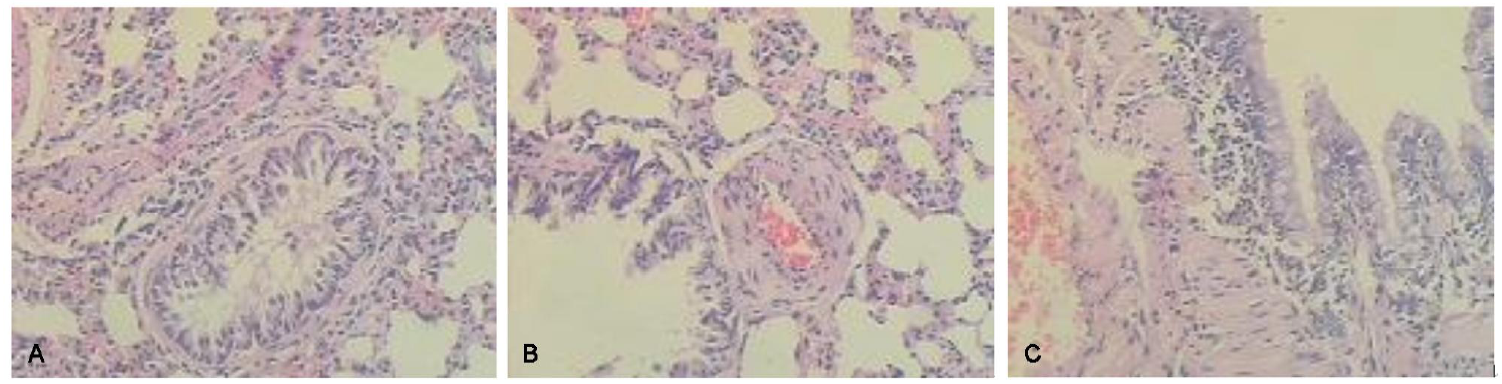
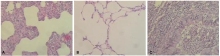
Figure 1

Pathological characteristics of rat lung tissue in normal group (HE staining, ×200)"

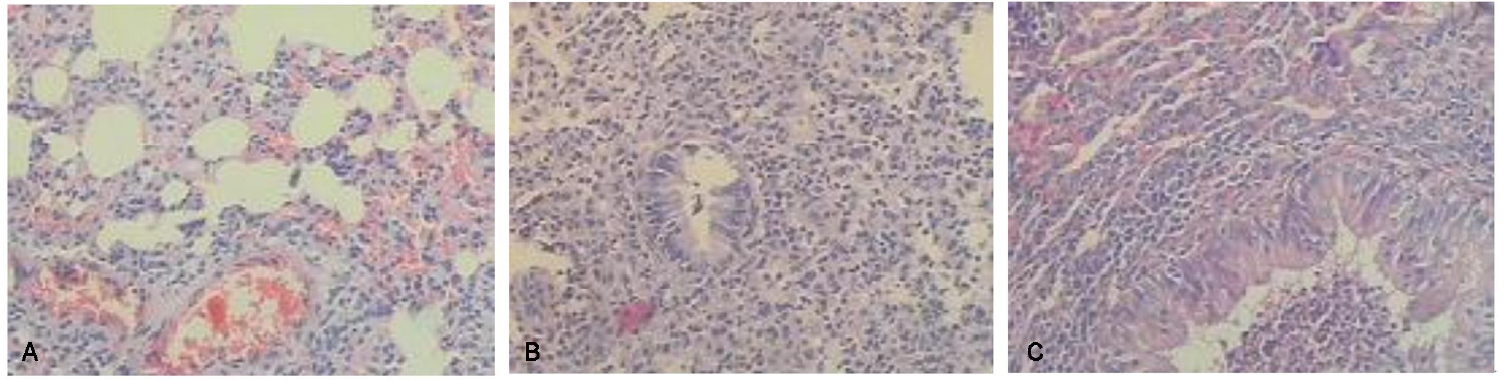
Figure 2

Pathological characteristics of rat lung tissue in cold pathogen group (HE staining, ×200)"

Figure 3

Pathological characteristics of rat lung tissue in cold-dampness pathogen group (HE staining, ×200)"

Table 1

Changes of the content of IL-6 and TNF-α and the expression of FKN mRNA in lung tissues of rats in different groups ($\bar{x}$±s)"

Group n IL-6 (ng/L) TNF-α (ng/L) FKN mRNA
Normal temperature 8 42.54±2.08 113.00±8.41 0.674 3±0.060 8
Cold pathogen 8 69.86±1.38** 278.38±7.11** 1.354 4±0.115 0**
Cold-dampness pathogen 7 76.34±2.54**△△ 391.71±7.09**△△ 1.614 6±0.021 6**△△
[1] Jia XH , Zhang W. Analysis of correlation between pathogenic cold and weather indexes. Shandong Zhong Yi Yao Da Xue Xue Bao. 2003; 27(6):402-405. Chinese with abstract in English.
doi: 10.3969/j.issn.1007-659X.2003.06.001
贾新华, 张伟 . 寒邪与气象因子相关性分析.山东中医药大学学报. 2003; 27(6):402-405.
doi: 10.3969/j.issn.1007-659X.2003.06.001
[2] Zhang W, Jia XH , Zhao Y. Analysis of the correlation between pathogenic cold and meteorologic factors in chronic bronchitis. Beijing Zhong Yi Yao Da Xue Xue Bao. 2004; 27(1):77-79. Chinese with abstract in English.
doi: 10.3321/j.issn:1006-2157.2004.01.025
张伟, 贾新华, 赵燕 . 慢性支气管炎中寒邪与气象因子相关性分析.北京中医药大学学报. 2004; 27(1):77-79.
doi: 10.3321/j.issn:1006-2157.2004.01.025
[3] Yoshida H, Imaizumi T, Fujimoto K , et al. Synergistic stimulation, by tumor necrosis factor-alpha and interferon-gamma, of fractalkine expression in human astrocytes. Neurosci Lett. 2001; 303(2):132-136.
doi: 10.1016/S0304-3940(01)01699-8
[4] Chen YM, Lin SL, Chen CW , et al. Tumor necrosis factor-alpha stimulates fractalkine production by mesangial cells and regulates monocyte transmigration: down- regulation by c AMP. Kidney Int. 2003; 63(2):474-486.
doi: 10.1046/j.1523-1755.2003.00766.x
[5] Wang L, Li TQ, Xiang GX, et al. Effect of dexametha- sone on expression of Fractalkine in lipopolysaccharide- induced acute lung injury. Sichuan Da Xue Xue Bao ( Yi Xue Ban ). 2006; 37(2):250-253. Chinese with abstract in English.
doi: 10.3969/j.issn.1672-173X.2006.02.022
王蕾, 李廷谦, 向国霞 , 等. 糖皮质激素对内毒素致急性肺损伤大鼠肺组织Fractalkine表达的影响. 四川大学学报(医学版). 2006; 37(2):250-253.
doi: 10.3969/j.issn.1672-173X.2006.02.022
[1] Na Wu , Lu Song , Xin-xin Yang, Jiang-lei Wei , Zhen-guo Liu. Effects of Chinese herbal medicine Tianqi Pingchan Granule on G protein-coupled receptor kinase 6 involved in the prevention of levodopa-induced dyskinesia in rats with Parkinson disease. Journal of Chinese Integrative Medicine, 2012, 10(9): 1018-1024.
[2] Lawrence A. Olatunji, Taofeek O. Usman, Joseph O. Adebayo, Victoria A. Olatunji . Effects of aqueous extract of Hibiscus sabdariffa on renal Na+-K+-ATPase and Ca2+-Mg2+-ATPase activities in Wistar rats. Journal of Chinese Integrative Medicine, 2012, 10(9): 1049-1055.
[3] Dhirender Kaushik, Ajay Kumar, Pawan Kaushik, Avatar C. Rana. Anticonvulsant activity of alcoholic extract of bark of Pinus roxburghii Sarg. Journal of Chinese Integrative Medicine, 2012, 10(9): 1056-1060.
[4] Chan Chen, Chang-xun Chen, Xi-min Wu, Rui Wang, Yi-ming Li. Effects of extracts of Radix Scrophulariae on blood pressure in spontaneously hypertensive rats and the underlying mechanisms. Journal of Chinese Integrative Medicine, 2012, 10(9): 1009-1017.
[5] Jian-sheng Li, Ya Li, Su-yun Li, Yuan-yuan Wang, Li Deng, Yan-ge Tian, Su-li Jiang , Ying Wang. Long-term effects of Tiaobu Feishen therapies on systemic and local inflammation responses in rats with stable chronic obstructive pulmonary disease. Journal of Chinese Integrative Medicine, 2012, 10(9): 1039-1048.
[6] Lu-ming Chen, Hui Yu, Da-rong Wu , Xun Hu , Lan Zheng. Investigation on response of the patient-reported outcome scale of the main-symptoms of chronic obstructive pulmonary disease complicated with pulmonary heart disease. Journal of Chinese Integrative Medicine, 2012, 10(9): 970-974.
[7] Karuna A. Talpate, Uma A. Bhosale, Mandar R. Zambare. Clitorea ternatea, a herb from Indian folklore, improves streptozotocin-induced diabetes and diabetes-induced cognitive decline in rats. Journal of Chinese Integrative Medicine, 2012, 10(8): 939-947.
[8] Samuel Joshua Pragasam, Vachana Murunikara, Evan Prince Sabina, Mahaboobkhan Rasool. Antiperoxidative potential of p-coumaric acid, a common dietary phenol, in adjuvant-induced arthritis in rats. Journal of Chinese Integrative Medicine, 2012, 10(8): 932-938.
[9] Zi-hui Li, Jian Wang, Rong-lin Cai, You-wen Wang, Jian-peng Hu. Establishment and evaluation of a rat model of ulcerative colitis with syndrome of dampness stagnancy due to spleen deficiency. Journal of Chinese Integrative Medicine, 2012, 10(8): 918-924.
[10] Meng Li, Ling Hu, Rong-lin Cai, Zi-jian Wu, Ke-ming Wang. Effects of electro-acupuncture at PC6 and BL15 on nerve electrical activity in spinal dorsal root and norepinephrine and dopamine contents in paraventricular nucleus of hypothalamus in rats with acute myocardial ischemia. Journal of Chinese Integrative Medicine, 2012, 10(8): 874-879.
[11] Xin-min Li, Hui Chen, Yan-yan Ren, Yan-li Lu. Effects of Chinese herbal medicine Xifeng Capsule on multidrug resistance-associated protein 1 expression in hippocampus and cortex of rats with lithium-pilocarpine-induced epilepsy. Journal of Chinese Integrative Medicine, 2012, 10(8): 911-917.
[12] Hong Wang , Jing-tian Ou , Xin Zhao , Ying Guoz , Hao-ping Mao. Vasodilator effect of oroxylin A on thoracic aorta isolated from rats. Journal of Chinese Integrative Medicine, 2012, 10(8): 880-885.
[13] C. Mouli Kalla, Vijaya Tartte, Dattatreya Rao Sirpurkar. Effectiveness of flavonoid-rich leaf extract of Acalypha indica in reversing experimental myocardial ischemia: biochemical and histopathological evidence. Journal of Chinese Integrative Medicine, 2012, 10(7): 784-792.
[14] Feng Xin-ying, Zhu Min, Zhang Qi-qi, Chen Yi-ping, Li Wen-wei. Selective protection of nigral dopaminergic neurons by echinacoside in a rat model of Parkinson disease induced by rotenone. Journal of Chinese Integrative Medicine, 2012, 10(7): 777-783.
[15] Shui-qiu Deng, Xue-nong Ouyang, Zong-yang Yu, Xi-hu Dai, Xi Chen, Fang-zheng Fang, Wen-wu Wang, Zhi-zhen Liu. Influence of Chinese herbal medicine Feitai Capsule on completion or delay of chemotherapy in patients with stage ⅢB/Ⅳ non-small-cell lung cancer: a Randomized controlled trial. Journal of Chinese Integrative Medicine, 2012, 10(6): 635-640.
Viewed
Full text


Abstract

Cited

  Shared   
  Discussed   
[1] Jin-rong Fu. Establishment of multivariate diagnosis and treatment system of modern gynecology of traditional Chinese medicine. Journal of Chinese Integrative Medicine, 2008, 6(1): 22-24
[2] Hao Li, Ming-jiang Yao, Wen-ming Zhao, Jie Guan, Lin-lin Cai, Ling Cui. A randomized, controlled, double-blind trial of Huannao Yicong capsule in senile patients with mild cognitive impairment. Journal of Chinese Integrative Medicine, 2008, 6(1): 25-31
[3] Zhi-chun Jin. Problems in establishing clinical guideline for integrated traditional Chinese and Western medicine. Journal of Chinese Integrative Medicine, 2008, 6(1): 5-8
[4] SUN Ming-yu, ZUO Jian, DUAN Ji-feng, HAN Jun, FAN Shi-ming, ZHANG Wei, ZHU Li-fang, YAO Ming-hui. Antitumor activities of kushen flavonoids in vivo and in vitro. Journal of Chinese Integrative Medicine, 2008, 6(1): 51-59
[5] Min Cheng, Qiong Feng, Shu-wen Qian, Hui Gao, Cui-qing Zhu. Preliminary assay of p-amyloid binding elements in heart-beneficial recipe. Journal of Chinese Integrative Medicine, 2008, 6(1): 68-72
[6] Ning-qun Wang, Liang-duo Jiang, Zong-xing Li. Research progress in asthma-related quality of life. Journal of Chinese Integrative Medicine, 2008, 6(1): 93-97
[7] Jing-yuan Mao, Chang-xiao Liu, Heng-he Wang, Guang-li Wei , Zhen-peng Zhang, Jie Xing, Wang Xian liang , Ying-fei Bi . Effects of Shenmai Injection on serum concentration and pharmacokinetics of digoxin in dogs with heart failure. Journal of Chinese Integrative Medicine, 2010, 8(11): 1070-1074
[8] Zhi-mei Wang, Bin Zhang. A study on translation of ellipses in Huangdi Neijing from perspective of hermeneutic theory. Journal of Chinese Integrative Medicine, 2010, 8(11): 1097-1100
[9] Gui Yu, Jie Wang. Thinking on building the network cardiovasology of Chinese medicine. Journal of Chinese Integrative Medicine, 2012, 10(11): 1206-1210
[10] Pedro Saganha João, Doenitz Christoph, Greten Tobias, Efferth Thomas, J. Greten Henry. Qigong therapy for physiotherapists suffering from burnout: a preliminary study. Journal of Chinese Integrative Medicine, 2012, 10(11): 1233-1239
[an error occurred while processing this directive]