Journal of Chinese Integrative Medicine ›› 2012, Vol. 10 ›› Issue (4): 436-447.doi: 10.3736/jcim20120413
Previous Articles Next Articles
Chinese herbal decoction Shiquan Dabu Tang inhibits tumor growth and angiogenesis of metastasis after primary tumor surgical removal in mice
Gang Guo, Jian-hua Xu( ), Jian-hong Han, Fang Liang, Yong Zhang, Qiang Zhang, Jue Sun, Zhong-ze Fan#br#
- Department of Oncology, Putuo Hospital Affiliated to Shanghai University of Traditional Chinese Medicine, Shanghai 200062, China
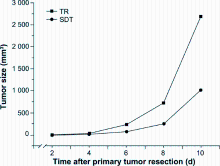
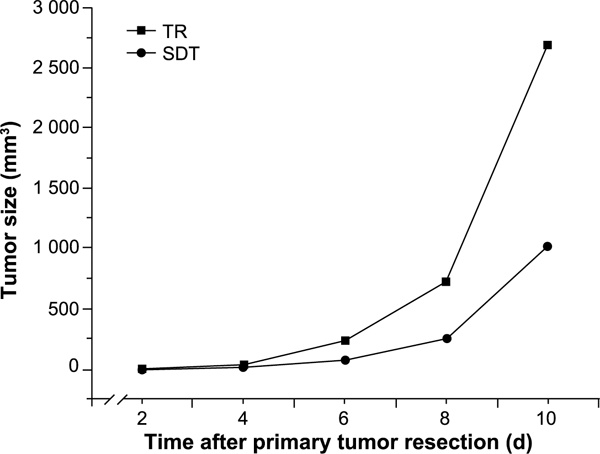
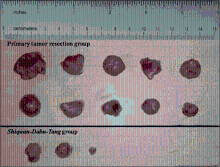
| [1] | Tsoulfas G, Pramateftakis MG, Kanellos I . Surgical treatment of hepatic metastases from colorectal cancer. World J Gastrointest Oncol. 2011; 3(1):1-9. |
| [2] |
van der Bij GJ, Oosterling SJ, Beelen RH, Meijer S, Coffey JC, van Egmond M . The perioperative period is an underutilized window of therapeutic opportunity in patients with colorectal cancer. Ann Surg. 2009 ; 249(5):727-734.
doi: 10.1097/SLA.0b013e3181a3ddbd |
| [3] | Zee-Cheng RK . Shi-quan-da-bu-tang (ten significant tonic decoction), SQT. A potent Chinese biological response modifier in cancer immunotherapy, potentiation and detoxification of anticancer drugs. Methods Find Exp Clin Pharmacol. 1992; 14(9):725-736. |
| [4] |
Ohnishi Y, Fujii H, Hay akawa Y, Sakukawa R, Yamaura T, Sakamoto T, Tsukada K, Fujimaki M, Nunome S, Komatsu Y, Saiki I . Oral administration of a Kampo (Japanese herbal) medicine Juzen-taiho-to inhibits liver metastasis of colon 26-L5 carcinoma cells. Jpn J Cancer Res. 1998; 89(2):206-213.
doi: 10.1111/cas.1998.89.issue-2 |
| [5] | Matsuo M, Tani T, Saiki I . Organ selectivity of Juzen- taiho-to and Ninjin-yoei-to in the expression of anti- metastatic efficacy.J Trad Med. 2002; 19(3):93-97. |
| [6] | Kamiyama H, Takano S, Ishikawa E, Tsuboi K, Matsumura A . Anti-angiogenic and immunomodulatory effect of the herbal medicine “Juzen-taiho-to” on malignant glioma. Biol Pharm Bull. 2005; 8(11):2111-2116. |
| [7] |
Haider J, Kamat AA, Landen CN Jr, Han LY, Lutgendorf SK, Lin YG, Merritt WM, Jennings NB, Chavez-Reyes A, Coleman RL, Gershenson DM, Schmandt R, Cole SW, Lopez-Berestein G, Sood AK . Focal adhesion kinase targeting using in vivo short interfering RNA delivery in neutral liposomes for ovarian carcinoma therapy. Clin Cancer Res. 2006; 12(16):4916-4924.
doi: 10.1158/1078-0432.CCR-06-0021 |
| [8] |
Hwang JY, Mangala LS, Fok JY, Lin YG, Merritt WM, Spannuth WA, Nick AM, Fiterman DJ, Vivas- Mejia PE, Deavers MT, Coleman RL, Lopez-Berestein G, Mehta K, Sood AK . Clinical and biological significance of tissue transglutaminase in ovarian carcinoma. Cancer Res. 2008; 68(14):5849-5858.
doi: 10.1158/0008-5472.CAN-07-6130 |
| [9] | Fisher B, Gunduz N, Saffer EA . Influence of the interval between primary tumor removal and chemotherapy on kinetics and growth of metastases. Cancer Res. 1983; 43(4) : 1488-1492. |
| [10] | Iwanuma Y, Chen FA, Egilmez NK, Takita H, Bankert RB . Antitumor immune response of human peripheral blood lymphocytes coengrafted with tumor into severe combined immunodeficient mice. Cancer Res. 1997; 57(14):2937-2942. |
| [11] | Hofer SO, Shrayer D, Reichner JS, Hoekstra HJ, Wanebo HJ . Wound-induced tumor progression: a probable role in recurrence after tumor resection. Arch Surg. 1998; 133(4) : 383-389. |
| [12] |
Weidner N . Current pathologic methods for measuring intratumoral microvessel density within breast carcinoma and other solid tumors. Breast Cancer Res Treat. 1995; 36(2) : 169-180.
doi: 10.1007/BF00666038 |
| [13] |
Kontogeorgos G . Classification and pathology of pituitary tumors. Endocrine. 2005; 28(1) : 27-35.
doi: 10.1385/ENDO:28:1 |
| [14] |
McLennan G, Cressman EN, Xu Y, Zhang D, Jagtap MR, Jayaram HN . The effect of benzamide riboside on the VX2 model of liver cancer in rabbits.J Vase Interv Radiol. 2005; 16(11):1499-1504.
doi: 10.1097/01.RVI.0000185416.08458.01 |
| [15] |
Demicheli R, Retsky MW, Hrushesky WJ, Baum M, Gukas ID . The effects of surgery on tumor growth: a century of investigations. Ann Oncol. 2008; 19(11):1821-1828.
doi: 10.1093/annonc/mdn386 |
| [16] |
Retsky M, Demicheli R, Hrushesky W, Baum M, Gukas I . Surgery triggers outgrowth of latent distant disease in breast cancer: an inconvenient truth? Cancers. 2010; 2(2) : 305-337.
doi: 10.3390/cancers2020305 |
| [17] | Matsuda T, Maekawa K, Asano K, Hisamitsu T. Suppressive effect of Juzen-Taiho-To on lung metastasis of B16 melanoma cells in vivo. Evid Based Complement Alternat Med. 2009 Jan 8. [Epub ahead of print] |
| [18] |
Moserle L, Amadori A, Indraccolo S . The angiogenic switch: implications in the regulation of tumor dormancy. Curr Mol Med. 2009; 9(8):935-941.
doi: 10.2174/156652409789712800 |
| [19] | Zhao T, Xia WH, Zheng MQ, Lu CQ, Han X, Sun YJ . Surgical excision promotes tumor growth and metastasis by promoting expression of MMP-9 and VEGF in a breast cancer model. Exp Oncol. 2008; 30(1):60-64. |
| [20] |
Tolentino MJ . Current molecular understanding and future treatment strategies for pathologic ocular neovascularization. Curr Mol Med. 2009; 9(8):973-981.
doi: 10.2174/156652409789712783 |
| [21] |
Nieves BJ , D’Amore PA, Bryan BA. The function of vascular endothelial growth factor. Biofactors. 2009 ; 35(4) : 332-337.
doi: 10.1002/biof.v35:4 |
| [22] |
Ribatti D . Endogenous inhibitors of angiogenesis : a historical review. Leuk Res. 2009; 33(5):638-644.
doi: 10.1016/j.leukres.2008.11.019 |
| [23] |
Karamouzis MV, Moschos SJ . The use of endostatin in the treatment of solid tumors. Expert Opin Biol Ther. 2009; 9(5):641-648.
doi: 10.1517/14712590902882118 |
| [24] | Hanahan D, Christofori G, Naik P, Arbeit J . Transgenic mouse models of tumour angiogenesis: the angiogenic switch, its molecular controls, and prospects for preclinical therapeutic models. Eur J Cancer. 1996 ; 32A(14 ): 2386-2393. |
| [25] |
Distler O, Neidhart M, Gay RE, Gay S . The molecular control of angiogenesis. Int Rev Immunol. 2002 ; 21(1):33-49.
doi: 10.1080/08830180210415 |
| [26] |
'Reilly MS, Boehm T, Shing Y, Fukai N, Vasios G, Lane WS, Flynn E, Birkhead JR, Olsen BR, Folkman J . Endostatin: an endogenous inhibitor of angiogenesis and tumor growth. Cell. 1997; 88(2):277-285.
doi: 10.1016/S0092-8674(00)81848-6 |
| [27] |
O 5 Reilly MS, Holmgren L, Shing Y, Chen C, Rosenthal RA, Moses M, Lane WS, Cao Y, Sage EH, Folkman J . Angiostatin : a novel angiogenesis inhibitor that mediates the suppression of metastases by a Lewis lung carcinoma. Cell. 1994; 79(2) : 315-328.
doi: 10.1016/0092-8674(94)90200-3 |
| [28] | Justinger C, Schliiter C, Oliviera-Frick V, Kopp B, Rubie C, Schilling MK . Increased growth factor expression after hepatic and pancreatic resection. Oncol Rep. 2008; 20(6) : 1527-1531. |
| [29] |
Peeters CF, de Geus LF, Westphal JR, de Waal RM, Ruiter DJ, Wobbes T, Oyen WJ, Ruers TJ . Decrease in circulating anti-angiogenic factors (angiostatin and endostatin) after surgical removal of primary colorectal carcinoma coincides with increased metabolic activity of liver metastases. Surgery. 2005; 137(2):246-249.
doi: 10.1016/j.surg.2004.06.004 |
| [1] | Yong Zhang, Xiao-wen Sun, Jian-hua Xu, Hai Lu, Zhong-ze Fan, Jue Sun, Xiao-xiao Zhang. Effects of medicated serum prepared with Chinese herbal medicine Changweiqing on pharmacokinetics of oxaliplatin in colon cancer cells. Journal of Chinese Integrative Medicine, 2012, 10(8): 901-910. |
| [2] | Mei-jiao Mao, Jun-ping Hu, Cong Wang, Yi-yi Zhang, Ping Liu. Effects of Chinese herbal medicine Guanxinkang on expression of PPARγ-LXRα-ABCA1 pathway in ApoE-knockout mice with atherosclerosis. Journal of Chinese Integrative Medicine, 2012, 10(7): 814-820. |
| [3] | Lin Wang, Guan-liang Wang, Jia-han Liu, Di Li, De-zeng Zhu, Liang-neng Wu . Effects of ursolic acid in ameliorating insulin resistance in liver of KKAy mice via peroxisome proliferator-activated receptors α and γ. Journal of Chinese Integrative Medicine, 2012, 10(7): 793-799. |
| [4] | Yi-tao Zhao , Xin-guang Zhang , Li Bai , Li-qing Li , Jian-er Yu . Effects of Chinese herbal medicine Pingchuan Formula on airway inflammation, interferon-γ and interleukin-4 in mice with asthma. Journal of Chinese Integrative Medicine, 2012, 10(7): 807-813. |
| [5] | Dong-mei Zhang, Li-xia Lou, Ai-ming Wu, Xi-ying Lü, Zhao-juan Hu, Yan-hong Zhang, Hong-fang Liu. Effects of Astragalus membranaceus and Potentilla discolor mixture on insulin resistance and its related mRNA expressions in KKAy mice with type 2 diabetes. Journal of Chinese Integrative Medicine, 2012, 10(7): 821-826. |
| [6] | Ling Xu, Qiao-ling Zhou, Jie Han, Dan-ying Zhang, Hui-juan Dong, Zai-long Cai, Chao-qin Yu, Dong-xia Zhai . Effects of Chinese herbal medicine Neiyi Recipe-medicated serum on angiopoiesis of endometriosis in the chick chorioallantoic membrane model. Journal of Chinese Integrative Medicine, 2012, 10(7): 800-806. |
| [7] | Jing Guo, Ju-yong Wang, Zhan Zheng, Qing Wang, Chang-sheng Dong . Effects of Chinese herbal medicine Feiyanning Decoction on the ratio of CD4+CD25+ regulatory T cells and expression of transcription factor Foxp3 in mice bearing Lewis lung carcinoma. Journal of Chinese Integrative Medicine, 2012, 10(5): 584-590. |
| [8] | Surendra Kr. Sharma, Naveen Goyal. Protective effect of Heliotropium eichwaldi against cisplatin-induced nephrotoxicity in mice. Journal of Chinese Integrative Medicine, 2012, 10(5): 555-560. |
| [9] | Zhan gheng, Ju-yong Wang, Qing Wang, Ling Xu, Zhen-ye Xu. Effects of Chinese herbal medicine Feiyanning decoction on expressions of nucleosome conformation-regulating factors H3-K56, Rtt109, Asf1 and E2F1 in Lewis-bearing mice. Journal of Chinese Integrative Medicine, 2012, 10(4): 448-453. |
| [10] | Mahmoudian Alireza, Rajaei Ziba, Haghir Hossein, Banihashemian Shahaboldin, Hami Javad. Effects of valerian consumption during pregnancy on cortical volume and the levels of zinc and copper in the brain tissue of mouse fetus. Journal of Chinese Integrative Medicine, 2012, 10(4): 424-429. |
| [11] | Meenakshi Sundaram, Satyajit Patra, Gunasingham Maniarasu. Antitumor activity of ethanol extract of Gracilaria edulis (Gmelin) Silva on Ehrlich ascites carcinoma-bearing mice. Journal of Chinese Integrative Medicine, 2012, 10(4): 430-435. |
| [12] | Gao Shan, Wang Xing-hui, Huang Ling-ling, Yu Ting-ting, Du Su-ming, Guo Yan-wei, Jia Yuan, Wang Jian. Effects of a compound Chinese medicine Xinji’erkang on isoproterenol-induced ventricular remodeling in mice. Journal of Chinese Integrative Medicine, 2012, 10(3): 330-336. |
| [13] | Rahmatullah Mohammed, Kanij Hasan Sumaiyah, Ali Zulfiquar, Rahman Shahnaz, Jahan Rownak. Antihyperglycemic and antinociceptive activities of methanolic extract of Euphorbia thymifolia L. whole plants. Journal of Chinese Integrative Medicine, 2012, 10(2): 228-232. |
| [14] | Hosseini Mahmoud, Jafarianheris Taha, Seddighi Navid, Parvaneh Mohammad, Ghorbani Ahmad, Reza Sadeghnia Hamid, Rakhshandeh Hassan. Effects of different extracts of Eugenia caryophyllata on pentylenetetrazole-induced seizures in mice. Journal of Chinese Integrative Medicine, 2012, 10(12): 1476-1481. |
| [15] | Su-fang Zhang, Chang-quan Ling , Bai Li, Hong-yun Chen , Zhe Chen. Effects of Sisheng Decoction on the immunity and anti-stress function in mice with spleen deficiency syndrome. Journal of Chinese Integrative Medicine, 2012, 10(12): 1465-1469. |