[an error occurred while processing this directive]

Journal of Chinese Integrative Medicine ›› 2006, Vol. 4 ›› Issue (3): 285-288.doi: 10.3736/jcim20060313

• Original Experimental Research • Previous Articles     Next Articles

Inhibiting effects of root of Mallotus apelta on duck hepatitis B virus

Shu XU, Zhi-ping Lv, Hong-bing Cai, Xiao-gang Zhang, Qiang Liu, Yan Tan   

  1. School of Traditional Chinese Medicine, Nanfang Medical University, Guangzhou, Guangdong Province 510515, China
  • Online:2006-05-31 Published:2006-05-15

Objective

To evaluate the inhibiting effects of the root of Mallotus apelta (Lour.) Muell.-Arg. on duck hepatitis B virus (D-HBV) in vivo.

Methods

Forty nestling ducks with congenitally infection of D-HBV detected by PCR were randomly divided into five groups: untreated group, lamivudine-treated group, and high-, medium- and low-dose root of Mallotus apelta-treated groups. The ducks in the lamivudine-treated group were fed lamivudine with a dose of 50 mg/kg once. Ducks in the three-dose Mallotus apelta-treated groups were treated with different doses of decoction of this herbal medicine for 21 days respectively. The serum content of D-HBV DNA was determined by quantitative real-time PCR technique before and 7 days after the treatment, and on the 7th, 14th and 21st day of the treatment. Liver biopsy was also executed before and after the treatment to observe the histopathological changes.

Results

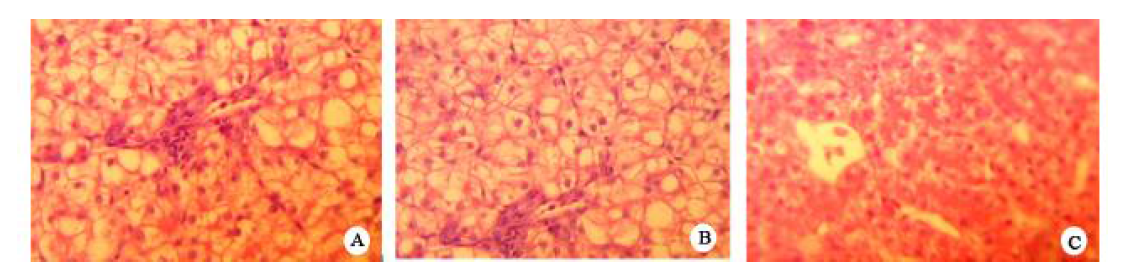
Lamivudine showed a rapid inhibiting effect on D-HBV DNA, but this effect didn't last long, and the serum level of D-HBV DNA increased again after treatment. The serum level of D-HBV DNA dropped markedly in the high- and medium-dose Mallotus apelta-treated groups on the 14th and 21st day. Low-dose Mallotus apelta revealed no obvious inhibiting effect on D-HBV. After treatment, the inhibiting effect in the root of Mallotus apelta-treated group continued as compared with that in the untreated group. The histopathological changes of liver tissues showed that the inflammation in the high-dose root of Mallotus apelta-treated group was weakened as compared with that in the lamivudine-treated group.

Conclusion

The root of Mallotus apelta has therapeutic effect on D-HBV. It can restrain the duplication of D-HBV in vivo. Although this effect is weaker than that of lamivudine, it continues longer. Thus this herbal medicine is an effective, safe and economical drug for hepatitis B.

Key words: Drugs, Chinese herbal, Root of Mallotus apelta (Lour.) Muell.-Arg., Duck hepatitis B virus, Quantitative real-time PCR, Animal experimentation

CLC Number: 

  • R512.62

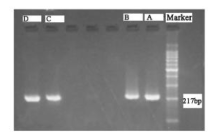
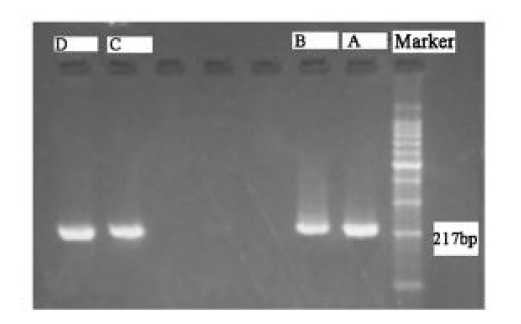
Figure 1

Electrophoregram of PCR products of D-HBVA & B: Positive samples; C & D: Positive-detected samples."

Table 1

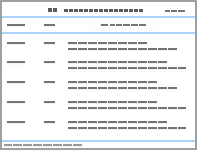
Copy number of D-HBV DNA in serum of nestling ducks before, during and after treatment in different groups(ヌ±S, copy/ml)"

Group n Copy number of D-HBV DNA
Pre-treatment Treatment for 7 days Treatment for 14 days Treatment for 21 days 7 days after treatment
Untreated 8 (1.95±0.95)×108 (1.73±0.74)×108 (1.47±0.71)×108 (6.64±0.77)×108 (1.45±0.75)×108*
High-dose M. 8 (1.92±1.13)×108 (1.80±1.09)×108▲▲ (6.69±2.84)×107* (4.97±4.83)×107*△△ (4.02±3.53)×107*
apelta-treated
Medium-dose M. 8 (1.87±0.90)×108 (1.54±0.69)×108▲▲ (7.48±4.81)×107△▲▲ (5.66±4.14)×107*△△ (4.87±4.27)×107*
apelta-treated
Low-dose M. 8 (1.73±0.66)×108 (1.52±0.61)×108▲▲ (1.51±0.61)×108▲▲ (1.36±0.47)×108▲▲ (1.28±0.65)×108*
apelta-treated
Lamivudine- 8 (1.68±1.17)×108 (1.14±0.57)×107*△△ (6.35±8.79)×106*△△ (3.77±3.43)×106*△△ (6.82±6.39)×107
treated

Figure 2

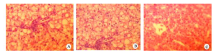
Histopathological changes of liver tissue in nestling ducks with D-HBV infection before and after treatment (HE staining, ×400)A: Pre-treatment; B: Lamivudine-treated group after treatment; C: High-dose Mallotus apelta-treated group after treatment."

Figure 3

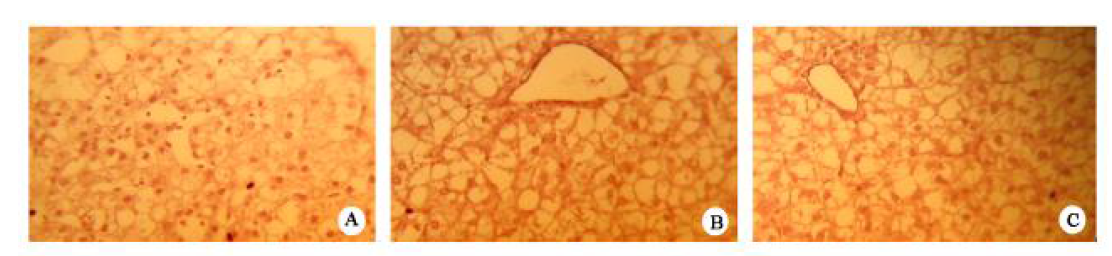
Histopathological changes of liver tissue in nestling ducks with D-HBV infection beforeand after treatment (aceto-orcein staining, ×400)A: Pre-treatment; B: Lamivudine-treated group after treatment; C: High-dose Mallotus apelta-treated group after treatment."

[1] Lavanchy D . Hepatitis B virus epidemiology, disease burden, treatment, current and emerging prevention and control measures: a review[J]. J Viral Hepat, 2004,11(2):97-107
[2] 杨书兰, 张奉学, 朱宇同 , 等. 用PCR法筛选先天感染鸭乙型肝炎模型及与后天感染模型的比较[J]. 广州中医药大学学报, 2001,18(3):256-259
doi: 10.3969/j.issn.1007-3213.2001.03.018
[3] 邓学龙, 朱宇同, 方宏勋 , 等. 广州地区3个鸭种1日龄雏鸭垂直感染鸭乙型肝炎病毒调查[J]. 广州中医药大学学报, 1997,14(4):274-276
[4] 邓学龙, 朱宇同, 郭兴伯 , 等. 先天和后天感染鸭乙型肝炎病毒的广州麻鸭外周血中病毒血症的动态比较及应用[J]. 广州中医药大学学报, 1999,16(1):56-60
doi: 10.3969/j.issn.1007-3213.1999.01.017
[5] 邹文, 杨旭, 杨立平 , 等. SYBR实时定量聚合酶链反应检测鸭乙型肝炎病毒的研究[J]. 中华肝脏病杂志, 2004,12(7):444
doi: 10.3760/j.issn:1007-3418.2004.07.026
[6] 赵进军, 吕志平, 张绪富 . 白背叶根对肝纤维化大鼠的实验研究[J]. 现代诊断与治疗, 2002,13(5):257-259
doi: 10.3969/j.issn.1001-8174.2002.05.001
[1] Jian-sheng Li, Ya Li, Su-yun Li, Yuan-yuan Wang, Li Deng, Yan-ge Tian, Su-li Jiang , Ying Wang. Long-term effects of Tiaobu Feishen therapies on systemic and local inflammation responses in rats with stable chronic obstructive pulmonary disease. Journal of Chinese Integrative Medicine, 2012, 10(9): 1039-1048.
[2] Lu Yu, Shui-miao Lin, Ru-qian Zhou, Wei-jun Tang, Pin-xian Huang, Ying Dong, Jian Wang, Zhi-hua Yu, Jiu-lin Chen, Li Wei, San-li Xing, Hui-juan Cao, Hong-bin Zhao. Chinese herbal medicine for patients with mild to moderate Alzheimer disease based on syndrome differentiation: A randomized controlled trial. Journal of Chinese Integrative Medicine, 2012, 10(7): 766-776.
[3] Ling Xu, Qiao-ling Zhou, Jie Han, Dan-ying Zhang, Hui-juan Dong, Zai-long Cai, Chao-qin Yu, Dong-xia Zhai . Effects of Chinese herbal medicine Neiyi Recipe-medicated serum on angiopoiesis of endometriosis in the chick chorioallantoic membrane model. Journal of Chinese Integrative Medicine, 2012, 10(7): 800-806.
[4] Dong-mei Zhang, Li-xia Lou, Ai-ming Wu, Xi-ying Lü, Zhao-juan Hu, Yan-hong Zhang, Hong-fang Liu. Effects of Astragalus membranaceus and Potentilla discolor mixture on insulin resistance and its related mRNA expressions in KKAy mice with type 2 diabetes. Journal of Chinese Integrative Medicine, 2012, 10(7): 821-826.
[5] Mei-jiao Mao, Jun-ping Hu, Cong Wang, Yi-yi Zhang, Ping Liu. Effects of Chinese herbal medicine Guanxinkang on expression of PPARγ-LXRα-ABCA1 pathway in ApoE-knockout mice with atherosclerosis. Journal of Chinese Integrative Medicine, 2012, 10(7): 814-820.
[6] Yi-tao Zhao , Xin-guang Zhang , Li Bai , Li-qing Li , Jian-er Yu . Effects of Chinese herbal medicine Pingchuan Formula on airway inflammation, interferon-γ and interleukin-4 in mice with asthma. Journal of Chinese Integrative Medicine, 2012, 10(7): 807-813.
[7] Shui-qiu Deng, Xue-nong Ouyang, Zong-yang Yu, Xi-hu Dai, Xi Chen, Fang-zheng Fang, Wen-wu Wang, Zhi-zhen Liu. Influence of Chinese herbal medicine Feitai Capsule on completion or delay of chemotherapy in patients with stage ⅢB/Ⅳ non-small-cell lung cancer: a Randomized controlled trial. Journal of Chinese Integrative Medicine, 2012, 10(6): 635-640.
[8] Chuan Chen, Hui-ying Chi, Zhi-hua Yu, Jiu-lin Chen . Effects of Chinese herbal medicine Shoushen Granule on telomere length and telomerase activity of peripheral white blood cells and vascular cells in rats with atherosclerosis. Journal of Chinese Integrative Medicine, 2012, 10(6): 667-673.
[9] Hui Luo, Jian-ping Liu, Qing Li. Methodological issues and suggestions for improvement in randomized controlled trials of Chinese herbal medicine for recurrent miscarriage. Journal of Chinese Integrative Medicine, 2012, 10(6): 604-614.
[10] Daniel A. Weber, Janelle M. Wheat , Geoffrey M. Currie. Cancer stem cells and the impact of Chinese herbs, isolates and other complementary medical botanicals: A review. Journal of Chinese Integrative Medicine, 2012, 10(5): 493-503.
[11] Jing Guo, Ju-yong Wang, Zhan Zheng, Qing Wang, Chang-sheng Dong . Effects of Chinese herbal medicine Feiyanning Decoction on the ratio of CD4+CD25+ regulatory T cells and expression of transcription factor Foxp3 in mice bearing Lewis lung carcinoma. Journal of Chinese Integrative Medicine, 2012, 10(5): 584-590.
[12] Qing-lan Wang, Yan-yan Tao , Li Shen , Hong-yan Cui , Cheng-hai Liu. Chinese herbal medicine Fuzheng Huayu recipe inhibits liver fibrosis by mediating the transforming growth factor-β1/Smads signaling pathway. Journal of Chinese Integrative Medicine, 2012, 10(5): 561-568.
[13] Zhan gheng, Ju-yong Wang, Qing Wang, Ling Xu, Zhen-ye Xu. Effects of Chinese herbal medicine Feiyanning decoction on expressions of nucleosome conformation-regulating factors H3-K56, Rtt109, Asf1 and E2F1 in Lewis-bearing mice. Journal of Chinese Integrative Medicine, 2012, 10(4): 448-453.
[14] Ying-chun Miao , Jin-zhou Tian , Jing Shi , Min Mao. Effects of Chinese medicine for tonifying the kidney and resolving phlegm and blood stasis in treating patients with amnestic mild cognitive impairment: A randomized, double-blind and parallel-controlled trial. Journal of Chinese Integrative Medicine, 2012, 10(4): 390-397.
[15] Na Mu-hai, Yao Cheng-zeng, Yu Xiao-tian, Jiang Mei-xian. Effects of added therapy with Chinese herbal medicine Kanli Granule on skeletal muscle dysfunction in patients with chronic heart failure. Journal of Chinese Integrative Medicine, 2012, 10(3): 324-329.
Viewed
Full text


Abstract

Cited

  Shared   
  Discussed   
[1] Jin-rong Fu. Establishment of multivariate diagnosis and treatment system of modern gynecology of traditional Chinese medicine. Journal of Chinese Integrative Medicine, 2008, 6(1): 22-24
[2] Hao Li, Ming-jiang Yao, Wen-ming Zhao, Jie Guan, Lin-lin Cai, Ling Cui. A randomized, controlled, double-blind trial of Huannao Yicong capsule in senile patients with mild cognitive impairment. Journal of Chinese Integrative Medicine, 2008, 6(1): 25-31
[3] Zhi-chun Jin. Problems in establishing clinical guideline for integrated traditional Chinese and Western medicine. Journal of Chinese Integrative Medicine, 2008, 6(1): 5-8
[4] SUN Ming-yu, ZUO Jian, DUAN Ji-feng, HAN Jun, FAN Shi-ming, ZHANG Wei, ZHU Li-fang, YAO Ming-hui. Antitumor activities of kushen flavonoids in vivo and in vitro. Journal of Chinese Integrative Medicine, 2008, 6(1): 51-59
[5] Min Cheng, Qiong Feng, Shu-wen Qian, Hui Gao, Cui-qing Zhu. Preliminary assay of p-amyloid binding elements in heart-beneficial recipe. Journal of Chinese Integrative Medicine, 2008, 6(1): 68-72
[6] Ning-qun Wang, Liang-duo Jiang, Zong-xing Li. Research progress in asthma-related quality of life. Journal of Chinese Integrative Medicine, 2008, 6(1): 93-97
[7] Jing-yuan Mao, Chang-xiao Liu, Heng-he Wang, Guang-li Wei , Zhen-peng Zhang, Jie Xing, Wang Xian liang , Ying-fei Bi . Effects of Shenmai Injection on serum concentration and pharmacokinetics of digoxin in dogs with heart failure. Journal of Chinese Integrative Medicine, 2010, 8(11): 1070-1074
[8] Zhi-mei Wang, Bin Zhang. A study on translation of ellipses in Huangdi Neijing from perspective of hermeneutic theory. Journal of Chinese Integrative Medicine, 2010, 8(11): 1097-1100
[9] Gui Yu, Jie Wang. Thinking on building the network cardiovasology of Chinese medicine. Journal of Chinese Integrative Medicine, 2012, 10(11): 1206-1210
[10] Pedro Saganha João, Doenitz Christoph, Greten Tobias, Efferth Thomas, J. Greten Henry. Qigong therapy for physiotherapists suffering from burnout: a preliminary study. Journal of Chinese Integrative Medicine, 2012, 10(11): 1233-1239
[an error occurred while processing this directive]