[an error occurred while processing this directive]

Journal of Chinese Integrative Medicine ›› 2009, Vol. 7 ›› Issue (4): 325-329.doi: 10.3736/jcim20090405

• Original Clinical Research • Previous Articles     Next Articles

Relationship between polymorphism of platelet membrane glycoprotein Ⅲa and coronary heart disease with blood-stasis syndrome in Chinese Han population

Mei Xue , Ke-ji Chen, Hui-jun Yin   

  1. Laboratory of Cardiovascular Diseases, Xiyuan Hospital, China Academy of Chinese Medical Sciences, Beijing 100091, China
  • Received:2009-01-09 Accepted:2009-03-09 Online:2009-04-20 Published:2009-04-15

Objective

To investigate the genotype distributions of PLA1/PLA2 polymorphism in Chinese Han population from Beijing and Hebei Province and to study the correlation between the platelet membrane glycoprotein Ⅲa polymorphism and coronary heart disease (CHD) or CHD with blood-stasis syndrome.
Methods

A total of 110 CHD patients with blood-stasis syndrome and 102 CHD patients with non-blood stasis syndrome were enrolled in the case-control study. Thirty-nine healthy volunteers were included as normal control. Syndrome differentiation in traditional Chinese medicine was performed in all of the patients. The genomic DNA was isolated from the whole blood and the locus typing of PLA was determined by TaqMan probe technology.
Results

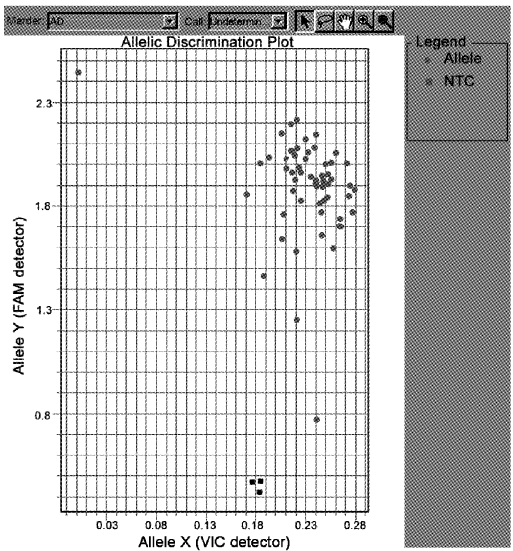
The locus typing of PLA1/PLA2 gene polymorphism was exclusively PLA1/PLA1 (TT) in healthy people, CHD patients and CHD patients with blood-stasis syndrome, while GPⅢa PLA1/PLA2 (TC) and PLA2/PLA2 (CC) were not found in all the selected objects. Statistical analysis of locus typing for other PLA1/PLA1 polymorphisms was not made in the study.
Conclusion

The PLA1/PLA2 polymorphism of membrane glycoprotein Ⅲa is not a risk factor for CHD patients or CHD patients with blood-stasis syndrome in Chinese Han population, and the related genes may be some other gene polymorphisms.

Key words: Coronary heart disease, Blood stasis, Platelet membrane glycoprotein H b-EIa, Polymorphism, Gene

Table 1

GPⅢa PLA1/PLA2 polymorphism"

Amino acid pos HPA classification Personal name classification dbSNP allele dbSNP rs#cluster ID
GPⅢa HPA-1a PLA1 T rs5918
Leu 33 Pro HPA-1b PLA2 C

Figure 1

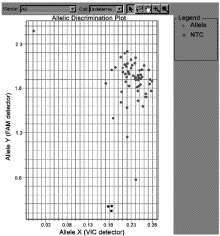
Classification chart for rs5918 locus typing Abscissa: VIC signal intensity; Ordinate: FAM signal intensity; NTC: No template control. Round spot: Allele T homozygote."

[1] Chen KJ, Xue M, Yin HJ . The relationship between platelet activation and coronary heart disease and blood-stasis syndrome[J]. Shou Du Yi Ke Da Xue Xue Bao, 2008,29(3):266-269
陈可冀, 薛梅, 殷惠军 . 血小板活化与冠状动脉粥样硬化性心脏病和血瘀证的关系[J]. 首都医科大学学报, 2008,29(3):266-269
[2] Melus V, Pullmann R, Hybenova J, Skerenova M, Pullmann R Jr . Is PLA1/PLA2 gene polymorphism of platelet membrane glycoprotein Ⅲa a risk factor for myocardial infarct?[J]. Bratisl Lek Listy, 1999,100(11):593-597
[3] Mikkelsson J, Perola M, Penttil A, Karhunen PJ . Platelet glycoprotein Ⅰbalpha HPA-2 Met/VNTR B haplotype as a genetic predictor of myocardial infarction and sudden cardiac death[J]. Circulation, 2001,104(8):876-880
doi: 10.1161/hc3301.094907
[4] Beer JH, Pederiva S, Pontiggia L . Genetics of platelet receptor single-nucleotide polymorphisms: clinical implications in thrombosis[J]. Ann Med, 2000,32(Suppl 1):10-14
[5] Bray PF, Howard TD, Vittinghoff E, Sane DC, Herrington DM . Effect of genetic variations in platelet glycoproteinsⅠbalpha and Ⅵ on the risk for coronary heart disease events in postmenopausal women taking hormone therapy[J]. Blood, 2007,109(5):1862-1869
doi: 10.1182/blood-2006-03-013151
[6] Jackson SP, Schoenwaelder SM . Antiplatelet therapy: in search of the 'magic bullet'[J]. Nat Rev Drug Discov, 2003,2(10):775-789
doi: 10.1038/nrd1198
[7] Chen HZ. Practical internal medicine(12th ed)[M]. Beijing: People's Medical Publishing House, 2005,( 12th ed):1472-1473
陈灏珠 . 实用内科学(第12版)[M]. 北京: 人民卫生出版社, 2005,( 第12版):1472-1473
[8] Professional Committee of Cardiology, Chinese Asso-ciation of Integrative Medicine. The standard of syndrome differentiation for coronary heart disease[J]. Zhongguo Zhong Xi Yi Jie He Za Zhi, 1991,11(5):257
中国中西医结合学会心血管专业委员会. 冠心病中医辨证标准[J]. 中国中西医结合杂志, 1991,11(5):257
[9] Xue M, Chen KJ, Ma XJ, Liu JG, Jiang YR, Miao Y, Yin HJ . Effects of Xuefu Zhuyu Oral Liquid on hemorheology in patients with blood-stasis syndrome due to coronary disease and their relationship with human platelet antigen-3 polymorphism[J]. J Chin Integr Med, 2008,6(11):1129-1135
薛梅, 陈可冀, 马晓娟, 刘剑刚, 蒋跃绒, 缪宇, 殷惠军 . 血府逐瘀口服液对冠心病血瘀证患者血液流变学的影响及其与人类血小板抗原3基因多态性的相关性[J]. 中西医结合学报, 2008,6(11):1129-1135
[10] Di Castelnuovo A, de Gaetano G, Benedetta Donati M, Iacoviello L . Platelet glycoprotein GPⅡb-Ⅲa polymorphism and coronary artery disease: implications for clinical practice[J]. Am J Pharmacogenomics, 2005,5(2):93-99
doi: 10.2165/00129785-200505020-00002
[11] Lagercrantz J, Bergman M, Lundman P, Tornvall P, Hjemdahl P, Hamsten A, Eriksson P . No evidence that the PLA1/PLA2 polymorphism of platelet glycoprotein Ⅲa is implicated in angiographically characterized coronary atherosclerosis and premature myocardial infarction[J]. Blood Coagul Fibrinolysis, 2003,14(8):749-753
doi: 10.1097/00001721-200312000-00010
[12] Abu-Amero KK, Wyngaard CA, Dzimiri N . Association of the platelet glycoprotein receptor Ⅲa(PLA1/PLA1) genotype with coronary artery disease in Arabs[J]. Blood Coagul Fibrinolysis, 2004,15(1):77-79
doi: 10.1097/00001721-200401000-00012
[13] Pegoraro RJ, Ranjith N . Plasminogen activator inhibitor type 1(PAI-1) and platelet glycoprotein Ⅲa(PGⅢa) polymorphisms in young Asian Indians with acute myocardial infarction[J]. Cardiovasc J S Afr, 2005,16(5):266-270
[14] You HW, Gao DS, Wang PX . The association between the platelet GPⅡb -Ⅲa polymorphism and myocardial infarction in Chinese population[J]. Jining Yi Xue Yuan Xue Bao, 2004,27(4):25-26
油红文, 高东升, 王佩显 . 血小板糖蛋白Ⅱb-Ⅲa的PLA基因多态性与心肌梗死关系的研究[J]. 济宁医学院学报, 2004,27(4):25-26
[15] Yang SL, He BX, He ZY, Zhang H, Zou YC, Hong XF . Glycoprotein Ⅲa gene polymorphisms and risk for coronary artery disease in Chinese Urumqi Uygur and Han population[J]. Zhongguo Wei Xun Huan., 2003,7(3):136-139
杨胜利, 何秉贤, 何作云, 张华, 邹阳春, 洪秀芳 . 乌鲁木齐地区维汉两民族中糖蛋白Ⅲa基因多态性与冠心病危险性的关系[J]. 中国微循环, 2003,7(3):136-139
[1] Di Li, Guan-liang Wang, Meng-ya Shan, Jia-han Liu, Lin Wang, De-zeng Zhu. Effects of ursolic acid on c-Cbl-associated protein expression in 3T3-L1 adipocytes with insulin resistance. Journal of Chinese Integrative Medicine, 2012, 10(8): 886-893.
[2] Yan Guan , Hui Zhang, Wei Zhang, Shi-bing Su . Analysis of differential gene expression profile in peripheral blood of patients with chronic hepatitis B and syndromes of dual deficiency of liver and kidney yin and accumulation of dampness heat. Journal of Chinese Integrative Medicine, 2012, 10(7): 751-756.
[3] Ze-long Dai, Hui Chen, Xiao-ying Wu . Relationship between cytochrome P450 2C19*17 genotype distribution platelet aggregation and bleeding risk in patients with blood stasis syndrome of coronary artery disease treated with clopidogrel. Journal of Chinese Integrative Medicine, 2012, 10(6): 647-654.
[4] Chun Li, Yong Wang, Yu-lin Ouyang , Wen-jing Chuo , Qi Qiu , Shu-zhen Guo, Wei Wang. Effects of a compound Chinese herbal medicine Yixin Jiedu Formula on haemodynamic in rats with heart failure of qi-deficiency and blood stasis syndrome. Journal of Chinese Integrative Medicine, 2012, 10(5): 577-583.
[5] Li Weng, Juan Du, Wen-ring He, Chang-quan Ling. Characteristic genomics of peripheral blood mononuclear cells of hepatocellular carcinoma patients with liver-kidney yin deficiency syndrome. Journal of Chinese Integrative Medicine, 2012, 10(4): 406-415.
[6] Santu Kumar Saha, Sreemanti Das, Anisur Rahman Khuda-Bukhsh. Phenotypic evidence of ultra-highly diluted homeopathic remedies acting at gene expression level: A novel probe on experimental phage infectivity in bacteria. Journal of Chinese Integrative Medicine, 2012, 10(4): 462-470.
[7] Tao Li-li, Lei Yan. Effects of extracts from Panax ginseng, Panax notoginseng and Ligusticum chuanxiong on expression of β-galactosidase and signal pathway p16-cyclin D/CDK-Rb in vascular smooth muscle cells. Journal of Chinese Integrative Medicine, 2012, 10(1): 76-84.
[8] Cai Lin-lin, Li Hao, Liu Jian-gang, Liu Long-tao, Guan Jie, Liu Ming-fang, Hu Jia, Wei Yun. Effects of early intervention with Huannao Yicong formula effective components on behavior and cholinergic system of β-amyloid precursor protein transgenic mice. Journal of Chinese Integrative Medicine, 2011, 9(3): 292-298.
[9] Yong Wang, Shu-zhen Guo, Chun Li, Jian-xin Chen, Wen-jing Chuo, Fang Dong, Wei Wang, Ying-feng Wang. Analysis of plasma metabonomics of mini-swines with qi deficiency and blood stasis syndrome due to chronic myocardial ischemia. Journal of Chinese Integrative Medicine, 2011, 9(2): 158-164.
[10] Qin Bian, Jian-hua Huang, Zhu Yang, You Ning, Yong-jian Zhao, Yong-jun Wang, Zi-yin Shen. Effects of active ingredients in three kidney-tonifying Chinese herbal drugs on gene expression profile of bone marrow stromal cells from a rat model of corticosterone-induced osteoporosis. Journal of Chinese Integrative Medicine, 2011, 9(2): 179-185.
[11] Shuo Zhang , Hong-cai Shang. Correlation between traditional Chinese medicine syndromes and omics: A literature review. Journal of Chinese Integrative Medicine, 2011, 9(12): 1286-1291.
[12] Jian-peng Du, Da-zhuo Shi , Tian-chang Li, Hao Xu, Hao Chen. Correlation between blood stasis syndrome and pathological characteristics of coronary artery in patients with coronary heart disease. Journal of Chinese Integrative Medicine, 2010, 8(9): 848-852.
[13] YY Xu, HY Jin, XZ Tan, XF Liu, YJ Ding. Tea polyphenol inhibits colorectal cancer with microsatellite instability by regulating the expressions of HES1, JAG1, MT2A and MAFA. Journal of Chinese Integrative Medicine, 2010, 8(9): 870-876.
[14] Hui Han, Li-min Wu, Wen-ming Yang, Mei-xia Wang, Jing-jing Tang, Han Wang, Zhi-xiu Liu, Rong-zhi Liu, Ting Dong, Juan Zhang , Bo Yang, Ming-xiang Han. Characteristics of traditional Chinese medicine syndromes in post-stroke depression. Journal of Chinese Integrative Medicine, 2010, 8(5): 427-431.
[15] Xuan Liu , Qing-qi Wang. Professor Wang Qingqi's experience in treating senile diseases based on the theory of blood stasis. Journal of Chinese Integrative Medicine, 2010, 8(5): 486-488.
Viewed
Full text


Abstract

Cited

  Shared   
  Discussed   
[1] Jin-zhou Tian, Jing Shi, Xin-qing Zhang, Qi Bi, Xin Ma, Zhi-liang Wang, Xiao-bin Li, Shu-li Shen, Lin Li, Zhen-yun Wu, Li-yan Fang, Xiao-dong Zhao, Ying-chun Miao, Peng-wen Wang, Ying Ren, Jun-xiang Yin, Yong-yan Wang, Beijing United Study Group on MCI of the Capital Foundation of Medical Developments. An explanation on "guiding principles of clinical research on mild cognitive impairment (protocol)". Journal of Chinese Integrative Medicine, 2008, 6(1): 15-21
[2] Yi-ting He, Qing-lin Zha, Jian-ping Yu, Yong Tan, Cheng Lu, Ai-ping Lv. Principal factor analysis of symptoms of rheumatoid arthritis and their correlations with efficacy of traditional Chinese medicine and Western medicine. Journal of Chinese Integrative Medicine, 2008, 6(1): 32-36
[3] Jun Cai, Hua Wang, Sheng Zhou, Bin Wu, Hua-rong Song, Zheng-rong Xuan. Effect of Sijunzi Decoction and enteral nutrition on T-cell subsets and nutritional status in patients with gastric cancer after operation: A randomized controlled trial. Journal of Chinese Integrative Medicine, 2008, 6(1): 37-40
[4] Wei Zhang, Xiang-feng Lu, Xiao-mei Zhang, Jian-jun Wu, Liang-duo Jiang. A rat model of pulmonary fibrosis induced by infusing bleomycin quickly through tracheal intubation. Journal of Chinese Integrative Medicine, 2008, 6(1): 60-67
[5] A-gao Zhou, Yong Zhang, Gang Kui, De-Yun Kong, Hai-liang Ge, Qiu-hua Ren, Jia-rong Dong, Sheng Hong, Xu-ming Mao, Yin Wang, Hui-zheng Zhang, Shu-jun Wang. Influence of traditional Chinese compound recipes with different efficacy on body weight, tumor weight and immune function in H22 cancer-bearing mice. Journal of Chinese Integrative Medicine, 2008, 6(1): 77-82
[6] Guo-hong Yuan, Xiao-jing Pang, He-chao Ma. Synergic effects of Danggui Buxue Decoction in reducing toxicity of cytoxan in tumor-bearing mice. Journal of Chinese Integrative Medicine, 2008, 6(1): 83-88
[7] Li Zhou, Hong-xing Zhang, Ling-guang Liu, Wen-jun Wan. Effect of electro-acupuncture at Fenglong (GV 16) on nitric oxide and endothelin in rats with hyperlipidemia. Journal of Chinese Integrative Medicine, 2008, 6(1): 89-92
[8] Jin-zhou Tian, Jing Shi, Xin-qing Zhang, Qi Bi, Xin Ma, Zhi-liang Wang, Xiao-bin Li, Shu-li Shen, Lin Li, Zhen-yun Wu, Li-yan Fang, Xiao-dong Zhao, Ying-chun Miao, Peng-wen Wang, Ying Ren, Jun-xiang Yin, Yong-yan Wang, Beijing United Study Group on MCI of the Capital Foundation of Medical Developments. Guiding principles of clinical research on mild cognitive impairment (protocol). Journal of Chinese Integrative Medicine, 2008, 6(1): 9-14
[9] Xin-jun Wang, Ling-ling Wang . A mechanism of endogenous opioid peptides for rapid onset of acupuncture effect in treatment of depression. Journal of Chinese Integrative Medicine, 2010, 8(11): 1014-1017
[10] Bo Wang , Wei Yan , Li-hui Hou, Xiao-ke Wu. Disorder of Tiangui (kidney essence) and reproductive dysfunction in patients with polycystic ovary syndrome. Journal of Chinese Integrative Medicine, 2010, 8(11): 1018-1022
[an error occurred while processing this directive]