[an error occurred while processing this directive]

Journal of Chinese Integrative Medicine ›› 2012, Vol. 10 ›› Issue (12): 1451-1459.doi: 10.3736/jcim20121218

• Original Experimental Research • Previous Articles     Next Articles

Ethanolic extract of Thuja occidentalis blocks proliferation of A549 cells and induces apoptosis in vitro

Mukherjee Avinaba1,Sikdar Sourav1,Bishayee Kausik1,Paul Avijit1,Ghosh Samrat1,Boujedaini Naoual2,Rahman Khuda-Bukhsh Anisur1()   

  1. 1. Cytogenetics and Molecular Biology Laboratory, Department of Zoology, University of Kalyani, Kalyani 741235,West Bengal,India
    2. Boiron Laboratories, Lyon 69110, France
  • Received:2012-07-27 Accepted:2012-10-15 Online:2012-12-20 Published:2018-12-15
  • Supported by:
    This work was financially supported by a grant sanctioned to Prof. A.R. Khuda-Bukhsh, Department of Zoology, University of Kalyani, India, by Boiron Laboratories, Lyon, France.

Objective: To study the possible anticancer and antiproliferative activities of ethanolic leaf extract of Thuja occidentalis (TO) on A549 non-small lung carcinoma cells in vitro.
Methods: Cell viability was ascertained through 3-(4,5-dimethylthiazol-2-yl)-2,5-diphenyltetrazolium bromide assay after deployment of TO in different doses. The half maximal inhibitory concentration (IC50) dose (282 μg/mL) was determined, and two other doses for dose-dependence study, one below the IC50 dose (IC35 =188 μg/mL) and one above the IC50 dose (IC65=376 μg/mL) were selected. Bromodeoxyuridine (BrdU) incorporation assay and migration studies were performed to elucidate antiproliferative activity of the drug, if any. Fluorescence-activated cell sorting analysis after annexin V-fluorescein isothiocyanate and propidium iodide (annexin V-FITC-PI) dual staining method was done to ascertain early stage of apoptosis, if any. DNA fragmentation assay was done through Hoechst 33258 and acridine orange-ethidium bromide staining. DNA damage was quantified through comet assay. Bax-Bcl2 regulation and expression studies were performed through indirect enzyme-linked immunosorbent assay (ELISA). Caspase 3 activity was measured at gene level through reverse transcription-polymerase chain reaction (RT-PCR) analysis. Its activation at protein level was analyzed through indirect ELISA and Western blot analysis.
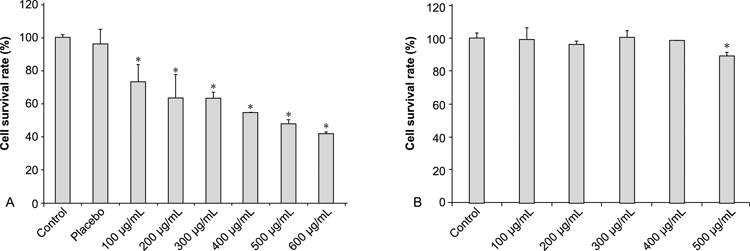
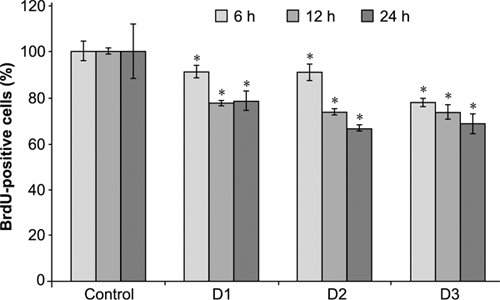
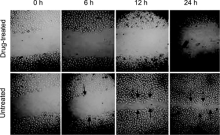
Results: TO demonstrated a dose-dependent decrease in viability of A549 cells after 24 h of exposure. Cell proliferation was reduced in a time-dependent manner of drug exposure as revealed from BrdU incorporation and migration studies. Annexin-V-FITC positivity of cells up to 11.72% as compared to the untreated control revealed early state of TO-induced apoptosis. Occurrence of comet tail and increased fluorescence of Hoechst after 24 h of drug exposure revealed significant DNA nick generation and chromatin condensation. Bax up-regulation and Bcl-2 down-regulation suitably altered ratio of Bax/Bcl-2 in favor of apoptosis. From RT-PCR, indirect ELISA and Western blot studies, caspase 3 activity was also found to be significantly increased along with cleaved poly ADP-ribose polymerase expression.
Conclusion: Ethanolic leaf extract of TO demonstrated apoptotic and antiproliferative potentials against A549 cell line.

Key words: Thuja, plant extracts, carcinoma, non-small-cell lung,cell proliferation, apoptosis, antineoplastic agents,phytogenic, in vitro

Figure 1

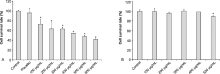
Effects of Thuja occidentalis ethanolic extract on viability of A549 cell line (A) and L-132 cell line (B) Cells were exposed to Thuja occidentalis ethanolic extract for 24 h at different concentrations and the cell viability was determined by MTT assay. Results are expressed as percentage of viability and data are expressed as mean±standard deviation, n= 6; *P<0.05, vs control group. MTT: 3-(4,5-Dimethylthiazol-2-yl)-2,5-diphenyltetrazolium bromide."

Figure 2

Effects of Thuja occidentalis ethanolic extract on cellular proliferation tested by BrdU incorporation assay Cells were exposed to three different concentration of Thuja occidentalis ethanolic extract for 6, 12 and 24 h along with incorporation of BrdU. Incorporated BrdU was labelled with anti-BrdU antibody and intensity was measured at 405 nm using PNPP as a colour developer. Data are expressed as mean±standard deviation, n=6; *P<0.05, vs normal control group. D1: 188 μg/mL; D2: 282 μg/mL; D3: 376 μg/mL; BrdU: bromodeoxyuridine; PNPP: paranitrophenylphosphate."

Figure 3

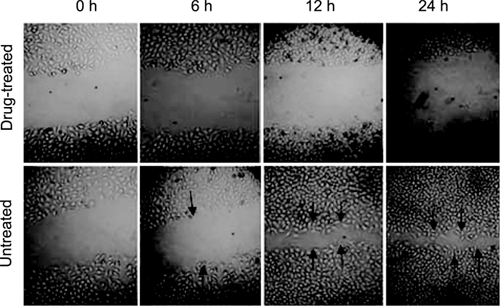
Effects of Thuja occidentalis ethanolic extract on A549 cell migration (Light microscopy, ×20) Wound-healing assays were performed to assess cell migration. Cells were untreated or treated with Thuja occidentalis ethanolic extract (< IC50 dose 188 μg/mL) for 6, 12 and 24 h. Representative photographs of treated and untreated cells are presented. Black arrows indicate migratory cells in untreated ones which found to be less in number in the treated ones."

Figure 4

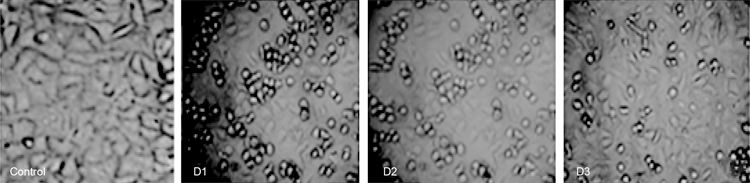
Analysis of cellular morphology by a phase-contrast microscope (Light microscopy, ×20) D1: 188 μg/mL, D2: 282 μg/mL, D3: 376 μg/mL."

Figure 5

FACS analysis after annexin V-fluorescein isothiocyanate and propidium iodide dual staining assay D1: 188 μg/mL; D2: 282 μg/mL; D3: 376 μg/mL."

Figure 6

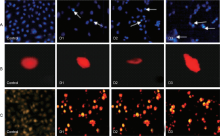
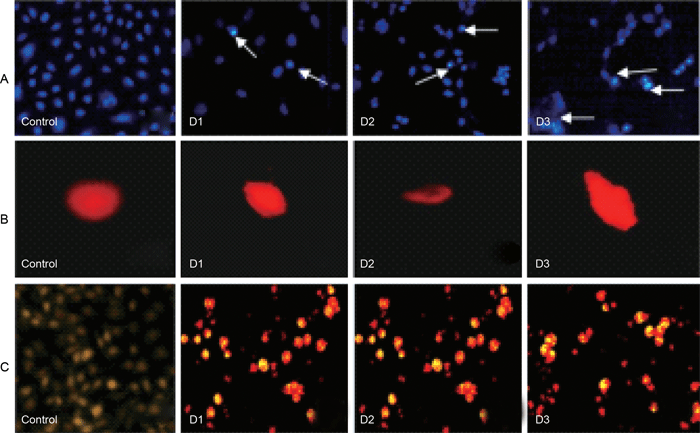
Assessment of DNA damage by Hoechst staining, comet assay, and acridine orange-ethidium bromide staining assay (Fluorescence microscopy, ×40) DNA nick generation was indicated by Hoechst 33258 (A), increasing comet tail length (B), and acridine orange-ethidium bromide fluorescence (C). Changing colour pattern of acridine orange from green (control) to slightly orange (drug-treated) indicates significant DNA fragmentation in a dose-dependent manner. White arrows indicate fragmented nuclei of the apoptotic cells. D1: 188 μg/mL; D2: 282 μg/mL; D3: 376 μg/mL."

Figure 7

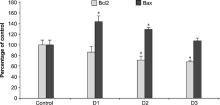
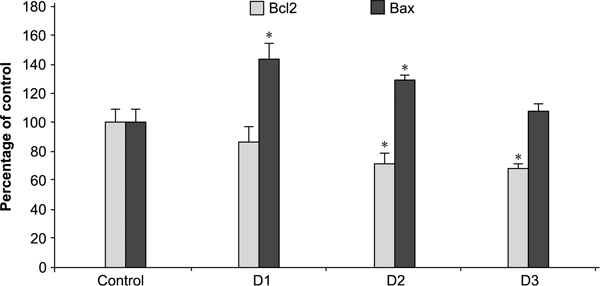
Effects of TO on Bax/Bcl2 expression at protein levels Significant Bax up-regulation and Bcl2 down-regulation were observed by enzyme-linked immunosorbent assay after drug treatment for 18 h in A549 cells. Results are expressed as percentage of control and data are expressed as mean±standard deviation, n=6; *P<0.05, vs control group. D1: 188 μg/mL; D2: 282 μg/mL; D3: 376 μg/mL."

Figure 8

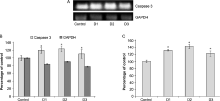
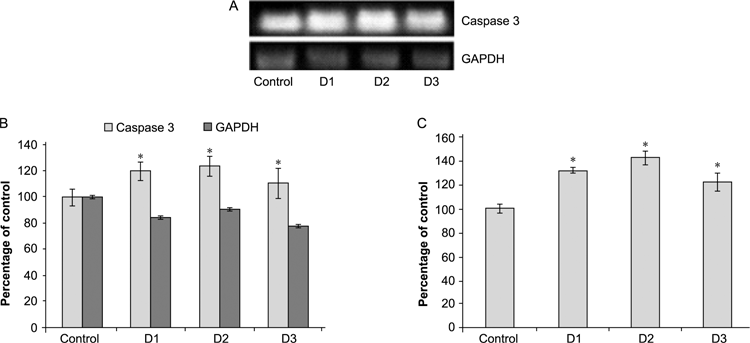
Caspase 3 expression analysis after drug treatment at different doses Caspase 3 gene expression was elevated after drug treatment as revealed from RT-PCR band (A) and their relative intensities (B). Caspase 3 expression at protein level was also increased as revealed from indirect ELISA analysis (C). Band intensities of RT-PCR and protein expression by ELISA assay were expressed as percentage of control and data are expressed as mean±standard deviation, n=6; *P<0.05, vs normal control group. GAPDH was used as a housekeeping gene control. D1: 188 μg/mL; D2: 282 μg/mL; D3: 376 μg/mL; RT-PCR: reverse transcription-polymerase chain reaction; ELISA: enzyme-linked immunosorbent assay; GAPDH: glyceraldehyde 3-phosphate dehydrogenase."

Figure 9

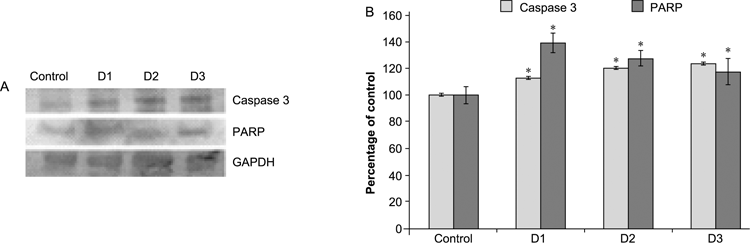
Immunoblot analysis of caspase 3 and PARP Expression of caspase 3 and PARP was increased as revealed from Western blot band (A) and their relative intensities (B). Band intensities of Western blot analysis were expressed as percentage of control and data are expressed as mean±standard deviation, n=6; *P<0.05, vs normal control group. GAPDH was used as a housekeeping gene control. D1: 188 μg/mL; D2: 282 μg/mL; D3: 376 μg/mL; PARP: poly ADP-ribose polymerase; GAPDH: glyceraldehyde 3-phosphate dehydrogenase."

[1] Siegel R, Naishadham D, Jemal A . Cancer statistics, 2012. CA CancerJ Clin. 2012; 62(1):10-29.
doi: 10.3322/caac.20138
[2] Tsiri D, Graikou K, Pobłocka-Olech L, Krauze- Baranowska M, Spyropoulos C, Chinou I . Chemosystematic value of the essential oil composition of Thuja species cultivated in Poland-antimicrobial activity. Molecules. 2009; 14(11):4707-4715.
doi: 10.3390/molecules14114707
[3] Naser B, Bodinet C, Tegtmeier M, Lindequist U . Thuja occidentalis i^Arbor vitae') : A review of its pharmaceutical, pharmacological and clinical properties. Evid Based Complement Alternat Med. 2005; 2(1):69-78.
doi: 10.1093/ecam/neh065
[4] Biswas R, Mandal SK, Dutta S, Bhattacharyya SS, Boujedaini N, Khuda-Bukhsh AR . Thujone-rich fraction of Thuja occidentalis demonstrates major anti-cancer potentials: Evidences from in vitro studies on A375 cells. Evid Based Complement Alternat Med. 2011 ; 2011 : 568148.
[5] Sunila ES, Kuttan G . A preliminary study on antimetastatic activity of Thuja occidentalis L. in mice model. Immu- nopharmacolImmunotoxicol. 2006 ; 28(2) : 269-280.
[6] Elmore S . Apoptosis: a review of programmed cell death. Toxicol Pathol. 2007; 35(4):495-516.
doi: 10.1080/01926230701320337 pmid: 2117903
[7] Fesik SW . Promoting apoptosis as a strategy for cancer drug discovery. Nat Rev Cancer. 2005; 5(11):876-885.
doi: 10.1038/nrc1736 pmid: 16239906
[8] Wong KK, Engelman JA, Cantley LC . Targeting the PI3K signalling pathway in cancer. Curr Opin Genet Dev. 2010; 20(1) : 87-90.
doi: 10.1016/j.gde.2009.11.002 pmid: 2822054
[9] Mosmann T . Rapid colorimetric assay for cellular growth and survival: application to proliferation and cytotoxicity assays.J Immunol Methods. 1983; 65(1-2) : 55-63.
[10] Liang CC, Park AY, Guan JL . In vitro scratch assay: a convenient and inexpensive method for analysis of cell migration in vitro. Nat Protoc. 2007 ; 2(2) : 329-333.
doi: 10.1038/nprot.2007.30
[11] De A, Das D, Dutta S, Chakraborty D, Boujedaini N, Khuda-bukhsh AR . Potentized homeopathic drug Arse- nicaum Album 30C inhibits intracellular reactive oxygen species generation and up-regulates expression of arsenic resistance gene in arsenine-exposed bacteria Escherechia coli. J Chin Integr Med. 2012; 10(2):210-227. English with abstract inChinese.
De A, Das D, Dutta S, Chakraborty D, Boujedaini N, Khuda-Bukhsh AR. 顺势疗法药物白砷剂抑制暴露于三氧化二砷的大肠杆菌细胞内活性氧的产生并上调其抗三氧化二砷基因的表达.中西医结合学报. 2012; 10(2):210-227.
[12] Morley N, Rapp A, Dittmar H, Salter L, Gould D, Greulich KO, Curnow A . UVA-induced apoptosis studied by the new apo/necro-Comet-assay which distinguishes viable, apoptotic and necrotic cells. Mutagenesis. 2006; 21(2):105-114.
doi: 10.1093/mutage/gel004
[13] Chakraborty D, Mukherjee A, Sikdar S, Paul A, Ghosh S, Khuda-Bukhsh AR .[ 6]-Gingerol isolated from ginger attenuates sodium arsenite induced oxidative stress and plays a corrective role in improving insulin signalling in mice. Toxicol Lett. 2012 ; 210(1) : 34-43.
doi: 10.1016/j.toxlet.2012.01.002
[14] Bhattacharyya SS, Paul S, Mandal SK, Banerjee A, Boujedaini N, Khuda-Bukhsh AR . A synthetic coumarin (4-methyl-7 hydroxy coumarin) has anti-cancer potentials against DMBA-induced skin cancer in mice. Eur J Pharmacol. 2009; 614(1-3):128-136.
doi: 10.1016/j.ejphar.2009.04.015
[15] Cheng YL, Chang WL, Lee SC, Liu YG, Chen CJ, Lin SZ, Tsai NM, Yu DS, Yen CY, Harn HJ . Acetone extract of Angelica sinensis inhibits proliferation of human cancer cells via inducing cell cycle arrest and apoptosis. Life Sci. 2004; 75(13):1579-1594.
doi: 10.1016/j.lfs.2004.03.009
[16] Cassileth BR . Alternative and complementary cancer treatments. Oncologist. 1996; 1(3) : 173-179.
[17] Zhang JH, Xu M . DNA fragmentation in apoptosis. Cell Res. 2010; 10(3):205-211.
[18] Audrito V, Vaisitti T, Rossi D, Gottardi D , D ' Arena G, Laurenti L, Gaidano G, Malavasi F, Deagilo S. Nicotinamide blocks proliferation and induces apoptosis of chronic lymphocytic leukemia cells through activation of the p53/miR-34a/SIRTl tumor suppressor network . Cancer Res. 2011; 71(13):4473-4483.
doi: 10.1158/0008-5472.CAN-10-4452
[19] Yu J, Zhou X, He X, Dai M, Zhang Q . Curcumin induces apoptosis involving bax/bcl-2 in human hepatoma SMMC-7721 cells.Asian Pac J Cancer Prev. 2011; 12(8):1925-1929.
doi: 10.1007/978-3-642-16602-0_13 pmid: 22292626
[20] Mandal SK, Biswas R, Bhattacharyya SS, Paul S, Dutta S, Pathak S, Khuda-Bukhsh AR . Lycopodine from Lycopodium clavatum extract inhibits proliferation of HeLa cells through induction of apoptosis via caspase-3 activation. Eur J Pharmacol. 2010; 626(2-3):115-122.
[1] Avijit Paul, Kausik Bishayee, Samrat Ghosh, Avinaba Mukherjee, Sourav Sikdar, Debrup Chakraborty, Naoual Boujedaini, Anisur Rahman Khuda-Bukhsh. Chelidonine isolated from ethanolic extract of Chelidonium majus promotes apoptosis in HeLa cells through p38-p53 and PI3K/AKT signalling pathways. Journal of Chinese Integrative Medicine, 2012, 10(9): 1025-1038.
[2] Dhirender Kaushik, Ajay Kumar, Pawan Kaushik, Avatar C. Rana. Anticonvulsant activity of alcoholic extract of bark of Pinus roxburghii Sarg. Journal of Chinese Integrative Medicine, 2012, 10(9): 1056-1060.
[3] Chan Chen, Chang-xun Chen, Xi-min Wu, Rui Wang, Yi-ming Li. Effects of extracts of Radix Scrophulariae on blood pressure in spontaneously hypertensive rats and the underlying mechanisms. Journal of Chinese Integrative Medicine, 2012, 10(9): 1009-1017.
[4] Samuel Joshua Pragasam, Vachana Murunikara, Evan Prince Sabina, Mahaboobkhan Rasool. Antiperoxidative potential of p-coumaric acid, a common dietary phenol, in adjuvant-induced arthritis in rats. Journal of Chinese Integrative Medicine, 2012, 10(8): 932-938.
[5] Hong Wang , Jing-tian Ou , Xin Zhao , Ying Guoz , Hao-ping Mao. Vasodilator effect of oroxylin A on thoracic aorta isolated from rats. Journal of Chinese Integrative Medicine, 2012, 10(8): 880-885.
[6] C. Mouli Kalla, Vijaya Tartte, Dattatreya Rao Sirpurkar. Effectiveness of flavonoid-rich leaf extract of Acalypha indica in reversing experimental myocardial ischemia: biochemical and histopathological evidence. Journal of Chinese Integrative Medicine, 2012, 10(7): 784-792.
[7] Yogesh Bendale, Vineeta Bendale, Saili Paul, Soumya Sundar Bhattacharyya. Green synthesis, characterization and anticancer potential of platinum nanoparticles Bioplatin. Journal of Chinese Integrative Medicine, 2012, 10(6): 681-689.
[8] Yathiraj Ashwini, Mohamed Rafiq, Gollapalle L. Viswanatha, Subbanna Rajesh, Selvam Senthilraja, Mohammed Azeemuddin, Suryakanth D. Anturlikar, Paramesh Rangesh, Pralhad S. Patki . Polyherbal formulation Bresol® protects the mast cells against compound 48/80-induced disruption and histamine release: A non-immunological mechanism of mast cell stabilization. Journal of Chinese Integrative Medicine, 2012, 10(6): 690-694.
[9] Surendra Kr. Sharma, Naveen Goyal. Protective effect of Heliotropium eichwaldi against cisplatin-induced nephrotoxicity in mice. Journal of Chinese Integrative Medicine, 2012, 10(5): 555-560.
[10] Yue-hua Wang, Xiao-li He, Xiao-xiu Li, Hai-lin Qin, Guan-hua Du . Effects of the effective component group of Chinese herbal medicine Xiaoxuming Decoction on brain mitochondria in rats with chronic cerebral ischemia. Journal of Chinese Integrative Medicine, 2012, 10(5): 569-576.
[11] V. Patil Vikas, C. Bhangale Shandavi, J. Chaudhari Prashant, P. Chaudhari Kundan, T. Kakade Rajanikant, M. Thakare Vinod, G. Bonde Chandrakant, R. Patil Vijay. Evaluation of the antidiarrheal activity of the plant extracts of Ficus species. Journal of Chinese Integrative Medicine, 2012, 10(3): 347-352.
[12] Dhiman Anju, Nanda Arun, Ahmad Sayeed. A recent update in research on the antihepatotoxic potential of medicinal plants. Journal of Chinese Integrative Medicine, 2012, 10(2): 117-127.
[13] Mao Zhi-min, Song Hai-yan, Yang Li-li, Liu Tao, Li Dong-fei, Zheng Pei-yong, Liu Ping, Ji Guang. Effects of the mixture of Swertia pseudochinensis Hara and Silybum marianum Gaertn extracts on CCl4-induced liver injury in rats with non-alcoholic fatty liver disease. Journal of Chinese Integrative Medicine, 2012, 10(2): 193-199.
[14] Rahmatullah Mohammed, Kanij Hasan Sumaiyah, Ali Zulfiquar, Rahman Shahnaz, Jahan Rownak. Antihyperglycemic and antinociceptive activities of methanolic extract of Euphorbia thymifolia L. whole plants. Journal of Chinese Integrative Medicine, 2012, 10(2): 228-232.
[15] Arul Raj Chinthamony, Sophia Dominic, Ragavendran Paramasivam, Starlin Thangarajan, Ahalliya Rathi Muthian, Kanniappan Gopalakrishnan Velliyur. Leaf extract of Alpinia purpurata (Vieill.) K. Schum screened for its phytochemical constituents and antibacterial and anticancer activities. Journal of Chinese Integrative Medicine, 2012, 10(12): 1460-1464.
Viewed
Full text


Abstract

Cited

  Shared   
  Discussed   
[1] Jin-zhou Tian, Jing Shi, Xin-qing Zhang, Qi Bi, Xin Ma, Zhi-liang Wang, Xiao-bin Li, Shu-li Shen, Lin Li, Zhen-yun Wu, Li-yan Fang, Xiao-dong Zhao, Ying-chun Miao, Peng-wen Wang, Ying Ren, Jun-xiang Yin, Yong-yan Wang, Beijing United Study Group on MCI of the Capital Foundation of Medical Developments. An explanation on "guiding principles of clinical research on mild cognitive impairment (protocol)". Journal of Chinese Integrative Medicine, 2008, 6(1): 15-21
[2] Yi-ting He, Qing-lin Zha, Jian-ping Yu, Yong Tan, Cheng Lu, Ai-ping Lv. Principal factor analysis of symptoms of rheumatoid arthritis and their correlations with efficacy of traditional Chinese medicine and Western medicine. Journal of Chinese Integrative Medicine, 2008, 6(1): 32-36
[3] Jun Cai, Hua Wang, Sheng Zhou, Bin Wu, Hua-rong Song, Zheng-rong Xuan. Effect of Sijunzi Decoction and enteral nutrition on T-cell subsets and nutritional status in patients with gastric cancer after operation: A randomized controlled trial. Journal of Chinese Integrative Medicine, 2008, 6(1): 37-40
[4] Wei Zhang, Xiang-feng Lu, Xiao-mei Zhang, Jian-jun Wu, Liang-duo Jiang. A rat model of pulmonary fibrosis induced by infusing bleomycin quickly through tracheal intubation. Journal of Chinese Integrative Medicine, 2008, 6(1): 60-67
[5] A-gao Zhou, Yong Zhang, Gang Kui, De-Yun Kong, Hai-liang Ge, Qiu-hua Ren, Jia-rong Dong, Sheng Hong, Xu-ming Mao, Yin Wang, Hui-zheng Zhang, Shu-jun Wang. Influence of traditional Chinese compound recipes with different efficacy on body weight, tumor weight and immune function in H22 cancer-bearing mice. Journal of Chinese Integrative Medicine, 2008, 6(1): 77-82
[6] Guo-hong Yuan, Xiao-jing Pang, He-chao Ma. Synergic effects of Danggui Buxue Decoction in reducing toxicity of cytoxan in tumor-bearing mice. Journal of Chinese Integrative Medicine, 2008, 6(1): 83-88
[7] Li Zhou, Hong-xing Zhang, Ling-guang Liu, Wen-jun Wan. Effect of electro-acupuncture at Fenglong (GV 16) on nitric oxide and endothelin in rats with hyperlipidemia. Journal of Chinese Integrative Medicine, 2008, 6(1): 89-92
[8] Jin-zhou Tian, Jing Shi, Xin-qing Zhang, Qi Bi, Xin Ma, Zhi-liang Wang, Xiao-bin Li, Shu-li Shen, Lin Li, Zhen-yun Wu, Li-yan Fang, Xiao-dong Zhao, Ying-chun Miao, Peng-wen Wang, Ying Ren, Jun-xiang Yin, Yong-yan Wang, Beijing United Study Group on MCI of the Capital Foundation of Medical Developments. Guiding principles of clinical research on mild cognitive impairment (protocol). Journal of Chinese Integrative Medicine, 2008, 6(1): 9-14
[9] Xin-jun Wang, Ling-ling Wang . A mechanism of endogenous opioid peptides for rapid onset of acupuncture effect in treatment of depression. Journal of Chinese Integrative Medicine, 2010, 8(11): 1014-1017
[10] Bo Wang , Wei Yan , Li-hui Hou, Xiao-ke Wu. Disorder of Tiangui (kidney essence) and reproductive dysfunction in patients with polycystic ovary syndrome. Journal of Chinese Integrative Medicine, 2010, 8(11): 1018-1022
[an error occurred while processing this directive]