[an error occurred while processing this directive]

Journal of Chinese Integrative Medicine ›› 2010, Vol. 8 ›› Issue (8): 750-756.doi: 10.3736/jcim20100804

• Original Clinical Research • Previous Articles     Next Articles

Quantitative evaluation of the degrees of qualitative syndromes commonly encountered in patients with coronary heart disease

Dong-tao Lia, Jie Lib, Jian Wanga, Fu-yu Lia, Jing-xiu Zhuc, Mei-zeng Zhangd, Jun-yan Lia, Yan-lai Xua, Ling-bo Weib, Wen-yan Jib, Rong-qin Jiange, Xue-fa Liub   

  1. a Department of Traditional Chinese Medicine,Qingdao First Sanatorium of Jinan Military Region, Qingdao 266071, Shandong Province, China
    b Department of Chinese Traditional Cardiology, Qingdao Haici Medical Corporation, Qingdao 266033, Shandong Province, China
    c Department of Traditional Chinese Medicine,Qingdao Second Sanatorium of Jinan Military Region, Qingdao 266071, Shandong Province, China
    d Department of Neurology, Affiliated Hospital of Qingdao University Medical College, Qingdao 266071, Shandong Province, China
    e Department of Medical Services, Qingdao Integrated Traditional Chinese and Western Medicine Hospital, Qingdao 266002, Shandong Province, China
  • Received:2010-01-20 Accepted:2010-04-29 Online:2010-08-20 Published:2010-08-15

Objective

To establish a quantitative model for evaluating the degree of traditional Chinese medicine (TCM) syndromes often seen in patients with coronary heart disease (CHD).
Methods

Medical literature concerning clinical investigation of TCM syndromes of CHD was collected and organized, and the “Hall for Workshop of Metasynthetic Engineering” expert symposium method was applied. First, the 100 millimeter scaling was used for combining with scoring on degree of symptoms to establish a quantitative criterion for classification of symptom degree in CHD patients, and the model was established by using comprehensive analytic hierarchy process as the mathematical tool to estimate the weight of the criterion for evaluating qualitative syndromes in various layers by specialists. Then the model was verified in clinical practice and the outcomes were compared with fuzzy evaluation from the specialists.
Results

A total of 287 clinical observation forms on CHD cases were collected, and 167 forms were available after excluding any irregular forms. The results showed that basic coincidence rate between the outcomes derived from specialists and those from the model was 68.26% (114/167), and part coincidence rate was 88.62% (148/167).
Conclusion

This model, with good rationality and feasibility, has a high coincidence rate with fuzzy evaluation from specialists, and can be promoted in clinical practice. It is a good quantitative model for evaluating the degree of TCM syndromes of CHD.

Key words: Coronary heart disease, Syndrome, Quantitative analysis, Analytic hierarchy process

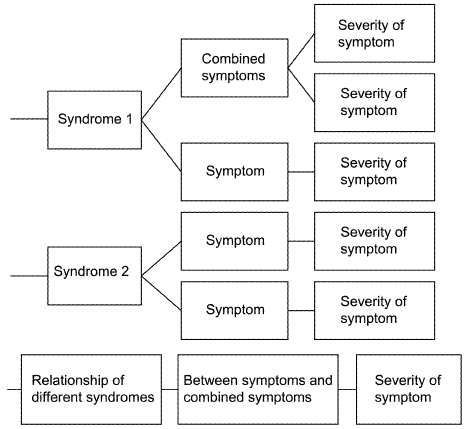
Figure 1

Target tree using analytic hierarchy process in quantitative evaluating degrees of qualitative syndromes often appeared in patients with coronary heart disease"

Table 1

Optimizing matrix of deficiency syndrome"

[1] Qian XS . A new discipline of science: the study of open complex giant system and methodology[J]. Cheng Shi Fa Zhan Yan Jiu, 2005,12(5):1-8
doi: 10.3969/j.issn.1006-3862.2005.05.001
钱学森 . 一个科学新领域——开放的复杂巨系统及其方法论[J]. 城市发展研究, 2005,12(5):1-8
doi: 10.3969/j.issn.1006-3862.2005.05.001
[2] Qian XS . Recognition on open complex giant system[J]. Mo Shi Shi Bie Yu Ren Gong Zhi Neng, 1991,4(1):1-4
钱学森 . 再谈开放的复杂巨系统[J]. 模式识别与人工智能, 1991,4(1):1-4
[3] Yu SL. Medical statistics[M]. Beijing: People’s Medical Publishing House,2002: 386-390
余松林 . 医学统计学[M]. 北京: 人民卫生出版社,2002: 386-390
[4] Chinese Association of Psychiatry . Chinese chassification of mental disorders: third edition(CCMD-3)(3rd ed)[M]. Jinan: Shandong Scientific and Technical Publishers, 2001,( 3rd ed):4
中华精神科学会. 中国精神障碍分类方案与诊断标准(CCMD-3)(第3版)[M]. 济南: 山东科学技术出版社, 2001,( 第3版):4
[5] Ye YW, Wang YS. Operating instructions for clinical laboratory tests in China(2nd ed)[M]. Nanjing: Southeast University Press, 1997,( 2nd ed):410-414
叶应妩, 王毓三 . 全国临床检验操作规程(第2版)[M]. 南京: 东南大学出版社, 1997,( 第2版):410-414
[6] Deng TT. Diagnostics of traditional Chinese medicine(5th ed)[M]. Shanghai: Shanghai Scientific and Technical Publishers, 1984,( 5th ed):11
邓铁涛 . 中医诊断学(第5版)[M]. 上海: 上海科学技术出版社, 1984,( 第5版):11
[7] Luo YJ . Evaluation and chinical application of simplified McGill Pain Questionnaire[J]. Zhongguo Kang Fu, 1992,7(4):160-164
罗跃嘉 . 简化McGill疼痛评分表的临床应用评价[J]. 中国康复, 1992,7(4):160-164
[8] Chen WB. Diagnostics(5th ed)[M]. Beijing: People’s Medical Publishing House, 2002,( 5th ed):6
陈文彬 . 诊断学(第5版)[M]. 北京: 人民卫生出版社, 2002,( 第5版):6
[9] Ye RG. Internal medicine(5th ed)[M]. Beijing: People’s Medical Publishing House, 2002,( 5th ed):6
叶任高 . 内科学(第5版)[M]. 北京: 人民卫生出版社, 2002,( 第5版):6
[10] Kuang HL. Differential diagnostics of internal medicine(3rd ed)[M]. Beijing: People’s Medical Publishing House, 1997,( 3rd ed):12
邝贺龄 . 内科疾病鉴别诊断学(第3版)[M]. 北京: 人民卫生出版社, 1997,( 第3版):12
[11] Zhao JD. Differential diagnostics of symptoms in traditional Chinese medicine[M]. Beijing: People’s Medical Publishing House,1987: 6
赵金铎 . 中医症状鉴别诊断学[M]. 北京: 人民卫生出版社,1987: 6
[12] Li ZM. Differential diagnostics of chinical symptoms(3rd ed)[M]. Shanghai: Shanghai Scientific and Technical Publishers, 1995,( 3rd ed):3
李宗明 . 临床症状鉴别诊断学(第3版)[M]. 上海: 上海科学技术出版社, 1995,( 第3版):3
[13] Zheng XY. Guidelines for clinical research on Chinese new herbal medicines(trial implementation)[M]. Beijing: Medical Science and Technology Publishing House of China,2002: 5
郑筱萸 . 中药新药临床研究指导原则(试行)[M]. 北京: 中国医药科技出版社,2002: 5
[14] Report of the Joint International Society and Federation of Cardiology/World Health Organization Task Force on standardization of clinical nomenclature. Nomenclature and criteria for diagnosis of ischemic heart disease[J]. Circulation, 1979,59(3):607-609
doi: 10.1161/01.CIR.59.3.607
[15] Dai YW, Cao LB . Research of hall for workshop of metasynthetic engineering[J]. Guan Li Ke Xue Xue Bao, 2002,5(3):11-17
doi: 10.3321/j.issn:1007-9807.2002.03.002
戴汝为, 操龙兵 . 综合集成研讨厅的研制[J]. 管理科学学报, 2002,5(3):11-17
doi: 10.3321/j.issn:1007-9807.2002.03.002
[16] Cui X, Dai RW, Li YD . Emergence of collective wisdom in hall for workshop of metasynthetic engineering[J]. Xi Tong Fang Zhen Xue Bao, 2003,15(1):146-153
doi: 10.3969/j.issn.1004-731X.2003.01.041
崔霞, 戴汝为, 李耀东 . 群体智慧在综合集成研讨厅体系中的涌现[J]. 系统仿真学报, 2003,15(1):146-153
doi: 10.3969/j.issn.1004-731X.2003.01.041
[17] Wang DL, Dai YW . Behavior criteria for expert group in hall for workshop of metasynthetic engineering[J]. Guan Li Ke Xue Xue Bao, 2001,4(2):1-6
doi: 10.3321/j.issn:1007-9807.2001.02.001
王丹力, 戴汝为 . 综合集成研讨厅体系中专家群体行为的规范[J]. 管理科学学报, 2001,4(2):1-6
doi: 10.3321/j.issn:1007-9807.2001.02.001
[18] Nickel JC . Effective office management of chronic prostatitis[J]. Urol Clin North Am, 1998,25(4):677-684
doi: 10.1016/S0094-0143(05)70056-2 pmid: 10026774
[19] Guan JD, Wan X, Hu LS . Study on the methodology of quantification of symptoms of traditional Chinese medicine and assessment of therapeutic effects[J]. Zhongguo Zhong Xi Yi Jie He Za Zhi, 2002,22(6):431
doi: 10.3321/j.issn:1003-5370.2002.06.031
官君达, 万霞, 胡立胜 . 中医症状量化及其疗效评定方法探讨[J]. 中国中西医结合杂志, 2002,22(6):431
doi: 10.3321/j.issn:1003-5370.2002.06.031
[20] You S, Hu LS . Study on the methodology of the quantification of TCM symptoms and syndromes[J]. Beijing Zhong Yi Yao Da Xue Xue Bao, 2002,25(2):13
由松, 胡立胜 . 中医症状及证候的量化方法探讨[J]. 北京中医药大学学报, 2002,25(2):13
[21] Zhang ZB, Wang YY . Research on TCM syndrome nomenclature and classification: review and hypojournal[J]. Beijing Zhong Yi Yao Da Xue Xue Bao, 2003,26(2):1-4
doi: 10.3321/j.issn:1006-2157.2003.02.001
张志斌, 王永炎 . 证候名称及分类研究的回顾与假设的提出[J]. 北京中医药大学学报, 2003,26(2):1-4
doi: 10.3321/j.issn:1006-2157.2003.02.001
[1] Qi-sheng Tang, Wen-jun Sun, Miao Qu, Dong-fang Guo. Analysis of syndrome discipline of generalized anxiety disorder using data mining techniques. Journal of Chinese Integrative Medicine, 2012, 10(9): 975-982.
[2] Lu Liu, Ying Gao. Study on the correlation between traditional Chinese medicine syndrome and short-term prognosis of ischemic stroke using logistic regression model and repeated-measures analysis of variance. Journal of Chinese Integrative Medicine, 2012, 10(9): 983-990.
[3] Yan Guan , Hui Zhang, Wei Zhang, Shi-bing Su . Analysis of differential gene expression profile in peripheral blood of patients with chronic hepatitis B and syndromes of dual deficiency of liver and kidney yin and accumulation of dampness heat. Journal of Chinese Integrative Medicine, 2012, 10(7): 751-756.
[4] Ying-fei Bi , Jing-yuan Mao , Xian-liang Wang , Ya-zhu Hou , Yi-zhu Lu , Shan Bin Soh , Bo-li Zhang. Clinical epidemiology survey of the traditional Chinese medicine etiology and syndrome differentiation of coronary artery disease: Study protocol of a multicenter trial. Journal of Chinese Integrative Medicine, 2012, 10(6): 619-627.
[5] Qing-bo Lang, Dong-xia Zhai , Feng Huang, Jian-guo Chen, Yong-hui Zhang, Qun Liu, Xiao-feng Zhai , Bai Li, Chang-quan Ling. Investigation on traditional Chinese medicine syndrome distribution of 4 618 hepatitis B virus infection subjects in Qidong of Jiangsu Province, China. Journal of Chinese Integrative Medicine, 2012, 10(5): 525-531.
[6] Jia-jia Wang , Tian-fang Wang , Xiu-yan WU , Yah Zhao , Xiao-lin Xue , Qing-guo Wang. Weighting coefficients of symptoms and signs in the diagnosis of corresponding TCM syndrome elements of ulcerative colitis based on expert questionnaire investigation. Journal of Chinese Integrative Medicine, 2012, 10(4): 398-405.
[7] Zhu Yan-feng, Luo Hai-ming, Deng Zhong-long, Fu De-yu, Yao Wang, Dai Jian. Effects of the Chinese patent medicine, Honghua Injection, on platelet glycoprotein Ⅱb/Ⅲa receptors in patients with acute coronary syndrome: a randomized controlled trial. Journal of Chinese Integrative Medicine, 2012, 10(3): 318-323.
[8] Hu Xiao-Yu, Zhang Yang, Chen Guo, Zhong Sen, Fan Xin-Jian. A prospective cohort study on the influence of high doses of herbs for clearing heat and resolving stasis on survival rates in patients with hepatitis B-related acute-on-chronic liver failure. Journal of Chinese Integrative Medicine, 2012, 10(2): 176-185.
[9] Yu Zhao, Jing-hua Peng , Xue-mei Li , Qi-lin Fu, Tuan Cui , Qi Li, Ya-jun Tang , Qin Feng , Hua Zhang , Hua Zhou , Yi-yang Hu. Diagnostic value of clinical indices in syndrome differentiation of chronic hepatitis B: an exploration based on receiver operating characteristic curves and stepwise discriminant analysis. Journal of Chinese Integrative Medicine, 2012, 10(12): 1382-1387.
[10] Dong-tao Li, Jian Wang , Hong-yang Jiang , Feng-lei Shi , Fu-yu Li , Ji-hong Liu , Yong-mei Cheng , Nan Yan , Ai-hua Hu, Mei-zeng Zhang , Jie Li, Ling-bo Wei , Rong-qin Jiang. Quantitative evaluation of the degrees of traditional Chinese medicine qualitative syndromes of osteoporosis. Journal of Chinese Integrative Medicine, 2012, 10(11): 1254-1262.
[11] Jing Zhang , Long Liu , Xin Yan , Xiao-qiang Yue. Study of the syndromes of traditional Chinese medicine in terms of metabonomics technology: The current situation and considerations. Journal of Chinese Integrative Medicine, 2012, 10(10): 1069-1076.
[12] Gui-xiang Chu, Qing-guang Chen, Jia-tuo Xu , Bo Yu , Min Zhang , Long-tao Cui , Hong-jin Wu , Zhao-fu Fei. Analysis on pulse diagram characteristics of subjects with subhealth state. Journal of Chinese Integrative Medicine, 2012, 10(10): 1099-1105.
[13] Liu Yue, Xie Ming, Zhang Ye. Dynamic changes of laboratory parameters of rats with type 2 diabetes and insulin resistance: defining their role in development of traditional Chinese medicine syndrome. Journal of Chinese Integrative Medicine, 2012, 10(1): 100-108.
[14] Xing-jiang Xiong, Hai-xia Li . Experience on clinical application of Chinese herbal medicine Yi Guan Jian decoction. Journal of Chinese Integrative Medicine, 2011, 9(8): 920-923.
[15] Ji Sun, Sheng-liang Zhu, Shu-ying Ma, Xiao-su Wang, Jing Kong. Clinical characteristics of patients with reflux esophagitis exhibiting gallbladder heat attacking the stomach or stagnant heat of the liver and stomach syndrome. Journal of Chinese Integrative Medicine, 2011, 9(7): 732-736.
Viewed
Full text


Abstract

Cited

  Shared   
  Discussed   
[1] Jin-rong Fu. Establishment of multivariate diagnosis and treatment system of modern gynecology of traditional Chinese medicine. Journal of Chinese Integrative Medicine, 2008, 6(1): 22-24
[2] Hao Li, Ming-jiang Yao, Wen-ming Zhao, Jie Guan, Lin-lin Cai, Ling Cui. A randomized, controlled, double-blind trial of Huannao Yicong capsule in senile patients with mild cognitive impairment. Journal of Chinese Integrative Medicine, 2008, 6(1): 25-31
[3] Zhi-chun Jin. Problems in establishing clinical guideline for integrated traditional Chinese and Western medicine. Journal of Chinese Integrative Medicine, 2008, 6(1): 5-8
[4] SUN Ming-yu, ZUO Jian, DUAN Ji-feng, HAN Jun, FAN Shi-ming, ZHANG Wei, ZHU Li-fang, YAO Ming-hui. Antitumor activities of kushen flavonoids in vivo and in vitro. Journal of Chinese Integrative Medicine, 2008, 6(1): 51-59
[5] Min Cheng, Qiong Feng, Shu-wen Qian, Hui Gao, Cui-qing Zhu. Preliminary assay of p-amyloid binding elements in heart-beneficial recipe. Journal of Chinese Integrative Medicine, 2008, 6(1): 68-72
[6] Ning-qun Wang, Liang-duo Jiang, Zong-xing Li. Research progress in asthma-related quality of life. Journal of Chinese Integrative Medicine, 2008, 6(1): 93-97
[7] Jing-yuan Mao, Chang-xiao Liu, Heng-he Wang, Guang-li Wei , Zhen-peng Zhang, Jie Xing, Wang Xian liang , Ying-fei Bi . Effects of Shenmai Injection on serum concentration and pharmacokinetics of digoxin in dogs with heart failure. Journal of Chinese Integrative Medicine, 2010, 8(11): 1070-1074
[8] Zhi-mei Wang, Bin Zhang. A study on translation of ellipses in Huangdi Neijing from perspective of hermeneutic theory. Journal of Chinese Integrative Medicine, 2010, 8(11): 1097-1100
[9] Gui Yu, Jie Wang. Thinking on building the network cardiovasology of Chinese medicine. Journal of Chinese Integrative Medicine, 2012, 10(11): 1206-1210
[10] Pedro Saganha João, Doenitz Christoph, Greten Tobias, Efferth Thomas, J. Greten Henry. Qigong therapy for physiotherapists suffering from burnout: a preliminary study. Journal of Chinese Integrative Medicine, 2012, 10(11): 1233-1239
[an error occurred while processing this directive]