[an error occurred while processing this directive]

Journal of Chinese Integrative Medicine ›› 2006, Vol. 4 ›› Issue (2): 152-155.doi: 10.3736/jcim20060209

• Original Clinical Research • Previous Articles     Next Articles

Evaluation of therapeutic effects of Chinese materia medica by tongue image analysis software 1.0 based on tongue colors

Feng-lan Zhu1, Chao Gu1, Zhi-feng Zhang2, Chang-le Zhou3, Jia-tuo Xu2, Xiao-gu Liu2, Wen-shu Li4, Hui-qing Zhu1   

  1. 1. Department of Internal Medicine, Taicang First People’s Hospital, Taicang, Jiangsu Province 215400, China
    2. School of Basic Medical Science, Shanghai University of Traditional Chinese Medicine, Shanghai 201203, China
    3. School of Computer and Information Engineering, Xiamen University, Xiamen, Fujian Province 361005, China
    4. School of Computer Science, Zhejiang University, Hangzhou, Zhejiang Province 310027, China
  • Online:2006-03-20 Published:2006-03-15

Objective

To evaluate the therapeutic effects of Chinese materia medica in treating patients with different syndromes by tongue image analysis software 1.0 based on tongue colors, and to discuss the feasibility of applying this computer science-based techniques into drug evaluation.

Methods

The tongue colors and the areas of tongue fur were examined and analyzed by the tongue image analysis software 1.0 in healthy persons and the patients with different syndromes before and after treatment. The parameters of tongue colors consisted of the followings: the hue (H), the lightness (L), the saturation (S), and the values of red (R), green (G) and blue (B).

Results

Obvious differences could be revealed in tongue color index between the healthy persons and the patients in five groups of different syndromes. There also existed some significant differences in those index between patients before and after treatment.

Conclusion

The tongue image analysis software 1.0 based on tongue colors is helpful to evaluate the therapeutic effects of Chinese materia medica.

Key words: Tongue color, Image processing, Computer-assisted, Chinese materia medica, Drug evaluation, Treatment outcome

CLC Number: 

  • R241.25

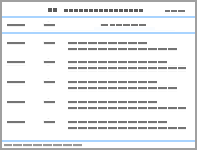
Table 1

Comparisons of tongue colors among normal control group and five groups of different syndromes before treatment (ヌ±S)"

Group n R G B H L S
Normal control 51 115.41±10.74 168.41±11.33 114.83±10.44 2.11±0.06 146.51±10.49 0.15±0.02
Syndrome of blood stasis 41 119.92±11.81 171.12±11.22 118.02±11.07 2.12±0.07 149.72±10.92 0.14±0.02
Syndrome of deficiency of both heart and spleen 22 109.53±10.64*△■ 164.11±12.83 116.03±18.49 2.21±0.30* 142.33±11.42 0.16±0.04*
Syndrome of deficiency of kidney-yin 20 109.52±9.93*△■ 168.79±9.50 105.41±10.03*△▲ 2.01±0.06 143.81±9.09△■ 0.18±0.03*△▲
Syndrome of excessive heat of stomach and intestine 20 100.63±13.88* 157.71±12.05* 102.72±13.24*△▲ 2.12±0.13 134.29±12.29*△▲ 0.18±0.03*△▲
Syndrome of deficiency of kidney-yang 22 115.54±10.52 167.13±13.27 115.81±8.93□■ 2.13±0.06 145.81±11.67 0.14±0.02□■

Table 2

Comparisons of tongue colors among five groups of different syndromes before and after treatment (ヌ±S)"

Group n R G B H L S
Syndrome of blood stasis
Before treatment 41 119.91±11.81 171.11±11.22 118.02±11.07 2.11±0.07 149.71±10.92 0.14±0.02
After 2 weeks of treatment 41 118.52±14.51 171.62±13.80 116.41±13.73 2.13±0.05 149.52±13.70 0.15±0.02
After 4 weeks of treatment 41 117.41±14.80 170.61±14.41 116.13±14.6 2.14±0.06 148.54±14.30 0.15±0.02
Syndrome of deficiency of both heart and spleen
Before treatment 22 109.52±10.64 164.12±12.83 116.04±18.49 2.23±0.30 142.31±11.42 0.16±0.04
After 2 weeks of treatment 22 106.72±9.02 162.02±9.70 109.02±9.91 2.12±0.08 139.42±9.00 0.16±0.02
After 4 weeks of treatment 22 103.64±11.20 160.01±11.13* 105.61±10.83 2.14±0.06 136.91±10.82 0.17±0.02
Syndrome of deficiency of kidney-yang
Before treatment 22 115.52±10.52 167.12±13.27 115.81±8.93 2.11±0.06 145.82±11.67 0.14±0.02
After 2 weeks of treatment 22 111.41±12.51 164.62±12.61 111.03±11.40 2.11±0.06 142.62±12.20 0.15±0.02
After 4 weeks of treatment 22 109.64±12.71 162.13±12.61 108.61±10.90* 2.11±0.06 140.31±12.20 0.15±0.02
Syndrome of deficiency of kidney-yin
Before treatment 20 109.50±9.93 168.81±9.50 105.41±10.03 2.01±0.06 143.82±9.09 0.18±0.03
After 2 weeks of treatment 20 117.11±12.60* 173.62±13.02 113.02±9.52* 2.02±0.07 149.81±12.31 0.16±0.02*
After 4 weeks of treatment 20 119.44±10.20* 176.31±11.23* 115.92±8.80* 2.01±0.07 152.44±10.32* 0.16±0.02*
Syndrome of excessive heat of stomach and intestine
Before treatment 20 100.62±13.88 157.71±12.05 102.72±13.24 2.12±0.13 134.32±12.29 0.18±0.03
After 2 weeks of treatment 20 110.73±15.52* 166.62±14.81* 109.02±16.41 2.11±0.08 143.34±14.91* 0.17±0.03

Table 3

Changes of tongue fur areas in syndrome of deficiency of kidney-yin group and syndrome of excessive heat of stom-ach and intestine group before and after treatment (ヌ±S)"

Group n Tongue fur area /
tongue area (%)
Syndrome of deficiency of kidney-yin
Before treatment 20 26.76±26.45
After 2 weeks of treatment 20 30.62±25.06
Syndrome of excessive heat of stomach and intestine
Before treatment 20 56.53±20.85
After 2 weeks of treatment 20 39.42±21.64**
[1] 阮秋琦 . 数字图像处理学(第1版)[M]. 北京: 电子工业出版社,2001,(第1版):
[2] 何斌, 马天予, 王运坚 , 等. Visual C++数字图像处理(第1版)[M]. 北京: 人民邮电出版社,2001,(第1版):
[1] Na Wu , Lu Song , Xin-xin Yang, Jiang-lei Wei , Zhen-guo Liu. Effects of Chinese herbal medicine Tianqi Pingchan Granule on G protein-coupled receptor kinase 6 involved in the prevention of levodopa-induced dyskinesia in rats with Parkinson disease. Journal of Chinese Integrative Medicine, 2012, 10(9): 1018-1024.
[2] Zhao-lan Liu, Qing Li , Yu-jie Mu , Ying Gao, Jian-ping Liu. Using nested case-control study to appraise the effectiveness of Chinese medicines in the treatment of diabetic nephropathy. Journal of Chinese Integrative Medicine, 2012, 10(9): 991-996.
[3] Xin-min Li, Hui Chen, Yan-yan Ren, Yan-li Lu. Effects of Chinese herbal medicine Xifeng Capsule on multidrug resistance-associated protein 1 expression in hippocampus and cortex of rats with lithium-pilocarpine-induced epilepsy. Journal of Chinese Integrative Medicine, 2012, 10(8): 911-917.
[4] Yong Zhang, Xiao-wen Sun, Jian-hua Xu, Hai Lu, Zhong-ze Fan, Jue Sun, Xiao-xiao Zhang. Effects of medicated serum prepared with Chinese herbal medicine Changweiqing on pharmacokinetics of oxaliplatin in colon cancer cells. Journal of Chinese Integrative Medicine, 2012, 10(8): 901-910.
[5] Wei-hua Xu, Ze-huai Wen, Wei-xiong Liang, Qi Wang. A review of research on the development of instruments for therapeutic efficacy evaluation of traditional Chinese medicine. Journal of Chinese Integrative Medicine, 2012, 10(7): 726-737.
[6] Lin Wang, Guan-liang Wang, Jia-han Liu, Di Li, De-zeng Zhu, Liang-neng Wu . Effects of ursolic acid in ameliorating insulin resistance in liver of KKAy mice via peroxisome proliferator-activated receptors α and γ. Journal of Chinese Integrative Medicine, 2012, 10(7): 793-799.
[7] Yu-ting Yin, Xiao-wan Li , Yang Dong , Jian-rong Shi. Research progress in biological basis of cold and heat essence of Chinese medicine. Journal of Chinese Integrative Medicine, 2012, 10(12): 1328-1335.
[8] Rui Jin , Bing Zhang . A complexity analysis of Chinese herbal property theory: The multiple expressions of herbal property (Part 2). Journal of Chinese Integrative Medicine, 2012, 10(12): 1321-1327.
[9] Yan-bo Zhu , Hideki Origasa, Xiao-xia Luo, Yang-yang Wang , Jie Di , Lin Lin. Responsiveness of three subjective report of outcome measures for chronic heart failure. Journal of Chinese Integrative Medicine, 2012, 10(12): 1375-1381.
[10] Rui Jin, Bing Zhang. A complexity analysis of Chinese herbal property theory: the multiple formations of herbal property (Part 1). Journal of Chinese Integrative Medicine, 2012, 10(11): 1198-1205.
[11] Ying Xu , Chang-chun Zeng , Xiu-yu Cai , Rong-ping Guo , Guang Nie , Ying Jin. Chromaticity and optical spectrum colorimetry of the tongue color in different syndromes of primary hepatic carcinoma. Journal of Chinese Integrative Medicine, 2012, 10(11): 1263-1271.
[12] Jie-ning Wang, Sheng Ye, Dong-hai Yu, Hui Zhao, Le-yi Du. Practice and exploration on clinical evaluations of hospital-made Chinese herbal formulas in the Pudong New Area of Shanghai. Journal of Chinese Integrative Medicine, 2012, 10(10): 1084-1087.
[13] Jing Zhou , Hong-yue Ma , Xin-sheng Fan , Wei Xiao , Tuan-jie Wang . Molecular docking of chlorogenic acid, 3,4-di-O-caffeoylquinic acid and 3,5-di-O-caffeoylquinic acid with human serum albumin. Journal of Chinese Integrative Medicine, 2012, 10(10): 1149-1154.
[14] Rui Jin, Bing Zhang , Xiao-qing Liu , Chun-miao Xue , Qian Zhang, Lian-zhen Li, Qian Zhao, Kang Li . A theoretical and experimental study on the Fuzzy evaluation model of biological performance of Chinese materia medica with an either cold or hot herbal property. Journal of Chinese Integrative Medicine, 2012, 10(10): 1106-1119.
[15] Xiao-ping Huang , Xiao-dan Liu , Chang-qing Deng . Effects of the combination of active component extracts from Astragalus membranaceus and Panax notoginseng on apoptosis, reactive oxygen species and mitochondrial membrane potential of PC12 cells with oxidative injury. Journal of Chinese Integrative Medicine, 2012, 10(10): 1127-1134.
Viewed
Full text


Abstract

Cited

  Shared   
  Discussed   
[1] Jin-rong Fu. Establishment of multivariate diagnosis and treatment system of modern gynecology of traditional Chinese medicine. Journal of Chinese Integrative Medicine, 2008, 6(1): 22-24
[2] Hao Li, Ming-jiang Yao, Wen-ming Zhao, Jie Guan, Lin-lin Cai, Ling Cui. A randomized, controlled, double-blind trial of Huannao Yicong capsule in senile patients with mild cognitive impairment. Journal of Chinese Integrative Medicine, 2008, 6(1): 25-31
[3] Zhi-chun Jin. Problems in establishing clinical guideline for integrated traditional Chinese and Western medicine. Journal of Chinese Integrative Medicine, 2008, 6(1): 5-8
[4] SUN Ming-yu, ZUO Jian, DUAN Ji-feng, HAN Jun, FAN Shi-ming, ZHANG Wei, ZHU Li-fang, YAO Ming-hui. Antitumor activities of kushen flavonoids in vivo and in vitro. Journal of Chinese Integrative Medicine, 2008, 6(1): 51-59
[5] Min Cheng, Qiong Feng, Shu-wen Qian, Hui Gao, Cui-qing Zhu. Preliminary assay of p-amyloid binding elements in heart-beneficial recipe. Journal of Chinese Integrative Medicine, 2008, 6(1): 68-72
[6] Ning-qun Wang, Liang-duo Jiang, Zong-xing Li. Research progress in asthma-related quality of life. Journal of Chinese Integrative Medicine, 2008, 6(1): 93-97
[7] Jing-yuan Mao, Chang-xiao Liu, Heng-he Wang, Guang-li Wei , Zhen-peng Zhang, Jie Xing, Wang Xian liang , Ying-fei Bi . Effects of Shenmai Injection on serum concentration and pharmacokinetics of digoxin in dogs with heart failure. Journal of Chinese Integrative Medicine, 2010, 8(11): 1070-1074
[8] Zhi-mei Wang, Bin Zhang. A study on translation of ellipses in Huangdi Neijing from perspective of hermeneutic theory. Journal of Chinese Integrative Medicine, 2010, 8(11): 1097-1100
[9] Gui Yu, Jie Wang. Thinking on building the network cardiovasology of Chinese medicine. Journal of Chinese Integrative Medicine, 2012, 10(11): 1206-1210
[10] Pedro Saganha João, Doenitz Christoph, Greten Tobias, Efferth Thomas, J. Greten Henry. Qigong therapy for physiotherapists suffering from burnout: a preliminary study. Journal of Chinese Integrative Medicine, 2012, 10(11): 1233-1239
[an error occurred while processing this directive]