[an error occurred while processing this directive]

Journal of Chinese Integrative Medicine ›› 2005, Vol. 3 ›› Issue (3): 220-223.doi: 10.3736/jcim20050315

• Original Experimental Research • Previous Articles     Next Articles

Effects of Wenshen Jianpi Recipe on chronic wound healing in rats

Yong-qing Cao,Chun-mei He,Jin-gen Lu   

  1. Shanghai Municipal Clinical Medicine Center for Chinese Traditional Surgery, Shanghai 200032, China
  • Received:2005-03-29 Online:2005-05-20 Published:2005-05-20
  • Contact: Yong-qing Cao E-mail:CaoYQ88@sh163.net

Objective

To study the effects of Wenshen Jianpi Recipe (WSJPR, a traditional Chinese medicine for warming kidney and invigorating spleen) on chronic wound healing and the mechanism.

Methods

Ninety-six SD rats were randomly divided into 4 groups, with 24 rats in each group, and back wound was made in the rats. For rats in 3 of the 4 groups, hydrocortisone injection was administered to induce chronic wound. Rats in 2 of the 3 groups were treated with WSJPR and Xinpukang Granules (XPKG) respectively, and the rats in the other group were untreated. The rats in the fourth group were taken as control. The wound healing time and the width of new epidermis were observed, and the histomorphological changes and cell cycle of the granulation tissue, and the protein expressions of epidermal growth factor (EGF), transforming growth factor-β1 (TGF-β1) and fibronectin (FN) in the granulation tissue were tested with immunohistochemical technique and flow cytometry.

Results

The wound healing time of the WSJPR-treated and XPKG-treated groups was (17.0±1.9) and (18.8±1.9) d respectively, much shorter than that of the untreated and control groups (P<0.05). On the 14th experiment day, the width of new epidermis of the WSJPR-treated and XPKG-treated groups was (3.73±0.19) and (3.21±0.15) mm respectively, much wider than that of the untreated and control groups (P<0.05). The numbers of angiogenesis, fibroblasts and cells in the S phase in WSJPR-treated and XPKG-treated groups were much higher than those in the untreated and control groups (P<0.05). Compared with the untreated and control groups, the protein expressions of EGF, TGF-β1 and FN in WSJPR-treated and XPKG-treated groups were higher (P<0.05).

Conclusion

WSJPR can enhance the wound healing. It was likely through accelerating the cell proliferation and up-regulating the expressions of EGF, TGF-β1 and FN.

Key words: Pharmacotherapy, TCM, Wound healing, Granulation tissue, Histology, Comparative, Cytokines

CLC Number: 

  • R283.661

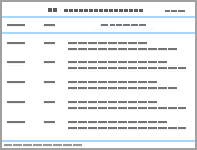
Tab 1

Wound healing time and width of new epidermis on the 14th experiment day ($\bar{x}$±s)"

Group n Wound healing time (d) Width of new epidermis (mm)
Untreated group 8 22.4±2.1 1.96±0.14
Control group 8 20.1±1.8 2.64±0.21
WSJPR-treated group 8 17.0±1.9* 3.73±0.19*
XPKG-treated group 8 18.8±1.9* 3.21±0.15*

Tab 2

Scores of histomorphological examination of granulation tissue($\bar{x}$±s)"

Group n Angiogenesis Fibroblast Necrosis
Untreated group 6 1.50±0.55 1.33±0.52 1.83±0.75
Control group 6 1.67±0.82 1.67±0.82 1.67±0.52
WSJPR-treated group 6 2.33±0.52*△▲ 2.50±0.55*△▲ 1.16±0.75
XPKG-treated group 6 1.83±0.75 1.83±0.75 1.50±0.55

Tab 3

Cells in different cell cycles of granulation tissue($\bar{x}$±s, %)"

Group n G0-G1 G2-M S
Untreated group 8 84.9±2.6 3.6±1.1 11.5±1.9
Control group 8 82.6±1.7 3.8±0.8 13.6±2.1
WSJPR-treated group 8 82.1±2.8 3.5±0.5 14.6±2.9*△▲
XPKG-treated group 8 82.6±2.1 3.2±1.1 14.2±1.2

Tab 4

Protein expressions of EGF, TGF-β1 and FN in granulation tissue ($\bar{x}$±s)"

Group n IOD (×103)
EGF TGF-β1 FN
Untreated group 4 61.28±8.95 62.26±2.85 121.03±35.69
Control group 4 86.42±11.70 268.53±107.20 284.00±66.88
WSJPR-treated group 4 179.47±35.56* 452.64±56.32* 482.57±16.91*
XPKG-treated group 4 106.08±28.09* 281.33±20.04 339.96±60.19*
[1] 傅小兵, 王亚平, 常国友 , 等. 碱性成纤维细胞生长因子促进受创皮肤再生的实验研究[J]. 中国修复重建外科杂志, 1996,10(1):23-25
[2] 陈奇 . 中药药理实验方法学(第1版)[M]. 北京: 人民卫生出版社, 1994,( 第1版):176
[3] 傅小兵, 王德文 . 创伤修复基础(第1版)[M]. 北京: 人民军医出版社, 1997,( 第1版):182
[4] Brown KJ, Maynes SF, Bezos A , et al. A novel in vitro assay for human angiogenesis[J]. Lab Invest, 1996,75(4):539-555
pmid: 8874385
[5] 陈奇 . 中药药理研究方法学(第1版)[M]. 北京: 人民卫生出版社, 1993,( 第1版):982
[6] 陈星伟 . 纤维结合蛋白在创伤愈合中的作用[J]. 中华创伤杂志, 1990,6(4):245-247
[1] Wen Sun, Jian Yu, Yu-min Shi, Hao Zhang, Ying Wang, Bing-bing Wu. Effects of Cordyceps extract on cytokines and transcription factors in peripheral blood mononuclear cells of asthmatic children during remission stage. Journal of Chinese Integrative Medicine, 2010, 8(4): 341-346.
[2] Daniel Weber, Janelle M Wheat, Geoffrey M Currie. Inflammation and cancer: Tumor initiation, progression and metastasis,and Chinese botanical medicines. Journal of Chinese Integrative Medicine, 2010, 8(11): 1006-1013.
[3] Ju-yong Wang, Zhan Zheng, Zhen-ye Xu, Jing Guo, Wan So. Effects of Feiyanning Decoction on proliferation of lung adenocarcinoma cell line and their production of interleukin-6 and interleukin-8 induced by tumor necrosis factor-α. Journal of Chinese Integrative Medicine, 2009, 7(8): 741-745.
[4] Chun Zhang , Lin Li, Yun Jiang. Psychotherapy and traditional Chinese medicine for perimenopausal depression: A literature review. Journal of Chinese Integrative Medicine, 2009, 7(8): 779-783.
[5] Jian-wen Guo, Jun-ya Li, Yan Huang. Effects of Chinese medicine for regulating “sea of blood in brain” combined with bone marrow stromal stem cell transplantation on angiogenesis in ischemic brain tissue of rats. Journal of Chinese Integrative Medicine, 2009, 7(8): 763-768.
[6] Wei Zhang, Jing-tao Cao, Hai-yu Liu. Effects of pathogenic wind-dampness on lung tissue cytokines in rats with syndrome due to pathogenic cold invading lung. Journal of Chinese Integrative Medicine, 2008, 6(7): 748-751.
[7] Sheng-li Tian, Yong-ming Zhou, Tao Huang, Zhi-zhong Xue, Wei He. Effects of Yisui Jiedu Recipe on JAK2-STAT5 signal transduction pathway in bone marrow hematopoietic cells from patients with myelodysplastic syndrome-refractory anemia. Journal of Chinese Integrative Medicine, 2008, 6(2): 185-189.
[8] Jie Xing, Hua-fa Que, Han-jun Tang. Growth of granulation tissue in wound promoted by Chinese medicinal herbs: a review of recent experimental study. Journal of Chinese Integrative Medicine, 2008, 6(10): 1080-1085.
[9] Xin-bin Sui, Qing Zhang, Hua-sen Qiu, Ji-chun Zhou, Xi-dong Gu, Zhou-xiang Lu, Chao Li, Gang Wang. Mechanism of salvianolate in preventing postoperative intestinal adhesion in rats. Journal of Chinese Integrative Medicine, 2007, 5(5): 521-525.
[10] Guo-lin Peng, Xiao-yun Zhang. Effects of Salvia miltiorrhiza on serum levels of inflammatory cytokines in patients with severe acute pancreatitis. Journal of Chinese Integrative Medicine, 2007, 5(1): 28-31.
[11] Xiang Li​, Yuan-fen Liu​, Xiao-ren Xiang​, Yi-biao Zhou​, Zhi-lei Zhang​. Comparative study of the effects of Gypsum Fibrosum and Gypsum Fibrosum Preparatum in promoting granulation. Journal of Chinese Integrative Medicine, 2006, 4(6): 624-627.
[12] Jin-shui Zhu, Ming-quan Song, Long Wang, Qun Sun, Li Zhu, Chun Fang. Immunoregulation and short-term therapeutic effects of super-selective intra-arterial chemotherapy combined with traditional Chinese drugs on gastric cancer patients. Journal of Chinese Integrative Medicine, 2006, 4(5): 478-481.
[13] Qiang Wang​, Kun-zheng Wang​, Guang-ye Wang​. Effects of soybean isoflavones on expression levels of osteoprotegerin and osteoprotegerin ligand mRNAs in bone tissues of ovariectomized rats. Journal of Chinese Integrative Medicine, 2006, 4(3): 303-306.
[14] Jing-zhe Zhang, Xue-lin Zhang, Ju Gao, Ping Shen, En-wei Ma, Hong-gang Gu, Pei-ting Zhu. Impact of antipyretic and purgative herbs on intestinal mucosal barrier and inflammatory response in treatment of acute cholangitis in rats. Journal of Chinese Integrative Medicine, 2005, 3(3): 211-215.
[15] Gui-ping Fu​. Treatment of refractory carbuncle of the nape with Herba Taraxaci: A report of one case. Journal of Chinese Integrative Medicine, 2005, 3(3): 194-194.
Viewed
Full text


Abstract

Cited

  Shared   
  Discussed   
[1] Jin-zhou Tian, Jing Shi, Xin-qing Zhang, Qi Bi, Xin Ma, Zhi-liang Wang, Xiao-bin Li, Shu-li Shen, Lin Li, Zhen-yun Wu, Li-yan Fang, Xiao-dong Zhao, Ying-chun Miao, Peng-wen Wang, Ying Ren, Jun-xiang Yin, Yong-yan Wang, Beijing United Study Group on MCI of the Capital Foundation of Medical Developments. An explanation on "guiding principles of clinical research on mild cognitive impairment (protocol)". Journal of Chinese Integrative Medicine, 2008, 6(1): 15-21
[2] Yi-ting He, Qing-lin Zha, Jian-ping Yu, Yong Tan, Cheng Lu, Ai-ping Lv. Principal factor analysis of symptoms of rheumatoid arthritis and their correlations with efficacy of traditional Chinese medicine and Western medicine. Journal of Chinese Integrative Medicine, 2008, 6(1): 32-36
[3] Jun Cai, Hua Wang, Sheng Zhou, Bin Wu, Hua-rong Song, Zheng-rong Xuan. Effect of Sijunzi Decoction and enteral nutrition on T-cell subsets and nutritional status in patients with gastric cancer after operation: A randomized controlled trial. Journal of Chinese Integrative Medicine, 2008, 6(1): 37-40
[4] Wei Zhang, Xiang-feng Lu, Xiao-mei Zhang, Jian-jun Wu, Liang-duo Jiang. A rat model of pulmonary fibrosis induced by infusing bleomycin quickly through tracheal intubation. Journal of Chinese Integrative Medicine, 2008, 6(1): 60-67
[5] A-gao Zhou, Yong Zhang, Gang Kui, De-Yun Kong, Hai-liang Ge, Qiu-hua Ren, Jia-rong Dong, Sheng Hong, Xu-ming Mao, Yin Wang, Hui-zheng Zhang, Shu-jun Wang. Influence of traditional Chinese compound recipes with different efficacy on body weight, tumor weight and immune function in H22 cancer-bearing mice. Journal of Chinese Integrative Medicine, 2008, 6(1): 77-82
[6] Guo-hong Yuan, Xiao-jing Pang, He-chao Ma. Synergic effects of Danggui Buxue Decoction in reducing toxicity of cytoxan in tumor-bearing mice. Journal of Chinese Integrative Medicine, 2008, 6(1): 83-88
[7] Li Zhou, Hong-xing Zhang, Ling-guang Liu, Wen-jun Wan. Effect of electro-acupuncture at Fenglong (GV 16) on nitric oxide and endothelin in rats with hyperlipidemia. Journal of Chinese Integrative Medicine, 2008, 6(1): 89-92
[8] Jin-zhou Tian, Jing Shi, Xin-qing Zhang, Qi Bi, Xin Ma, Zhi-liang Wang, Xiao-bin Li, Shu-li Shen, Lin Li, Zhen-yun Wu, Li-yan Fang, Xiao-dong Zhao, Ying-chun Miao, Peng-wen Wang, Ying Ren, Jun-xiang Yin, Yong-yan Wang, Beijing United Study Group on MCI of the Capital Foundation of Medical Developments. Guiding principles of clinical research on mild cognitive impairment (protocol). Journal of Chinese Integrative Medicine, 2008, 6(1): 9-14
[9] Xin-jun Wang, Ling-ling Wang . A mechanism of endogenous opioid peptides for rapid onset of acupuncture effect in treatment of depression. Journal of Chinese Integrative Medicine, 2010, 8(11): 1014-1017
[10] Bo Wang , Wei Yan , Li-hui Hou, Xiao-ke Wu. Disorder of Tiangui (kidney essence) and reproductive dysfunction in patients with polycystic ovary syndrome. Journal of Chinese Integrative Medicine, 2010, 8(11): 1018-1022
[an error occurred while processing this directive]