[an error occurred while processing this directive]

Journal of Chinese Integrative Medicine ›› 2008, Vol. 6 ›› Issue (5): 502-507.doi: 10.3736/jcim20080514

• Original Experimental Research • Previous Articles     Next Articles

Aristolochic acid induces renal tubular injury and inhibits expression of bone morphogenetic protein-7 mRNA in renal tissue of rats

Hui-ling Wang(), Jing-yuan Zhang   

  1. Department of Nephrology, the 455th Hospital of Peoples Liberation Army, Shanghai 200052, China
  • Received:2008-02-18 Online:2008-05-20 Published:2008-05-15
  • Contact: WANG Hui-ling E-mail:violingwang@163.com

Objective: To investigate the pathogenic mechanism of aristolochic acid nephropathy (AAN) by observing the renal tubular injury and the change of the expression of bone morphogenetic protein-7 (BMP-7) mRNA in renal tissue of rats induced by aristolochic acid (AA), an active constituent in Caulis Aristolochiae Manshuriensis (CAM).
Methods: Forty-six male Wistar rats were randomly divided into normal control group (n=20) and AA-treated group (n=26). Rats in AA-treated group were intragastrically administered with AA 20 mg/(kg·d), and rats in control group were treated with equal volume of potable water. At the end of the 4th, 8th and 12th week of administration, the 24 h-urine was collected by metabolic cage for detecting the activity of N-acetyl-β-D-glucosaminidase (NAG) and the blood samples were obtained from abdominal aorta for detecting serum creatinine (SCr). Pathological change and the degree of injury of the kidneys were observed by microscopy. The expression of proliferative cell nuclear antigen (PCNA) was detected by immunohistochemical method, and mRNA expression of bone morphogenetic protein-7 (BMP-7) in the renal tissue was detected by reverse transcription polymerase chain reaction (RT-PCR).
Results: Compared with the normal control group, the activity of NAG and the ratio of SCr vs body weight were markedly increased in rats of the AA-treated group after treatment (P<0.05 and P<0.01). Pathological section of renal tissue showed that most renal tubules had cloudy swelling, and vacuolar degenerating in tubular epithelial cells, with brush border dropping off, and parts of tubular basement membrane were exposed. The degrees of injuries were aggravated depending on treating time. The tubulointerstitial injury (TI) parameter in rats of AA-treated group was higher than that of the normal control group. The positive expression of PCNA was observed in the damaged tubular cells. The proliferation index of PCNA was significantly increased after 4- and 8-week treatment (P<0.01), but was decreased after 12-week treatment (P<0.05). The mRNA expression of BMP-7 was markedly decreased in the AA-treated group compared with the normal control group after 4-week treatment (P<0.05), and decreased with the extension of treatment time.
Conclusion: AA can induce injury of the renal tubules, impair the cell regeneration, and inhibit the expression of BMP-7 mRNA in renal tissue. This may be one of the pathogenic mechanisms of AAN.

Key words: aristolochic acid, kidney tubule, Caulis Aristolochiae Manshuriensis , bone morphogenetic protein- 7, rats

CLC Number: 

  • R285.5

Table 1

Changes of activity of urinary NAG and ratio of SCr/BW in rats in two groups ($\bar{x}$±s)"

Group n Urinary NAG (U/L) SCr/BW [μmol/(L·kg)]
4 weeks 8 weeks 12 weeks 4 weeks 8 weeks 12 weeks
Normal control 6 18.16±2.37 18.56±2.34 21.36±4.29 58.11±9.85 55.15±0.76 63.60±10.86
AA-treated 6 33.06±6.05* 36.51±6.63* 42.28±8.32** 96.20±10.73** 124.55±16.63** 175.82±32.18**

Table 2

Degree of tubular injury and TI parameter in rats in two groups ($\bar{x}$±s)"

Group n Ratio of tubular injury (%) TI parameter
4 weeks 8 weeks 12 weeks 12 weeks
Normal control 6 3.45±0.36 3.43±0.51 3.03±0.29 0
AA-treated 6 49.68±3.01** 72.77±5.78** 92.93±3.52** 4.29±0.14**

Figure 1

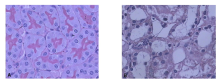
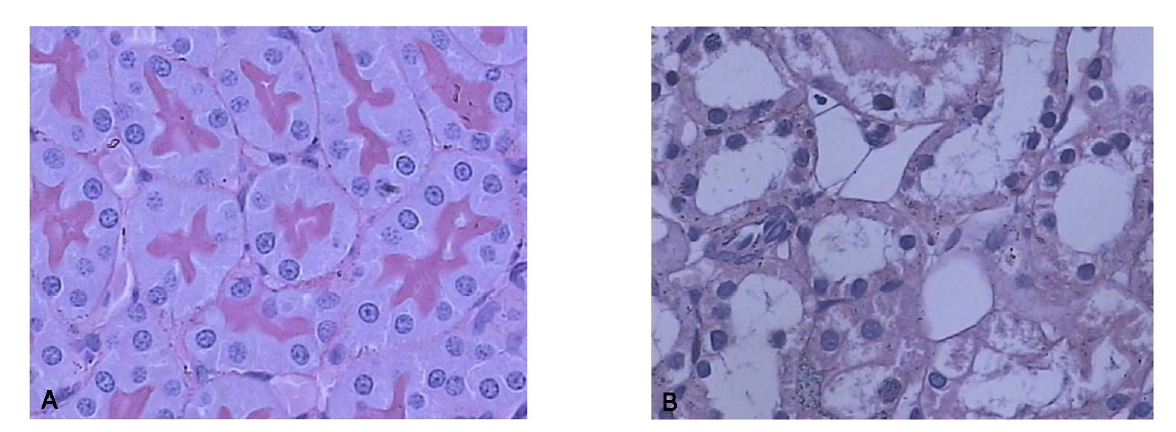
Pathological section of renal tissue at the 8th week of administration under light microscope (PAS staining, ×200) In control group (A), the configuration of renal tubule was normal, and there was no pathological change. In AA-treated group (B), most renal tubule had cloudy swelling, with brush border dropped off, and there was vacuolar degeneration in tubular epithelial cells, and parts of tubular basement membrane were exposed."

Figure 2

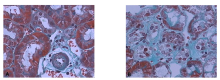
Pathological section of renal tissue at the 12th week of administration under light microscope (Masson staining, ×200)In control group (A), there showed no tubular-interstitial fibrosis. In AA-treated group (B), extensive and severe renal tubular necrosis, patches of tubule atrophy and focal interstitial fibrosis were observed."

Table 3

Proliferation index of PCNA in renal tubules of rats in two groups at different time ($\bar{x}$±s)"

Group n Proliferation index
4 weeks 8 weeks 12 weeks
Normal control 6 193.32±35.33 155.06±32.45 153.36±12.13
AA-treated 6 363.16±23.26** 337.21±67.18** 211.30±30.39*

Figure 3

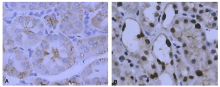
Expression of PCNA in renal tubules in rats in two groups (Immunohistochemical staining, ×400) A: Normal control group; B: AA-treated group."

Table 4

Expression of BMP-7 mRNA in renal parenchyma of rats in two groups at different time ($\bar{x}$±s)"

Group n BMP-7 mRNA
4 weeks 8 weeks 12 weeks
Normal control 4 1.29±0.20 1.46±0.47 1.71±0.25
AA-treated 4 1.04±0.67* 0.36±0.13** 0.26±0.06**

Figure 4

Expression of BMP-7 mRNA in renal parenchyma tested by RT-PCR method A: Normal control group; B: AA-treated group after 4-week treatment; C: AA-treated group after 8-week treatment; D: AA-treated group after 12-week treatment."

[1] Zhou N, Li XM . New advances on researches of aristolochic acid nephropathy[J]. Yao Wu Bu Liang Fan Ying Za Zhi, 2007,9(1):1-6
周娜, 李晓玫 . 马兜铃酸肾病研究的新进展[J]. 药物不良反应杂志, 2007,9(1):1-6
[2] Nony PA, Schnellmann RG . Mechanisms of renal cell repair and regeneration after acute renal failure[J]. J Pharmacol Exp Ther, 2003,304(3):905-912
[3] Zeisberg M, Shah AA, Kalluri R . Bone morphogenic protein-7 induces mesenchymal to epithelial transition in adult renal fibroblasts and facilitates regeneration of injured kidney[J]. J Biol Chem, 2005,280(9):8094-8100
doi: 10.1074/jbc.M413102200
[4] Wang HL, Zhang JY, Huang J . Experimental study on the correlation of aristolochic acid dosage and renal toxicity[J]. Lin Chuang Shen Zang Bing Za Zhi, 2005,5(6):261-264
王会玲, 张金元, 黄健 . 马兜铃酸剂量与大鼠肾损害相关性研究[J]. 临床肾脏病杂志, 2005,5(6):261-264
[5] Wang WW, Zhang JY . Effect of erythropoietin on renal tubular epithelial cells stimulated by aristolochic acid[J]. Shen Zang Bing Yu Tou Xi Shen Yi Zhi Za Zhi, 2006,15(6):531-534
王巍巍, 张金元 . 促红细胞生成素对马兜铃酸致肾小管上皮细胞凋亡的影响[J]. 肾脏病与透析肾移植杂志, 2006,15(6):531-534
[6] Su Z, Xu SW, Zheng FL , et al. Aristolochic acid induced transdifferentiation and apoptosis in human tubular epithelial cells in vitro[J]. Zhonghua Yu Fang Yi Xue Za Zhi, 2002,36(5):301-304
doi: 10.3760/j:issn:0253-9624.2002.05.004
苏震, 徐少伟, 郑法雷 , 等. 马兜铃酸对人肾小管上皮细胞转分化和凋亡作用的体外实验研究[J]. 中华预防医学杂志, 2002,36(5):301-304
doi: 10.3760/j:issn:0253-9624.2002.05.004
[7] Lebeau C, Arlt VM, Schmeiser HH , et al. Aristolochic acid impedes endocytosis and induces DNA adducts in proximal tubular cells[J]. Kidney Int, 2001,60(4):1332-1342
doi: 10.1046/j.1523-1755.2001.00938.x
[8] Yang L, Li XM, Wang SX , et al. Peritubular capillary injury in Chinese herb guan-mu-tong-induced acute tubular necrosis[J]. Zhonghua Nei Ke Za Zhi, 2005,44(7):525-529
doi: 10.3760/j.issn:0578-1426.2005.07.015
杨莉, 李晓玫, 王素霞 , 等. 关木通致急性肾小管坏死患者肾间质微血管病变的研究[J]. 中华内科杂志, 2005,44(7):525-529
doi: 10.3760/j.issn:0578-1426.2005.07.015
[9] Leung AY, Leung JC, Chan LY , et al. Proliferating cell nuclear antigen(PCNA) as a proliferative marker during embryonic and adult zebrafish hematopoiesis[J]. Histochem Cell Biol, 2005,124(2):105-111
doi: 10.1007/s00418-005-0003-2
[10] Yang L, Li XM, Wang HY . A comparative study of manchurian dutchmanspipe and antibiotics induced acute tubular necrosis in renal cellular biological features[J]. Zhongguo Zhong Xi Yi Jie He Za Zhi, 2003,23(5):329-334
doi: 10.7661/CJIM.2003.5.329
杨莉, 李晓玫, 王海燕 . 关木通与抗生素致急性肾小管坏死细胞生物学特征的比较研究[J]. 中国中西医结合杂志, 2003,23(5):329-334
doi: 10.7661/CJIM.2003.5.329
[11] Klahr S, Morrissey J . Obstructive nephropathy and renal fibrosis: The role of bone morphogenic protein-7 and hepatocyte growth factor[J]. Kidney Int Suppl, 2003,( 87):105-112
[12] Ikeda Y, Jung YO, Kim H , et al. Exogenous bone morphogenetic protein-7 fails to attenuate renal fibrosis in rats with overload proteinuria[J]. Nephron Exp Nephrol, 2004,97(4):123-135
doi: 10.1159/000079177
[1] Na Wu , Lu Song , Xin-xin Yang, Jiang-lei Wei , Zhen-guo Liu. Effects of Chinese herbal medicine Tianqi Pingchan Granule on G protein-coupled receptor kinase 6 involved in the prevention of levodopa-induced dyskinesia in rats with Parkinson disease. Journal of Chinese Integrative Medicine, 2012, 10(9): 1018-1024.
[2] Lawrence A. Olatunji, Taofeek O. Usman, Joseph O. Adebayo, Victoria A. Olatunji . Effects of aqueous extract of Hibiscus sabdariffa on renal Na+-K+-ATPase and Ca2+-Mg2+-ATPase activities in Wistar rats. Journal of Chinese Integrative Medicine, 2012, 10(9): 1049-1055.
[3] Dhirender Kaushik, Ajay Kumar, Pawan Kaushik, Avatar C. Rana. Anticonvulsant activity of alcoholic extract of bark of Pinus roxburghii Sarg. Journal of Chinese Integrative Medicine, 2012, 10(9): 1056-1060.
[4] Chan Chen, Chang-xun Chen, Xi-min Wu, Rui Wang, Yi-ming Li. Effects of extracts of Radix Scrophulariae on blood pressure in spontaneously hypertensive rats and the underlying mechanisms. Journal of Chinese Integrative Medicine, 2012, 10(9): 1009-1017.
[5] Jian-sheng Li, Ya Li, Su-yun Li, Yuan-yuan Wang, Li Deng, Yan-ge Tian, Su-li Jiang , Ying Wang. Long-term effects of Tiaobu Feishen therapies on systemic and local inflammation responses in rats with stable chronic obstructive pulmonary disease. Journal of Chinese Integrative Medicine, 2012, 10(9): 1039-1048.
[6] Karuna A. Talpate, Uma A. Bhosale, Mandar R. Zambare. Clitorea ternatea, a herb from Indian folklore, improves streptozotocin-induced diabetes and diabetes-induced cognitive decline in rats. Journal of Chinese Integrative Medicine, 2012, 10(8): 939-947.
[7] Samuel Joshua Pragasam, Vachana Murunikara, Evan Prince Sabina, Mahaboobkhan Rasool. Antiperoxidative potential of p-coumaric acid, a common dietary phenol, in adjuvant-induced arthritis in rats. Journal of Chinese Integrative Medicine, 2012, 10(8): 932-938.
[8] Zi-hui Li, Jian Wang, Rong-lin Cai, You-wen Wang, Jian-peng Hu. Establishment and evaluation of a rat model of ulcerative colitis with syndrome of dampness stagnancy due to spleen deficiency. Journal of Chinese Integrative Medicine, 2012, 10(8): 918-924.
[9] Meng Li, Ling Hu, Rong-lin Cai, Zi-jian Wu, Ke-ming Wang. Effects of electro-acupuncture at PC6 and BL15 on nerve electrical activity in spinal dorsal root and norepinephrine and dopamine contents in paraventricular nucleus of hypothalamus in rats with acute myocardial ischemia. Journal of Chinese Integrative Medicine, 2012, 10(8): 874-879.
[10] Xin-min Li, Hui Chen, Yan-yan Ren, Yan-li Lu. Effects of Chinese herbal medicine Xifeng Capsule on multidrug resistance-associated protein 1 expression in hippocampus and cortex of rats with lithium-pilocarpine-induced epilepsy. Journal of Chinese Integrative Medicine, 2012, 10(8): 911-917.
[11] Hong Wang , Jing-tian Ou , Xin Zhao , Ying Guoz , Hao-ping Mao. Vasodilator effect of oroxylin A on thoracic aorta isolated from rats. Journal of Chinese Integrative Medicine, 2012, 10(8): 880-885.
[12] C. Mouli Kalla, Vijaya Tartte, Dattatreya Rao Sirpurkar. Effectiveness of flavonoid-rich leaf extract of Acalypha indica in reversing experimental myocardial ischemia: biochemical and histopathological evidence. Journal of Chinese Integrative Medicine, 2012, 10(7): 784-792.
[13] Feng Xin-ying, Zhu Min, Zhang Qi-qi, Chen Yi-ping, Li Wen-wei. Selective protection of nigral dopaminergic neurons by echinacoside in a rat model of Parkinson disease induced by rotenone. Journal of Chinese Integrative Medicine, 2012, 10(7): 777-783.
[14] Chuan Chen, Hui-ying Chi, Zhi-hua Yu, Jiu-lin Chen . Effects of Chinese herbal medicine Shoushen Granule on telomere length and telomerase activity of peripheral white blood cells and vascular cells in rats with atherosclerosis. Journal of Chinese Integrative Medicine, 2012, 10(6): 667-673.
[15] Hui-qing Zhang , Zi-fei Yin , Jia-yu Sheng , Zhu-qian Jiang , Bao-yu Wu , Yong-hua Su. A comparison study of pharmacokinetics between bufalin-loaded bovine serum albumin nanoparticles and bufalin in rats. Journal of Chinese Integrative Medicine, 2012, 10(6): 674-680.
Viewed
Full text


Abstract

Cited

  Shared   
  Discussed   
[1] Jin-zhou Tian, Jing Shi, Xin-qing Zhang, Qi Bi, Xin Ma, Zhi-liang Wang, Xiao-bin Li, Shu-li Shen, Lin Li, Zhen-yun Wu, Li-yan Fang, Xiao-dong Zhao, Ying-chun Miao, Peng-wen Wang, Ying Ren, Jun-xiang Yin, Yong-yan Wang, Beijing United Study Group on MCI of the Capital Foundation of Medical Developments. An explanation on "guiding principles of clinical research on mild cognitive impairment (protocol)". Journal of Chinese Integrative Medicine, 2008, 6(1): 15-21
[2] Yi-ting He, Qing-lin Zha, Jian-ping Yu, Yong Tan, Cheng Lu, Ai-ping Lv. Principal factor analysis of symptoms of rheumatoid arthritis and their correlations with efficacy of traditional Chinese medicine and Western medicine. Journal of Chinese Integrative Medicine, 2008, 6(1): 32-36
[3] Jun Cai, Hua Wang, Sheng Zhou, Bin Wu, Hua-rong Song, Zheng-rong Xuan. Effect of Sijunzi Decoction and enteral nutrition on T-cell subsets and nutritional status in patients with gastric cancer after operation: A randomized controlled trial. Journal of Chinese Integrative Medicine, 2008, 6(1): 37-40
[4] Wei Zhang, Xiang-feng Lu, Xiao-mei Zhang, Jian-jun Wu, Liang-duo Jiang. A rat model of pulmonary fibrosis induced by infusing bleomycin quickly through tracheal intubation. Journal of Chinese Integrative Medicine, 2008, 6(1): 60-67
[5] A-gao Zhou, Yong Zhang, Gang Kui, De-Yun Kong, Hai-liang Ge, Qiu-hua Ren, Jia-rong Dong, Sheng Hong, Xu-ming Mao, Yin Wang, Hui-zheng Zhang, Shu-jun Wang. Influence of traditional Chinese compound recipes with different efficacy on body weight, tumor weight and immune function in H22 cancer-bearing mice. Journal of Chinese Integrative Medicine, 2008, 6(1): 77-82
[6] Guo-hong Yuan, Xiao-jing Pang, He-chao Ma. Synergic effects of Danggui Buxue Decoction in reducing toxicity of cytoxan in tumor-bearing mice. Journal of Chinese Integrative Medicine, 2008, 6(1): 83-88
[7] Li Zhou, Hong-xing Zhang, Ling-guang Liu, Wen-jun Wan. Effect of electro-acupuncture at Fenglong (GV 16) on nitric oxide and endothelin in rats with hyperlipidemia. Journal of Chinese Integrative Medicine, 2008, 6(1): 89-92
[8] Jin-zhou Tian, Jing Shi, Xin-qing Zhang, Qi Bi, Xin Ma, Zhi-liang Wang, Xiao-bin Li, Shu-li Shen, Lin Li, Zhen-yun Wu, Li-yan Fang, Xiao-dong Zhao, Ying-chun Miao, Peng-wen Wang, Ying Ren, Jun-xiang Yin, Yong-yan Wang, Beijing United Study Group on MCI of the Capital Foundation of Medical Developments. Guiding principles of clinical research on mild cognitive impairment (protocol). Journal of Chinese Integrative Medicine, 2008, 6(1): 9-14
[9] Xin-jun Wang, Ling-ling Wang . A mechanism of endogenous opioid peptides for rapid onset of acupuncture effect in treatment of depression. Journal of Chinese Integrative Medicine, 2010, 8(11): 1014-1017
[10] Bo Wang , Wei Yan , Li-hui Hou, Xiao-ke Wu. Disorder of Tiangui (kidney essence) and reproductive dysfunction in patients with polycystic ovary syndrome. Journal of Chinese Integrative Medicine, 2010, 8(11): 1018-1022
[an error occurred while processing this directive]