[an error occurred while processing this directive]

Journal of Chinese Integrative Medicine ›› 2009, Vol. 7 ›› Issue (7): 629-635.doi: 10.3736/jcim20090706

• Original Clinical Research • Previous Articles     Next Articles

Serum proteomes of hypertension patients with abundant phlegm-dampness

Yu-guang Chua,Jie Shia,Yuan-hui Hua,Hua-qin Wua,Gui-jian Liub,Chao-jun Huc,Yong-zhe Lic,Yi Lia, Zi-jing Chena,Qing Hea   

  1. a Department of Cardiology,Guang’anmen Hospital, China Academy of Chinese Medical Sciences, Beijing 100053, China;
    b Clinical Laboratory, Guang’anmen Hospital,China Academy of Chinese Medical Sciences,Beijing 100053,China;
    c Clinical Laboratory, Peking Union Medical College Hospital, Chinese Academy of Medical Sciences &• Peking Union Medical College, Beijing 100730, China;
  • Received:2009-02-14 Accepted:2009-04-14 Online:2009-07-20 Published:2009-07-15
  • Contact: Yuan-hui Hu E-mail:huiyuhui@yahoo.com.cn

Objective

To study the serum proteomes of essential hypertension (EH) patients with abundant phlegm-dampness, and try to find special proteins associated with abundant phlegm-dampness syndrome.

Methods

Fifty-nine hypertension patients were included, and the patients were divided into abundant phlegm-dampness syndrome group (39 cases) and non-phlegm-dampness syndrome group (20 cases). To find the special proteins associated with abundant phlegm-dampness, the EH patients with non-phlegm-dampness and another 30 healthy persons were regarded as control. Weak cation nano-magnetic beads were used to capture proteins in serum, and proteomic fingerprint was made by matrix-assisted laser desorption ionization time-of-flight mass spectrometry (MALDI-TOF-MS). All the proteomic fingerprints were analyzed by Biomarker Wizard 3.1 Software. Then Biomarker Patterns Software (BPS) 5.0 was used to identify the differentiated proteins, which could induce phlegm-dampness.
Results

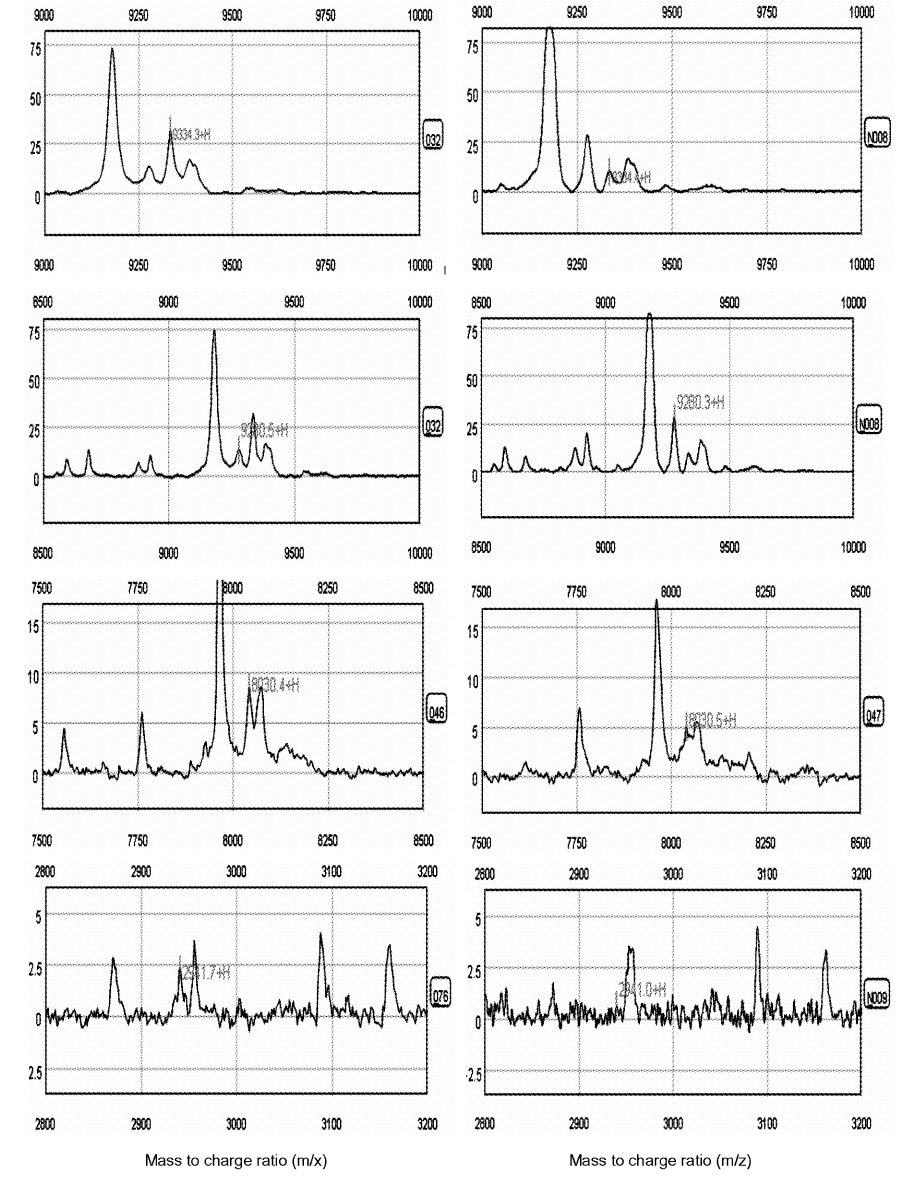
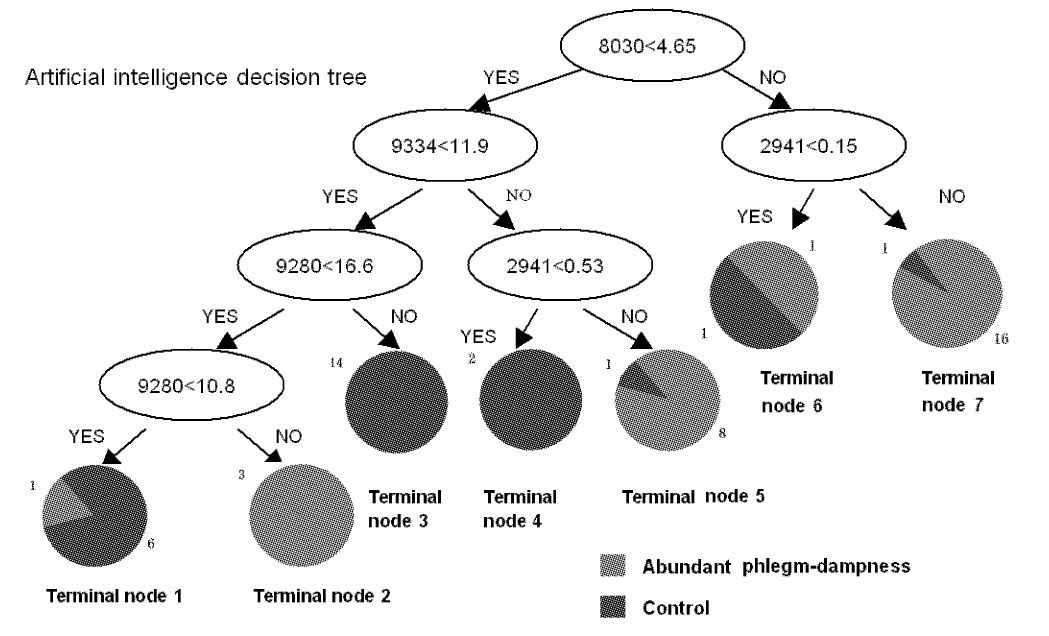
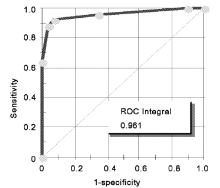
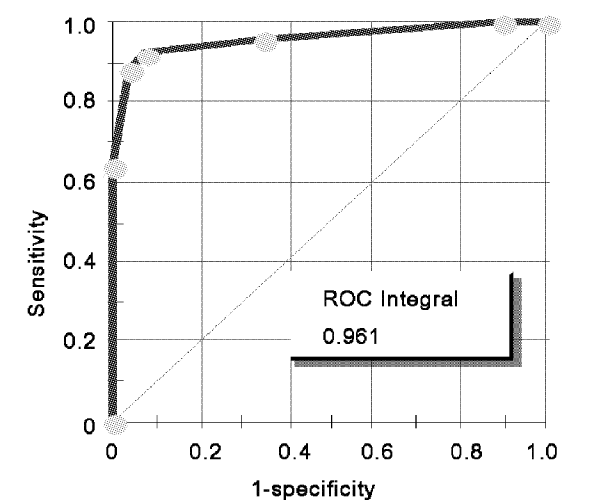
There were 102 differentiated protein peaks between abundant phlegm-dampness and the control group. The best markers of abundant phlegm-dampness were protein peaks with the mass to charge ratio (m/z) of 9 334.958 m/z (the expression increased), 9 280.191 m/z (the expression decreased), 8 030.794 m/z (the expression increased), and 2 941.551 m/z (the expression increased). These four protein peaks found by BPS could induce abundant phlegm-dampness. They could be used to separate the abundant phlegm-dampness syndrome from the healthy persons and the hypertension patients with non-phlegm-dampness. The sensitivity of the model was 93.103% (27/29), specificity was 92% (23/25), false positive rate was 8% (2/25), false negative rate was 6.897% (2/29) and Youden's index was 85.103%. Blind test data indicated a sensitivity of 90% (9/10) and a specificity of 88% (22/25), and the false positive rate was 12% (3/25), false negative rate was 10% (1/10), and Youden's index was 78%.
Conclusion

The differentiated proteins between the abundant phlegm-dampness group and the control group are the material foundation of abundant phlegm-dampness. The selected differentiated proteins can be used to distinguish the EH patients with abundant phlegm-dampness from the healthy persons and the EH patients with non-phlegm-dampness. The molecular biology diagnosis model can offer an objective and accurate way for TCM syndrome differentiation.

Key words: Proteome, Molecular biology, Hypertension, Phlegm-dampness

"

Group n Male/Female
(Cases)
Age (Years) Average age
($\bar{x}$±s, years)
Modeling (Cases) Blind text (Cases)
Normal 30 15/15 20-56 49.91±10.26 15 15
Non-abundant phlegm-dampness 20 21/18 16-59 52.35±11.22 10 10
Abundant phlegm-dampness 39 11/9 19-59 50.68±10.05 29 10

"

m/z m/z m/z m/z m/z m/z m/z m/z
2 006.818* 3 887.151* 4 497.380 5 214.152 5 807.037 6 829.344 7 813.754 9 495.915
2 018.805* 3 936.318 4 533.016 5 246.498 5 846.632 6 846.526 7 828.585 10 179.280
2 238.140* 3 957.645 4 647.887 5 340.609* 6 198.601 6 969.257 8 030.794* 11 078.130*
2 546.051 3 974.755 4 752.432 5 475.257* 6 298.461 7 000.946 8 277.397 11 369.050
2 761.555 3 989.617 4 763.711 5 519.908 6 311.630 7 052.607 8 337.660 11 478.980
2 871.509 4 071.080 4 791.812 5 539.739 6 355.350 7 080.104 8 599.531 12 096.720
2 941.551* 4 092.452 4 886.402* 5 555.771 6 379.086* 7 144.659* 8 819.858 12 543.330
3 089.231 4 155.501 4 963.829 5 586.006 6 426.604 7 206.562* 8 853.621 12 646.800
3 161.262 4 175.258 4 992.906 5 634.816 6 475.907 7 255.409 8 922.654 16 710.000
3 292.019 4 301.903* 5 023.282 5 701.429* 6 503.667 7 410.660 9 051.455 18 016.100
3 687.000 4 382.989* 5 063.736 5 730.362* 6 581.261 7 477.221 9 130.553 18 517.140*
3 817.091 4 442.688* 5 098.803 5 748.292 6 624.362 7 636.356 9 280.191 21 641.550
3 829.682 4 473.557 5 132.748 6 810.002 7 762.536 9 334.958*

Figure 1

Mass spectrum of modeling protein peaksThe left stands for abundant phlegm-dampness group, and the right stands for control group."

Figure 2

Diagnostic decision tree model of abundant phlegm-dampness"

Figure 3

ROC curve of diagnosis model of abundant phlegm-dampness"

[1] Liu LS, Gong LS. A draft of Chinese guidelines for hypertension prevention and treatment[M]. Beijing: People's Medical Publishing House, 2005
刘力生, 龚兰生 . 中国高血压防治指南[M]. 北京: 人民卫生出版社, 2005
[2] State Bureau of Technical Supervision. National standards of People's Republic of China: Syndrome part of terminology of traditional Chinese medicine clinical diagnosis and treatment[M]. Beijing: Standards Press of China, 1997
国家技术监督局. 中华人民共和国国家标准·中医临床诊疗术语证候部分[M]. 北京: 中国标准出版社, 1997
[3] Bureau of Drug Administration of China Ministry of Public Health. Guidelines for clinical research on Chinese new herbal medicines[M]. Beijing: Chinese Medical Science and Technology Press, 2002
卫生部药政司. 中药新药临床研究指导原则[M]. 北京: 中国医药科技出版社, 2002
[4] Baumeister W . From proteomic inventory to architecture[J]. FEBS Lett, 2005,579(4):933-937
doi: 10.1016/j.febslet.2004.10.102 pmid: 15680977
[5] Chung CH, Levy S, Chaurand P, Carbone DP . Genomics and proteomics: emerging technologies in clinical cancer research[J]. Crit Rev Oncol Hematol, 2005,61(1):1-25
doi: 10.1016/j.critrevonc.2006.06.005 pmid: 17015021
[6] Xiao MF, Liang QH, Xiong XG, Zeng NJ, Ou JG, Zhang YX, Chen J, Liang XH, Zhao Y, Yang B, Fan R . Study of peripheral blood mononuclear cells of hypertension intracerebral hemorrhage patients with liver yang forming wind syndrome by proteomic method[J]. Shi Yong Yu Fang Yi Xue, 2008,15(3):623-627
doi: 10.3969/j.issn.1006-3110.2008.03.001
萧梅芳, 梁清华, 熊新贵, 曾年菊, 区健刚, 张雨星, 陈疆, 梁相辉, 赵艳, 杨波, 范荣 . 高血压脑出血肝阳化风证患者外周血单个核细胞的蛋白质组学研究[J]. 实用预防医学, 2008,15(3):623-627
doi: 10.3969/j.issn.1006-3110.2008.03.001
[7] Xiong XG, Liang QH, Hou JL, Chen J, Liu AP, Yan DH, Guan YJ . Study on serum proteomes of hypertensive intracerebral hemorrhage patients with liver-yang forming wind syndrome and hyperactivity of liver-yang syndrome[J]. Shi Yong Yu Fang Yi Xue, 2007,14(6):1649-1652
熊新贵, 梁清华, 侯俊良, 陈疆, 刘爱平, 鄢东红, 关勇军 . 高血压脑出血肝阳化风证与肝阳上亢证患者血清蛋白质组学研究[J]. 实用预防医学, 2007,14(6):1649-1652
[1] Chan Chen, Chang-xun Chen, Xi-min Wu, Rui Wang, Yi-ming Li. Effects of extracts of Radix Scrophulariae on blood pressure in spontaneously hypertensive rats and the underlying mechanisms. Journal of Chinese Integrative Medicine, 2012, 10(9): 1009-1017.
[2] Tao Li-li, Lei Yan. Effects of extracts from Panax ginseng, Panax notoginseng and Ligusticum chuanxiong on expression of β-galactosidase and signal pathway p16-cyclin D/CDK-Rb in vascular smooth muscle cells. Journal of Chinese Integrative Medicine, 2012, 10(1): 76-84.
[3] Lin-na Yu, Jian Pei. Application of differential proteomics in mechanism research of acupuncture. Journal of Chinese Integrative Medicine, 2011, 9(8): 819-823.
[4] Rong Fan, Feng He, Yang Wang, Guang-wei Zhong, Yun-hui Li. Changes of protein expression profile in vascular tissues of spontaneously hypertensive rats treated by a compound Chinese herbal medicine. Journal of Chinese Integrative Medicine, 2011, 9(6): 643-650.
[5] Mei-qun Cao, Zheng-zhi Wu, Wei-kang Wu. Identification of salivary biomarkers in breast cancer patients with thick white or thick yellow tongue fur using isobaric tags for relative and absolute quantitative proteomics. Journal of Chinese Integrative Medicine, 2011, 9(3): 275-280.
[6] Shuo Zhang , Hong-cai Shang. Correlation between traditional Chinese medicine syndromes and omics: A literature review. Journal of Chinese Integrative Medicine, 2011, 9(12): 1286-1291.
[7] Wan-li Gu , Zai-xiang Shi, Yun-xu Yu, Yu-wei Wu, Bao-wei Lu, Ka-kit Hui . Distribution characteristics of syndrome types in essential hypertension. Journal of Chinese Integrative Medicine, 2010, 8(9): 842-847.
[8] Hao Li , Long-tao Liu, Wen-ming Zhao, Jian-gang Liu, Ming-jiang Yao, Yong-xiang Han, Yan-peng Shen, Xing-dong Liu, Li Liu, Xue-mei Wang, Lin-lin Cai, Jie Guan. Traditional Chinese versus integrative treatment in elderly patients with isolated systolic hypertension: A multicenter, randomized, double-blind controlled trial. Journal of Chinese Integrative Medicine, 2010, 8(5): 410-416.
[9] Zhi-qiang Pan, Zhao-qin Fang, Wen-li Lu, Xiao-mei Liu, Dong-yuan Guan, Chao Liang. Differential gene expressions of steroid- and catecholamine-synthesizing enzymes in adrenal gland of rats with different diseases but the same syndromes. Journal of Chinese Integrative Medicine, 2010, 8(4): 352-357.
[10] Ding-zhu Shen , Qing Ta, Jin-xing Du, Sai-dan Ding, Gao-feng Chen, Yi-yang Ru, Ping Liu. Effects of Yiguanjian Decoction on liver cirrhosis formation: A differential proteomics study in rats. Journal of Chinese Integrative Medicine, 2010, 8(2): 158-167.
[11] Yi Chen, Wen-jian Wang. Relationships between insulin resistant and hypertension and traditional Chinese medicine intervention. Journal of Chinese Integrative Medicine, 2010, 8(12): 1114-1118.
[12] Yan-bo Zhu, Qi Wang, Qi-wei Deng, Jing Cai, Xiao-hong Song, Xue Yan. Relationships between constitutional types of traditional Chinese medicine and hypertension. Journal of Chinese Integrative Medicine, 2010, 8(1): 40-45.
[13] Hao Li, Long-tao Liu. Considerations about treatment programs of elderly patients with hypertension. Journal of Chinese Integrative Medicine, 2009, 7(7): 607-610.
[14] Li Fu, Zhen-xing Mao, Jing Wang, Jing Zhang, Tai-rong Zheng, Sheng-lian Wang. Effects of Songling Xuemaikang Capsule on ambulatory blood pressure in treatment of essential hypertension: A single-blind randomized controlled trial. Journal of Chinese Integrative Medicine, 2009, 7(6): 509-513.
[15] Bai-yu Li, Li-na Wang, Xiao-qiang Yue, Bai Li. Characteristics of sublingual vein and expressions of vascular endothelial growth factor and hypoxia-inducible factor 1α proteins in sublingual tissues of Beagle dogs with portal hypertension. Journal of Chinese Integrative Medicine, 2009, 7(5): 463-467.
Viewed
Full text


Abstract

Cited

  Shared   
  Discussed   
[1] Jin-zhou Tian, Jing Shi, Xin-qing Zhang, Qi Bi, Xin Ma, Zhi-liang Wang, Xiao-bin Li, Shu-li Shen, Lin Li, Zhen-yun Wu, Li-yan Fang, Xiao-dong Zhao, Ying-chun Miao, Peng-wen Wang, Ying Ren, Jun-xiang Yin, Yong-yan Wang, Beijing United Study Group on MCI of the Capital Foundation of Medical Developments. An explanation on "guiding principles of clinical research on mild cognitive impairment (protocol)". Journal of Chinese Integrative Medicine, 2008, 6(1): 15-21
[2] Yi-ting He, Qing-lin Zha, Jian-ping Yu, Yong Tan, Cheng Lu, Ai-ping Lv. Principal factor analysis of symptoms of rheumatoid arthritis and their correlations with efficacy of traditional Chinese medicine and Western medicine. Journal of Chinese Integrative Medicine, 2008, 6(1): 32-36
[3] Jun Cai, Hua Wang, Sheng Zhou, Bin Wu, Hua-rong Song, Zheng-rong Xuan. Effect of Sijunzi Decoction and enteral nutrition on T-cell subsets and nutritional status in patients with gastric cancer after operation: A randomized controlled trial. Journal of Chinese Integrative Medicine, 2008, 6(1): 37-40
[4] Wei Zhang, Xiang-feng Lu, Xiao-mei Zhang, Jian-jun Wu, Liang-duo Jiang. A rat model of pulmonary fibrosis induced by infusing bleomycin quickly through tracheal intubation. Journal of Chinese Integrative Medicine, 2008, 6(1): 60-67
[5] A-gao Zhou, Yong Zhang, Gang Kui, De-Yun Kong, Hai-liang Ge, Qiu-hua Ren, Jia-rong Dong, Sheng Hong, Xu-ming Mao, Yin Wang, Hui-zheng Zhang, Shu-jun Wang. Influence of traditional Chinese compound recipes with different efficacy on body weight, tumor weight and immune function in H22 cancer-bearing mice. Journal of Chinese Integrative Medicine, 2008, 6(1): 77-82
[6] Guo-hong Yuan, Xiao-jing Pang, He-chao Ma. Synergic effects of Danggui Buxue Decoction in reducing toxicity of cytoxan in tumor-bearing mice. Journal of Chinese Integrative Medicine, 2008, 6(1): 83-88
[7] Li Zhou, Hong-xing Zhang, Ling-guang Liu, Wen-jun Wan. Effect of electro-acupuncture at Fenglong (GV 16) on nitric oxide and endothelin in rats with hyperlipidemia. Journal of Chinese Integrative Medicine, 2008, 6(1): 89-92
[8] Jin-zhou Tian, Jing Shi, Xin-qing Zhang, Qi Bi, Xin Ma, Zhi-liang Wang, Xiao-bin Li, Shu-li Shen, Lin Li, Zhen-yun Wu, Li-yan Fang, Xiao-dong Zhao, Ying-chun Miao, Peng-wen Wang, Ying Ren, Jun-xiang Yin, Yong-yan Wang, Beijing United Study Group on MCI of the Capital Foundation of Medical Developments. Guiding principles of clinical research on mild cognitive impairment (protocol). Journal of Chinese Integrative Medicine, 2008, 6(1): 9-14
[9] Xin-jun Wang, Ling-ling Wang . A mechanism of endogenous opioid peptides for rapid onset of acupuncture effect in treatment of depression. Journal of Chinese Integrative Medicine, 2010, 8(11): 1014-1017
[10] Bo Wang , Wei Yan , Li-hui Hou, Xiao-ke Wu. Disorder of Tiangui (kidney essence) and reproductive dysfunction in patients with polycystic ovary syndrome. Journal of Chinese Integrative Medicine, 2010, 8(11): 1018-1022
[an error occurred while processing this directive]